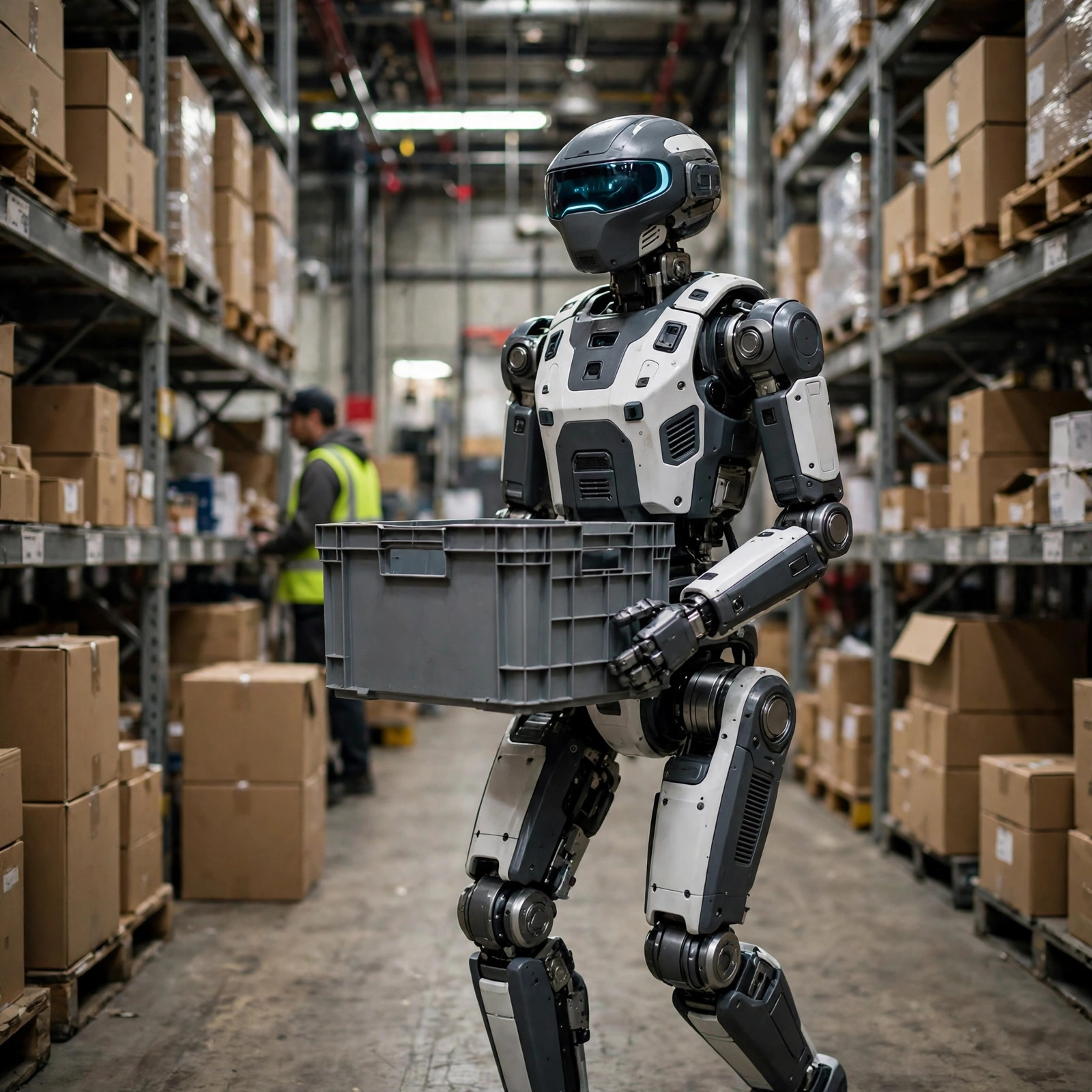
Hi, this is Datumdraft. If you watched the financial news or scrolled through tech feeds this past week, you probably saw three numbers attached to the newly listed ticker AGLT: a $2.5 billion valuation, a $300 million order backlog, and the title of America’s first publicly traded pure-play humanoid robotics company. For individual investors who have spent the last two years watching private funding rounds for Figure AI, Boston Dynamics, and Tesla’s Optimus from the sidelines, Agility Robotics landing on the Nasdaq on November 5, 2026, looked like the first clean ticket into the warehouse humanoid sector.
Then the SEC merger prospectus and half-year financial filings started circulating among analysts. When you put the press release next to the accounting statements, a very different company emerges. Agility Robotics generated $1.78 million in total revenue across all of 2025 while posting a net loss of $138.1 million. In the first half of 2026, top-line revenue dropped 72 percent year-over-year to just $174,000, while net losses expanded to $361.9 million. On June 30, 2026, right before the merger money arrived, the company had $14.7 million in cash left on its balance sheet and carried a formal going-concern warning from its auditors.
None of this means Agility Robotics is a fake operation. Their bipedal machines have moved totes inside real logistics hubs for GXO, Schaeffler, and Toyota Motor Manufacturing Canada. What it does mean is that anyone buying AGLT shares today needs to know exactly what that $2.5 billion valuation buys. You are not buying an established commercial equipment vendor collecting $300 million in current sales. You are funding a capital-intensive hardware transition from an older workhorse model (Digit 4) to an unproven fifth-generation platform (Digit 5) that had roughly ten physical units built as of early November 2026.
Executive Summary for Investors: Agility Robotics began trading on the Nasdaq under the ticker AGLT on November 5, 2026, after completing a SPAC merger with Churchill Capital Corp XI. While headlines highlight a $2.5B pre-money valuation, $465M in gross proceeds, and a $300M+ order backlog, SEC filings show 2025 revenue of $1.78M (58% from Amazon) and H1 2026 revenue of $174,000 against a $361.9M H1 net loss. The $300M backlog consists mostly of a multi-year, milestone-contingent RaaS agreement with a single related-party customer for 1,000 Digit 5 units. Furthermore, the publicized 65,000+ hours of commercial work belong primarily to the older Digit 4 model, whereas Digit 5 general availability is targeted for late 2027.
The Debut in 60 Seconds: What Actually Happened on November 4 and 5, 2026
Agility Robotics did not go public through a traditional underwritten initial public offering. Instead, the Oregon-based robotics developer merged with Churchill Capital Corp XI, a special purpose acquisition company (SPAC). Shareholders finalized the business combination on November 4, 2026, and the combined company began trading on the Nasdaq Global Market the next morning, November 5, 2026, under the common stock ticker AGLT and warrant ticker AGLTW. In its official listing announcement, management described Agility as the first U.S. publicly listed pure-play humanoid robotics company.
First-day trading showed the typical volatility of a high-profile hardware SPAC debut, though it avoided the immediate collapse that plagued many blank-check mergers in prior cycles. Compared against the standard $10.00 SPAC deal baseline, AGLT opened at $11.26, dipped to an intraday low of $8.40 as early holders rotated out, rallied to an intraday high of $12.15, and settled at a closing price of $11.51. Depending on whether you measure against the $10.00 deal benchmark or the morning opening print, the stock held its ground on day one, finishing up 2.2 percent from its opening price and 15.1 percent above the $10.00 trust reference.
| Metric / Event | Verified Figure / Status | Context & Filing Details |
|---|---|---|
| Listing Vehicle | Churchill Capital Corp XI (SPAC) | Business combination closed Nov 4, 2026; trading started Nov 5, 2026. |
| Nasdaq Tickers | AGLT (Common) / AGLTW (Warrants) | Company claims status as first U.S. public pure-play humanoid firm. |
| Day 1 Price Action (Nov 5) | Open: $11.26 / Close: $11.51 | Intraday range ran from $8.40 low to $12.15 high. |
| Pre-Money Valuation | ~$2.5 Billion | Set during the Churchill Capital XI merger agreement. |
| Gross Proceeds | ~$465 Million (before expenses) | Includes $100M in equity financing received prior to merger closing. |
Unpacking the $465 Million Cash Injection
The press release states that the transaction delivered approximately $465 million in gross proceeds before deducting transaction fees and advisory costs. That number requires one immediate adjustment if you are modeling the company’s forward cash runway. Out of that $465 million figure, $100 million came from an equity financing round that Agility received and began tapping before the November 4 merger closing. It was not $465 million in untouched, brand-new cash hitting the bank account on the morning of November 5. Even so, netting well over $300 million in fresh liquidity after prior tranches and fees rescued a balance sheet that was running on fumes by mid-year.
The $300M Backlog Is Not Revenue: The Most Misunderstood Number in This Story
Across social media and retail stock forums, the most frequently cited bullish statistic for AGLT is its “over $300 million backlog.” To a casual reader, a $300 million backlog against a $2.5 billion valuation sounds like a reasonable 8.3x forward sales multiple for a high-growth hardware company. That interpretation falls apart the moment you read the footnotes in the regulatory filings.
In corporate accounting, recognized revenue and conditional order backlogs live in different universes. Agility Robotics’ $300 million-plus backlog is a multi-year order book heavily contingent on future hardware milestones and technical specifications. Even more important, the bulk of this figure stems from a single related-party customer under an agreement structured around deploying 1,000 Digit 5 units over a three-year window via a Robot-as-a-Service (RaaS) subscription model. Because the contract contains strict performance and delivery triggers—and involves a related party—the exact accounting treatment for this arrangement has been under review.
Warning — $300M Backlog Does Not Equal Banked Sales: An order book tied to unreleased hardware specifications can be delayed, renegotiated, or canceled if the supplier misses engineering deadlines. Until Digit 5 units pass customer acceptance testing and begin operating on site under billable RaaS terms, not a single dollar of that $300M+ headline sits on the income statement as earned revenue.
Headline Narrative vs. Audited Financial Statements
When we strip out conditional future commitments and look strictly at historical GAAP performance through mid-2026, the gap between market valuation and realized commercial sales is stark. In fiscal year 2025, Agility Robotics booked $1.78 million in revenue. During the same twelve months, the company recorded a net loss of $138.1 million.
The numbers tightened further in the first six months of 2026. For H1 2026 (ended June 30, 2026), revenue dropped 72 percent compared to the prior-year period, landing at $174,000. Over that same six-month stretch, Agility recorded an operating loss of $362.7 million and a net loss of $361.9 million (keep these two figures separate when reviewing the income statement, as non-operating items create a slight difference between operating loss and bottom-line net loss). Why did revenue shrink to $174,000 right before going public? Because the company has been winding down focus on its fourth-generation robot while pouring engineering and supply-chain resources into getting Digit 5 ready for 2027.
| Financial Dimension | What the Headlines Emphasize | What the SEC Filings Show |
|---|---|---|
| Top-Line Scale | $300M+ commercial order backlog | $1.78M full-year 2025 revenue; $174,000 H1 2026 revenue (-72% YoY). |
| Contract Quality | 1,000-unit multi-year RaaS demand | Concentrated in a single related-party customer; conditional on Digit 5 milestones; accounting under review. |
| Customer Diversity | Logos from Amazon, GXO, Schaeffler, Toyota | Amazon alone accounted for ~58% ($1.04M of $1.78M) of total 2025 revenue. |
| Profitability & Burn | Backed by $465M in merger proceeds | 2025 net loss of $138.1M; H1 2026 net loss of $361.9M (operating loss $362.7M); H1 operating cash burn of $86.2M. |
| Pre-Merger Liquidity | $2.5B Nasdaq robotics leader | $14.7M cash on hand as of June 30, 2026, accompanied by a formal going-concern warning. |
Customer Concentration and the Pre-Merger Cash Crunch
Agility’s press materials rightly point out that several blue-chip logistics and automotive manufacturers have tested or deployed Digit. Publicly named customers include GXO Logistics, motion-technology manufacturer Schaeffler, and Toyota Motor Manufacturing Canada. Having Toyota and GXO put your bipedal robots on their warehouse floors is a genuine technical validation that most robotics startups never achieve.
Yet pilot programs and small fleet trials do not automatically generate diversified revenue. In 2025, a single client—Amazon—generated approximately 58 percent of Agility’s total revenue, contributing roughly $1.04 million out of the $1.78 million total. When one testing partner accounts for more than half of your annual billings, and your forward $300 million order book rests largely on a single related-party deal, customer concentration becomes a central risk factor.
This explains why the Churchill Capital XI SPAC merger was a lifeline rather than a victory lap. In the first half of 2026, Agility burned through $86.2 million in cash from operating activities alone. By June 30, 2026, cash and cash equivalents sat at just $14.7 million—less than two months of operating runway at that burn rate. Because of that math, the pre-merger SEC prospectus included an explicit going-concern warning. Closing the SPAC deal on November 4 solved the immediate survival problem, giving management the capital required to build out Digit 5 without facing insolvency in late 2026.
Digit 5 vs. Digit 4: Do Not Let 65,000 Hours Fool You
When Agility Robotics pitches its commercial lead over competitors, two operational stats come up repeatedly: Digit has logged more than 65,000 hours of real-world workplace operation, and the company operates RoboFab in Salem, Oregon—a 70,000-square-foot manufacturing facility with a stated capacity of up to 10,000 humanoid robots per year. Both statements are factually grounded, and both frequently lead investors to the wrong conclusion if you do not separate past hardware from future hardware.
Here is the hardware distinction that every AGLT shareholder needs to keep straight: the 65,000+ hours of commercial tote-moving work were logged overwhelmingly by Digit 4, the prior generation robot. Meanwhile, the $300 million-plus backlog and the entire growth thesis for 2027 and beyond depend on Digit 5, a thoroughly redesigned machine unveiled on September 15, 2026.
What Changed in Digit 5—and How Many Actually Exist?
Unveiled less than two months before the Nasdaq listing, Digit 5 is a much larger, heavier-duty machine built to work directly alongside human warehouse staff rather than inside fenced-off safety zones. Standing 7.2 feet (approximately 2.2 meters) tall, Digit 5 increases maximum payload capacity to 50 pounds (roughly 23 kilograms), features redesigned legs and battery packs for up to 20 hours of daily operation, and runs its onboard AI perception and control workloads on NVIDIA IGX Thor compute hardware.
Those specifications look competitive on paper. However, as of early November 2026, Agility Robotics had built only about 10 units (roughly a dozen prototypes and pre-production machines) of Digit 5. The company’s own roadmap targets Early Access deployments with select partners in the first half of 2027, followed by General Availability in late 2027. Note that both windows are management targets, not locked commercial guarantees.
| Specification / Metric | Digit 4 (Legacy Workhorse) | Digit 5 (Next-Gen Platform) |
|---|---|---|
| Unveil & Release Status | Deployed in active warehouse pilots through 2025–2026. | Unveiled Sept 15, 2026; Early Access targeted H1 2027; General Availability targeted late 2027. |
| Commercial Track Record | Accounts for the vast majority of the 65,000+ operating hours. | Roughly 10 units built as of early Nov 2026; awaiting 2027 commercial rollout. |
| Physical Dimensions & Lift | Smaller frame, lighter tote-handling payload limits. | 7.2 ft (2.2m) height; lifts up to 50 lbs (23 kg). |
| Onboard Compute & Safety | Earlier generation onboard processors; primarily workcell operation. | NVIDIA IGX Thor compute; redesigned legs, batteries, and human-safe co-working upgrades. |
| Role in $300M+ Backlog | Legacy pilot revenue ($1.78M in 2025). | Required vehicle for the 1,000-unit, 3-year RaaS backlog conversion. |
RoboFab’s 10,000-Unit Capacity vs. Current Field Deployments
The same precision applies to RoboFab. Agility’s 70,000-square-foot facility in Salem, Oregon, is frequently described as capable of producing 10,000 robots annually. In manufacturing terminology, 10,000 units per year is the plant’s theoretical design capacity—what the floor space and assembly lines could output at full build-out and peak multi-shift utilization. As of November 2026, actual field deployments across all 9 customer facilities total in the dozens of robots, not thousands. Scaling from 10 hand-built Digit 5 units in late 2026 to hundreds of field-ready RaaS machines in late 2027 is the central engineering hurdle ahead.
A Four-Point Due Diligence Checklist for Robotics Press Releases
Whenever you read an analyst note, press release, or social media thread about AGLT—or any emerging humanoid robotics stock over the next twelve months—run the numbers through these four verification filters before acting on them:
- Filter 1: Is this number recognized revenue or conditional backlog? Check whether money has actually changed hands for delivered services, or if the dollar figure sits in a multi-year order book tied to future delivery milestones and accounting reviews.
- Filter 2: Does this metric belong to Digit 4 or Digit 5? Do not credit Digit 5 with reliability hours accumulated by Digit 4. Conversely, remember that forward RaaS revenue depends on Digit 5 meeting its 50-pound lift, 20-hour battery life, and safety targets in 2027.
- Filter 3: Are you looking at factory design capacity or actual production output? An empty or partially equipped 70,000-square-foot building rated for 10,000 units a year does not generate cash flow until supply chains, actuators, and quality control lines are running at volume.
- Filter 4: Is the claim company-stated or independently verified in SEC tables? Positioning statements like “first U.S. pure-play humanoid stock” or target rollout dates (“late 2027 general availability”) come from management presentations; historical revenue ($174,000 in H1 2026) and customer concentration (58% Amazon in 2025) come from audited or reviewed financial disclosures.
So What Is AGLT Worth Betting On? The Honest Bull and Bear Case
Disclaimer: The following analysis is for informational and educational purposes only and does not constitute financial or investment advice.
When a company with $174,000 in six-month revenue commands a $2.5 billion valuation, traditional discounted cash flow models or price-to-sales ratios are useless. Public market participants pricing AGLT around $11.51 per share are treating the stock like a publicly traded venture capital round. To decide whether that bet makes sense on your own scorecard, you have to weigh the structural advantages Agility just locked in against the execution traps revealed in its filings.
The Bull Case: Why Institutional Money Backed the Merger
- Scarcity Value on Public Exchanges: Until Figure AI, Boston Dynamics, or Apptronik file IPO paperwork—or unless you buy Tesla for its auto and energy business just to get exposure to Optimus—AGLT is, by the company’s account, the only pure-play humanoid robotics ticker available to U.S. public equity portfolios.
- Real Warehouse Pedigree: Walking on two legs without falling over in a staged lab video is easy now; running 65,000 hours of repetitive tote transfers across 9 commercial facilities for companies like GXO, Schaeffler, and Toyota Motor Manufacturing Canada is hard. Even if Digit 4 logged those hours, the software stack, fleet management lessons, and safety certifications carry directly into Digit 5.
- Manufacturing Infrastructure Already Built: Building a factory from scratch takes years. RoboFab in Salem, Oregon (70,000 sq ft) is already standing, leased, and outfitted to scale toward a 10,000-unit annual design capacity as demand solidifies.
- Runway Solved for the 2027 Ramp: The ~$465 million gross proceeds package extinguishes the mid-2026 going-concern threat and gives management the capital buffer required to bridge the 12-to-18-month gap until Digit 5 reaches general availability in late 2027.
The Bear Case: Where the Thesis Could Break
- Extreme Valuation-to-Revenue Disconnect: Paying $2.5 billion pre-money for a business that generated $1.78 million in 2025 and $174,000 in H1 2026 leaves zero margin for error if commercial adoption slips into 2028.
- Related-Party and Single-Customer Concentration: Having 58 percent of 2025 revenue tied to Amazon and the lion’s share of the $300 million-plus backlog tied to a single related-party customer (for 1,000 Digit 5 units over 3 years) creates severe counterparty risk. If that related-party contract hits an accounting snag or fails milestone testing, the headline backlog evaporates.
- Unproven Mass Production of Digit 5: Moving from roughly 10 hand-assembled Digit 5 units in November 2026 to hundreds of reliable 50-pound-lifting machines running 20 hours a day in late 2027 exposes the company to supply-chain bottlenecks, actuator failures, and warranty cost overruns.
- Relentless Cash Consumption: With H1 2026 operating cash outflow sitting at $86.2 million (nearly $172 million annualized before ramping Digit 5 inventory), even $300M+ in net new cash can be consumed within two years if RaaS subscription inflows do not scale rapidly in 2027.
Final Takeaways: Three Numbers to Track Next Quarter
Agility Robotics is not a company collecting $300 million in current humanoid sales; it is a company using $465 million in gross SPAC merger proceeds to build a factory line for Digit 5. Separating those two realities protects you from buying into headline hype while giving you a clear framework to judge management’s execution over the coming quarters.
Instead of guessing where AGLT’s share price will trade next week, bookmark this breakdown and check three specific items when Agility files its next quarterly earnings report:
- Digit 5 Early Access Delivery Count: Watch whether the company moves meaningfully past its ~10 pre-production Digit 5 units and delivers Early Access machines to non-related commercial customers on schedule in the first half of 2027.
- Backlog Accounting and Related-Party Conversion: Look for the resolution of the accounting review on the 1,000-unit related-party RaaS contract, and check how much of the $300M+ order book converts into recognized quarterly GAAP revenue above the $174,000 H1 2026 trough.
- Post-Merger Quarterly Cash Burn Rate: Compare future operating cash outflows against the $86.2 million burned in H1 2026. That single line item on the cash flow statement will tell you whether the November 2026 capital raise is enough to reach break-even production, or if shareholders should brace for secondary share dilution down the road.
If you found this filing breakdown useful, save this page for Agility’s next earnings release and share it with anyone still treating a conditional hardware backlog as banked revenue. This article is for informational purposes only and is not investment advice.
Sources
- Agility Robotics and Churchill Capital Corp XI Complete Business Combination — Agility Robotics Official Press Release, November 4, 2026
- Agility Becomes First U.S. Publicly Listed Pure-Play Humanoid Robotics Company; Begins Trading Today on Nasdaq as AGLT — Agility Robotics Official Press Release, November 5, 2026
- Agility Robotics Nasdaq Debut at $2.5 Billion Valuation — TechRepublic, November 5, 2026
- Agility Robotics AGLT Stock Debuts on Nasdaq With $1.8M Sales and $138M Net Loss — TechTimes, November 6, 2026
- Agility Robotics (AGLT) First Humanoid Stock Debut: Sales and Filing Analysis — AI Stock Wire, November 6, 2026
- Agility Robotics Co-Founder on Its Nasdaq Debut, Lessons From Amazon, and the Future of Work — GeekWire, November 6, 2026
- Agility’s New Digit 5 Robot Lifts 50 Pounds, Works 20 Hours a Day, and Operates Alongside People — GeekWire, September 15, 2026
- Agility’s Digit 5 Humanoid Has New Legs, Batteries, and Safety Upgrades — The Robot Report, September 2026