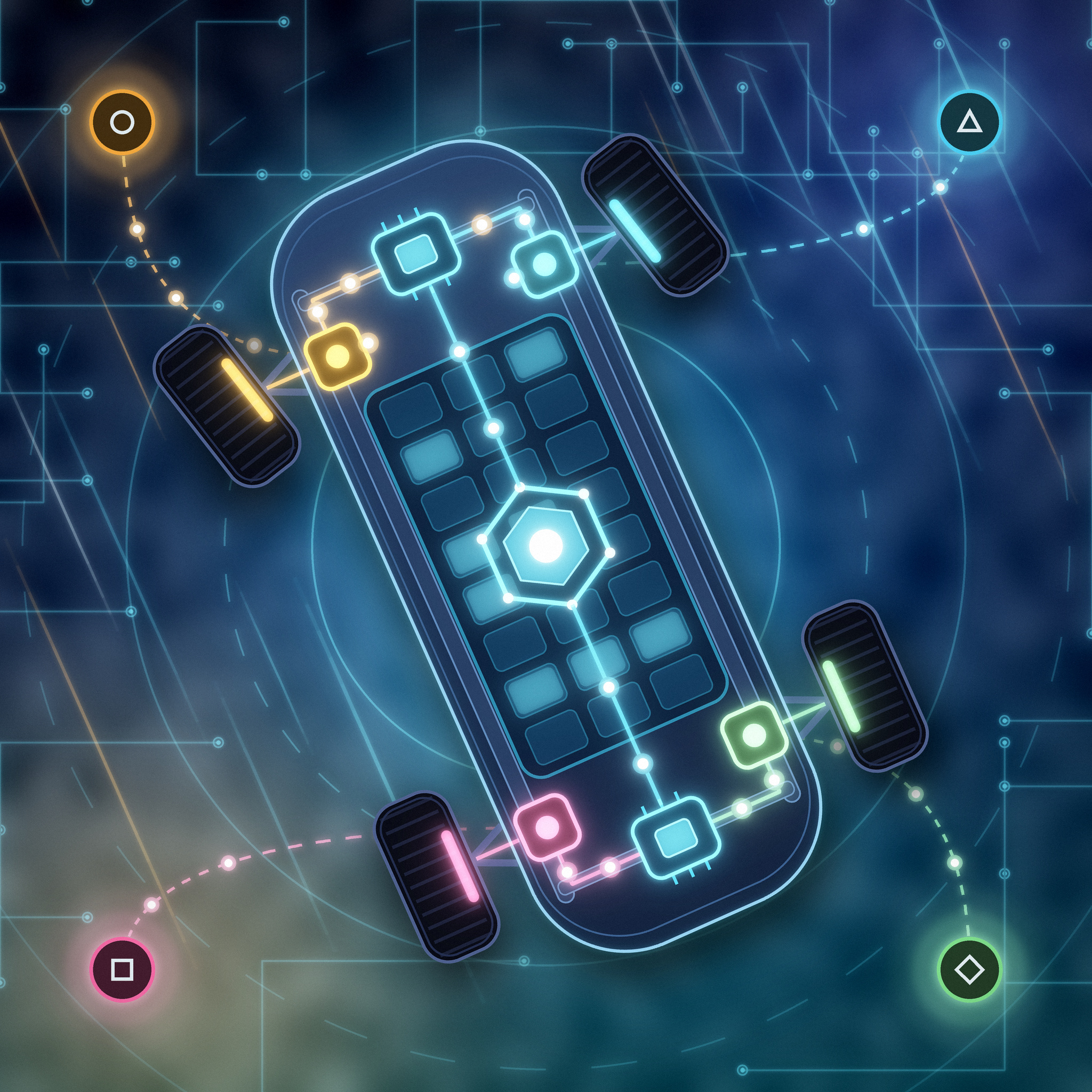
Hi, this is DatumDraft. When people talk about autonomous driving and Software-Defined Vehicles (SDVs), most of the attention goes to solid-state batteries, high-compute AI system-on-chips (SoCs), and end-to-end neural networks. Yet a multi-billion-parameter driving model cannot stop a 2.5-ton electric SUV on black ice by itself. The physical limits of how a car stops (braking), turns (steering), and holds the road (suspension) are still governed by the chassis.
What happens if you remove the steel steering column connecting your hands to the front wheels, or drain every drop of hydraulic brake fluid from the undercarriage? That shift is already in production. Automotive chassis engineering is moving away from mechanical linkages and hydraulic pressure toward pure electrical signals known as X-by-Wire, while independent control units are merging into unified Vehicle Motion Control (VMC) software. This architectural overhaul is redrawing the market share map across global Tier 1 suppliers.
Why the Chassis System Is the Hottest Battleground in the EV and SDV Era
For over a century, the three foundational domains of the automotive chassis—steering, braking, and suspension—operated as mechanical amplifiers of the human driver. You turned a wheel, twisted a torsion bar, and an electric or hydraulic pump helped push a rack. You pressed a pedal, and vacuum pressure forced fluid through steel lines to clamp a caliper.
The transition to battery electric vehicles (BEVs) and centralized SDV architectures handed chassis engineers three difficult physical problems all at once:
- Severe curb weight penalties: Large battery packs add 400 to 700 kg to a vehicle’s mass. Heavier cars require exponentially higher braking clamping forces, stiffer suspension bushings, and stronger roll stabilization without sacrificing tire wear or cabin comfort.
- Interior packaging and skateboard constraints: EV platforms stretch the wheelbase to fit more battery cells between the axles. Designers want flat floors, cab-forward dash layouts, and retractable steering wheels for autonomous lounge modes. A rigid steel intermediate shaft running through the firewall blocks all of those goals.
- Millisecond actuator response for ADAS and autonomy: When a central autonomous driving computer spots an obstacle and calculates an evasive trajectory, traditional hydraulic valves and isolated mechanical linkages introduce tens of milliseconds of latency. Modern central controllers need smart actuators that execute commands in 1 millisecond (0.001 seconds) with exact repeatability.
Where the traditional chassis amplified human muscle, the modern smart chassis acts as a high-speed nervous system and muscle group that translates digital torque and vectoring commands from the central brain directly onto the asphalt.
- Traditional Mechanical & Early Mechatronic Chassis: Relies on a physical intermediate steering shaft, hydraulic brake lines filled with DOT fluid, passive coil springs with fixed damper valves, and isolated domain ECUs (separate boxes for ESC, MDPS, and ECS) communicating over low-bandwidth CAN buses.
- Next-Generation SDV Smart Chassis: Eliminates mechanical connections via Steer-by-Wire (SbW) and dry Electro-Mechanical Brakes (EMB), runs high-output 48V active suspension actuators, and consolidates 6-Degrees-of-Freedom (6-DoF) motion logic into a central zonal controller over gigabit Automotive Ethernet.
Four Core Smart Chassis Technologies Leading R&D Labs Today
1. The End of Mechanical Linkages: X-by-Wire (SbW and Dry EMB)
The centerpiece of modern chassis R&D is X-by-Wire, beginning with Steer-by-Wire (SbW). In an SbW system, the physical intermediate shaft connecting the steering wheel to the steering rack is removed entirely. It is replaced by two main assemblies: a Steering Feel Actuator (SFA) in the cabin that reads the driver’s angle inputs while generating artificial road feedback torque, and a Road Wheel Actuator (RWA) mounted on the axle that physically turns the tie rods via high-torque electric motors.
Removing the mechanical column unlocks variable gear ratios. In a conventional car, turning the wheels from lock to lock requires about 2.5 to 3 full rotations of the steering wheel (roughly 900 to 1,080 degrees). With SbW—already in mass production on the Tesla Cybertruck, the Lexus RZ (One Motion Grip), and the NIO ET9—the software dynamically adjusts the steering ratio based on vehicle speed. In a tight parking lot, a 150-degree turn of the wheel swings the tires to full lock without requiring hand-over-hand shuffling. At 120 km/h on the highway, that same steering movement translates to a subtle, stable lane adjustment.
Braking is undergoing an identical transformation through Electro-Mechanical Brakes (EMB), often called dry brake-by-wire. While today’s electric cars use “wet” brake-by-wire systems that decouple the pedal from the master cylinder but still push hydraulic brake fluid to the calipers, true dry EMB eliminates the master cylinder, hydraulic lines, and brake fluid completely. Instead, each wheel caliper houses a compact electric motor and planetary gear set that presses the brake pads directly against the rotor when commanded over a wire.
Because neither SbW nor EMB has a mechanical fallback if a wire snaps or a chip fails, both systems must meet ISO 26262 ASIL-D, the highest functional safety integrity level in the automotive industry. Engineers achieve ASIL-D through full hardware redundancy: dual-wound electric motors (where half the stator windings can still steer or stop the car if one circuit shorts), dual-channel ECUs with independent microcontrollers, dual torque and angle sensors, and split power feeds backed by independent 48V and 12V battery rails.
Quick Reference: The 5 Stages of Automotive Braking Evolution
- Stage 1 — CBS (Conventional Brake System): Purely mechanical and hydraulic; uses engine intake vacuum to amplify the driver’s foot force.
- Stage 2 — ABS / ESC (Electronic Stability Control): Adds a hydraulic modulator (HECU) that rapidly pulses individual wheel calipers to prevent skidding and wheel lockup.
- Stage 3 — Two-Box Electrified Braking (e-Booster + ESC): Replaces the engine vacuum booster with an electric motor booster (e.g., Bosch iBooster Gen 1) plus a separate ESC module to blend regenerative braking in early hybrids and EVs.
- Stage 4 — One-Box Integrated Brake-by-Wire (Wet System): Merges the electric pressure generator, pedal feel simulator, and ESC valves into a single compact unit (e.g., Bosch IPB, Continental MK C2, HL Mando IDB, Hyundai Mobis MEB). This is the current global mainstream standard.
- Stage 5 — Dry-Type EMB (Electro-Mechanical Brake): Eliminates hydraulic fluid and pipes altogether; uses 4-wheel electric caliper actuators (or a hybrid Front-Wet One-Box + Rear-Dry EMB setup) for zero drag torque, instant clamping, and plug-and-play assembly.
2. Making Long-Wheelbase EVs Agile: Rear Wheel Steering (RWS) and e-Corner Modules
Dedicated EV skateboard platforms frequently stretch the wheelbase beyond 3,000 mm to pack 80 to 110 kWh of battery capacity between the axles. A 3.1-meter wheelbase gives rear passengers limousine-like legroom, but it makes U-turns and tight underground parking ramps a nightmare. Rear Wheel Steering (RWS)—also known as Active Rear Steering (ARS)—solves this geometry problem and has rapidly moved from flagship luxury sedans into mainstream EV SUVs and pickups.
RWS operates in two distinct phases depending on speed:
- Low-Speed Counter-Phase Steering (Out-of-Phase): Below roughly 60 km/h, the rear wheels turn in the opposite direction of the front wheels by up to 10 to 12 degrees. This virtually shortens the wheelbase and cuts the turning diameter by 1.2 to 2.0 meters, allowing a full-size electric SUV to pivot like a compact hatchback.
- High-Speed In-Phase Steering: Above 60 km/h, the rear wheels turn in the same direction as the front wheels (typically 2 to 3 degrees). Instead of pivoting the nose and waiting for the rear tires to build lateral slip angle, the car slides laterally into the adjacent lane with almost zero yaw overshoot, significantly improving high-speed stability and rear-seat motion sickness prevention.
Taking independent wheel actuation to its structural conclusion leads to the e-Corner Module. Pioneered in working demonstration vehicles like Hyundai Mobis’s MOBION (equipped with the e-Corner System) and Schaeffler’s 90-degree corner architecture, an e-Corner module integrates four systems—an in-wheel electric propulsion motor, a dry brake-by-wire caliper, an independent steer-by-wire actuator, and an active electric damper—directly inside the wheel hub assembly.
Because each wheel can steer up to 90 degrees independently, an e-Corner vehicle requires no traditional axles, driveshafts, or engine bay. It can execute a 90-degree parallel “crab walk” into a tight curb space, perform a 360-degree zero-turn tank spin on the spot, or drive diagonally across an intersection. While unsprung mass (the weight sitting in the wheel hub below the spring) keeps full e-Corner modules out of high-speed sports sedans for now, Purpose-Built Vehicles (PBVs), urban robo-shuttles, and last-mile autonomous logistics pods are adopting modular corner architectures on flat skateboard frames.
3. Breaking the Ride-vs.-Handling Compromise: Preview Suspension and 48V Active Roll Control
Mechanical suspension design has always been a zero-sum tug-of-war between ride comfort and handling stability. Soft springs and loose damper valves soak up potholes smoothly, but let the body wallow and roll heavily when cornering or braking hard. Stiff springs and firm anti-roll bars keep the chassis flat through fast corners, but transmit every road crack directly into the cabin.
Modern smart chassis systems break this physical trade-off using three technologies working together:
- Camera & ADAS-Linked Preview Suspension: Instead of reacting after a tire hits a speed bump, preview air and electromagnetic suspensions use forward-facing ADAS stereo cameras, LiDAR road-profile scanning, and cloud crowd-sourced road roughness maps to read the asphalt 10 to 50 meters ahead. The ECU pre-adjusts damper solenoid valves or air spring chamber volumes milliseconds before impact.
- 48V Electromechanical Active Roll Stabilization (eARS): Traditional steel anti-roll (stabilizer) bars permanently tie the left and right wheels of an axle together, copying single-wheel pothole impacts across the car. A 48V eARS unit splits the stabilizer bar in the middle and inserts a brushless electric motor with a multi-stage planetary gearbox. On straight roads, it decouples the bar so each wheel absorbs bumps independently. In a hard corner, the 48V motor twists the bar halves in opposite directions with over 1,000 Nm of counter-torque to keep the body level.
- Full Active Electro-Hydraulic & Electromagnetic Damper Actuators: The latest frontier—seen in Porsche Active Ride, NIO’s SkyRide (developed with ClearMotion), and BYD’s DiSus-X / DiSus-Z—replaces passive shock absorbers with high-speed motor-driven hydraulic pumps or linear electromagnetic motors at each corner. Operating at up to 1,000 Hz (adjusting 1,000 times per second) on 48V or 400V/800V high-voltage rails, these actuators can actively push a wheel down into a rut or pull it up over a crest. They even allow the car to lean into corners like a motorcycle or pitch the nose up during hard braking to eliminate passenger head-toss.
4. The Brain Governing the Hardware: Vehicle Motion Control (VMC) and Zonal Architecture
Putting SbW, Dry EMB, RWS, and 48V active suspension on the same car creates a new engineering headache: over-actuation. In a traditional car, only the steering wheel controlled yaw (turning left or right). In a modern EV, you can generate a yaw moment in four ways at the same time: turning the front SbW rack, angling the rear RWS actuator, applying asymmetric brake clamping via EMB on one wheel, or torque-vectoring dual/quad electric drive motors.
If the braking ECU (from Supplier A), the steering ECU (from Supplier B), and the suspension ECU (from Supplier C) each run their own closed-loop stability algorithms independently, they fight one another during an emergency maneuver. That is why the industry is converging on unified Vehicle Motion Control (VMC)—also referred to as Integrated Chassis Control (ICC) or Software-Defined Chassis.
Under a centralized SDV Zonal E/E Architecture, the smart actuators at each corner of the car are stripped of their high-level decision-making software. They become standardized “muscle” nodes connected to front and rear Zonal Gateways. All 6-Degrees-of-Freedom (6-DoF) vehicle dynamics—longitudinal (surge), lateral (sway), vertical (heave), roll, pitch, and yaw—are calculated in one unified VMC software layer running on the central High-Performance Computer (HPC). When the driver or autonomous driving stack requests a path vector, the VMC coordinator distributes the exact torque, clamping force, slip ratio, and damping force across all four wheels in a single 1-millisecond control loop.
Global Competitive Landscape: European Giants vs. Korean Specialists vs. China’s Rise
As chassis value shifts from cast iron and hydraulic machining toward ASIL-D electronics and VMC software algorithms, the competitive hierarchy among global Tier 1 suppliers has split into three distinct camps.
The European Triumvirate: ZF, Bosch, and Continental
- ZF Friedrichshafen (The Full-Line Motion Giant): Through its mega-acquisitions of TRW (passenger car steering and braking) and Wabco (commercial vehicle chassis controls), ZF built the broadest mechanical-to-software chassis portfolio in the world. ZF holds a strong lead in commercializing both Dry EMB (plus hybrid wet-front/dry-rear braking architectures) and Steer-by-Wire across European, North American, and Chinese OEMs. Crucially, ZF unbundled its software from its hardware with cubiX—a hardware-agnostic VMC software platform already running in production vehicles like the Lotus Eletre and Emeya, capable of controlling third-party dampers and brakes.
- Robert Bosch (The One-Box & Cross-Domain Powerhouse): Bosch dominated the initial EV braking transition with its two-box iBooster and followed up with the IPB (Integrated Power Brake) One-Box system, supplying millions of units across global OEMs. Bosch is leveraging its massive scale in silicon carbide (SiC) power electronics, MEMS inertial sensors, and its Vehicle Motion Management (VMM) software suite to lock in turnkey zonal chassis contracts, while advancing hydraulic-free brake-by-wire for late-decade platforms.
- Continental (Brake-by-Wire & Air Suspension Veteran): Continental was an early mover in One-Box electro-hydraulic braking with its MK C1 and lighter, cost-optimized MK C2 platforms. Beyond braking, Continental is a global leader in smart air suspension systems (CAirS) and sensor-fused chassis electronics, targeting semi-dry and full-dry future brake corner modules for European premium brands.
The Korean Core Players: Hyundai Mobis vs. HL Mando
- Hyundai Mobis (From Module Assembler to In-House System Integrator): Historically known for assembling complete chassis modules for Hyundai Motor Group (HMG), Hyundai Mobis has aggressively internalized core electronic actuators. It mass-produces its own One-Box integrated electronic brake (MEB), dual-redundant ASIL-D electric power steering (MDPS / SbW), and preview air/electronic suspension systems. Mobis also gained global engineering recognition by demonstrating the functional e-Corner System (MOBION), positioning itself as the primary hardware and zonal chassis integrator for HMG’s next-generation SDV platforms as well as external European and North American customers.
- HL Mando (Pure-Play Chassis R&D Specialist): Unlike diversified conglomerates, HL Mando focuses almost exclusively on steering, braking, and suspension. That concentration has paid off in massive global order backlogs. Mando’s One-Box brake system (IDB / IDB2) and next-generation Steer-by-Wire (SbW) and Dry EMB actuators have won major production contracts not only with Hyundai-Kia, but also with top North American EV makers, European legacy OEMs, and fast-growing Chinese NEV brands. Through its joint venture HL Klemove (autonomous driving sensors/compute), HL Mando bridges ADAS perception directly with chassis actuation.
The Chinese Challenger Wave: Bethel (WBTL), Tuopu, and Nexteer
The fastest variable in the global chassis supply chain is the domestic localization surge in China. Five years ago, foreign Tier 1s controlled over 85% of China’s One-Box brake and active suspension market. Today, Chinese suppliers are scaling rapidly on the back of domestic NEV volume and aggressive 18-month development cycles:
- Bethel Automotive Safety Systems (WBTL): The first Chinese supplier to mass-produce its own One-Box WCBS (Wire-Controlled Brake System) at million-unit scale, Bethel is now rolling out dry EMB calipers and mechanical/electric steering racks at 20% to 30% lower unit cost than European incumbents.
- Ningbo Tuopu Group & KH Automotive / Baolong: Tuopu grew alongside Tesla’s Shanghai Gigafactory as a lightweight aluminum structural chassis and thermal supplier, and has now expanded into closed-loop air suspension systems, rotary/linear actuators, and IBS (Intelligent Brake Systems). Meanwhile, Baolong and KH Automotive have slashed the price of dual-chamber air springs and CDC dampers, bringing air suspension down into $28,000 (200,000 RMB) Chinese family EVs.
| Tier 1 Supplier | Core Chassis Domains | Flagship By-Wire & VMC Solutions | Key OEM Reference Base | Strategic Edge |
|---|---|---|---|---|
| ZF (Germany) | Steering, Braking, Active Dampers, Commercial Chassis | Dry/Hybrid EMB, Steer-by-Wire, AKC (RWS), cubiX VMC SW, sMOTION | Lotus, NIO, Mercedes-Benz, BMW, Stellantis, GM | Only player mass-producing full Dry EMB + SbW + standalone cubiX software |
| Bosch (Germany) | Braking, Sensors, Power Semiconductors, Steering | IPB (1-Box), Redundant Brakes, VMM (Vehicle Motion Mgmt) | VW Group, BMW, Tesla, Geely, global multi-OEM base | Unmatched production scale in 1-Box IPB and cross-domain ECU/sensor integration |
| Continental (Germany) | Braking, Air Suspension, Wheel-End Sensors | MK C2 (1-Box), Future Brake System (Dry EMB), CAirS Air Suspension | Mercedes-Benz, Audi, Ford, Renault, European OEMs | Ultra-lightweight MK C2 architecture and strong OEM air suspension share |
| HL Mando (South Korea) | Pure-Play Steering, Braking, Smart Suspension | IDB2 (1-Box), Dual-Safe SbW, Dry EMB, Smart Damping Control (SDC) | Hyundai-Kia, North American EV OEMs, Geely, NIO, Changan | High R&D agility; diversified client book across US, Korea, China, and Europe |
| Hyundai Mobis (South Korea) | Full Chassis Modules, Steering, Braking, In-Wheel | MEB (1-Box), SbW, RWS, Preview Air Susp, e-Corner System | Hyundai, Kia, Genesis, plus expanding European/US OEM orders | End-to-end module assembly scale paired with next-gen e-Corner integration |
| Bethel / Tuopu (China) | 1-Box Braking, Air Suspension, Lightweight Subframes | WCBS 2.0 (1-Box), Local Dry EMB, Closed-Loop Air Suspension | BYD, Chery, Li Auto, Xiaomi Auto, XPeng, Geely | Rapid 18-month iteration cycles and 20-30% cost advantage in domestic NEVs |
Three Key inflection Points That Will Decide the Market Over the Next 3 to 5 Years
When tracking automotive earnings calls, CES technical showcases, or platform announcements between 2026 and 2030, keep your eyes on three structural inflection points:
1. Dry EMB Regulatory Rollout and the “Hybrid Braking” Bridge (2026–2028)
With UNECE R13/R13H regulatory updates clearing the legal path for hydraulic-free braking in Europe and Asia, 2026 through 2028 marks the first real wave of Dry EMB mass production (SOP). However, rather than jumping straight to 4-wheel Dry EMB across every vehicle segment overnight, many OEMs are adopting a pragmatic “Hybrid Brake-by-Wire” intermediate step: keeping a proven Wet One-Box hydraulic system on the front axle (which handles roughly 70% of dynamic braking load) while deploying Dry EMB electric calipers on the rear axle (eliminating the longest hydraulic fluid lines running under the battery pack and simplifying electronic parking brakes). Watching which Tier 1s win 4-wheel Dry EMB vs. Hybrid EMB contracts will reveal how quickly OEMs trust pure electromechanical stopping power.
2. The Software Licensing Tug-of-War: OEM In-House VMC vs. Tier 1 Middleware
Who owns the 6-DoF Vehicle Motion Control brain? Vertically integrated automakers—including Tesla, BYD, Rivian, Xiaomi, and Hyundai Motor Group—want to write the top-level VMC algorithms in-house so they can tune their brand’s unique driving signature and push over-the-air (OTA) handling updates. If OEMs succeed in turning Tier 1s into pure “build-to-print” smart actuator vendors, hardware margins will compress. Conversely, legacy OEMs struggling with software complexity are licensing turnkey middleware like ZF’s cubiX or Bosch’s VMM. Tier 1s that can sell open-interface smart actuators to vertically integrated OEMs while charging per-vehicle software royalties to traditional OEMs will capture the highest operating margins.
3. 48V Architecture Adoption and Smart Actuator Cost Curves
Running Steer-by-Wire racks for 3-ton electric trucks, clamping Dry EMB calipers in 80 milliseconds, and driving active suspension motors all hit a hard physical wall on legacy 12V electrical systems: current ($I = P / V$) becomes so high that copper wire harnesses grow thick, heavy, and expensive. Transitioning the chassis power rail from 12V to 48V cuts current by 75% for the same power output, shrinking actuator motor windings and MOSFET inverters. Originally pioneered by luxury SUVs and the Tesla Cybertruck, 48V zonal architecture is the single biggest enabler for bringing SbW and active suspension down from $100,000 flagship vehicles into $35,000 mass-market EVs by 2028–2030.
Where the Value Flows Next in the Chassis Supply Chain
While traditional internal combustion powertrain suppliers—makers of pistons, exhaust manifolds, fuel injectors, and multi-speed transmissions—face structural decline as EVs scale, chassis suppliers sit in the opposite position. Every electric and autonomous vehicle still needs four tires on the pavement, and the hardware controlling those four contact patches is getting smarter, heavier-duty, and more software-intensive every year.
Moving from a conventional vacuum brake booster and mechanical steering rack to a 1-Box IDB/EMB setup, dual-redundant Steer-by-Wire, Rear Wheel Steering, and 48V active suspension more than doubles the dollar content per vehicle (CPV) for chassis Tier 1s. For engineers, industry analysts, and investors, the winners of the SDV era will not just be the companies designing AI chips in the dashboard, but the chassis specialists mastering ASIL-D fail-operational actuators and 6-DoF motion control underneath the floor.
If you found this breakdown useful for your industry research or engineering reference, feel free to bookmark this page. I am also curious to hear your take in the comments: Would you feel comfortable driving at highway speeds in a Steer-by-Wire and Dry Brake-by-Wire car with zero mechanical connection between your hands, your feet, and the wheels?