Hi, I’m Datumdraft. If you own a relatively recent vehicle from a traditional automaker, you have probably asked yourself a simple question at least once: why do I still have to book a service center appointment and leave my car on a lift for half a day just to update a vehicle control feature? Meanwhile, Tesla pushes an Over-The-Air (OTA) firmware patch overnight that recalibrates ABS braking logic and shortens the stopping distance of a Model 3 by several feet, while many legacy vehicles limit wireless updates to navigation maps and infotainment menus.
It is easy to assume this gap comes down to software coding talent. In practice, the bottleneck is physical. The real divide lies underneath the sheet metal, inside the Electrical/Electronic (E/E) architecture that dictates how every sensor, Electronic Control Unit (ECU), and actuator is wired and how they exchange data.
1. Five kilometers of copper: Why distributed and domain architectures hit a wall
For decades, adding a new feature to a car meant adding a new box. Whenever an automaker introduced heated seats, power windows, electronic stability control, or blind-spot monitoring, a Tier 1 supplier—such as Bosch, Continental, ZF, or Hyundai Mobis—delivered a standalone, black-box ECU dedicated solely to that task. In this distributed architecture, a modern luxury vehicle easily accumulated between 70 and 150 separate ECUs.
Each of those boxes required its own power feed and dedicated point-to-point signal wires. Worse, the source code running inside each ECU belonged to the Tier 1 supplier rather than the automaker. If an OEM wanted to modify how two systems interacted, it had to issue formal change requests across multiple suppliers, wait months for revised firmware binaries, and validate them separately.
The partial fix: Grouping by functional domain
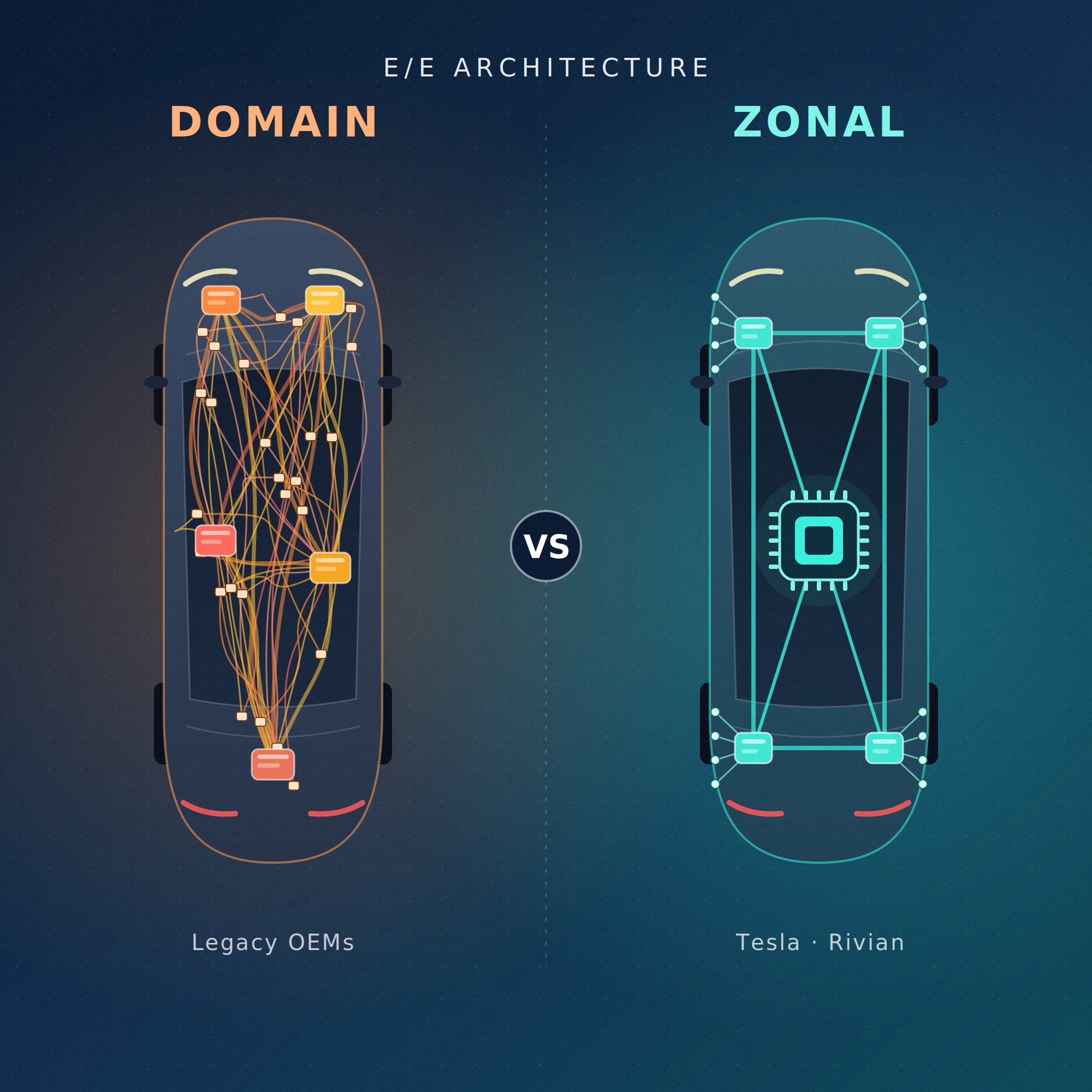
To bring order to this sprawl, automakers introduced domain architecture. Instead of scattering dozens of isolated microcontrollers everywhere, engineers consolidated control into five or six functional domains: Powertrain, Chassis, Body & Comfort, Infotainment (IVI), and Advanced Driver Assistance Systems (ADAS). High-level domain control units (DCUs) took charge of coordinating the smaller sub-ECUs within their specific functional group.
The fatal flaw of domain architecture: Functions are grouped, but hardware is not
Domain architecture looks clean on an organizational chart, yet it leaves a massive physical problem unsolved: while the controllers are grouped by function, the actual sensors and actuators remain scattered across the entire footprint of the car.
Consider what happens when a front bumper camera or radar unit detects a hazard and the vehicle needs to flash a rear warning light near the trunk while vibrating the driver’s seat in the center cabin. In a domain-centric layout, the ADAS domain controller must route dedicated wiring or traverse multiple domain gateways across the full length of the chassis. Every domain ends up laying its own spiderweb of copper wires from the front bumper to the rear bumper.
As a result, the wiring harness in a typical internal combustion vehicle or first-generation domain-based electric vehicle stretches between 3 and 5 kilometers in total length and weighs 50 to 70 kilograms. After the chassis body and the engine or high-voltage battery pack, that bundle of copper wire is the third-heaviest component in the car—and because thick, flexible cable bundles are notoriously difficult for robotic arms to manipulate, wiring harness installation remains one of the most labor-intensive manual assembly tasks in modern automotive manufacturing.
We see this transitional domain architecture across many flagship vehicles on the road today, including the Audi A8 (which pioneered central driver assistance domain controllers like zFAS), the Mercedes-Benz S-Class (W222 and early W223 generations), and Hyundai Motor Group’s third-generation N3 platform and E-GMP electric vehicles (such as the Hyundai Ioniq 5 and Kia EV6). While vehicles like the Ioniq 5 and EV6 successfully consolidated EV powertrain orchestration into integrated modules like the Vehicle Control Unit (VCU) and Integrated Charging Control Unit (ICCU), tens of peripheral body, chassis, and comfort sub-controllers remain supplied by external Tier 1 vendors. That structural fragmentation explains why many domain-era vehicles only support “halfway OTA”—updating the central infotainment screen smoothly while requiring dealer diagnostic tools to flash deep sub-controllers whose source code and bootloader keys remain locked with Tier 1 suppliers.
2. How zonal architecture and central HPCs flip the board
If domain architecture is like running dedicated phone lines for every corporate department across a five-story office building—forcing the HR department to pull its own private cables from the first floor to the fifth floor, while Accounting and Engineering pull theirs right alongside them—zonal architecture is like installing one high-speed router on each floor and linking those routers to a central server room with a single fiber-optic trunk line.
In a zonal E/E architecture, engineers abandon functional grouping at the wiring level and divide the vehicle into physical geographic zones—typically Front, Left, Right, and Rear (or Front-Left, Front-Right, Rear-Left, and Rear-Right). Every sensor and actuator plugs directly into whichever zone controller is physically closest to it, regardless of its functional domain.
Take the driver-side door area. The power window motor (Body), the side-mirror heating element (Comfort), the blind-spot radar sensor (ADAS), and the front-left suspension height sensor (Chassis) no longer run long wires back to four separate domain controllers. Instead, all four devices terminate at the Left Zone Controller just inches away.
Separating I/O from compute: Automotive Ethernet and eFuses
The core engineering principle behind zonal architecture is the strict separation of Input/Output (I/O) and power distribution from logical computation.
In a zonal vehicle, the zone controllers do not make high-level driving decisions. Their job is twofold:
- Intelligent power distribution via eFuses: Instead of routing thick wires through bulky mechanical relay and physical blade-fuse boxes under the hood, each zone controller houses solid-state semiconductor switches known as eFuses (Smart MOSFETs). These chips monitor current draw in real time, trip within microseconds during an overcurrent fault, and can be reset remotely via software without a driver ever replacing a blown physical fuse.
- Data aggregation and protocol translation: The zone controller gathers raw signals from local sensors over short, inexpensive legacy buses (such as LIN, CAN, or CAN-FD running at 1 to 8 Mbps) and packages those frames into high-speed data packets.
All actual decision-making—whether calculating torque vectoring, rendering 3D cockpit graphics, or fusing camera feeds for highway autonomy—takes place inside the central High-Performance Computer (HPC) located in the middle of the vehicle. Linking the zone gateways to that central HPC requires only a few lightweight twisted-pair cables running Automotive Ethernet (100BASE-T1, 1000BASE-T1, and up to 10Gbps links) paired with Time-Sensitive Networking (TSN) standards to guarantee deterministic, sub-millisecond latency for safety-critical braking and steering commands.
3. Real-world vehicle teardowns: Who is actually shipping zonal architecture?
Slide decks from Tier 1 suppliers have promised zonal architectures for years, but putting a clean-sheet E/E architecture onto a high-volume assembly line requires tearing up decades of purchasing contracts and vehicle packaging rules. Looking under the aluminum skin of production vehicles from Tesla, Rivian, Volkswagen, and Hyundai Motor Group reveals a stark divide between clean-sheet execution and legacy refactoring.
Tesla: From Model 3’s body controllers to Cybertruck’s 48V Gigabit Ethernet loop
Tesla did not wait for the automotive standards bodies to finalize zonal specifications. Back in 2017, while the rest of the industry was still struggling to merge basic powertrain and chassis ECUs into functional domains, Tesla launched the Model 3 with the industry’s first mass-produced zonal E/E architecture.
Instead of dozens of cabin and body modules, the Model 3 routed vehicle intelligence into a Central Compute Module (CCM)—combining infotainment and Autopilot processors—paired with just three physical zone gateways: the Front Body Controller Module (FBCM), the Left Body Controller Module (LBCM), and the Right Body Controller Module (RBCM). The LBCM handled everything on the left half of the car, while the RBCM even took charge of climate control pumps and rear lighting. That single generational leap cut the total wiring harness length from roughly 3 kilometers in the older Model S down to 1.5 kilometers in the Model 3, while eliminating the traditional physical fuse box in favor of board-mounted eFuses.
With the Cybertruck (late 2023 onward), Tesla solved the two remaining physical bottlenecks of zonal design: low-voltage current draw and data cable redundancy.
- 48V low-voltage architecture: For more than half a century, passenger cars ran their auxiliary electronics on 12V power. As modern vehicles added high-wattage active suspension actuators, steer-by-wire motors, and multi-hundred-watt compute boards, 12V systems required massive electrical currents—and high current demands thick, heavy copper wire. By quadrupling the low-voltage system to 48V ($P = V \times I$), Tesla cut the required current to one-quarter of a 12V system for the same power output, reducing copper wire cross-sectional area and mass by roughly 75% on high-load circuits.
- Gigabit Ethernet daisy-chain loop: Rather than running individual star-topology CAN buses back to a central switch, the Cybertruck links its zonal controllers and smart actuators—including its front and rear steer-by-wire actuators—along a continuous Gigabit Ethernet daisy-chain ring that combines high-speed data with 48V power distribution. Because the loop forms a closed ring, if a wire is physically severed at any single point along the chassis, data packets instantaneously route in the opposite direction around the loop with sub-millisecond latency.
Rivian R1 Gen 2 (2024 refresh): The textbook refactoring case study
If Tesla showed how to build a zonal vehicle from scratch, Rivian provided the cleanest before-and-after benchmark in automotive history. When Rivian launched the second-generation refresh of its R1T pickup and R1S SUV in June 2024, the exterior sheet metal looked nearly identical to the 2021 original. Underneath, however, Rivian’s engineering team completely ripped out the first-generation domain-based E/E architecture and replaced it with an in-house zonal system.
The quantifiable savings from that single architectural swap were dramatic:
- ECU consolidation from 17 to 7: Rivian eliminated 10 separate ECUs across the vehicle, replacing a tangle of third-party domain modules with three in-house zonal controllers (Front, Rear, and Cabin/Body) alongside consolidated autonomy and infotainment compute modules.
- 1.6 miles (2.57 km) of wiring removed per vehicle: By plugging door latches, air suspension valves, lighting, and HVAC actuators into the nearest physical zone controller, Rivian stripped 1.6 miles of copper wire out of every single R1 built.
- 44 pounds (20 kg) of harness weight saved: Cutting that copper and plastic connector bulk shaved 44 pounds off the wiring harness alone, directly reducing material Bill of Materials (BOM) costs and shortening assembly line installation times.
Legacy OEMs in the trenches: Volkswagen’s $5.8B Rivian bet and Hyundai Motor Group’s SDV push
Why haven’t traditional automotive giants simply done what Tesla and Rivian did? The painful saga of Volkswagen Group shows how deeply E/E architecture is entangled with legacy supply chains.
When Volkswagen developed the ID.3 electric hatchback on its MEB platform, it attempted to transition to its E³ 1.1 architecture by consolidating vehicle functions into a smaller number of overarching computers. However, dozens of underlying sub-controllers were still sourced from disparate Tier 1 suppliers running incompatible legacy software stacks. Volkswagen’s internal software subsidiary, CARIAD, became bogged down trying to integrate and debug millions of lines of third-party code across E³ 1.1 and the subsequent E³ 1.2 platform. The resulting software instability parked thousands of unfinished ID.3s in storage lots, delayed the launch of the Porsche Macan EV and Audi Q6 e-tron by nearly two years, and ultimately contributed to the ouster of former Volkswagen Group CEO Herbert Diess.
Hyundai Motor Group is navigating a similarly high-stakes architectural leap. While its current E-GMP vehicles (such as the Ioniq 5, Ioniq 6, and Kia EV9) operate on a well-executed domain architecture, the group recognized early that true Software-Defined Vehicle (SDV) capability requires full decoupling of hardware from software. Working alongside its autonomous driving and software subsidiary 42dot and engineers at the Namyang R&D Center, Hyundai Motor Group is developing a next-generation HPVC (High-Performance Vehicle Computer) paired with localized zonal controllers and its unified vehicle operating system, Pleos Vehicle OS, actively validating the centralized zonal architecture through SDV “Pace Car” development vehicles ahead of mass-production rollout.
4. Is a zonal, centralized architecture a silver bullet? The engineering trade-offs
Reading industry white papers, one might conclude that moving to a centralized HPC and four zonal gateways solves every problem in automotive engineering. Anyone who works in vehicle architecture or chassis R&D knows that every architectural consolidation introduces sharp engineering trade-offs.
Three undeniable advantages of zonal architecture
- Wiring harness diet and assembly line automation: A 60-kilogram, 5-kilometer wiring harness is limp, heavy, and impossible for factory robots to thread through a vehicle body-in-white. Workers must lay and clip it by hand. Breaking the harness into short, rigid, modular zonal sub-harnesses not only slashes copper cost and vehicle curb weight, it allows automated robotic arms to install wiring modules on the assembly line.
- Complete hardware-software decoupling: During the global semiconductor shortage, legacy automakers had to halt entire factories when a single $2 microcontroller inside a supplier’s door module went out of stock, because the software was hard-coded to that specific chip. In a zonal architecture, peripheral sensors and motors act as “dumb” I/O devices. If an OEM swaps a Bosch radar or window motor for a Continental unit, engineers simply update a driver abstraction layer inside the central HPC without redesigning the vehicle’s control units.
- True bumper-to-bumper OTA updates: Because powertrain torque, suspension damping, brake blending, and body controls are all orchestrated by software running on the central HPC under the automaker’s direct control, the OEM can continuously refine ride comfort, pedal calibration, and active safety years after the car leaves the dealership.
Three hidden risks and engineering headaches few talk about
- The terror of a Single Point of Failure (SPOF): In an old distributed car, if the power-window ECU burned out, your window stayed shut, but you could still drive home safely. In a centralized zonal vehicle, if the Left Zone Controller or the central HPC suffers a catastrophic hardware fault or power loss, you risk losing every function on the left half of the car—or losing propulsion and steering entirely. Preventing this requires strict ISO 26262 ASIL-D hardware redundancy: dual power rails, fail-operational backup microcontrollers, and redundant ring networks. Building in all that redundancy significantly inflates upfront silicon and PCB design costs.
- Thermal management and vampire power drain: Previously, 100 tiny ECUs dissipated a few watts of heat each through passive air convection across the car body. When you pack 1,000 to 2,000 TOPS of compute performance—using flagship System-on-Chips (SoCs) like Nvidia DRIVE Thor or Qualcomm Snapdragon Ride Flex—into a single central HPC box, that unit alone can draw several hundred watts of continuous power. Air cooling is no longer enough. Engineers are forced to route dedicated liquid-cooling refrigerant plumbing right into the passenger cabin dashboard just to keep the central computer from thermal-throttling.
- Cybersecurity blast radius and organizational warfare: When infotainment, telematics, and chassis braking share a unified Ethernet backbone, a single vulnerability in the cellular modem or browser could theoretically expose safety-critical vehicle motion controls unless hardware hypervisors and strict gateway firewalls are flawlessly enforced. Even harder than the cybersecurity math is the human element: legacy automakers are structured around fierce departmental silos—Chassis R&D, Body Engineering, Powertrain, and Infotainment—each with its own budget and supplier relationships. Telling the Chassis division to surrender its dedicated controller and run its braking code as a virtualized container inside a central computer managed by the Software division triggers intense organizational resistance.
Core comparison matrix: Distributed vs. Domain vs. Zonal architecture
| Comparison Metric | Distributed Architecture | Domain Architecture | Zonal + Central HPC Architecture |
|---|---|---|---|
| Controller Grouping Rule | 1 Function = 1 Dedicated ECU | Grouped by Function (ADAS, Chassis, Body, Powertrain, IVI) | Grouped by Physical Location (Front, Left, Right, Rear Zones + Central HPC) |
| Average ECUs per Vehicle | 70 – 150 ECUs | 30 – 60 ECUs | 7 – 20 ECUs (typically 1–2 HPCs + 3–4 Zone Gateways) |
| Wiring Harness Length & Weight | 3.5 – 5.0 km (50 – 70 kg) | 2.5 – 4.0 km (40 – 55 kg) | 1.0 – 1.8 km (15 – 30 kg, up to 70% reduction with 48V) |
| Primary Communication Bus & Power | LIN, Classical CAN (up to 1 Mbps), 12V Physical Blade Fuses | CAN-FD (2–8 Mbps), Early 100BASE-T1 Ethernet, 12V Relays | Gigabit Automotive Ethernet (1000BASE-T1 / 10Gbps TSN), 48V + Solid-State eFuses |
| OTA Update Scope & Representative Models | None or Infotainment Maps Only (Legacy ICE vehicles) | Partial OTA: IVI & select modules (VW ID.3, early W223 S-Class, Hyundai Ioniq 5 / Kia EV6, Rivian R1 Gen 1) | Full Vehicle OTA: Powertrain, Chassis, ADAS & Body (Tesla Model 3/Y, Cybertruck, Rivian R1 Gen 2) |
How to buy a car that won’t become obsolete in three years
The shift from distributed and domain layouts to zonal E/E architecture is far more than a cost-cutting exercise to save a few miles of copper wire. It represents a fundamental re-engineering of the automobile from a mechanical assembly of supplier black boxes into an integrated, upgradable computing platform on wheels.
For decades, car buyers judged a vehicle’s longevity by its engine displacement, transmission gear count, or battery kilowatt-hour capacity. In the era of Software-Defined Vehicles, those numbers only tell half the story. Two electric SUVs sitting side by side in a showroom today can boast the exact same 800V battery charging speed and dual-motor horsepower—yet three years after purchase, the one built on a true zonal architecture with a centralized HPC will continue to receive sharp new autonomous driving capabilities, smoother suspension damping profiles, and responsive UI upgrades, while the one built on a fragmented legacy domain harness remains frozen in time.
The next time you evaluate a new EV or modern passenger car, look past the spec-sheet horsepower and ask a deeper question: what generation of E/E architecture is sitting underneath this chassis?