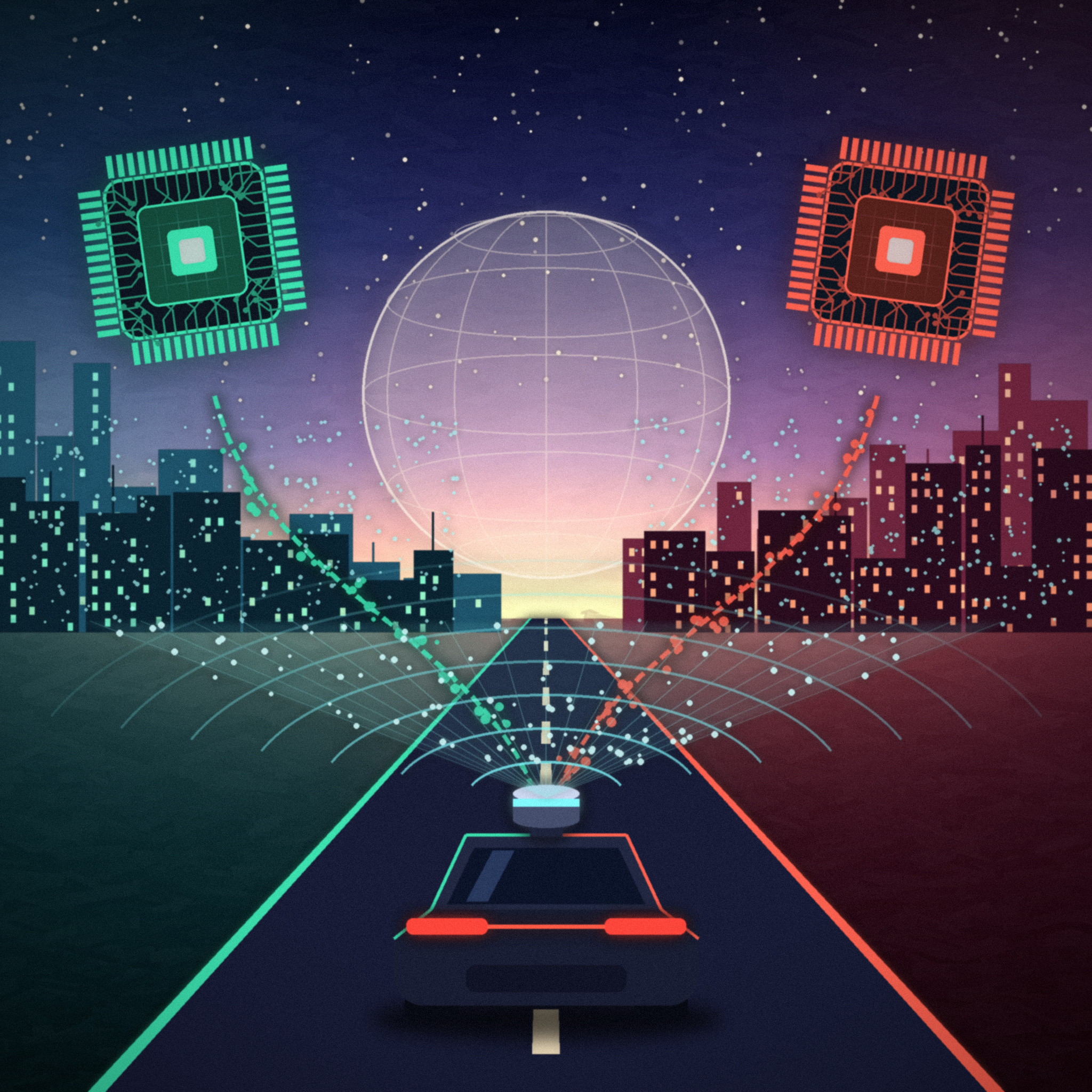
Hi, this is DatumDraft. Every time you open the tech news lately, a flood of unfamiliar names and numbers spills across the screen. One headline talks about NVIDIA Orin and Thor hitting thousands of TOPS, the next covers Mobileye’s efficiency, and another points out that Chinese companies like Horizon Robotics and Hesai are taking over electric vehicles in Beijing and Shanghai. Unless you spend your days reading semiconductor datasheets or optical sensor specs, stringing these pieces into a single, clear picture of the auto industry feels nearly impossible.
Most commentary online still gets stuck in the old argument over whether Tesla’s camera-only approach beats LiDAR, or it just copies raw engineering tables without explaining why any of it matters to car buyers and investors. If we step back and look at the supply chain in late 2026, the real story is much bigger: the global autonomous driving hardware market has split straight down the middle into two competing camps.
Executive Summary: The 2026 Autonomous Hardware Split in Three Sentences
1. The global market for self-driving hardware is now divided between the Western camp (NVIDIA and Mobileye), which focuses on ultra-high compute performance and general-purpose software ecosystems, and the Chinese camp (Horizon Robotics and Hesai), which competes through aggressive cost reduction and rapid vertical integration.
2. Because of U.S. connected-car trade barriers and China’s state-backed push for Level 3 commercialization, neither side can freely sell its hardware in the other’s backyard.
3. As a result, global automakers are entering a “Dual-Stack” era where the exact same car model gets fitted with a different silicon brain and different laser eyes depending on whether it is sold in North America, Europe, or China.
1. Why the Car’s “Brain (SoC)” and “Eyes (LiDAR)” Are the Hottest Battleground Right Now
To understand why automakers and tech giants are spending billions on silicon and lasers, we need to strip away the engineering jargon. Building a car that can drive itself down a busy city street in the rain comes down to two physical components working in lockstep: the eyes that see the road, and the brain that decides what to do next.
The Eyes (LiDAR): From Luxury Experiment to $200 Everyday Sensor
A LiDAR (Light Detection and Ranging) sensor fires millions of invisible laser pulses every second and measures how long they take to bounce back. Unlike a standard camera that sees flat 2D images and struggles with glare, pitch-black nights, or white trucks against a bright sky, LiDAR draws an exact 3D map of everything around the vehicle down to the centimeter.
Ten years ago, a single automotive-grade LiDAR unit sat spinning on the roof of a test vehicle and cost tens of thousands of dollars. Putting one on a family sedan was out of the question. Between 2016 and 2026, however, hardware prices dropped by more than 90 percent. Today, mainstream ADAS LiDAR units are hitting target prices of $200 to $500 (roughly 300,000 to 700,000 KRW). Because of that price collapse, LiDAR has moved out of research labs and onto the roofs and behind the windshields of everyday passenger cars.
The Brain (Autonomous SoC): Making Life-or-Death Calls in 0.01 Seconds
Having sharp eyes does nothing on its own. When cameras, radars, and LiDARs are running together, they pour several gigabytes of raw sensor data into the car’s wiring harness every single second. The System-on-Chip (SoC) is the command center that digests all of that data, predicts whether a scooter is about to cut across the lane, and tells the steering rack and brakes how to react within 10 milliseconds.
Think of the relationship between the chip and the LiDAR like a driver’s reflexes and eyesight. If you have 20/20 vision (a great LiDAR) but your brain takes five seconds to process what you see (a slow chip), you will crash into the car ahead. On the flip side, if you have the fastest brain in the world (a 2,000-TOPS chip) but your eyes are blurry in the dark (poor sensors), you have to pull over when it rains. That is why automakers cannot shop for chips and sensors separately anymore; they have to design and buy them as a matched pair.
Key Takeaway: A self-driving car is only as safe as the link between its 3D laser eyes (LiDAR) and its decision-making silicon (SoC)—and falling sensor prices have turned this hardware pairing into a mass-market fight.
2. The Brain War: “Monster Spec” NVIDIA vs. “Efficiency King” Mobileye vs. “China’s Challenger” Horizon Robotics
In the market for autonomous driving chips, three companies represent three completely different engineering philosophies. If we compare them to engines and wardrobe choices, the trade-offs become easy to spot.
NVIDIA (Drive Orin & Thor): The F1 Supercar Engine and All-in-One Department Store
NVIDIA dominates the high-end autonomous chip market by throwing massive compute power at the problem. Its current-generation Drive Orin chip (254 TOPS) became the gold standard for premium EVs over the last few years, and its next-generation Drive Thor pushes compute capacity up to 1,000 to 2,000 TOPS.
Thor is designed as a centralized brain for Software-Defined Vehicles (SDVs). Instead of using one chip for highway driving, another for automatic parking, and a third for the dashboard screens, a single Drive Thor chip can run end-to-end autonomous driving models, cabin voice assistants, and passenger gaming screens all at once. The catch is simple: like a Formula 1 engine, it is expensive to buy and draws significant electrical power, requiring heavy liquid or advanced thermal cooling systems that eat into the profit margins of affordable cars.
Mobileye (EyeQ6 High & Lite): The Tailored Suit Focused on Fuel Economy
Israel-based Mobileye, backed by Intel, has supplied more traditional ADAS chips to global automakers than anyone else in history. With its flagship EyeQ6 High (34 DL TOPS, built on a 7nm process) and EyeQ6 Lite (5 DL TOPS), Mobileye refuses to play NVIDIA’s raw TOPS numbers game.
Think of Mobileye as a bespoke tailored suit rather than a giant department store. Because Mobileye writes its own perception algorithms alongside its silicon, it packs the EyeQ6 with specialized hardware accelerators (like XNN and PMA) tuned specifically for vision and radar processing. That allows its SuperVision and Chauffeur platforms to handle hands-free driving at a fraction of the power consumption and chip cost of a general-purpose GPU. Even so, Mobileye has faced stiff headwinds recently: Chinese automakers that once relied on Mobileye have rapidly switched to in-house chips or domestic Chinese suppliers, forcing Mobileye to defend its turf among European, Japanese, and North American legacy OEMs.
Horizon Robotics (Journey 6 Series): China’s Value-Packed Hybrid Powerhouse
If NVIDIA is the luxury supercar engine, Beijing-based Horizon Robotics is the high-efficiency hybrid powertrain taking over the world’s largest auto market. Often called “China’s NVIDIA,” Horizon launched its Journey 6 series into mass production in late 2025, offering a full family of chips ranging from entry-level active safety all the way up to the flagship Journey 6P (560 TOPS, 37 billion transistors, 18-core CPU).
Horizon is sweeping up orders from BYD, Li Auto, Geely, and Volkswagen’s Chinese joint ventures for two practical reasons. First, its hardware and software stack is trained from the ground up on China’s chaotic city streets, where delivery scooters, pedestrians, and unmarked lane merges happen all at once—making it ideal for Urban NOA (Navigate on Autopilot). Second, it delivers high compute density at a price point that lets Chinese automakers put urban self-driving features into $20,000 family cars without blowing up their bill of materials.
| Metric / Player | NVIDIA | Mobileye | Horizon Robotics |
|---|---|---|---|
| Flagship Chipset | Drive Orin (254 TOPS) / Drive Thor (1,000–2,000 TOPS) | EyeQ6 High (34 DL TOPS, 7nm) / EyeQ6 Lite (5 TOPS) | Journey 6 Series / Flagship Journey 6P (560 TOPS) |
| Analogy & Positioning | F1 Supercar Engine / All-in-one department store brain | Bespoke Tailored Suit / Ultra-efficient fuel-saver | High-Value Hybrid / Scalable urban traffic specialist |
| Architectural Strength | Single-chip centralization (ADAS + Cockpit + GenAI), CUDA ecosystem | Dedicated accelerators (XNN, PMA), low thermal load, turnkey software | BPU Nash architecture optimized for Transformer models & Urban NOA |
| Major Customers | Mercedes-Benz, Volvo, Polestar, BYD (select lines), Xiaomi, Zeekr | Volkswagen Group (Global), Porsche, Ford, Mahindra, Japanese OEMs | BYD, Li Auto, Chery, SAIC, Volkswagen China (CARIZON JV) |
| Key Vulnerability | High chip cost, heavy power draw, U.S. export cap risk in China | Closed “black-box” perception, losing share among Chinese EV makers | Geopolitical blockade barring entry into U.S. and Western markets |
Key Takeaway: While NVIDIA builds massive all-in-one supercomputers and Mobileye squeezes maximum mileage out of low-power silicon, Horizon Robotics is winning China’s volume market by pairing 560-TOPS performance with mass-market pricing.
3. The Eyes War: How China’s Hesai Crushed Multi-Thousand-Dollar LiDARs Down to $200
If the chip war is a three-way tug-of-war, the battle for automotive LiDAR has turned into a lopsided rout in favor of Chinese manufacturers. Just a few years ago, dozens of Western LiDAR startups went public via SPACs with grand promises. By 2026, many of those Western players have either gone bankrupt, merged to survive, or remained stuck in low-volume luxury niches because of high manufacturing costs and slow automaker validation cycles.
Meanwhile, China’s Hesai Technology and RoboSense have quietly locked up nearly half of the entire global automotive LiDAR market. According to Yole Group and TechInsights benchmarks, Hesai alone captures 62 percent of the global robotaxi LiDAR market and ranks #1 worldwide in passenger vehicle LiDAR with roughly 28 percent share. Right behind it sits RoboSense in second place with around 20 percent share. RoboSense hit a historic milestone in Q4 2025 by turning its first quarterly net profit, while Hesai raised over $530 million in its September 2025 Hong Kong dual primary listing to fund its next wave of factory automation.
Secret 1: Turning Hand-Built Eyeglasses into Semiconductor Chips
How did Hesai and RoboSense cut the cost of a LiDAR unit to one-tenth of what it used to be? Think of early Western LiDARs like luxury handmade Swiss watches or boutique eyeglasses. Inside the housing, technicians had to align hundreds of individual lasers and optical receivers by hand. That approach works fine if you are building 500 test cars, but it falls apart when an automaker asks for half a million units at $300 apiece.
Hesai solved this by treating LiDAR like a semiconductor problem rather than an optical assembly problem. By integrating hundreds of laser transmitters and receivers directly onto custom silicon chips (in-house ASICs), they replaced bulky mechanical parts with wafer-level electronics. Today, printing a LiDAR core looks a lot like stamping out smartphone camera sensors on an automated production line—and by 2030, silicon-photonics “LiDAR-on-a-chip” designs are on track to push unit prices below $100.
Secret 2: A Domestic Market Obsessed with Roof-Mounted “Safety Badges”
Technology only gets cheap when someone buys it in massive volume. In Europe and the United States, automakers treated LiDAR carefully, holding back deployment until legal liability for Level 3 driving was fully sorted out. In China, local EV buyers treated that little bump above the windshield as a visible badge of safety and status.
Because Chinese consumers actively demanded LiDAR-equipped trims for city assisted driving, domestic brands placed orders in the hundreds of thousands. That flood of cash and real-world road data allowed Hesai and RoboSense to fund their next generation of hardware—including ultra-slim, solid-state units tucked cleanly behind the cabin windshield—while their Western rivals were still fighting to break even on first-generation tooling.
| Comparison Dimension | Western LiDAR Camp (Luminar, Innoviz, Valeo) | Chinese LiDAR Camp (Hesai, RoboSense) |
|---|---|---|
| Unit Price Range (2026) | $500 – $1,000+ (Premium L3/L2+ focus) | $200 – $500 (Mass-market ADAS & Urban NOA) |
| Manufacturing Approach | High-performance optical architecture (including 1550nm & MEMS), slower volume ramp | 905nm/940nm chip-scale ASIC integration, fully automated Uniqlo-style mass production |
| Production Scale | Tens of thousands to low hundreds of thousands annually | Over 1.5 million combined annual shipments; nearly 50% of global automotive volume |
| Geopolitical Exposure | Protected supplier status in North America and Europe; compliant with U.S. rules | Blacklisted or restricted in U.S. defense/connected-car rules; dominant in China |
Key Takeaway: By turning complex laser assemblies into mass-produced silicon chips and riding a wave of domestic EV orders, China’s Hesai and RoboSense turned LiDAR into a $200 commodity that Western startups struggle to match on price.
4. Tech Walls and Regulations: One World, Two Completely Divided Autonomous Ecosystems
If Chinese LiDARs are so cheap and Horizon’s chips are so capable, why doesn’t every car in California or Germany use them? Because autonomous driving hardware is no longer judged purely on price and performance. Between 2025 and 2026, Washington and Beijing built regulatory walls that permanently split the global supply chain in two.
Washington Locks the Door on Chinese Sensors and Silicon
From the U.S. perspective, an autonomous car is basically a rolling intelligence gatherer covered in high-definition cameras and 3D laser scanners. Through Department of Commerce connected-vehicle regulations and National Defense Authorization Act (NDAA) watchlists, Washington has drawn a hard line: Chinese-designed autonomous driving software, communication modules, and LiDAR units cannot be installed on vehicles sold in the United States. At the same time, U.S. export controls continue to cap the advanced AI semiconductors and manufacturing equipment that can be shipped to Chinese chip designers.
BeijingHits the Accelerator with National Level 3 Laws
Rather than slowing down, China responded by turning its massive domestic highway and city network into a state-sponsored incubator. After granting conditional approvals for Level 3 autonomous vehicles in 2025, Chinese authorities went a step further in August 2026 by releasing a landmark draft revision to the national Road Traffic Safety Law. For the first time, the law includes a dedicated chapter for autonomous vehicles alongside China’s first mandatory national safety standards for intelligent driving systems.
Combine that legal clarity with China’s strict geospatial data laws—which forbid foreign companies from transferring high-definition street maps outside Chinese borders—and the result is a closed loop. A car driving in Los Angeles or Munich is legally barred or politically discouraged from using Chinese sensors and silicon, while a car competing in Shanghai cannot survive on price or local street navigation unless it uses Horizon Robotics, Hesai, or RoboSense.
Key Takeaway: U.S. security bans and China’s rapid Level 3 legalization have created two incompatible regulatory zones, making a single “world car” hardware stack impossible to build.
5. How South Korea (Hyundai Motor Group) and Global OEMs Are Playing Both Sides
Caught right in the middle of this US-China tug-of-war are the legacy global automakers—companies like Volkswagen, Mercedes-Benz, Toyota, and South Korea’s Hyundai Motor Group. For these manufacturers, picking just one side means giving up either the profitable Western market or the hyper-competitive Chinese EV market.
The Global Automaker’s Playbook: Pragmatic “Two-Track” Engineering
To survive, global automakers have dropped the idea of a single global hardware architecture and embraced a Two-Track (Dual-Stack) strategy. In China, foreign automakers are adopting a strict “In China, For China” playbook. Volkswagen formed its CARIZON joint venture with Horizon Robotics, and Hyundai Motor Group has partnered with local Chinese tech and smart-cockpit suppliers for its China-exclusive EV lineup so it can match local rivals on Urban NOA speed and sensor pricing.
Meanwhile, for vehicles sold in North America, Europe, and South Korea, those same automakers are building centralized Software-Defined Vehicle (SDV) architectures around Western-compliant silicon—combining NVIDIA platforms, Mobileye modules, or their own in-house chip designs with non-Chinese sensors that clear U.S. regulatory hurdles.
The Strategic Opening for South Korea’s Automotive Supply Chain
This supply chain split creates a massive headache for vehicle platform engineers, but it opens a rare window of opportunity for South Korean tier-1 suppliers, semiconductor fabs, and sensor startups. Right now, Western automakers desperately need high-volume, affordable LiDARs, 4D imaging radars, and AI inference chips that do not carry a “Made in China” security label—yet Western startups have struggled to manufacture hardware at low cost.
South Korea already possesses two things Western startups lack: world-class semiconductor foundry and memory fabrication, and battle-tested automotive tier-1 mass production led by companies like Hyundai Mobis, LG Innotek, and Samsung Electro-Mechanics, alongside domestic AI neural-processing startups. If Korean suppliers can use their manufacturing scale to build a “Trusted Non-China Supply Chain” that narrows the price gap with Hesai and Horizon Robotics, they can become the indispensable hardware backbone for North American and European automakers over the next three to five years.
Key Takeaway: Global automakers now split their vehicles into China-specific and Western-compliant hardware stacks—giving South Korean chip and sensor makers a clear opening to become the West’s go-to manufacturing partner.
Conclusion: Who Wins When Intelligence Meets Mass Production?
When we strip away all the acronyms, the global race for autonomous driving hardware comes down to one simple question: who can pair the smartest silicon brain with the sharpest laser eyes at a price that fits inside an everyday family car?
Right now, the United States and its partners still hold the crown in peak AI compute and generalized software ecosystems through NVIDIA, while China has proven unbeatable at taking complex hardware like LiDAR and mid-to-high-tier driving chips and stamping them out by the millions at rock-bottom prices. Because geopolitics prevents either side from winning the whole map, the dual-stack world is here to stay.
Now I want to hear your take. If you were buying your next car tomorrow, which setup would you trust with your life and your wallet: a battle-tested Western NVIDIA system that adds an extra $1,000 to the sticker price, or a Chinese Horizon-and-Hesai system that delivers city self-driving for half the cost? Drop your thoughts in the comments below, and bookmark this post if you found this breakdown helpful!