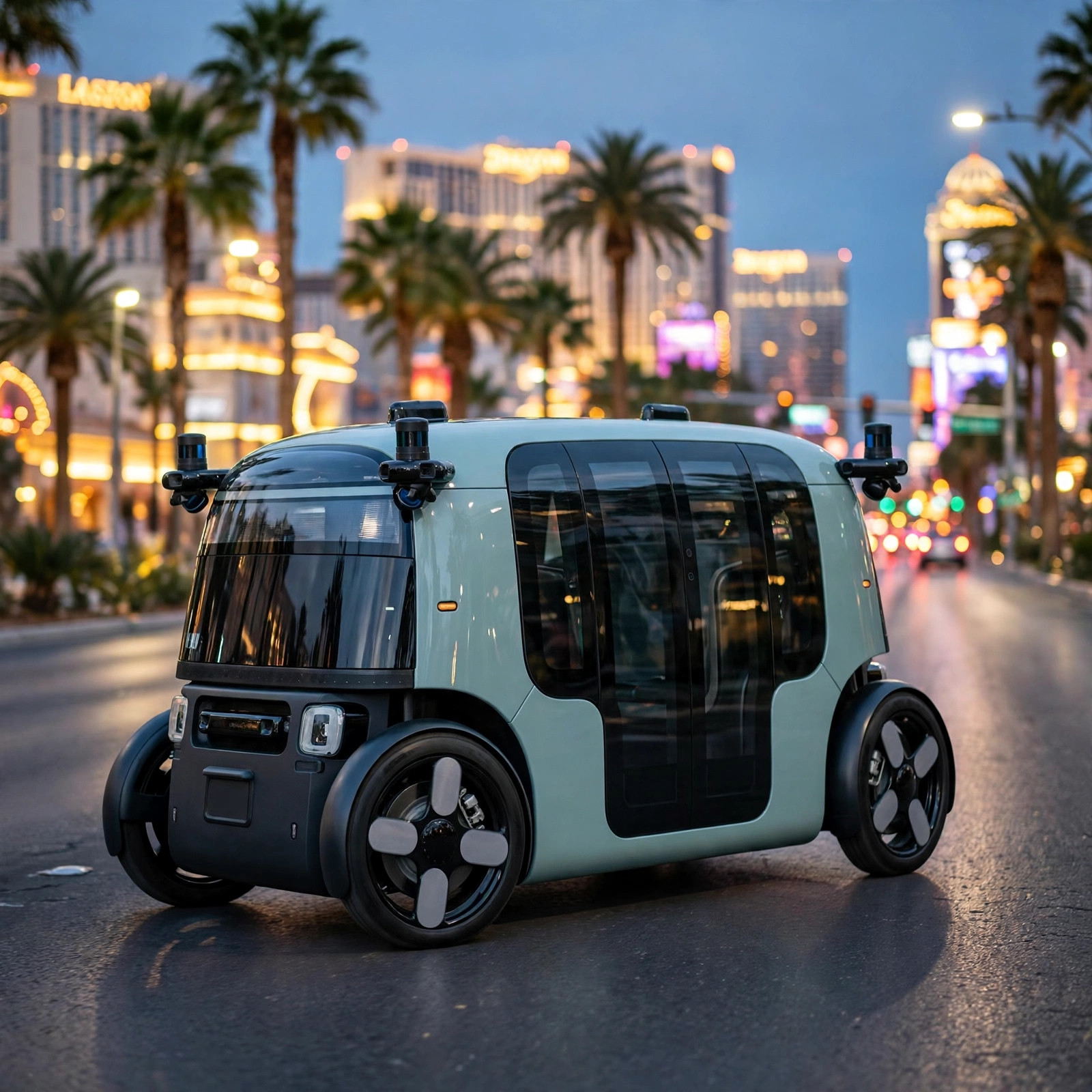
Hi, this is Datumdraft. Did you see the recent headlines claiming Amazon’s robotaxi unit is moving into Europe and Asia? If you live in London, Seoul, or Tokyo, you might wonder if a toaster-shaped, steering-wheel-free taxi will pick you up next year.
The reality behind the Zoox robotaxi expansion is much more cautious than the headlines suggest. On Wednesday, November 4, 2026, Zoox Chief Executive Officer Aicha Evans announced plans to start overseas testing at a Wall Street Journal technology conference.
However, Zoox is not sending its famous four-seat driverless shuttles overseas right now. Step one involves sending regular Toyota Highlander sport utility vehicles (SUVs) packed with sensors and human drivers to record local street data.
Furthermore, London, other European Union cities, South Korea, and Japan are currently on a target list rather than a confirmed launch schedule. Zoox has not shared a specific timeline or an overseas budget yet.
Common Myth vs. Fact Check (November 2026)
Myth: Amazon’s Zoox is starting driverless passenger rides in London, South Korea, and Japan using its steering-wheel-free robotaxis.
Fact: Step one of the Zoox robotaxi expansion sends human-driven Toyota Highlanders with sensors to map foreign roads. London, South Korea, and Japan are target candidates with no set launch dates.
Zoox robotaxi expansion step one: why Toyota Highlanders go before driverless pods
The first phase of the Zoox robotaxi expansion focuses entirely on street mapping with human drivers, not passenger service. Before a computer can drive a car safely in a foreign country, it must learn how local traffic actually moves.
Zoox is famous for its purpose-built vehicle. A purpose-built vehicle is a machine designed from scratch for one specific job, rather than modifying a regular family car.
The custom Zoox shuttle has no steering wheel, no brake pedals, and no front or back. Four passengers sit facing each other, and the vehicle can drive in both directions.
Yet this custom shuttle stays in the United States for now. For its initial overseas push, Zoox is shipping retrofitted Toyota Highlander SUVs to Europe and Asia.
These SUVs carry rooftop cameras, radar, and LiDAR units. LiDAR stands for Light Detection and Ranging, which is a laser sensor that measures the exact distance to nearby objects to build a 3D map of the street.
Think of this step like studying for a driving test in a foreign country. If you move from Nevada to London or Seoul, you do not jump straight onto a busy highway blindfolded.
First, you sit in a regular car, look at the unfamiliar road signs, measure the narrow alleys, and watch how local drivers merge. Human drivers in the Toyota Highlanders will drive around all day to write this digital textbook for the Zoox artificial intelligence software.
Zoox follows this exact two-step playbook whenever it enters a new American city. Only after the software masters the local road rules from the Highlander data does Zoox bring in the steering-wheel-free shuttles.
London, South Korea, and Japan: target candidates versus confirmed launch cities
The overseas places named by Zoox are priority research targets, not confirmed commercial markets with approved government permits. Readers should separate a company’s wish list from an official opening date.
Think of the difference between a target market and a confirmed launch like browsing travel brochures versus holding a boarding pass. Right now, Zoox is picking which countries to study next, rather than selling tickets to passengers.
During her November 4 presentation, Aicha Evans noted that the overseas target list includes London, cities across other European Union nations, South Korea, and Japan. Several blogs immediately listed these locations as upcoming robotaxi hubs.
However, Zoox has not announced when the Toyota Highlanders will land in each country. The company also kept its international expansion budget private.
Why these specific overseas markets matter for autonomous driving
Training an autonomous driving system only on wide, grid-style American roads creates blind spots. American cities like Las Vegas or Phoenix have broad lanes and predictable intersections.
In contrast, London and Japan require driving on the left side of the road. That single rule flips how a vehicle approaches every turn, roundabout, and crosswalk.
Meanwhile, South Korea and European Union cities feature dense urban layouts, medieval street curves, and heavy scooter and pedestrian traffic. By gathering sensor data in London, Seoul, and Tokyo, Zoox forces its software to handle the hardest driving environments on Earth.
Where you can actually ride Zoox today: inside the 150-vehicle U.S. fleet
Las Vegas is currently the only city in the world where regular passengers can pay to ride a steering-wheel-free Zoox robotaxi. While overseas plans remain in the preparation stage, Zoox has spent the second half of 2026 turning its American operations into a commercial business.
According to Aicha Evans on November 4, 2026, Zoox currently operates about 150 custom robotaxis in the United States. Most of these vehicles serve Las Vegas and San Francisco, while test fleets gather data across a dozen American locations.
The July 2026 federal exemption that unlocked paid rides
For years, federal rules blocked Zoox from charging money cleanly. Old safety rules were written decades ago under the assumption that every car has a human driver’s seat, a steering wheel, and foot pedals.
On July 30, 2026, the National Highway Traffic Safety Administration (NHTSA), which is the U.S. federal agency that sets vehicle safety rules, granted Zoox a landmark commercial exemption. It was the first commercial exemption in U.S. history for a custom vehicle built without driving controls.
Ten days later, on August 10, 2026, Zoox began charging fares for rides in Las Vegas. On September 3, 2026, Zoox expanded its Las Vegas service by adding passenger pickup and drop-off at Harry Reid International Airport.
San Francisco works differently right now. In San Francisco, Zoox runs its custom robotaxis through the Zoox Explorers Program.
Rides in San Francisco are completely free, and riders must join a public waitlist to get access. It is an active public testbed, not a paid commercial market yet.
The Uber partnership: hail a Zoox in Las Vegas starting late November 2026
The biggest near-term boost for passenger access was announced on the exact same day as the overseas news. On November 4, 2026, Uber held its third-quarter 2026 earnings conference call.
During that call, Uber revealed that Zoox robotaxis will officially launch on the Uber app in Las Vegas later in November 2026. Instead of downloading a separate Zoox app, Las Vegas riders will be able to match with a Zoox shuttle directly through Uber.
Uber also clarified the sequence for its other Las Vegas partner, Motional. Shortly after Zoox goes live on the Uber app in November, Motional will transition its Las Vegas vehicles on Uber to fully driverless operations.
These launches are part of a larger network goal shared on the November 4 earnings call. Uber expects to have approximately 700 fully autonomous vehicles operating across its global platform by the end of 2026.
By the end of 2027, Uber aims to scale that driverless fleet to more than 2,000 vehicles. That gives robotaxi builders like Zoox instant access to Uber’s 215 million monthly active platform consumers.
| Region / Market | Current Operating Status | Vehicle Type Used | Fare & Access Model | Key 2026 Milestones |
|---|---|---|---|---|
| Las Vegas, USA | Commercial driverless service | Purpose-built Zoox robotaxi (no steering wheel) | Paid public rides (Zoox app + Uber app in late Nov) | Aug 10 paid launch; Sept 3 airport access; late Nov Uber launch |
| San Francisco, USA | Public waitlist testing (Zoox Explorers) | Purpose-built Zoox robotaxi (no steering wheel) | Free rides only via public waitlist | Part of 150-vehicle U.S. fleet as of Nov 4, 2026 |
| London, EU, South Korea, Japan | Target list (Stage 1 preparation) | Toyota Highlander SUV with sensors and human driver | No passenger access (road mapping only) | Announced Nov 4, 2026 at WSJ Tech Live; timeline undisclosed |
Comparing the Zoox robotaxi expansion with Waymo in Madrid and Toronto
Even the most experienced autonomous driving companies take one to two years of local testing before carrying their first overseas passengers. Comparing Zoox with Alphabet’s Waymo shows why international expansion is a multi-year marathon.
Waymo is the largest robotaxi operator in the United States, yet it follows the exact same cautious script when crossing borders. Waymo does not drop driverless cars into foreign cities overnight.
Take Waymo’s expansion into Spain as an example. Waymo started with manual driving and local validation in Madrid, setting an official goal to welcome its first Madrid riders in 2027.
Some news summaries misquoted Waymo’s schedule as early 2027, but Waymo’s official Spain announcement simply states 2027. Precision matters when tracking regulatory approvals and safety validation.
Waymo is also expanding into Canada. In Toronto, Waymo began with manual driving and local testing, aiming to carry its first passengers in 2028.
Notice the pattern across both companies. If Waymo needs until 2027 in Madrid and 2028 in Toronto after starting manual mapping, Zoox’s custom robotaxis will also need substantial validation time after its Toyota Highlanders arrive in Europe and Asia.
Three questions to ask whenever you read robotaxi expansion news
Whenever a headline claims that robotaxis are coming to your city, check three simple points to see how close passenger service really is:
- Check the vehicle model: Is the company sending a regular SUV modified with roof sensors (like a Toyota Highlander) for road mapping, or a dedicated autonomous passenger vehicle?
- Check the driver’s seat: Is a human safety specialist sitting behind the wheel to take control, or is the vehicle running completely driverless?
- Check the booking method: Is the service limited to a free public waitlist (like Zoox in San Francisco), or can anyone hail a paid ride on demand via Uber or a public app (like Las Vegas)?
Key takeaways on the Zoox global roadmap
The Zoox robotaxi expansion announcement on November 4, 2026 marks a natural next step after a busy summer in the United States. In just four months, Zoox secured its July 30 NHTSA federal exemption, started paid Las Vegas rides on August 10, added Harry Reid International Airport access on September 3, and prepared to join the Uber app in late November.
While the first overseas vehicles will be human-driven Toyota Highlanders gathering street data rather than steering-wheel-free shuttles, naming London, South Korea, and Japan on its target list shows where Amazon’s autonomous mobility unit wants to compete next.
If you are planning a trip to Las Vegas from late November 2026 onward, open your Uber app to see if you can match with a custom Zoox robotaxi. And if you spot a sensor-rigged Zoox Toyota Highlander mapping streets in London, Seoul, or Tokyo, leave a comment below to share where you saw it. Bookmark this page to track future updates as official overseas timelines come out.
Sources
- Amazon’s Zoox Plans to Start Testing in Europe and Asia — The Wall Street Journal, November 4, 2026
- Amazon’s Zoox to test in Europe and Asia, eyeing London — Servospace, November 5, 2026
- Uber (UBER) Q3 2026 Earnings Call Transcript — The Motley Fool, November 4, 2026
- Uber Announces Results for Third Quarter 2026 — Uber Investor Relations, November 4, 2026
- Zoox Robotaxi Operations and Fleet Tracker — The Charge Port, 2026
- Robotaxi Status November 2026: Waymo, Tesla & Zoox — The Charge Port, October 25, 2026
- NHTSA Exempted Zoox From Eight Rules Written for a Driver’s Seat — The Weekly Driver, August 24, 2026
- Robotaxi Tracker: Where to Ride Driverless in 2026 — Modern Robotics & A.I., 2026
- Waymo in Spain: Madrid Autonomous Driving Expansion — Waymo Official Site, 2026
- Waymo in Canada: Toronto Autonomous Driving Expansion — Waymo Official Site, 2026