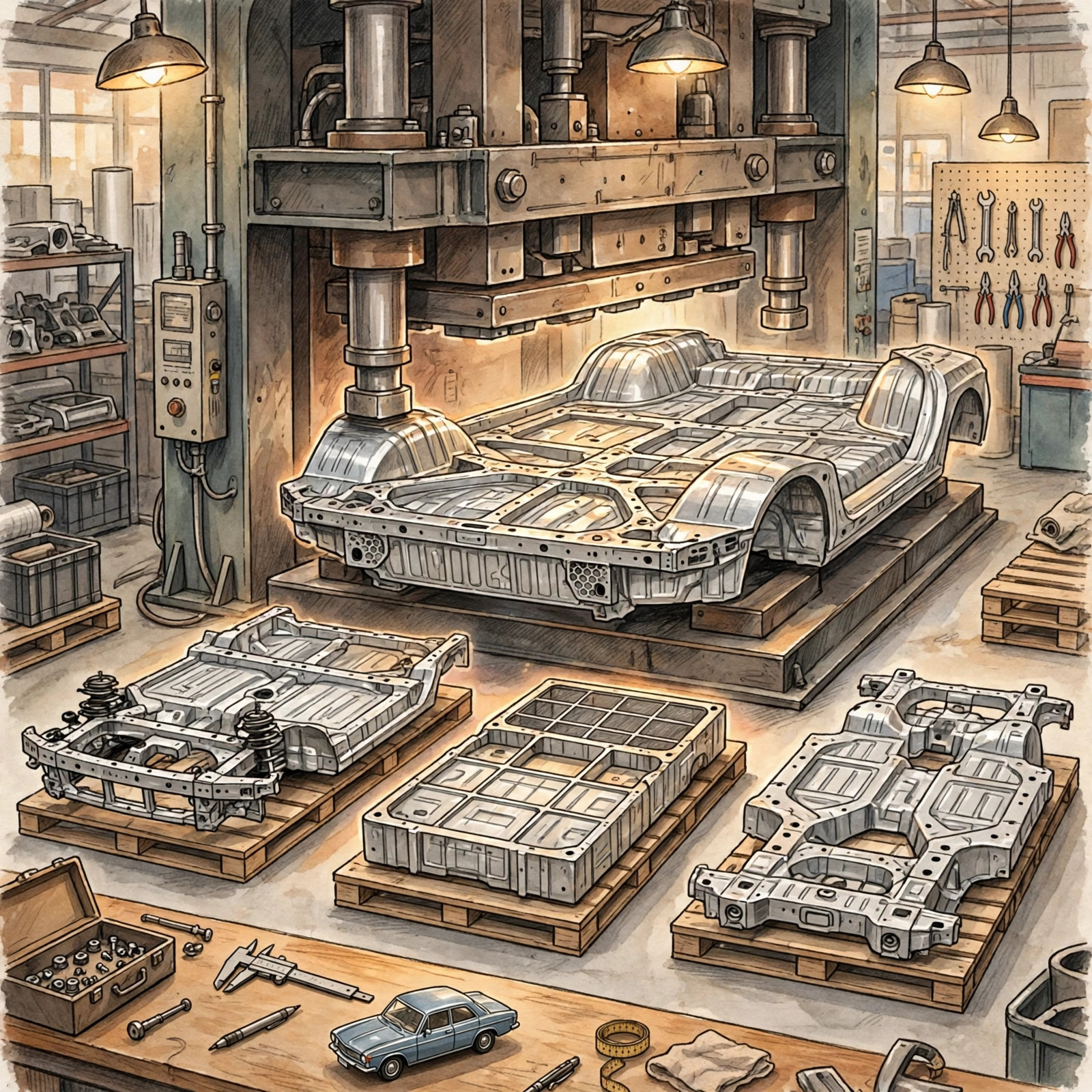
Hi, this is Datumdraft. If you ever flipped over a die-cast toy car like a Tomica or Hot Wheels when you were a kid, you probably noticed how the entire metal floor was formed in a single piece. Molten metal went into a steel mold, cooled down in seconds, and came out as a finished chassis. For over a century, real cars were built the exact opposite way. Automakers stamped hundreds of separate steel sheets and used rows of factory robots to spot-weld them together like a massive three-dimensional jigsaw puzzle.
When gigacasting entered the automotive world, the pitch was simple: why not stamp out full-scale car underbodies the same way we make toy cars? By injecting molten aluminum alloy into industrial high-pressure die-casting machines—known as Giga Presses, typically rated between 6,000 and 9,000 tons of clamping force—automakers could replace dozens of stamped metal parts with a single massive casting. Then the pushback started. Drivers and insurance analysts raised a frightening question: if the entire rear floor is one solid piece of cast aluminum, does a minor parking-lot fender bender mean the whole car has to be scrapped?
When word got out that Tesla had quietly backed away from casting an entire car floor in one piece, critics rushed to declare gigacasting a failed experiment. That reading misses what actually happened on the factory floor. Gigacasting did not fail; it matured into a standardized three-piece modular architecture. While Tesla locked in a front, center, and rear split to balance manufacturing risk, Toyota made an even more revealing move in 2026: it canceled its flagship Lexus LF-ZC electric sedan project, yet explicitly kept the gigacasting manufacturing system built for it. Even more surprising, multi-year European insurance crash testing has shown that a properly engineered gigacast rear end can actually cost less to repair than a traditional welded steel frame.
Replacing 70 Stamped Parts With One Shot of Molten Aluminum
To see why carmakers are so reluctant to walk away from high-pressure die casting, look at the rear underbody of the Tesla Model Y. In a conventional body shop, building the rear floor structure takes roughly 70 individual stamped steel and aluminum components. Each of those parts needs its own stamping dies, supply chain tracking, robotic sub-assembly cells, and structural adhesives or welds.
With a 6,000-ton to 9,000-ton Giga Press supplied by manufacturers like IDRA Group, molten aluminum alloy is shot into a mold at high velocity and held under immense pressure until it solidifies. Those 70 separate parts come out of the press as a single rear “mega cast.” To prevent a casting of that size from warping after it leaves the mold, engineers use specialized aluminum alloys formulated to reach structural strength and ductility without requiring a post-cast heat-treatment oven.
Why Tesla Halted Its One-Piece Underbody Plan and Locked In Three-Piece Casting
In May 2024, Reuters reported, citing two sources familiar with the matter, that Tesla had decided back in autumn 2023 to halt its push to cast an entire vehicle underbody in one piece. That single-piece hull had been envisioned as a centerpiece of Tesla’s “unboxed” manufacturing process for upcoming smaller vehicles. Although Tesla never officially confirmed or commented on the Reuters report, the news triggered a wave of headlines claiming that gigacasting had hit a dead end.
Looking at the physics of high-pressure die casting shows why stopping at three pieces was a pragmatic engineering decision rather than a retreat. When you cast a front or rear sub-frame separately, a 6,000-ton to 9,000-ton press can fill the mold cavity quickly enough for the molten aluminum to solidify evenly. If you try to cast the front sub-frame, the entire center floor, and the rear sub-frame in a single giant shot, the distance the liquid metal has to travel increases dramatically. As the molten alloy flows across a mold of that length, some zones begin to cool and solidify before other zones are completely filled, raising the risk of cold shuts, porosity, internal micro-cracks, and thermal distortion.
Furthermore, locking the entire underbody into a single die eliminates architectural flexibility. Adjusting wheelbase length or reconfiguring the floor for a different battery pack would require machining an entirely new, multi-million-dollar monolithic mold. Instead of chasing a risky single-piece floor, Tesla kept the proven three-piece formula already running on the Model Y and Cybertruck: a gigacast front section, a gigacast rear section, and a central aluminum-and-steel battery enclosure tying them together.
Toyota’s 2026 Paradox: Scrapping the Lexus LF-ZC While Keeping Gigacasting Alive
If you want proof that three-piece gigacasting is now a permanent fixture of automotive manufacturing, look at what Toyota did in the summer of 2026. Back at the October 2023 Japan Mobility Show, Toyota unveiled the Lexus LF-ZC (Lexus Future Zero-emission Catalyst) concept. It was billed as the spearhead of Toyota’s next-generation electric vehicle architecture, built around a three-module body with gigacast front and rear sections and a center-mounted battery pack. Originally slated for a 2026 launch, the LF-ZC was first delayed to mid-2027.
Then, in June 2026, Toyota Executive Vice President Hiroki Nakajima confirmed to Nikkei and Japanese media that development of the Lexus LF-ZC had been discontinued entirely. Why pull the plug on such a high-profile model? Reports pointed to two sets of pressures. Coverage in Nikkei and Electrek reported that the cost of molds and new production equipment for the specific LF-ZC program proved too high, while a Toyota spokesperson separately told Automotive News on June 1, 2026, that the cancellation reflected market-demand fluctuations and vehicle-planning workload.
Here is the critical detail that headlines missed: Toyota killed the car, not the casting technology. In the exact same June 2026 briefing, Nakajima emphasized that key technologies developed for the LF-ZC—”such as Gigacast, a new electrical and electronic platform for ADAS, and miniaturisation and weight reduction, have already been completed”—and confirmed that a successor vehicle will be developed using them, though its model name, specifications, and release window have not been disclosed.
How Gigacasting Fits Into Toyota’s Shanghai Lexus Plant
We can already see where Toyota’s completed Gigacast system is headed by tracking its wholly-owned Lexus electric vehicle plant in Jinshan District, Shanghai. Announced in February 2025 with a total investment of 14.6 billion yuan (approximately $2 billion USD, or 2.80 trillion KRW at November 2026 rates), the facility broke ground on June 27, 2025. According to China Daily, plant construction wrapped up in August 2026 ahead of a planned production start in August 2027, with an official nameplate capacity of roughly 100,000 vehicles per year.
However, Toyota is approaching that capacity with characteristic caution. On August 28, 2026, Nikkei reported (via CnEVPost) that when the Shanghai factory begins producing a new Lexus electric SUV in the second half of 2027, initial output will run at roughly 1,000 units per month—about 12,000 vehicles in its first year, or just 12% of the plant’s 100,000-unit annual capacity—before ramping up to tens of thousands of units per year from 2028 onward. Importantly, the Nikkei report noted that this Shanghai-built Lexus SUV will utilize Toyota’s Gigacast integrated die-casting technology. Canceling the LF-ZC while deploying Gigacast at a brand-new 14.6 billion yuan plant shows how Toyota separates individual vehicle styling cycles from core factory process engineering.
“One Rear-End Bump and It’s Totaled?” What Thatcham’s Crash Data Actually Found
The loudest criticism of gigacasting comes down to what happens after a collision. When a conventional mild-steel panel gets dented, a body shop technician can pull it back into shape on a frame machine or cut out the damaged bracket and weld in a new piece. Die-cast aluminum does not behave like stamped steel. Because of its crystalline grain structure and lower ductility, cast aluminum resists bending up to a threshold and then cracks or fractures. Attempting to heat and hammer a bent aluminum casting back into alignment degrades its structural integrity and crash-energy absorption.
Why Cast Aluminum Cannot Be Hammered Back Like Steel: Think of stamped mild steel like firm modeling clay—if it bends in a low-speed impact, a technician can pull and reshape it without destroying its core structure. High-pressure die-cast aluminum acts much closer to fired ceramic pottery. Under heavy impact, instead of stretching smoothly, it develops micro-fissures or snaps cleanly, and applying a standard welding torch alters the alloy’s temper around the weld zone. That is why manufacturer repair manuals require replacing a cracked structural casting or sectioning it only along factory-engineered joints using approved rivets and structural adhesives.
For years, that material behavior fueled fears that even a minor rear-end impact would force insurers to write off any gigacast EV. Then, on September 25, 2025, UK automotive risk intelligence organization Thatcham Research—working alongside UK insurance claims databases and the Allianz Centre for Technology (AZT) in Germany—published the results of a two-year physical crash, damage, and repair study on the Tesla Model Y’s single-piece aluminum rear mega cast.
The findings overturned the conventional wisdom. Comparing the Model Y’s single-piece cast aluminum rear against the traditional multi-part welded steel rear of the Tesla Model 3, Thatcham found that the gigacast Model Y was actually cheaper to repair in both partial and full replacement scenarios:
- 15 km/h Low-Speed Rear Impact: The Model Y’s rear mega cast suffered zero structural damage. All impact energy was absorbed by two bolt-on sacrificial rear crash rails mounted ahead of the casting. Those replaceable rear rails cost just £31 (approx. 55,000 KRW) each.
- 25 km/h Moderate Rear Impact: At this higher speed, impact forces reached the main casting and required a full mega-cast replacement. Even so, the replacement aluminum casting itself was priced at just £716 (approx. 1.27 million KRW), keeping the total claim cost competitive with conventional vehicles.
- Partial Rear Repair Savings: Partial replacement procedures on the Model Y mega cast averaged £2,167 (approx. 3.86 million KRW) cheaper than equivalent rear structural repairs on the multi-part steel Model 3.
- Full Rear Replacement Savings: Even when the entire Model Y rear mega cast had to be swapped out, the total job came in £519 (approx. 924,000 KRW) cheaper than replacing and welding the multi-part steel rear structure on a Model 3.
Why was the single-piece casting cheaper to fix than welded steel? In a traditional steel rear end made of 70 welded pieces, a 25 km/h crash crumples multiple overlapping panels. A body shop technician has to spend hours drilling out factory spot welds, aligning dozens of replacement brackets, and re-welding them one by one. With the Model Y, once the damaged rear casting is unbolted, separated at its factory joints, and swapped with a single £716 replacement unit, labor hours drop sharply.
Thatcham did highlight three essential caveats. First, these numbers apply specifically to the Model Y rear structure and cannot be blindly assumed for every future gigacast car. Second, any structural welding or sectioning on the mega cast must be carried out at Tesla-approved body facilities with trained technicians. Third, low repair costs depend entirely on smart upfront engineering—specifically designing £31 bolt-on crash rails to protect the casting in low-speed bumps and pricing the bare replacement casting reasonably.
Comparing the Three Underbody Manufacturing Approaches
To put the engineering trade-offs in one place, the table below compares conventional multi-part steel stamping, the halted single-piece underbody concept, and the three-piece modular gigacasting architecture now favored by both Tesla and Toyota.
| Comparison Metric | Traditional Stamping & Welding | One-Piece Underbody Casting | Three-Piece Modular Gigacasting |
|---|---|---|---|
| Rear Underbody Part Count | ~70 individual stamped components welded together (Model 3 benchmark) | Entire front, center floor, and rear integrated into 1 casting | 1 rear casting + 1 front casting + 1 central battery structure |
| Press Clamping Force | Standard mechanical/hydraulic stamping lines | Requires ultra-high tonnage beyond current 9,000T class | 6,000-ton to 9,000-ton class Giga Presses (e.g., IDRA Group) |
| Tooling & Defect Risk | Low per-part die risk; high cumulative weld complexity | Severe risk of uneven solidification, thermal warp, and inflexible wheelbase | Controlled flow distance; central module allows wheelbase flexibility |
| Low-Speed Crash Repair (15–25 km/h) | Panel pulling or spot-weld drilling; higher labor hours on multi-part rear | High risk of full-underbody replacement if impact bypasses crash rails | £31 (~55k KRW) bolt-on crash rails absorb 15 km/h hits; £716 (~1.27M KRW) rear casting at 25 km/h |
| 2026 Automaker Adoption Status | Legacy ICE and early-generation EV platforms | Halted by Tesla in autumn 2023 (per May 2024 Reuters report) | Active on Tesla Model Y & Cybertruck; retained by Toyota for post-LF-ZC models & H2 2027 Shanghai Lexus SUV |
Pre-Purchase Checklist for Drivers Shopping a Gigacast EV
Because Thatcham Research explicitly noted that low repair costs on the Model Y depend on vehicle-specific design choices and certified body shops, buyers should verify three practical details before signing for any EV built with large structural castings:
- Bolt-On Sacrificial Crash Box Architecture: Check whether the manufacturer places bolt-on steel or extruded aluminum crash cans between the bumper beam and the gigacast sub-frame. A £31 (~55,000 KRW) replaceable rail is what keeps a 15 km/h parking-lot bump from touching the main casting.
- Access to Manufacturer-Approved Structural Body Shops: Cast aluminum repairs require specialized self-piercing rivets, structural adhesives, and certified welding equipment. Confirm that an OEM-approved structural collision center operates within a reasonable distance of your home, and check the model’s specific insurance group rating with your carrier before taking delivery.
- Used EV Underbody Inspection Near Casting Mounts: When buying a pre-owned EV with gigacast sub-frames, ask for a lift inspection focused on the transition zones where the bolt-on crash rails meet the cast aluminum nodes, as well as the jacking points around the central battery enclosure, to rule out unrepaired hairlines from prior curb or tow-hook impacts.
Where the Three-Piece Compromise Leaves Buyers and Automakers
When you put the pieces together, the narrative around gigacasting looks very different from the extremes dominating social media feeds. Tesla did not abandon gigacasting when it shelved the single-piece underbody in autumn 2023; it simply recognized that a three-piece modular layout delivers the part-consolidation benefits of a 6,000-ton to 9,000-ton Giga Press without trapping the factory in high scrap rates or rigid wheelbase tooling. Toyota reached the exact same structural conclusion from the opposite direction—canceling the Lexus LF-ZC vehicle program in June 2026 while preserving its three-module Gigacast system for a successor model and preparing to roll out Gigacast production at its Shanghai Lexus facility starting in the second half of 2027.
At the same time, Thatcham Research and AZT have proved with hard crash data that a single-piece rear casting does not automatically mean sky-high insurance claims. When engineers pair a £716 (~1.27 million KRW) replacement rear casting with £31 (~55,000 KRW) bolt-on crash rails, repairing a gigacast rear end can beat the cost of fixing 70 welded steel parts on a Model 3 by £519 to £2,167. Before you order your next EV, take five minutes to check how its sub-frame is modularized and whether bolt-on crash cans stand between the bumper and the casting. How much weight do you give structural repairability and local body-shop access when comparing electric cars? Drop your thoughts in the comments below.
Sources
- Exclusive: Mega Cast Construction Saves on Vehicle Repairs, Study Finds — WardsAuto, September 5, 2025 (Thatcham Research two-year study)
- Lexus Killed Its Futuristic Sedan Before Launch, Then Immediately Approved A Successor — CarBuzz, June 26, 2026
- Lexus Killed Its Next EV Sedan, Then Approved Its Replacement The Same Day — Carscoops, June 25, 2026
- Reuters — Tesla drops one-piece underbody gigacasting, May 2024 (cited in the article; original article URL not independently confirmed)
- Nikkei via CnEVPost — BYD, NIO and Xiaomi gigacasting adoption, August 2026 (cited in the article; original article URL not independently confirmed)