Hi, this is Datumdraft.
A new passenger car rolls off the assembly line carrying 70 to 150 Electronic Control Units (ECUs) and several kilometers of bundled copper wire. Smartphones get thinner and lighter with every generation, yet cars keep gaining weight and electronic bulk. Why does a modern vehicle need a small data center worth of separate circuit boards just to move four wheels and run the cabin?
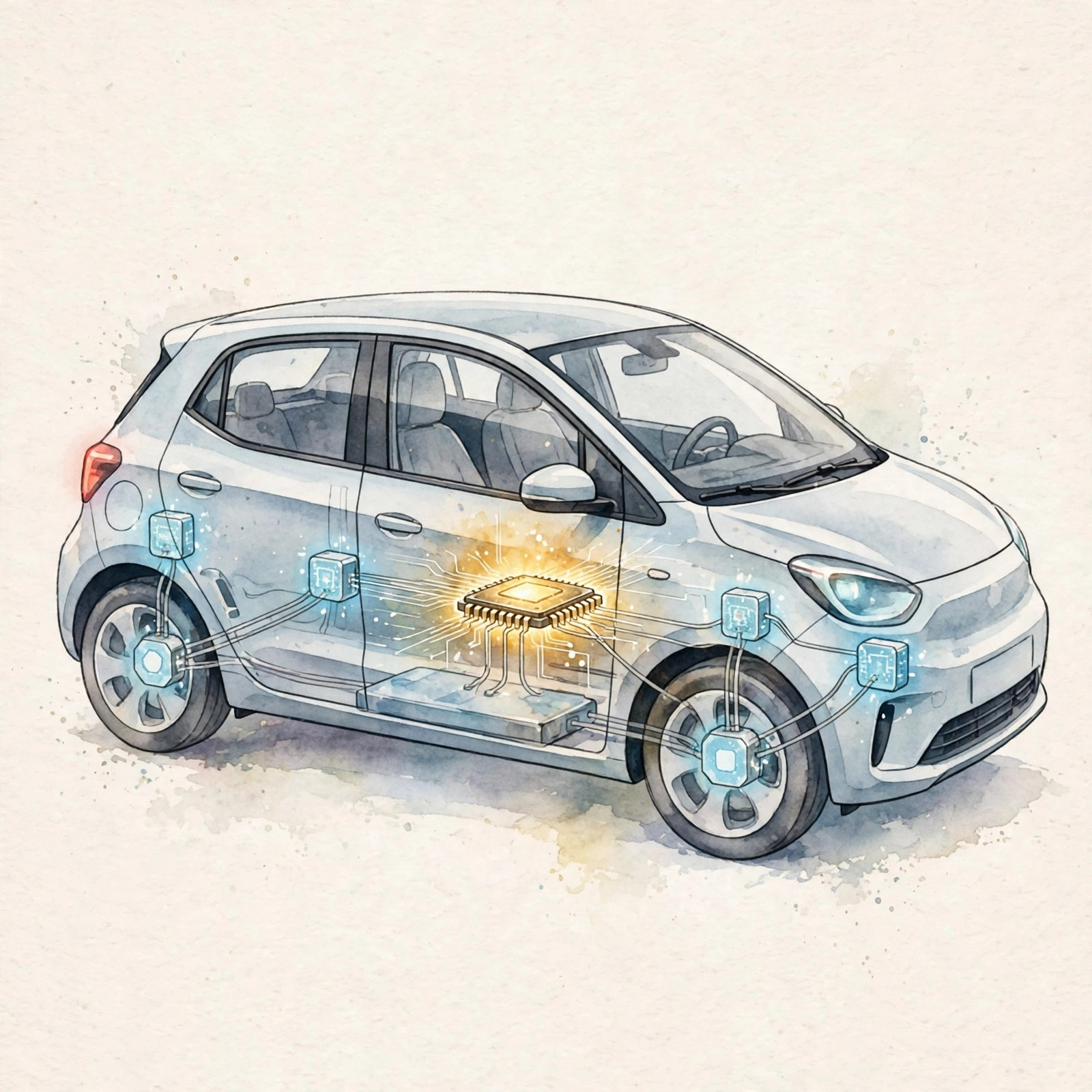
In late October and early November 2026 (official corporate release on October 26, 2026, ahead of the International Suppliers Fair in Wolfsburg), Volkswagen Group and NXP Semiconductors announced a strategic partnership to co-develop next-generation zonal vehicle architecture around the NXP S32K5 microcontroller (MCU) family. Zonal architecture divides a car into physical locations—front, rear, left, and right—so a handful of zone controllers manage all nearby hardware. This structural shift consolidates 70 to 150 legacy ECUs down to roughly 7 units and cuts wiring harness length by 30% to 50%.
Volkswagen will debut this hardware in 2027 inside its 20,000-euro entry-level electric hatchback, the ID. EVERY1. Rivian and Volkswagen Group Technologies (RV Tech), the joint venture between the two automakers, leads the system engineering and software integration.
- Hardware consolidation: Replacing 100 scattered ECUs with roughly 7 zonal controllers unlocks full-vehicle Over-The-Air (OTA) software updates.
- Silicon foundation: The 16nm NXP S32K5 chip acts as the regional brain inside each zone, combining real-time Arm cores with embedded Magnetic RAM (MRAM).
- Deployment roadmap: Mass production starts in 2027 with the affordable ID. EVERY1, then scales to Scout Motors, Audi, and Volkswagen Group’s Scalable Systems Platform (SSP).
1. Why the automotive nervous system became unmanageable
Legacy vehicle electronics grew by accretion rather than unified design. For decades, automakers operated under a domain architecture model. Whenever a car needed a new feature—heated seats, blind-spot radar, adaptive cruise control, or matrix LED headlights—the automaker bought a black-box ECU along with its dedicated wiring and software from a Tier-1 supplier like Bosch, Continental, or Valeo.
Think of it like renovating an apartment by hiring a different electrician for every single appliance. If you run a separate copper cable from the main breaker box in the basement to the living room ceiling fan, another cable to the air conditioner, and a third to the wall sconce, the walls quickly fill up with copper. Premium vehicles now carry over 100 individual ECUs. The wiring harness connecting them stretches roughly 5 kilometers and weighs 40 to 60 kilograms—making the copper bundle the third-heaviest component in an electric vehicle after the battery pack and the body-in-white chassis.
This legacy wiring scheme now hits three hard walls simultaneously:
- Physical weight penalty: Every extra kilogram of copper reduces battery electric range. When Rivian redesigned its R1 platform for Generation 2, shifting from 17 ECUs to 7 zonal controllers stripped out 1.6 miles (2.6 kilometers) of wiring and shed 44 pounds (20 kilograms) of dead weight.
- Manufacturing and supply chain cost: Designing, validating, purchasing, and stocking 100 distinct microcontrollers across dozens of suppliers creates massive procurement overhead. During Volkswagen Group’s Q3 2026 earnings call on October 28, 2026—where 9-month operating profit before special items stood at 8.8 billion euros (a 3.8% operating margin) on Q3 revenue of 75.28 billion euros—management emphasized a 31-billion-euro cost reduction program. Hardware simplification is a primary lever in that turnaround.
- The software integration wall: When 100 ECUs run different real-time operating systems written in incompatible dialects by 40 different Tier-1 vendors, pushing a clean over-the-air software update becomes a logistical nightmare. Updating the braking controller risks breaking handshake protocols with the dashboard cluster.
| Metric / Dimension | Legacy Domain Architecture | Next-Gen Zonal Architecture |
|---|---|---|
| Organizing Principle | Grouped by function (Powertrain, ADAS, Body, Infotainment) regardless of physical location | Grouped by physical location in the vehicle (Front-Left, Front-Right, Rear, Cabin zones) |
| ECU Count per Car | 70 to 150 separate ECUs | Roughly 7 zonal controllers + central compute unit |
| Wiring Harness Length | Up to 5 km of point-to-point copper cables (40 to 60 kg) | Reduced by 30% to 50% (~1.6 to 2.6 km cut; ~20 kg lighter) |
| Software & OTA Model | Fragmented Tier-1 firmware; partial or dealer-only updates | Unified OEM software stack; full-vehicle overnight OTA |
| Representative Vehicles | Legacy ICE models, first-gen EVs (early MEB platform) | Tesla Model 3/Y/Cybertruck, Rivian R1 Gen 2, VW ID. EVERY1 (2027) |
Section takeaway: Domain architecture buried cars under 5 kilometers of copper wire and 100 incompatible computers, forcing Volkswagen to rebuild its electrical nervous system around physical zones.
2. Dissecting the NXP S32K5: The regional brain of the zonal car
To replace dozens of single-purpose chips with one local hub, the silicon inside that hub has to handle vastly different workloads at once without lagging. On October 26, 2026, Volkswagen Group confirmed that it selected NXP Semiconductors’ S32K5 microcontroller family as the foundational building block for its future zonal software-defined vehicle (SDV) architecture.
First unveiled by NXP in March 2025 as part of its CoreRide platform, the S32K5 is the automotive industry’s first 16nm FinFET microcontroller equipped with embedded Magnetic RAM (MRAM). Before looking at the silicon blocks, let us define three core engineering terms in plain English:
- MCU (Microcontroller Unit): A compact, self-contained computer on a single chip designed to execute real-time physical commands—like firing a window motor or reading a brake pedal sensor—within microseconds.
- Zonal Controller: A regional manager box mounted in a specific corner of the car. It gathers sensor signals from its immediate neighborhood (doors, lights, suspension, wipers) and talks to the central computer over a single high-speed data cable.
- E/E Architecture (Electrical/Electronic Architecture): The master blueprint governing how power and data flow through every wire, sensor, switch, and processor inside a vehicle.
Why embedded MRAM matters on the factory floor
Most readers skip past memory specifications, yet embedded MRAM (Magnetic Random-Access Memory) is one of the primary operational reasons Volkswagen chose the S32K5. Traditional automotive microcontrollers store code in embedded NOR Flash memory. When you shrink chip transistors below 28nm down to 16nm, conventional Flash becomes expensive and difficult to manufacture reliably because it requires high voltage to erase memory cells before writing new data.
MRAM stores data using magnetic orientation rather than electrical charge. It keeps data when the power turns off, just like Flash, but it does not require an erase cycle before writing. Writing software to MRAM is more than 15 times faster than writing to traditional automotive Flash. On a high-volume assembly line building hundreds of thousands of cars a year, flashing gigabytes of firmware into vehicle controllers takes valuable minutes per station. Faster memory write speeds directly reduce factory end-of-line programming bottlenecks. For the car owner, that same speed translates into rapid overnight OTA updates that finish in minutes rather than locking the vehicle for an hour.
The 3 core missions of the NXP S32K5 inside a Volkswagen zone:
1. Local device aggregation: Directly drives motors, lighting, HVAC valves, locks, and suspension actuators in its physical corner using up to six Arm Cortex-M7 (200 MHz) and dual Cortex-R52 (800 MHz) cores.
2. High-speed protocol translation: Gathers slow legacy signals (CAN FD, CAN XL, LIN) and packs them onto a 10BASE-T1S and 2.5 Gbps Time-Sensitive Networking (TSN) automotive Ethernet backbone connected to the central computer.
3. Fail-operational safety isolation: Enforces hardware-level walls (ISO 26262 ASIL D) so a glitch in a comfort feature like ambient lighting can never interfere with steering or braking commands running on the same chip.
Why NXP instead of Infineon or Renesas?
Automotive engineers frequently ask how NXP’s S32K5 compares against Infineon’s AURIX TC4x family (which uses TriCore processors and embedded RRAM) or Renesas’s RH850. All three chips withstand brutal automotive environments: junction temperatures from -40 degrees Celsius to +150 degrees Celsius, constant chassis vibration, electromagnetic interference, and a mandatory 15-year operational lifespan.
The deciding factor here is software architecture alignment with RV Tech. The S32K5 runs on standard Arm Cortex-M and Cortex-R instruction sets, matching the Arm-based development toolchains, RTOS environments, and Sonatus/Elektrobit middleware stacks that modern software engineers already use. Furthermore, NXP’s integrated Ethernet switches and hardware network accelerators allow RV Tech engineers to route zone traffic without writing complex custom packet-handling code from scratch.
Section takeaway: The 16nm NXP S32K5 packs Arm real-time cores, 2.5 Gbps Ethernet, and fast-writing MRAM onto a single ASIL D die, letting one regional controller safely absorb the jobs of 15 legacy ECUs.
3. RV Tech and the $5.8 billion software shortcut
A zonal chip is useless without a unified operating system to command it. For years, Volkswagen Group struggled to unify software internally through its CARIAD division, resulting in delayed launches for the Porsche Macan EV and Audi Q6 e-tron. To break that bottleneck, Volkswagen committed up to $5.8 billion (roughly 8 trillion KRW) in 2024 to form its joint venture with Rivian: Rivian and Volkswagen Group Technologies, or RV Tech.
While CARIAD now focuses on maintaining existing software architectures (1.1 and 1.2) and specific cloud/ADAS functions, RV Tech owns the clean-sheet zonal E/E architecture and vehicle software platform (OS, OTA pipeline, and zonal hardware design) for all future Volkswagen Group and Rivian models. Notice how the supply chain hierarchy flipped: instead of asking a Tier-1 supplier to design a controller and pick whatever chip they prefer, Volkswagen and RV Tech specified the NXP S32K5 architecture directly and handed the blueprint to manufacturing partners.
The paradox of 2027: Why debut cutting-edge silicon in a €20,000 budget car?
Traditionally, automakers introduce new electrical architectures in flagship luxury sedans like the Mercedes-Benz S-Class or Audi A8, then let the technology trickle down to compact cars over a decade. Volkswagen is doing the exact opposite. The very first production vehicle to run the RV Tech zonal architecture and NXP S32K5 silicon will be the 2027 Volkswagen ID. EVERY1—an entry-level city electric car priced around 20,000 euros (roughly 31 million KRW).
From a systems engineering standpoint, starting at the bottom of the lineup solves two problems at once:
- Controlled complexity validation: A flagship luxury SUV has air suspension, rear-wheel steering, 30-way massage seats, and LiDAR arrays. Debugging a brand-new software stack on a vehicle with that many actuators invites delays. The ID. EVERY1 has a simple feature set, allowing RV Tech to deploy a streamlined single-zone-controller configuration first, iron out core operating system bugs in mass production, and then scale up to multi-zone configurations for Scout Motors (the Traveler SUV and Terra pickup truck in 2027) and Audi (from 2028 onward).
- Survival unit economics in small EVs: Making a profit on a 20,000-euro electric car in Europe is nearly impossible using a legacy domain harness and 80 separate ECUs. Stripping out dozens of control boxes and kilometers of copper wire is the only way the ID. EVERY1 can hit its target retail price without losing money on every unit sold.
| Driver Experience Shift | How It Worked in Legacy Domain Cars | How It Works with S32K5 Zonal Architecture |
|---|---|---|
| 1. Overnight Feature Upgrades | Updates limited to infotainment screens; chassis or battery tweaks required a dealership visit | MRAM-backed zonal controllers flash brake, thermal, and body firmware overnight via Wi-Fi or 5G |
| 2. Electrical Reliability | Hundreds of physical pin connectors and splices created frequent intermittent sensor faults | 30% to 50% fewer wires and fewer connector plugs drastically reduce wiring contact failures |
| 3. Modular Repair & Diagnostics | Mechanics tore apart dashboards to trace broken wires or hunt down one of 100 hidden ECUs | Software isolates faults to a specific regional hub; technicians swap a standardized zonal module |
| 4. Real-World EV Driving Range | Carrying 50 kg of copper wiring and dozens of metal ECU housings drained battery efficiency | Shedding ~20 kg of harness mass and consolidating power management extends range per kWh |
| 5. Five-Year Resale Value | Vehicle felt dated within 3 years as fixed-function hardware locked out new digital features | Software-defined power and body controls gain new driving modes and UI features years after purchase |
Section takeaway: By launching RV Tech’s zonal stack in the 20,000-euro ID. EVERY1 in 2027, Volkswagen validates its new software foundation on a simple vehicle while unlocking the cost savings needed to make budget EVs profitable.
4. Financial and valuation context: NXP, Volkswagen, and Rivian in late 2026
For technology and mobility investors tracking this partnership, the October 2026 announcement connects directly to the financial trajectories of all three companies. Following the October 26 partnership news and its Q3 2026 earnings release on October 27, NXP Semiconductors demonstrated why automotive silicon suppliers with sticky platform wins command resilient margins even when legacy automakers face margin compression.
In Q3 2026 (quarter ended September 27, 2026), NXP posted revenue of $3.79 billion, up 19.3% year-over-year, with Automotive segment revenue rising 12.7% year-over-year and GAAP gross margin reaching 57.8% (Non-GAAP gross margin guided to 59.0% for Q4 2026). Even though a zonal car uses fewer total chips than a 100-ECU domain car, the Average Selling Price (ASP) of a complex 16nm S32K5 zonal processor paired with NXP’s FS25 safety power management IC and Ethernet transceivers is substantially higher than the 8-bit and 32-bit commodity microcontrollers it replaces.
Section takeaway: Consolidating 100 ECUs into 7 S32K5-powered zonal hubs raises NXP’s silicon value per car while giving Volkswagen and Rivian the structural cost savings needed to compete in 2027.
5. Three takeaways and what to watch next
Stepping back from the circuit diagrams, Volkswagen and NXP’s partnership comes down to three structural shifts in how cars are built:
- From 100 scattered boxes to 7 regional managers: Grouping electronics by physical zone rather than functional domain cuts kilometers of copper wire, drops 20 kilograms of dead weight, and enables full-vehicle OTA updates.
- NXP S32K5 as the hardware anchor: Combining 16nm Arm real-time cores, embedded MRAM, multi-gigabit automotive Ethernet, and ASIL D safety isolation on one chip makes physical ECU consolidation possible without sacrificing safety or factory line speed.
- The 2027 ID. EVERY1 proving ground: Launching RV Tech’s zonal architecture first on a simple 20,000-euro compact EV de-risks the software before scaling across Scout Motors, Audi, and 30 million SSP platform vehicles.
If you follow the mobility and semiconductor sectors, watch the real-world winter test results and pre-production teardowns of the Volkswagen ID. EVERY1 and Scout Motors prototypes entering series production in 2027. Bookmark this page or subscribe to DatumDraft to track our upcoming hardware breakdowns. If you are planning to buy a new EV in 2027 or 2028, check whether the model runs on a legacy domain harness or a true zonal architecture—and drop a comment below if you want to know which architecture your target car uses.
In our next analysis, we will compare the architectural blueprints of the three primary zonal contenders side by side: “Tesla vs. Rivian vs. Volkswagen: Comparing Three Zonal Architecture Design Philosophies.”
Sources
- Volkswagen Group Strengthens its Strategic Semiconductor Ecosystem Through Partnership with NXP — NXP Semiconductors, October 26, 2026
- New S32K5 Microcontroller Family Advances Zonal SDV Architectures and Extends the NXP CoreRide Platform — NXP Semiconductors, March 11, 2025
- VW and Rivian advance zonal SDV architecture — Automotive Digital Transformation, November 19, 2025
- NXP Semiconductors 3Q 2026: Revenue $3.79B, EPS $3.48 — 10-Q Summary — TradingView, October 27, 2026
- RIVIAN ($RIVN) Releases Q3 2026 Earnings, Stock Rises — Moomoo, October 30, 2026