Hi, this is DatumDraft.
Most drivers treat an electric vehicle like a giant smartphone on wheels. If a phone battery wears out, a technician pops open the back cover and swaps in a fresh unit. Many people assume that if one tiny battery piece inside an electric car goes bad, a mechanic can simply open the box and replace that single piece.
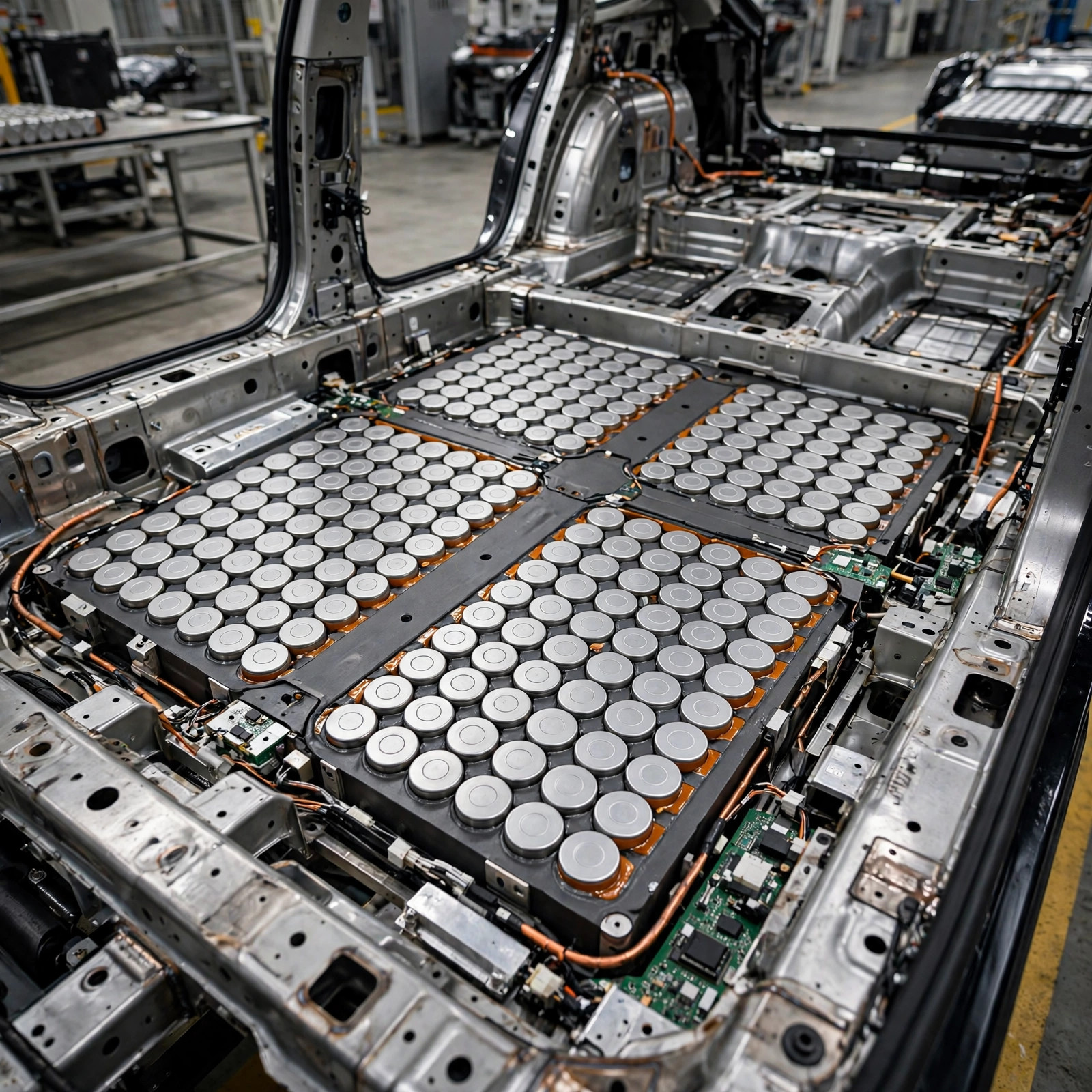
Modern electric car engineering has quietly killed that repair option. Automakers now glue thousands of battery cells directly into the structural floor of the vehicle to save weight and cabin space. When the battery becomes the physical floor you sit on, pulling out one broken cell is almost impossible.
An EV battery management system (BMS) is the electronic brain that monitors individual cell voltage and temperature, balances cell charges, estimates State of Charge (SoC) and State of Health (SoH), enforces safe charge and discharge limits, and contains thermal runaway. In modern Cell-to-Body (CTB) and structural battery architectures, cells are permanently bonded into the load-bearing floor of the car. Because individual cell replacement is nearly impossible in these packs, the EV battery management system acts as the primary guardian preventing a single weak cell from disabling the entire vehicle.
From Cargo to Chassis: The Day the Battery Became the Floor
Electric vehicle batteries started out as heavy cargo bolted underneath the frame, but automakers gradually stripped away internal packaging until the battery pack merged with the car floor itself. This structural shift created longer driving range and stiffer cars while completely changing how batteries age and fail.
Think of an older electric car battery like a set of Russian nesting dolls. Tiny battery cells sat inside metal boxes called modules. Several modules sat inside a massive protective tray called a battery pack, and workers bolted that heavy pack underneath the car body.
All those nested boxes wasted valuable room. Every extra wall of metal and plastic added dead weight that did not store a single watt of electricity. Engineers realized they could throw away the middle doll to pack more energy into the same footprint.
This first leap is called Cell-to-Pack (CTP), a design method that skips intermediate modules and places battery cells directly inside the main battery case. Chinese battery giant CATL pioneered the CTP concept. Soon after, BYD debuted its flat, long Blade Battery in a CTP layout inside the Han EV in June 2020.
Engineers soon looked at the top lid of the battery pack and the metal floor of the passenger cabin right above it. Having two separate sheets of metal stacked on top of each other felt redundant. Removing that boundary gave birth to Cell-to-Body (CTB) and Cell-to-Chassis (CTC) architectures, where the upper cover of the battery pack doubles as the structural floor of the car body.
BYD launched its CTB architecture in May 2022 on the BYD Seal, the first model built on its e-Platform 3.0 using Blade Batteries. According to BYD company claims, integrating the battery into the body pushed vehicle torsional stiffness past 40,000 Nm/degree. Torsional stiffness measures how hard it is to twist a car frame during sharp cornering, and BYD reported this figure was roughly 70% higher than conventional designs.
BYD also stated in its company claims that CTB increased internal pack volume utilization to 66%. In addition, BYD reported that the integrated floor reduced cabin intrusion during side-impact crashes by 45%. Note that these performance figures come directly from BYD company announcements rather than independent testing agencies.
Tesla took an even more aggressive path starting in 2022 with the Model Y built at Giga Texas. Tesla used cylindrical 4680 cells, which measure 46 millimeters wide by 80 millimeters tall and use a Nickel Manganese Cobalt (NMC) chemistry. Workers bonded these cells together into a rigid structural slab that sits directly between the front and rear megacastings, carrying road loads as part of the chassis.
Despite the headlines, turning a battery into a load-bearing floor is extremely hard to pull off on an assembly line. According to a 2024 ResearchAndMarkets report, only four automakers had actually launched production vehicles using CTC or CTB architectures at that time: Tesla, BYD, Leapmotor, and XPeng. That 2024 snapshot shows just how rare and demanding true structural battery engineering remains.
The One-Way Ticket: Why Structural Batteries Do Not Forgive Mistakes
Making the battery pack carry the weight of the car boosts safety and stiffness, but it creates a massive trade-off: you can no longer repair individual battery cells. Once those cells are sealed into the chassis, a single dead cell can force a full battery pack replacement.
To help a battery pack survive potholes, curb strikes, and highway crashes, factories cannot just set the cells loosely inside a tray. Workers pump tough structural glue and rigid polyurethane foam into every tiny gap between the cells. Once that chemical adhesive cures, the battery cells, cooling plates, and floor metal become one solid brick.
Independent vehicle teardowns of structural battery packs highlight the harsh reality of this design. Engineers who cut open these packs report that chiseling through rock-hard structural foam to pull out one faulty cell is nearly impossible without destroying neighboring cells or bending cooling tubes. Replacing a single degraded cell in a structural pack is effectively equivalent to replacing the entire battery pack.
If mechanics cannot open the floor with wrenches to fix a weak cell, the car needs an internal guardian that stops any cell from failing early. That invisible guardian is the EV battery management system.
Enter the Battery Management System: 5 Invisible Jobs Keeping the Floor Alive
Inside a sealed structural battery pack, the EV battery management system runs five continuous software and hardware tasks to keep every cell aging at the exact same pace. Without these five controls, minor manufacturing differences between cells would quickly ruin the pack.
1. Per-Cell Voltage and Temperature Monitoring
An electric car battery pack contains hundreds or even thousands of individual cells working together. The EV battery management system acts as a nervous system, checking the exact voltage and surface temperature of cells many times every second.
If a single cell starts running hotter than its neighbors or drops voltage unexpectedly, the BMS spots the anomaly right away. Catching tiny electrical drifts early is the only way to prevent permanent chemical damage inside a sealed floor.
2. Cell Balancing and the Law of the Weakest Link
Battery cells in an electric car are wired together in long chains to build up high voltage. Because of this chain layout, the entire battery pack is only as strong as its weakest single cell.
Imagine a wooden bucket made of vertical wooden slats bound together. If 99 slats are two feet tall, but one slat is broken down to six inches, you can only fill the bucket six inches high before water spills out. That old wooden stave rule explains how a battery pack behaves.
When you charge the car, the BMS must stop charging the entire pack the moment the fullest cell hits 100% to prevent a fire. When you drive, the BMS must shut down the car the moment the emptiest cell hits 0% to prevent permanent damage. Cell balancing is the process where the BMS drains tiny amounts of energy from fuller cells or shifts energy between cells so every slat in the bucket stays at the exact same height.
Why One Lazy Cell Ruins the Whole Floor
In a series-connected battery pack, charging stops the instant the first cell hits 100%, and driving stops the instant the weakest cell hits 0%. Even if 99% of your battery cells are healthy, a single degraded cell traps usable energy inside the rest of the pack and cuts your driving range. Every night while your car sits parked, the BMS performs cell balancing to level out these tiny voltage gaps and keep that one lazy cell from bricking the vehicle.
3. State of Charge (SoC) and State of Health (SoH) Estimation
A gasoline tank has a physical plastic float inside that rises and falls with the fuel level. A lithium-ion battery has no moving parts inside, so you cannot physically measure remaining electricity with a ruler.
Instead, the BMS calculates two critical numbers using complex math models. State of Charge (SoC) is the percentage of usable energy left in your battery right now, acting as your dashboard fuel gauge. State of Health (SoH) measures how much total energy the battery can hold today compared to when it was brand new at the factory.
4. Charge and Discharge Limits
When you plug into a highway fast charger or floor the accelerator pedal on an icy morning, raw electricity wants to rush in or out of the cells at violent speeds. Pushing high current into a freezing battery causes lithium metal to build up on the internal surfaces in spiky crystals, a destructive process called lithium plating.
The BMS acts as a strict traffic cop for electrical current. It constantly adjusts the maximum allowed charging and discharging power second by second based on cell temperature and current health. When your car charges slower on a cold winter day, that is the BMS protecting your structural floor from permanent internal scarring.
5. Thermal-Runaway Containment
Thermal runaway is a dangerous chain reaction where an overheated battery cell generates its own heat faster than it can cool down, leading to fire. If a road hazard pierces the bottom of the car or an internal short circuit happens, seconds matter.
The BMS is the first line of defense against thermal runaway. The moment its sensors detect an abnormal pressure drop, voltage collapse, or temperature spike, it slams open the main high-voltage switches to cut off power, commands the cooling pumps to run at maximum speed, and alerts the driver to exit the vehicle safely.
Cutting the Cord: Why Wireless BMS Is the Missing Puzzle Piece
Stuffing more battery cells directly into the car floor created a massive wiring headache inside the pack, pushing automakers toward wireless battery management systems. Removing copper sensor wires makes structural batteries safer, smaller, and less likely to fail from road vibrations.
Think about the irony of a tightly packed Cell-to-Body battery. Engineers worked hard to remove metal module walls so they could fit more battery cells inside. Yet every single cell group still needed copper wires running back to the central BMS computer to report voltage and temperature.
A traditional wiring harness snakes across the top of the cells like a thick nest of spaghetti. Those wires eat up valuable space, add weight, and create dozens of fragile plug connectors. Worse, inside a structural floor that absorbs every bump in the road for 15 years, a single snapped sensor wire can blind the BMS and disable the car.
The breakthrough arrived earlier than most drivers realize. Back in September 2020, semiconductor maker Analog Devices (ADI) announced the industry’s first Wireless BMS (wBMS), which debuted in production on General Motors’ Ultium electric vehicle platform. Rather than a recent 2026 experiment, wireless battery monitoring is a proven milestone introduced in 2020.
Instead of routing copper cables to every group of cells, each cell section gets a tiny wireless radio chip that beams voltage and temperature readings directly to the main controller. According to Analog Devices and GM company claims, switching to a wireless BMS eliminates up to 90% of internal pack wiring and saves up to 15% of internal battery pack volume.
Furthermore, ADI and GM stated that this wireless network meets ASIL-D (Automotive Safety Integrity Level D), which is the strictest automotive functional safety standard in the industry, reserved for critical systems like steering and braking. In a sealed structural battery that nobody can easily open to fix a loose wire, getting rid of the wires altogether removes a major point of failure.
| Architecture | How It Is Built | Key Milestone / Example | Repairability | What the BMS Must Protect Against |
|---|---|---|---|---|
| Conventional (Cell-to-Module-to-Pack) | Cells sit inside modules; modules bolt into a pack; pack bolts under the car body. | Legacy and standard modular electric vehicles across the industry. | Relatively straightforward; technicians can unbolt and swap individual faulty modules. | Basic module and cell temperature and voltage drift. |
| CTP (Cell-to-Pack) | Intermediate modules removed; cells mount directly inside the outer pack housing. | Pioneered by CATL; BYD Blade Battery CTP debuted in the BYD Han EV (June 2020). | Low; module-level swaps eliminated as high-density cells span the pack. | Faster heat transfer between tightly packed cells and stricter cell balancing. |
| CTB / CTC / Structural Pack | Top pack cover serves as the vehicle floor; cells bonded into a load-bearing slab. | BYD Seal (May 2022); Tesla Giga Texas Model Y (from 2022, 4680 NMC). Only 4 OEMs in production as of 2024 report (Tesla, BYD, Leapmotor, XPeng). | Near-impossible at the cell level; teardowns show single-cell failure requires near-total pack replacement. | Preventing even one weak cell from aging early and ruining the structural floor of the car. |
What This Means for EV Buyers and Owners: A Practical Reality Check
When shopping for a modern electric car or evaluating a used one, you should care less about brochure stiffness numbers and much more about how well the EV battery management system maintains cell balance. A high torsional stiffness rating like 40,000 Nm/degree makes a car handle great, but it also means the battery underneath your feet is likely sealed for life.
If an out-of-warranty cell fails inside a glued structural pack, you cannot pay a local shop a few hundred dollars to swap one small module. That reality also explains why insurance companies watch structural battery collisions closely. Your wallet depends entirely on the software inside the BMS keeping all cells healthy together.
Before buying a new or used electric vehicle, ask the dealer or seller these three practical questions:
- Can I see a diagnostic report showing both State of Health (SoH) and cell voltage delta? Overall battery health percentage is not enough. Ask for the maximum voltage difference (delta) between the highest and lowest cells at rest; a tight gap of just a few millivolts proves the BMS is balancing the pack properly.
- Does the battery warranty cover excessive capacity loss or single-cell imbalance through full pack replacement? Check the exact State of Health threshold (typically 70%) and confirm how the manufacturer handles cell imbalance defects on structural packs.
- Does the automaker deliver Over-the-Air (OTA) software updates for the BMS? Top EV makers continuously refine their BMS algorithms via wireless software updates, spotting early signs of cell degradation months before a warning light ever appears on the dashboard.
Takeaways: Software Is the Real Structural Material
When the battery became the floor of the car, automotive engineering crossed a one-way bridge. Stripping away metal modules and bonding cells directly to the chassis gave drivers lighter cars, roomier cabins, and stronger crash structures. At the same time, it turned the battery pack into a sealed vault where mechanical cell repairs are virtually off the table.
In this era of structural batteries, the toughest material holding your car together is not steel, aluminum castings, or polyurethane glue. It is the silent code running inside the EV battery management system, watching every millivolt and balancing every cell so that one weak link never brings the whole car down.
Do you know whether the electric car in your driveway—or the one on your shopping list—uses a repairable modular pack or a permanently bonded structural floor? Bookmark this guide and use the three-point BMS checklist above the next time you compare electric vehicles.
Sources
- BYD Official Press Release — BYD Launches CTB (Cell-to-Body) Technology and Unveils e-Platform 3.0 Seal Model (Torsional stiffness 40,000+ Nm/deg, 70% increase, 66% volume utilization, and 45% side-collision intrusion reduction company claims), May 2022.
- BYD Official Press Release — BYD Han EV Debuts Featuring Blade Battery in Cell-to-Pack (CTP) Configuration, June 2020.
- CATL Technical Overview — Pioneering Cell-to-Pack (CTP) Battery Architecture for Electric Vehicles, Contemporary Amperex Technology Co., Limited.
- Tesla, Inc. — Giga Texas Model Y Production Launch & 4680 (46×80 mm NMC) Structural Battery Pack Architecture Briefings and Independent Vehicle Teardowns (Munro & Associates structural foam/adhesive repairability analysis), 2022.
- Analog Devices (ADI) & General Motors Joint Announcement — Industry’s First Wireless Battery Management System (wBMS) for GM Ultium EV Platform (Up to 90% wiring reduction, 15% pack volume savings, and ASIL-D functional safety claims), September 2020.
- ResearchAndMarkets — Global Cell-to-Chassis (CTC) and Cell-to-Body (CTB) Electric Vehicle Battery Technology Report (Production automaker snapshot identifying Tesla, BYD, Leapmotor, and XPeng), 2024.