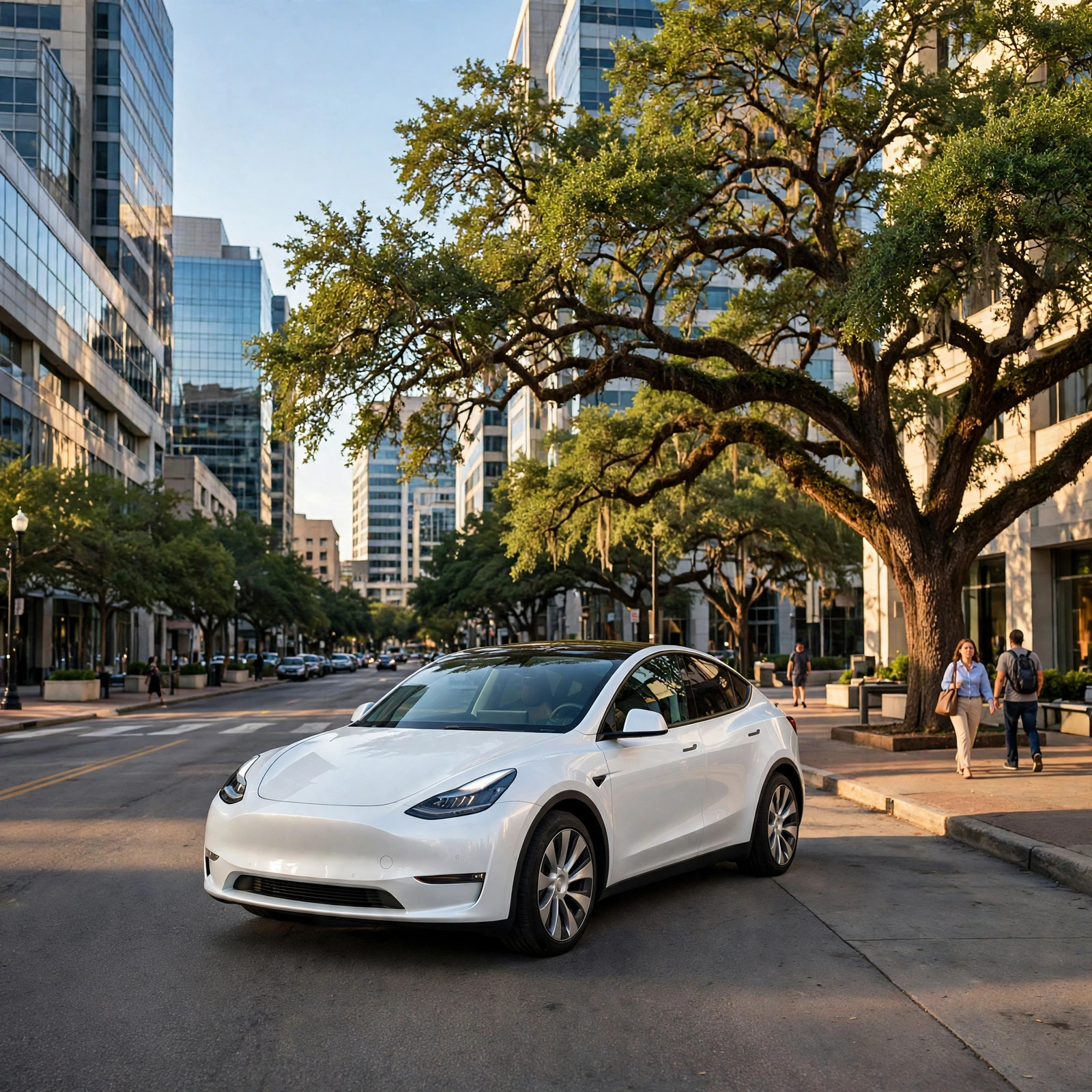
Hi, this is Datumdraft. Tesla opened its robotaxi service in San Antonio, Texas, on Monday, November 9, 2026, at 5:00 a.m. Central Time.
San Antonio is Tesla’s 8th unsupervised city. It joins Austin, Dallas, Fort Worth, Houston, Miami, Orlando, and Tampa. The launch covers an estimated 274 square miles, which is the largest day-one map for the service so far.
Still, riders and investors need to check the fine print before booking a trip. Every vehicle in the initial San Antonio fleet is a Model Y, not a Cybercab. In addition, you cannot take a robotaxi to or from San Antonio International Airport, even though the airport sits right inside the outer map boundary.
The 274-square-mile estimate and the airport cutout
San Antonio has the largest day-one service area of any Tesla robotaxi city at roughly 274 square miles, but riders cannot use it for airport trips.
To see why, you first need to know what a geofence is. A geofence is an invisible digital boundary drawn on a map that keeps a self-driving car inside approved streets. Think of it like an invisible wireless fence for a pet in a backyard. The car can drive freely inside the yard, but the software will not let you book a stop outside the line.
In San Antonio, that outer boundary covers about 274 to 275 square miles (estimate). Tesla did not publish an official square-mileage number. Instead, independent trackers at Electrek and Not a Tesla App calculated the ~274-square-mile estimate by measuring the active map inside the robotaxi app.
San Antonio Airport Alert: San Antonio International Airport (SAT) sits physically inside the outer boundary of the San Antonio zone, but the airport itself is blacked out. You cannot request a pickup or drop-off at the airport terminals.
Why would an airport sit inside the map without offering rides? Picture a freshly painted living room floor where the homeowner puts blue painter’s tape over the air vents. The roller covers the whole room at once, but the taped vents stay untouched.
Commercial airports require separate commercial permits, toll-plaza agreements, and strict curb-management rules before autonomous cars can load passengers. By drawing a cutout around San Antonio International Airport, Tesla opened the surrounding neighborhoods on day one without waiting for airport authority clearance.
Four common misunderstandings about the San Antonio rollout
Several early reports mixed up the launch date, the city count, the vehicle models, and the published operating data for San Antonio.
1. Launch date: November 9, not November 10
One media outlet reported that San Antonio service started on November 10. That date is wrong. Tesla’s official `@robotaxi` account, along with tracking reports from Not a Tesla App and Electrek, confirmed that rides went live on Monday, November 9, 2026, at 5:00 a.m. CT.
2. City count: 8th unsupervised city, not 9th
Some social media posts called San Antonio Tesla’s 9th robotaxi city. That blends two different categories together. San Antonio is Tesla’s 8th unsupervised city.
Tesla also operates in the San Francisco Bay Area, which is a 9th region. However, vehicles in the San Francisco Bay Area still carry a human safety driver behind the wheel. When counting cities without a safety driver in the driver’s seat, San Antonio is number eight.
3. Vehicle fleet: Model Y only, with Cybercab still confined to Austin
If you summon a ride in San Antonio today, a Model Y SUV will pull up to the curb. The two-seat Cybercab (Tesla’s purpose-built robotaxi without a steering wheel or pedals) is not part of the initial San Antonio launch.
Think of it like an airline opening a new regional route with its standard Boeing 737 jets while keeping its newest flagship aircraft on its main hub route. Tesla started paid Cybercab rides in Austin on September 3 and September 4, 2026. As of Tesla’s third-quarter earnings call on October 21, 2026, Austin remained the only city running Cybercabs.
You may also see older posts claiming that Austin only has 8 Cybercabs on the road. Do not use that number. On October 10, 2026, Tesla stated that more than 300 Cybercabs were serving Austin (this is a company claim).
4. Supervision status and undisclosed numbers
Tesla has not confirmed whether remote or in-car safety monitors are used in San Antonio, so the service is best described as reported unsupervised. Furthermore, Tesla has not disclosed the pricing structure, the number of Model Y vehicles in the local fleet, or the daily operating hours for San Antonio.
| Category | Confirmed Fact | Third-Party Estimate / Claim | Undisclosed by Tesla |
|---|---|---|---|
| Launch Time | Monday, Nov 9, 2026, 5:00 a.m. CT | — | — |
| City Status | 8th unsupervised city (SF Bay Area is a 9th region with safety driver) | — | Exact safety monitor setup (reported unsupervised) |
| Service Zone | San Antonio metro area | About 274–275 sq mi (Electrek / Not a Tesla App estimate) | Official Tesla square-mileage figure |
| Airport Access | San Antonio Int’l Airport is inside the zone but NOT served | — | Timeline for airport permit approval |
| San Antonio Fleet | Model Y only at launch (no Cybercab) | — | Local fleet size, fares, and operating hours |
| Austin Cybercabs | Paid rides began Sept 3–4, 2026; sole Cybercab city as of Oct 21 call | 300+ Cybercabs in Austin as of Oct 10, 2026 (Tesla company claim) | Independent third-party audit of active Austin units |
Two new cities in two weeks: The Texas-Florida belt and what comes next
Tesla added two new unsupervised cities in a two-week window, bringing its total to five cities in Texas and three in Florida.
Just one week before San Antonio went live, Tesla launched unsupervised service in Fort Worth on November 2, 2026. That makes San Antonio the second new city addition in two weeks.
Right now, Tesla’s unsupervised footprint sits entirely across two warm-weather states. In Texas, the network covers Austin, Dallas, Fort Worth, Houston, and San Antonio. In Florida, it runs in Miami, Orlando, and Tampa.
| City / Region | State | Supervision Classification | Confirmed Vehicle Types |
|---|---|---|---|
| Austin | Texas | Unsupervised hub | Model Y & Cybercab (300+ Cybercabs claimed Oct 10) |
| Dallas | Texas | Unsupervised hub | Model Y |
| Fort Worth | Texas | Unsupervised hub (Launched Nov 2, 2026) | Model Y |
| Houston | Texas | Unsupervised hub | Model Y |
| San Antonio | Texas | 8th unsupervised hub (Launched Nov 9, 2026; reported unsupervised) | Model Y only at launch |
| Miami | Florida | Unsupervised hub | Model Y |
| Orlando | Florida | Unsupervised hub | Model Y |
| Tampa | Florida | Unsupervised hub | Model Y |
| SF Bay Area | California | Separate 9th region WITH safety driver | Supervised fleet |
Where will Tesla go next? We already have the official shortlist. In its October 21, 2026 Safety Report, Tesla named four near-term target cities: San Antonio, Las Vegas, Phoenix, and Jacksonville.
With San Antonio now live, three announced targets remain on the board: Las Vegas, Phoenix, and Jacksonville.
How to read Tesla’s expansion next to Waymo
Investors often ask how Tesla’s rollout stacks up against Waymo, Alphabet’s autonomous ride-hailing unit. The key is recognizing that the two companies highlight completely different metrics.
Waymo reported more than 500,000 paid rides per week in March 2026, a figure that was still cited in October 2026. That 500,000+ weekly ride figure is a March 2026 number, not a fresh November release.
Meanwhile, Tesla has not published a ride count for San Antonio or its broader network. Because Tesla does not release ride volume, you cannot compare the two companies by weekly passenger trips. Instead, think of it like comparing two retail chains where one reports weekly store receipts and the other reports how many new store zip codes it opened this month. Waymo provides a verified weekly ride-volume baseline, while Tesla is demonstrating rapid city-count and geofence expansion.
Practical checklists for local riders and investors
Before booking a trip in San Antonio or trading on the announcement, check these three items for your situation.
Checklist for San Antonio riders
- Verify that neither pin is at the airport: San Antonio International Airport is inside the ~274-square-mile (estimate) boundary, but pickups and drop-offs at the airport are blocked.
- Look for a Model Y at the curb: Only Model Y vehicles are operating in San Antonio at launch. Do not expect a two-seat Cybercab.
- Check live fares and hours inside the app: Because Tesla has not published an official rate card or operating schedule for San Antonio, verify your fare quote and return-trip availability in the app before riding.
Checklist for investors
- Watch the remaining three target cities: Track whether Tesla launches Las Vegas, Phoenix, and Jacksonville—the remaining targets from the October 21 Safety Report—before the end of 2026.
- Monitor Cybercab expansion beyond Austin: As of the October 21 earnings call, Austin was the only city with Cybercabs. Watch for when Tesla deploys Cybercabs into a second city.
- Look for hard disclosures on fleet size and supervision: Watch upcoming filings and announcements to see if Tesla discloses local fleet sizes, ride counts, or safety monitor details for San Antonio.
Takeaways
Launching San Antonio on November 9 just one week after Fort Worth (November 2) shows how fast Tesla is expanding its map across Texas and Florida. Giving a new market an estimated 274 square miles of coverage on day one is a major step up in initial zone size.
At the same time, the rollout shows clear early boundaries. San Antonio starts with Model Y vehicles only, leaves out San Antonio International Airport despite surrounding it, and comes with no public data on fares, fleet size, or operating hours.
Which city from Tesla’s October 21 target list do you think will become the 9th unsupervised city next—Las Vegas, Phoenix, or Jacksonville? Let me know in the comments, and share this guide with anyone flying into San Antonio so they do not get stuck trying to summon a robotaxi at the airport curb.
Sources
- Tesla Official Robotaxi Account (@robotaxi) — San Antonio Launch Announcement (Monday, November 9, 2026, 5:00 a.m. CT)
- Not a Tesla App — Tesla Robotaxi San Antonio Launch, ~274–275 sq mi Geofence Estimate, Airport Exclusion, and Model Y Fleet Coverage (November 9, 2026)
- Electrek — Tesla Robotaxi San Antonio Rollout Analysis and Day-One Service Area Estimate (November 9, 2026)
- Tesla, Inc. — Q3 2026 Earnings Call Transcript and Safety Report: Near-Term Target Cities (San Antonio, Las Vegas, Phoenix, Jacksonville) and Austin Cybercab Status (October 21, 2026)
- Tesla, Inc. — Austin Cybercab Fleet Update (300+ Cybercabs Serving Austin Company Claim, October 10, 2026; Paid Austin Rides Initiated September 3–4, 2026)
- Waymo — Commercial Ride-Hailing Milestone Disclosure (500,000+ Paid Rides Per Week Announced March 2026; Cited October 2026)