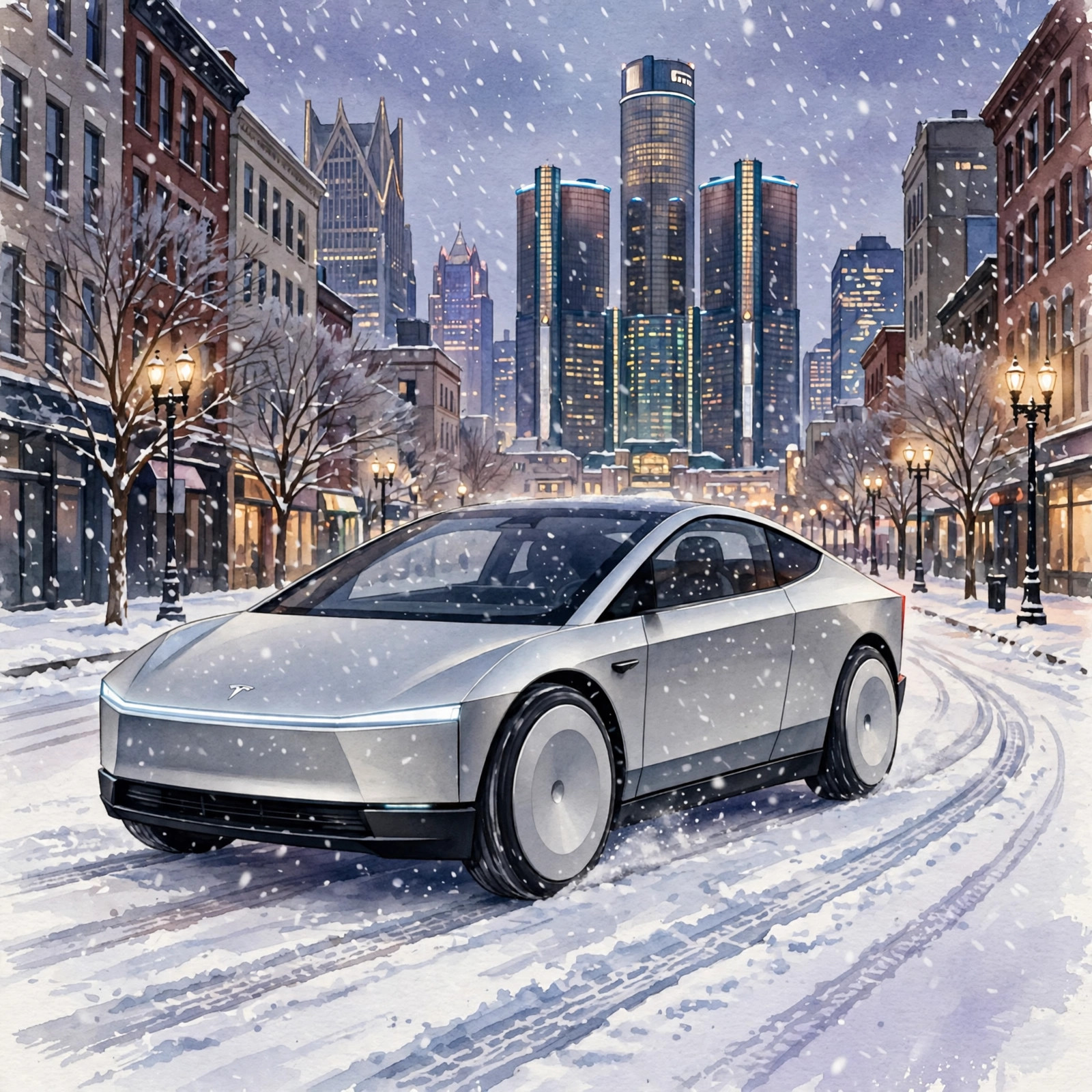
Hi, this is Datumdraft. If you follow autonomous vehicles, your feed probably blew up this week with photos of gold, two-seater Tesla Cybercabs cruising down chilly Michigan freeways. Seeing a robotaxi that debuted under the warm Texas sun suddenly show up in the heart of the American auto industry right before winter raises an obvious question: can a car that relies solely on cameras actually navigate a road where lane markings vanish under snow, slush, and road salt?
Before the internet hype gets ahead of reality, we need to establish the baseline facts. In early November 2026, about two dozen Tesla Cybercab test vehicles were spotted on public roads across Metro Detroit, including I-696, M-10, Telegraph Road, and Eight Mile Road. However, contrary to viral social media claims, these cars are not running driverless public rides. Unlike the production design unveiled without controls, the Detroit test cars are equipped with temporary steering wheels and occupied by human test drivers. Tesla has not announced a timeline, public ride plans, or an official reason for bringing the fleet to Michigan. Industry analysts view this deployment as an inferred push to gather cold-weather and winter road data outside Tesla’s warm-weather Sun Belt markets.
Fact-Check Summary (As of November 7, 2026): Tesla’s Cybercabs in Metro Detroit are not operating autonomously without human supervision. Each spotted vehicle carries a temporary steering wheel and a human test driver in the front seat. Furthermore, Tesla has issued no official statement confirming “winter testing” or public ride dates in Michigan; the winter validation purpose is an industry inference based on geography and season.
What Was Actually Spotted in Metro Detroit? (Facts vs. Rumors)
Whenever a new group of Tesla test vehicles appears in a major metro area, social media accounts quickly declare that commercial (driverless) service has arrived. That is not what is happening in Michigan right now.
On November 3, 2026, The Detroit News reported that a fleet of about two dozen Tesla Cybercabs had begun operating on public roads across Metro Detroit. Notice the phrasing: “about two dozen”. While some blogs rounded that figure into an exact count of 24 confirmed units, local observations only support an approximate fleet size of around twenty cars.
These vehicles are staging out of a specific base camp: Tesla’s collision repair and research facility on 12 Mile Road in Southfield, Michigan, a site originally approved for vehicle testing and maintenance back in 2022. From that Southfield hub, local commuters and automotive photographers have tracked the gold two-seaters running regular loops along Interstate 696 (I-696), the Lodge Freeway (M-10), Telegraph Road, and Eight Mile Road.
The biggest detail separating this Detroit test fleet from the Cybercab prototype Tesla first showed in October 2024 is right inside the cabin. The production-intent Cybercab was designed from the ground up without a steering wheel or pedals. Yet the vehicles photographed around Southfield and on I-696 clearly have temporary steering wheels installed, with human safety drivers actively seated behind them.
We also have to be strict about how we interpret Tesla’s motives. Tesla has not confirmed a Detroit testing schedule, has not announced public rides for Michigan residents, and has not stated why these cars are in town. As automotive analyst Stephanie Brinley noted to The Detroit News, Tesla has not officially said they are testing there. Calling this a “winter weather testing program” is a logical inference based on the fact that two dozen cars arrived in Michigan in November—not an official company statement.
Why Michigan’s Winter Is the Ultimate Boss Fight for Camera-Only AI
To understand why automotive engineers are paying such close attention to two dozen test cars in Southfield, look at where Tesla’s robotaxi network operates right now.
As of early November 2026, Tesla’s commercial robotaxi operations are concentrated entirely in the Sun Belt:
- Model Y-Based Robotaxi Service (6 Cities): Operating in Austin, Dallas, and Houston in Texas, plus Tampa and Miami in Florida. On November 2, 2026, Tesla expanded this Model Y network to a sixth market, launching driverless operations across a 143-square-mile geofenced zone in Fort Worth, Texas.
- Dedicated Cybercab Public Service (1 City): Public passenger rides inside the two-seater, pedal-free Cybercab are currently active only in Austin, Texas, where commercial service began in early September 2026 (with Dallas slated to follow later).
Texas and Florida share a massive engineering advantage for autonomous cars: clear skies, dry asphalt, and crisp white or yellow lane lines almost year-round. Leaving the Sun Belt for Metro Detroit in November exposes Tesla’s “Vision-only” architecture—which relies entirely on optical cameras and end-to-end neural networks without LiDAR or radar—to three harsh physical hurdles.
1. Camera Lens Occlusion and Blizzard Whiteouts
Because a Vision-only system has no active laser (LiDAR) or radio wave (radar) sensors to measure distance through particulates, its optical cameras must maintain a clean line of sight. On a highway like I-696 in January, trucks kick up a sticky mist of melted snow, road grime, and brine. When that salt slurry dries on a camera housing, it creates an opaque film. Add heavy lake-effect snow flurries that cause optical whiteout, and the car has to rely heavily on heated camera glass, washer nozzles, and multi-frame temporal memory just to avoid going blind.
2. Vanishing Lane Markings and Curbs
Reading painted white lines on dark Texas asphalt is easy for computer vision. In a Michigan winter, the entire road surface turns into a uniform sheet of white pack snow, gray slush, and chalky white salt stains. Worse, snowplows push banks of snow over the curbs, erasing the physical boundary between the outer driving lane and the sidewalk. When painted lanes disappear, the neural network cannot rely on simple line detection; it has to infer a safe driving corridor from the tire ruts of preceding vehicles, guardrails, utility poles, and building geometry.
3. Black Ice and Low-Friction Vehicle Dynamics
Even if the perception network figures out where the road goes, the control planner still has to stop and turn the car on surfaces where tire-road friction drops by 70 percent or more. Black ice looks nearly identical to wet pavement on an optical camera feed. A robotaxi without a steering wheel cannot rely on a human driver feeling the steering torque go light through their hands. The vehicle’s stability control and neural planner must detect micro-slip events at the wheels in milliseconds, extending following distances and modulating regenerative braking so the rear wheels do not lock up on slick freeway ramps.
Cybercab vs. Waymo’s Zeekr: Two Opposing Philosophies on the Same Snowy Roads
What makes Detroit even more interesting right now is that Tesla is not alone on these streets. One month before the Cybercabs showed up, Waymo kicked off a major milestone in the exact same metro area.
In October 2026, after mapping Detroit streets with human drivers starting in 2025, Waymo began testing its Geely-built Zeekr robotaxis in fully autonomous mode—operating in downtown Detroit with no human driver in the front seat. For now, Waymo’s driverless rides in Detroit are restricted to company employees, and just like Tesla, Waymo has not announced a date for opening the service to general public passengers.
| Comparison Metric | Tesla (Detroit Cybercab Fleet) | Waymo (Detroit Autonomous Fleet) |
|---|---|---|
| Vehicle Platform | Tesla Cybercab (2-seat dedicated robotaxi prototype) | Zeekr-based purpose-built robotaxi (Geely group) |
| Detroit Timing | Reported early November 2026 (Nov 3 sighting report) | Started October 2026 (Oct 6 driverless announcement) |
| Current Detroit Mode | Temporary steering wheel installed + human test driver aboard | Fully autonomous testing (no human in front seat; employees only) |
| Sensor Suite | Vision-only (optical cameras + end-to-end neural network) | Multi-modal fusion (LiDAR + imaging radar + cameras) |
| Detroit Public Rides | Unannounced (no timeline or official confirmation) | Unannounced (currently restricted to Waymo employees) |
Having both fleets operating in Michigan at the onset of winter sets up a direct engineering showdown on identical road conditions. Waymo’s Zeekr is built like a heavily geared polar explorer: it pairs high-resolution cameras with spinning 3D LiDAR units and millimeter-wave radar, backed by dedicated lens wipers, air puffers, and heating elements to punch through snow squalls. Even if snow blinds a camera lens for two seconds, Waymo’s radar and LiDAR still return exact distance and velocity vectors for the car ahead.
Tesla’s Cybercab takes the exact opposite bet: it tries to replicate a skilled human driver who navigates a snowstorm using only two eyes and a brain. If Tesla can train its vision neural network to handle I-696 in February without expensive LiDAR domes or radar arrays, its per-vehicle manufacturing cost stays dramatically lower than Waymo’s. Detroit is where we find out whether software alone can close that hardware gap when the temperature drops below freezing.
3 Milestones to Watch Before Cybercab Goes Truly Driverless in the North
Having two dozen cars with steering wheels driving around Southfield is step one. If you want to track whether Tesla is actually getting close to launching a commercial northern robotaxi service—or if this is strictly an internal R&D data-gathering run—watch for these three concrete signals over the coming months:
- Removal of the Temporary Steering Wheels: In Austin, Tesla progressed from human-driven test vehicles to Cybercabs without steering wheels or pedals (initially with a safety monitor in the passenger seat in June 2026) before opening public rides in September. Until the Detroit Cybercabs lose their temporary steering wheels and move the human out of the driver’s seat, commercial deployment in Michigan is not imminent.
- Peak Blizzard Performance (December through February): Early November in Detroit brings cold rain and light frost, not six inches of unplowed slush. The real engineering test happens between December and February. Watch local sightings during heavy snowfall on M-10 and Telegraph Road to see whether the Cybercabs stay out in active storms or retreat to the 12 Mile Road facility when visibility drops.
- An Official Statement on Northern Expansion: Right now, Tesla has said nothing publicly about why this fleet is in Detroit. Watch Tesla’s Q4 2026 earnings report and regulatory filings to see whether management frames Detroit purely as a winter training ground to improve Full Self-Driving (FSD) software for consumer cars, or names Detroit as a future commercial Robotaxi market alongside Sun Belt cities.
Launching a pedal-free robotaxi in sunny Austin was an important first step for Tesla, and adding Fort Worth to the Model Y network shows steady scaling in warm states. But no autonomous fleet can claim nationwide capability until it proves it can handle gray skies, salt-crusted lenses, and vanished lane lines in the Midwest. Putting two dozen Cybercabs onto Metro Detroit’s roads—even with temporary steering wheels and human test drivers—is a necessary rite of passage.
Now I want to hear from you: if you had to hail a ride down I-696 during a January snowstorm in Michigan, would you get into Waymo’s LiDAR-equipped Zeekr first, or would you trust Tesla’s camera-only Cybercab? Drop your thoughts in the comments below, and bookmark DatumDraft as we track what happens when the real snow hits Detroit this winter.
Sources
- Tesla Tests About Two Dozen Cybercabs on Detroit Roads — EVXL, November 3, 2026
- They’re freaky to see and they’re in metro Detroit: The Tesla Cybercab — Detroit Free Press, November 5, 2026
- Tesla Cybercab Test Fleet Expands to Detroit — Drive Tesla Canada, November 3, 2026
- The Detroit News — original report of about two dozen Cybercabs testing in Metro Detroit, November 3, 2026 (cited via EVXL; original article URL not independently confirmed)