Baidu Apollo World: How Baidu Teaches Robotaxis to Drive Like Humans — Without Driving Every Mile
Hi, this is Datumdraft. On November 3, 2026, during its AI Day event in Shenzhen, Baidu pulled back the curtain on a system that changes how its autonomous cars go to school. The system is called Apollo World. Instead of simply sending thousands of test vehicles onto city streets and waiting for rare traffic mishaps to occur naturally, Baidu built a generative physical simulator designed to let artificial intelligence train artificial intelligence.
Every autonomous driving company faces the same uncomfortable question from passengers and city regulators: how can a robotaxi stay safe on a street it has never seen before? If a vehicle learns only by memorizing specific intersections, every new district becomes a costly, slow mapping project. The answer Baidu presented in Shenzhen is to shift the workload from brute-force street driving to learning how the physical world behaves in simulation. According to Baidu, as reported by Reuters on November 3, 2026, Apollo World can generate up to 100,000 kilometers of simulated driving every single day. That figure comes directly from Baidu’s presentation and has not been independently audited by third-party safety agencies.
In this guide, we will walk through what Apollo World actually does under the hood, how it combines virtual physics with over one billion real sensor frames, why Baidu still requires over 700,000 kilometers of physical road testing per model update, and how the November 6, 2026 pilot rollout in Longgui, Shunde puts this training pipeline to an immediate neighborhood test.
What Apollo World Actually Is
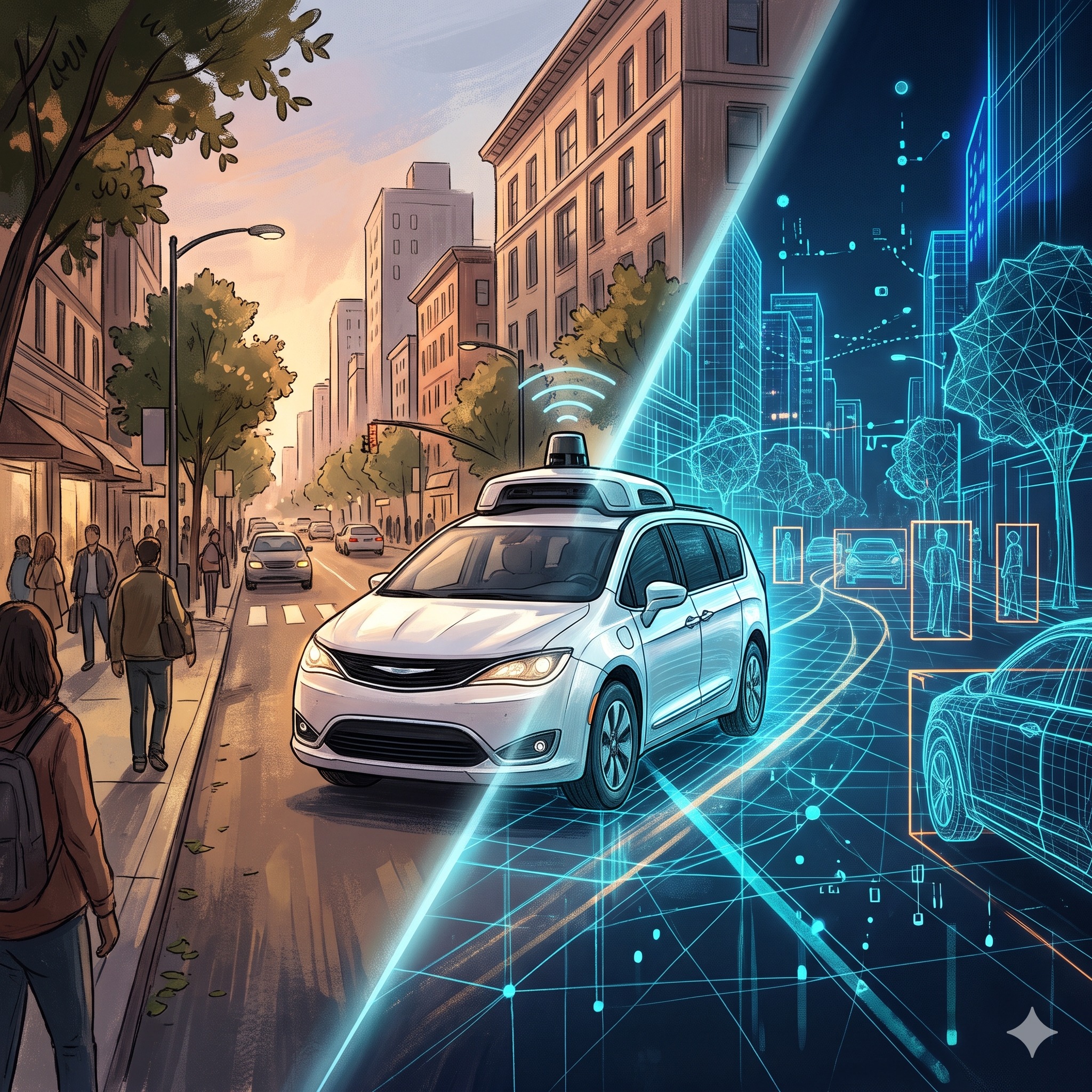
Put simply, Apollo World is an AI system that learns the physical rules of the road so it can build reactive, virtual cities for training Apollo Go robotaxis. In the machine learning community, this type of architecture is known as a world model. While a standard autonomous driving model looks at camera feeds and decides whether to turn the steering wheel or press the brake, a world model predicts what the entire street environment will do next if the robotaxi makes a specific move.
Think of the difference between studying for a written driving exam with flashcards versus sitting inside a commercial airline pilot simulator. Flashcards — which resemble traditional autonomous training datasets — show you a frozen picture of a pedestrian near a crosswalk and ask you for the right steering angle. Once you turn the wheel, the flashcard cannot show you what happens two seconds later. Because the recording was captured in the past, the cars and pedestrians in that video clip cannot react to your new trajectory. Apollo World acts like a responsive flight simulator. If the virtual robotaxi hesitates at an unprotected left turn, the simulated oncoming scooter might swerve, honk, or speed up across the gap. Wang Liang, chief architect of Baidu’s Intelligent Driving Group, described the platform on November 3, 2026 as a strict safety examiner rather than a visual effects generator.
During the Shenzhen presentation, Baidu introduced what it calls the “2+3” evaluation framework for autonomous driving world models. The first two foundational pillars are causality and interactivity: the virtual environment must understand cause and effect, and other road users must react dynamically to the robotaxi’s choices. The three performance metrics are physical accuracy, long-run persistence, and real-time processing speed. According to Baidu’s technical disclosure on November 3, 2026, Apollo World calculates safety decisions within one-thirtieth of a second (roughly 33.3 milliseconds), matching the real-time frame rates of physical onboard sensors.
| Training Dimension | Traditional Log-Replay & Rule Training | Baidu Apollo World (World Model Approach) |
|---|---|---|
| Core Mechanism | Replays recorded street videos and applies hand-coded traffic rules | Learns road physics and cause-and-effect to generate live, reactive scenarios |
| Traffic Response | Static playback; recorded pedestrians ignore the test vehicle’s new maneuvers | Closed-loop agents; virtual cars, cyclists, and pedestrians react in real time |
| Sensor Representation | Often relies on simplified bounding boxes or pre-recorded video clips | Synthesizes synchronized raw camera visuals and 3D LiDAR point clouds |
| Rare Hazard Coverage | Must wait months for rare accidents or weather events to happen on public streets | Creates counterfactual hazards on demand (night rain, sudden cut-ins, stray animals) |
| Daily Training Volume | Limited by physical fleet size, human safety drivers, and local speed limits | Up to 100,000 simulated km per day (Baidu claim, Nov 3, 2026; unverified) |
A simulator is only as smart as the real-world experience feeding it. Baidu did not build Apollo World from imagination or videogame graphics; it grounded the model in the operational history of its Apollo Go commercial robotaxi service. According to Baidu’s Q2 2026 financial results (reported in August 2026, the latest official quarterly filing available as of November 8, 2026), Apollo Go operates across 28 cities globally and has completed more than 23 million cumulative public rides. Across those cities, Baidu’s fleet has logged over 350 million kilometers of total autonomous driving, including more than 240 million kilometers in fully driverless mode without a human monitor in the front seat. That massive archive of street geometry, regional driving habits, and braking profiles forms the training bedrock for Apollo World.
The Three Ways Apollo World Learns
Turning raw street recordings into a functioning teacher for autonomous vehicles requires more than stitching video clips together. According to Baidu’s technical presentations at AI Day on November 3, 2026, Apollo World operates through a three-part cycle: simulating physical road mechanics, unifying multimodal sensor observations, and checking those virtual lessons against real asphalt.
1) Physical-World Simulation
The first pillar is teaching the AI how physical objects occupy space, move, and interact over time. When a human driver watches a delivery van double-park on a narrow wet street, the human brain immediately predicts what will happen next: cars behind the van will slow down, signal left, and nose into the adjacent lane, while braking distances on the wet pavement will stretch out. Apollo World learns these physical and behavioral patterns directly from Baidu’s 350 million kilometers of historical road logs.
Once the world model understands road physics and traffic causality, engineers can ask it “what if” questions — known in engineering as counterfactual simulations. During the November 3, 2026 demonstration in Shenzhen, Baidu showed Apollo World taking a normal intersection scenario and injecting dangerous variables: a cyclist abruptly cutting across traffic, a stray dog bolting into the crosswalk, or sudden torrential rain reducing visibility. Because the other vehicles and pedestrians inside Apollo World are modeled as interactive agents, they respond dynamically to whatever evasive action the Apollo Go software takes.
According to Baidu, as reported by Reuters on November 3, 2026, this simulation engine generates up to 100,000 kilometers of virtual driving scenarios per day. Baidu estimates that 100,000 kilometers of targeted virtual driving equals roughly three years of physical road testing by a single vehicle staffed with a human safety monitor. Again, it is important to note that both the 100,000-kilometer daily throughput and the three-year equivalency are internal company figures shared by Baidu without independent third-party verification.
2) Multimodal Perception
A common flaw in older driving simulators is that they cheat on perception. Many basic simulators feed the driving software a clean, mathematical list of exact object coordinates — telling the car, “There is a pedestrian 14.2 meters ahead moving at 1.3 meters per second”. On a real street, nobody hands the robotaxi a cheat sheet. The vehicle has to figure out where the pedestrian is by interpreting blurry camera pixels and bouncing laser pulses (LiDAR) off raincoats and umbrellas.
To train the entire driving stack from end to end, Apollo World uses multimodal perception synthesis. Instead of outputting simplified object boxes, the simulator generates synchronized, real-time camera video streams alongside 3D LiDAR point-cloud observations. When Apollo World adds a virtual cyclist swerving in front of the robotaxi, it simultaneously renders the visual appearance of that cyclist across multiple camera angles and calculates the exact laser reflections the rooftop and bumper LiDAR units would detect.
To teach Apollo World how cameras and LiDAR sensors perceive the same physical event simultaneously, Baidu filtered its massive driving archive down to the most informative moments. According to Baidu’s November 3, 2026 disclosure (reported by TechNode and China Securities Journal), Apollo World was trained on more than 1 billion high-value frames. Rather than feeding the model millions of hours of empty highway cruising, engineers selected dense urban interactions, complex lighting transitions, and tricky obstacle encounters so the world model could master realistic sensor generation.
3) Real-World Verification
If a simulator can generate 100,000 kilometers a day and render realistic camera and LiDAR feeds, can an automaker simply stop testing on public roads? Baidu’s own engineering numbers give a clear, unambiguous answer: no.
During the November 3, 2026 presentation, Baidu disclosed that each autonomous driving model iteration still requires, on average, more than 700,000 kilometers of physical road testing. That single statistic is the most grounding detail from the entire Shenzhen event. Far from proving that virtual mileage replaces physical streets, the 700,000-kilometer requirement demonstrates why real-world verification remains the non-negotiable final exam.
In Baidu’s workflow, simulation acts as a high-speed filter before the software ever touches public pavement. Engineers train a new model iteration inside Apollo World, expose it to thousands of synthetic edge cases, fix the software bugs that surface in the virtual city, and only then deploy the candidate model onto physical test vehicles to log its 700,000+ verification kilometers. Without Apollo World catching flaws early in the loop, fleets would waste millions of physical kilometers discovering basic behavioral bugs on public roads.
| Learning Pillar | Primary Function | Key Metric (Baidu Claim, Nov 3, 2026) | Role in the Safety Pipeline |
|---|---|---|---|
| 1. Physical-World Simulation | Models road physics, weather, and reactive traffic agents in a closed loop | Up to 100,000 simulated km per day (~3 years of 1 safety-driver car) | Rehearses rare, dangerous edge cases without risking public road users |
| 2. Multimodal Perception | Synthesizes synchronized raw camera images and 3D LiDAR point clouds | Trained on over 1 billion high-value sensor frames | Tests the robotaxi’s actual perception software rather than feeding ideal coordinates |
| 3. Real-World Verification | Validates simulation-trained models on physical city streets and traffic | Over 700,000 real-road km required per model iteration on average | Confirms that virtual lessons hold up against real hardware noise and human unpredictability |
Why Simulation Kilometers Are Not Safety Proof
Whenever an autonomous driving company announces a massive simulation milestone, headlines tend to blur the line between virtual training and real-world safety. It is tempting to look at 100,000 daily simulated kilometers, multiply that number by 365 days, and conclude that an AI driver has gained decades of infallible wisdom. That conclusion is a trap.
Simulation kilometers are not proof of physical safety. The goal of Apollo World is to reduce the burden of redundant public-road testing, not to replace real-world testing altogether. Even when a world model satisfies Baidu’s “2+3” criteria for causality and physical accuracy, a simulated street remains a mathematical approximation of reality. Several stubborn gaps separate a virtual kilometer from an actual kilometer on city pavement:
- Unmodeled Physical Chaos: A simulator only knows the physics it has been taught to recognize. On a real street in southern China, a flatbed truck might drop a bundle of translucent plastic sheeting that catches the wind and wraps around a bumper sensor, or fresh road tar might alter tire friction in ways no training frame captured.
- Hardware Degradation and Sensor Noise: Virtual LiDAR and camera streams inside Apollo World are synthesized by software. On a physical Apollo Go vehicle running twelve hours a day, mud splashes onto camera lenses, summer heat warms up electronic boards, and mechanical vibrations slightly shift sensor calibration over months of potholes.
- Human Irrationality and Cultural Nuance: While Apollo World models reactive traffic agents, real humans act in ways that defy statistical patterns. A pedestrian might step into traffic while staring at a smartphone, freeze mid-lane, wave the robotaxi through, and then abruptly lunge forward anyway.
- The Self-Grading Exam Problem: When the same engineering organization builds both the driving software and the world model testing that software, blind spots can be shared between the student and the teacher.
Simulation is where a robotaxi practices for the exam; public streets are where the exam actually takes place. Virtual mileage cuts out wasted rehearsal time, but it never signs the safety certificate.
Furthermore, readers and industry analysts must keep source attribution front and center. Every headline figure tied to Apollo World — up to 100,000 simulated kilometers per day, over 1 billion high-value training frames, the 1/30-second processing speed, and the 700,000-kilometer road testing average per model iteration — comes from Baidu’s own disclosures on November 3, 2026, as reported by Reuters, TechNode, and Chinese financial media. There is no independent third-party audit verifying how closely one kilometer inside Apollo World matches the risk density of one kilometer on a crowded city avenue.
What Changed on November 3 — And November 6
Many technology conferences feature flashy AI demonstrations that stay locked inside research labs for years. What makes the first week of November 2026 noteworthy for Baidu is the tight three-day window between announcing a core training methodology and putting cars into a new local trial.
On Tuesday, November 3, 2026, Baidu unveiled Apollo World at its AI Day event in Shenzhen, detailing how the world model prepares Apollo Go software for unfamiliar traffic patterns. Just three days later, on Friday, November 6, 2026, Apollo Go initiated a new local pilot phase in Longgui, a subdistrict of Shunde in Foshan, Guangdong province, releasing 20,000 experience coupons for residents to hail trial rides.
Why does a subdistrict like Longgui in Shunde matter to the global autonomous vehicle conversation? Shunde — located in the manufacturing heartland of the Pearl River Delta — opened its 806 square kilometers to connected and autonomous vehicle demonstrations earlier in August 2026, with Apollo Go already operating across neighboring areas like Daliang and Lecong. Moving into Longgui brings the fleet into a bustling town environment where factory logistics trucks, two-wheeled electric scooters, narrow residential shopping streets, and humid subtropical weather collide daily.
In the early years of robotaxis, expanding from a city center into an industrial-residential subdistrict like Longgui meant deploying mapping cars for months, manually writing local exception rules for every awkward roundabout, and slowly creeping up in speed. With Apollo World already integrated into Baidu’s training pipeline, engineers can take initial street scans of a new zone, populate those roads with reactive virtual scooters and delivery trucks, and run thousands of simulated trips before opening the app to local residents. Issuing 20,000 experience coupons on November 6, 2026 is a controlled way to gather real passenger feedback and physical road verification data while keeping the rollout in a structured pilot stage.
Apollo Go vs Waymo vs Tesla
Baidu is not alone in trying to solve the scalability bottleneck of autonomous driving. Across the global market, the three most watched autonomous driving programs — Baidu’s Apollo Go, Alphabet’s Waymo, and Tesla — are all chasing the same goal: teaching software to handle chaotic streets without needing five years of manual setup for every new town. However, their starting points, sensor philosophies, and training balances differ sharply.
Waymo built its reputation in US cities like Phoenix, San Francisco, and Los Angeles on rigorous, methodical real-world validation paired with high-resolution custom hardware and its own internal simulation tools (such as Simulation City). As we explored in our breakdown of how Waymo and Toyota are integrating autonomous hardware into the bZ4X at the Takaoka plant for 2027 Japan testing, scaling a multi-sensor robotaxi fleet into new countries requires deep factory coordination alongside localized software training.
Tesla takes the opposite hardware route. Rejecting LiDAR and radar altogether, Tesla relies on a vision-only camera network fed by millions of consumer passenger vehicles on public roads. While Tesla also uses neural world simulators internally to train its Full Self-Driving (FSD) software, its primary advantage is massive video volume collected by human customers driving their own cars. Meanwhile, across the wider automotive industry, handling high-bandwidth camera and LiDAR processing inside the car is pushing legacy automakers to overhaul their onboard wiring and compute chips — a shift we detailed in our analysis of how Volkswagen and NXP use zonal architecture and the S32K5 MCU to replace 100 ECUs.
| Comparison Factor | Baidu Apollo Go (Apollo World) | Waymo (Waymo Driver) | Tesla (FSD / Cybercab Program) |
|---|---|---|---|
| Primary Training Anchor | Multimodal world model simulation grounded in 350M+ commercial robotaxi km | High-precision real-world fleet mileage backed by structured virtual testing | Massive consumer fleet video collection paired with end-to-end neural networks |
| Sensor Architecture | Multimodal fusion: cameras, 3D LiDAR, and millimeter-wave radar | High-density multimodal suite: custom LiDAR, cameras, and radar | Vision-only (cameras only; no LiDAR or radar sensors) |
| Simulation Output Type | Real-time synchronized camera + LiDAR synthesis with reactive agents | Physics and sensor simulation focused on rigorous safety case validation | Video-generation world modeling driven by camera-only neural networks |
| Commercial Fleet Status (Nov 2026) | 28 cities, 23M+ cumulative rides, 240M+ driverless km (as of Q2 2026) | Commercial driverless operations in major US metro areas; international testing | Supervised FSD on consumer cars; dedicated robotaxi in testing/development |
| Final Safety Gatekeeper | Physical road verification (700,000+ real km per model iteration on average) | Extensive public road validation and safety case sign-off per metro zone | Real-world shadow mode and fleet intervention tracking on public streets |
Despite their disagreements over LiDAR sensors and fleet sourcing, notice what all three companies have in common at the bottom of the table: every single one relies on physical road verification as the final gatekeeper. Whether you start with Baidu’s multimodal world model, Waymo’s safety-case engineering, or Tesla’s consumer video clips, no operator is willing to launch an unverified model onto city streets based solely on simulator scores.
What This Means for the Robotaxi Market
Stepping back from the code, Apollo World highlights three practical shifts in how commercial robotaxi networks are built, budgeted, and scaled in late 2026.
1. The Cost Equation Shifts from Asphalt to Compute: Running physical test cars with human safety drivers on board is one of the heaviest operating expenses in autonomous driving. Every vehicle requires insurance, maintenance, charging, depot staff, and two shifts of trained safety monitors. By shifting early bug discovery into a virtual environment that runs up to 100,000 kilometers a day (per Baidu’s claim), operators can cut down the wasted miles where a test car simply drives down an empty boulevard learning nothing new. However, the cost does not drop to zero: companies still pay for massive GPU server clusters to run the world model, and they still fund the 700,000+ kilometers of physical road validation required for each software iteration. (Note: Baidu has not yet released its Q3 2026 financial results as of November 8, 2026, so any impact of Apollo World on recent quarterly R&D margins remains undisclosed.)
2. Faster City Onboarding: As Arthur D. Little analyst Frank McCleary noted in Reuters coverage of the November 3 launch, the speed of geographic expansion in the robotaxi industry depends on how quickly a driving system can adapt to unfamiliar local roads. When a world model can take local road geometry and populate it with realistic regional traffic behaviors before a large physical fleet arrives, the preparation window for entering a subdistrict like Longgui in Shunde shrinks considerably.
3. Practicing the Unthinkable Safely: You cannot legally or ethically stage a near-miss with a child on a bicycle on a public street just to see if your new software update brakes smoothly. In Apollo World, engineers can run that exact scenario ten thousand times under glaring sun, heavy fog, and sensor glare. The limitation, as always, is that the robotaxi only gets better at the hazards the simulator knows how to render realistically.
One important boundary for developers and researchers: as of November 8, 2026, Apollo World is strictly an internal training and validation platform for Baidu. Despite headlines stating that Baidu “opened” or “launched” the simulator, the company has not released public APIs, downloadable software packages, or open-source model weights for external developers.
What to Watch Next
Now that Baidu has connected its November 3, 2026 world model announcement in Shenzhen with its November 6 trial launch in Longgui, Shunde, four concrete indicators will show whether Apollo World delivers on its engineering promises over the coming months:
- Longgui Pilot Feedback and Coupon Redemption: Watch how quickly local residents in Shunde burn through the 20,000 trial experience coupons released on November 6, 2026, and pay attention to rider videos on Chinese social platforms. Smooth merges around scooters and delivery tricycles will tell us far more than slide-deck numbers.
- The Pace of Subdistrict and International Expansion: Apollo Go stood at 28 cities as of Q2 2026 and recently ran public trials in Hong Kong’s Tung Chung area alongside partnerships aimed at European markets. If Apollo World genuinely cuts pre-deployment preparation time, we should see shorter intervals between initial road mapping and public trial launches in 2027.
- Transparency on Sim-to-Real Validation Metrics: So far, Baidu has shared top-line training numbers (100,000 daily virtual kilometers, 1 billion frames, 700,000 physical verification kilometers per iteration). The next step for industry credibility is publishing peer-reviewed or regulator-verified data showing how often a safety fix made inside Apollo World prevents an intervention on a physical street.
- Counter-Moves from Waymo, Tesla, and Chinese Rivals: Domestic competitors like Pony.ai and WeRide, along with Waymo and Tesla, are investing heavily in generative simulation. Watch whether competitors adopt or challenge Baidu’s “2+3” evaluation benchmark for world models.
Final Thoughts: Smarter Practice, Same Street Exam
Baidu’s Apollo World represents a clear shift in autonomous vehicle engineering: trying to teach robotaxis by learning smarter in simulation rather than blindly driving more empty miles on public streets. By combining over 1 billion high-value multimodal sensor frames with a physics-aware world model that generates up to 100,000 virtual kilometers a day (according to Baidu’s November 3, 2026 figures), Apollo Go can rehearse dangerous, rare traffic encounters long before a passenger steps inside.
Yet the most important takeaway from Shenzhen is what simulation cannot do. Virtual kilometers do not replace physical pavement. Baidu’s own requirement of more than 700,000 real-world testing kilometers per model iteration proves that the goal of a world model is to reduce risky, repetitive street testing — never to eliminate final verification in real traffic.
That leaves us with a question every urban commuter will eventually face: if a driverless taxi pulls up to your curb next year, would you feel comfortable climbing into the back seat knowing the AI practiced most of its emergency maneuvers inside a virtual world model?
Sources
- Baidu Tests a New Way to Train Robotaxis — TechNode, November 5, 2026
- Baidu Unveils “Apollo World” AI for Autonomous Driving Training — BigGo Finance, November 4, 2026
- Baidu discloses the Apollo World driving model — Venture Atlas, November 3, 2026
- Baidu Opens Apollo World Simulator for Robotaxi Training — Emergent, November 4, 2026
- Baidu unveils Apollo World to train Apollo Go robotaxis — AI Weekly, November 5, 2026
- Reuters — Apollo World announcement coverage, November 3, 2026 (cited in the article; article URL not independently confirmed)
- China Securities Journal — Apollo World session coverage, November 3, 2026 (cited via Venture Atlas; article URL not independently confirmed)