Automotive Ethernet TSN in Zonal Architecture: How Cars Guarantee Zero Brake Lag
Hi, this is Datumdraft. Imagine you are downloading a large game file in your office and a web page freezes for one second. In an office, a one-second freeze is just a minor annoyance. Now imagine you are riding in a self-driving car moving at 100 kilometers per hour. Your child in the back seat starts streaming a 4K movie, and that video traffic delays an emergency braking signal from the front laser sensor by just 0.01 seconds. That tiny delay changes where the car stops by almost 30 centimeters, which is the difference between a safe stop and a serious crash. This exact problem is why carmakers are rebuilding vehicle wiring around automotive Ethernet TSN.
Traditional car networks rely on a system called Controller Area Network, or CAN. Standard CAN sends data at a maximum speed of 1 megabit per second (Mbps). Even its upgraded version, called CAN with Flexible Data-Rate (CAN FD), tops out between 5 Mbps and 8 Mbps. Meanwhile, modern driver-assistance cameras and laser sensors generate several gigabits of data every single second. Trying to push gigabits of sensor video through a CAN wire is like trying to drain a swimming pool through a coffee straw.
Standard office Ethernet has plenty of speed, easily handling gigabits of data per second. Yet standard Ethernet has a fatal flaw for cars: it operates on a first-come, first-served basis, which engineers call best-effort delivery. If a massive video file arrives at a network switch one microsecond before an emergency brake command, the brake command has to wait in line. When packets collide or queue up, standard Ethernet cannot guarantee exact arrival times.
Core Takeaway: Automotive Ethernet TSN (Time-Sensitive Networking) combines single-pair car Ethernet wires capable of speeds above 10 gigabits per second (Gbps) with IEEE 802.1 traffic scheduling rules. It guarantees microsecond-level delivery times and zero packet loss on a shared wire. By adopting automotive Ethernet TSN, carmakers can group vehicle electronics by physical location into a zonal architecture and cut wiring harness weight by more than 30%.
To see how engineers solved this dilemma, we need to look inside the metal body of a modern car and examine the copper wires holding it back.
The collapse of the copper empire and the shift to zonal architecture
Replacing legacy car networks with Ethernet is first and foremost a physical wiring revolution that cuts tens of kilograms of copper out of the vehicle. Before we talk about software packets, we have to look at the physical weight of the wires running under your car seats.
A modern car contains between 3 kilometers and 5 kilometers of copper wiring. All those bundled cables, known as the wiring harness, weigh between 50 kilograms and 60 kilograms. The wiring harness is the third heaviest and third most expensive component in a car, right behind the metal chassis and the battery or engine. Every time an automaker adds a new heated seat sensor, blind-spot radar, or cabin camera, another dedicated copper wire gets taped into that thick bundle.
For the last decade, cars used what engineers call a domain architecture. In a domain architecture, Electronic Control Units (ECUs)—the small computers that control car functions—are grouped by their job. One main computer handles the powertrain, another handles entertainment, and another handles safety sensors. Because sensors sit at the bumpers while the computer sits behind the dashboard, wires have to criss-cross the entire length of the car like a tangled spiderweb. Pulling a 4-meter copper cable from a rear bumper radar all the way to a front dashboard computer wastes copper, adds weight, and makes factory assembly slow and expensive.
To fix this wiring obesity, automakers are moving to azonal architecture. Instead of grouping computers by what they do, a zonal architecture groups them by where they sit in the car. The vehicle is divided into physical zones, such as front-left, front-right, and rear. Every sensor and motor in the front-left corner plugs into a nearby local hub called a Zonal Gateway. That Zonal Gateway collects all the local signals from the headlight, the front wheel speed sensor, and the side mirror camera. Then, the gateway sends all that combined data to the car’s central brain—the High-Performance Computer (HPC)—over a single high-speed Ethernet backbone cable.
You might wonder if carmakers just buy standard office Ethernet cables and plug them into those Zonal Gateways. They do not. An office Category 6 (Cat.6) Ethernet cable is thick, stiff, and contains four twisted pairs of copper wire—eight individual copper strands in total. If you put office Ethernet cables inside a vibrating car door that slams shut thousands of times in freezing winters and scorching summers, the connectors will loosen and the heavy cable will drag down fuel efficiency.
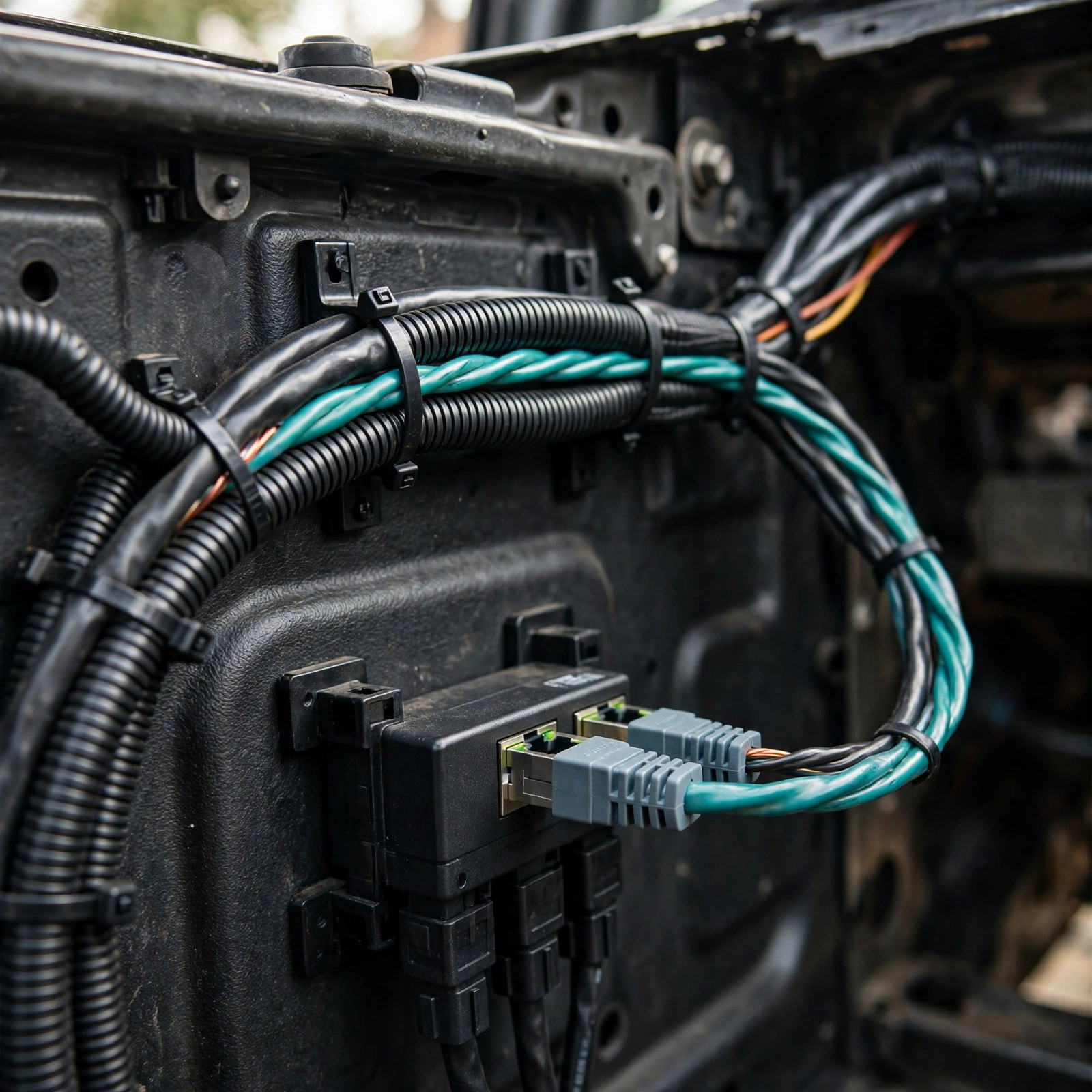
Instead, the industry created a specialized physical layer (PHY)—the hardware layer that turns digital ones and zeros into electrical signals on a wire—called Single-Pair Ethernet, labeled with the suffix BASE-T1. Standards like 100BASE-T1 (100 Mbps), 1000BASE-T1 (1 Gbps), and MultiGBASE-T1 (2.5 Gbps, 5 Gbps, and 10 Gbps under IEEE 802.3ch) use just one twisted pair of copper wire. That is only two copper strands instead of eight. Using echo-cancellation chips, both ends of the wire talk and listen at the exact same time on the same two strands, a capability called full-duplex communication. Switching to a single unshielded twisted pair (UTP) cuts cable weight by roughly 30% and reduces connectivity installation costs by up to 80%.
| Network Technology | Max Bandwidth | Physical Wiring Structure | Determinism Method | Primary Vehicle Domain & Relative Cost |
|---|---|---|---|---|
| Classic CAN | 1 Mbps | Shared 2-wire bus (linear topology) | Priority ID arbitration (non-destructive bitwise) | Simple body switches, low-speed actuators (Lowest cost) |
| CAN FD | 5 Mbps to 8 Mbps | Shared 2-wire bus (linear topology) | Priority ID arbitration with larger 64-byte payloads | Engine, transmission, general body control (Low cost) |
| FlexRay | 10 Mbps | Dual-channel 2-wire bus or star | TDMA (Time-Division Multiple Access) fixed cycle slots | Legacy high-end chassis and suspension control (High cost, phasing out) |
| 10BASE-T1S (IEEE 802.3cg) | 10 Mbps | Single-pair UTP multidrop bus (up to 25 meters) | PLCA (Physical Layer Collision Avoidance) round-robin | Zonal edge sensors, actuators, CAN FD replacement (Low-Medium cost) |
| 100BASE-T1 / 1000BASE-T1 | 100 Mbps / 1 Gbps | Single-pair UTP point-to-point switched link | IEEE 802.1 TSN traffic shapers and preemption | Radar, HD cameras, Zonal Gateway uplinks (Medium cost) |
| MultiGBASE-T1 (IEEE 802.3ch) | 2.5 Gbps / 5 Gbps / 10 Gbps | Single-pair shielded/unshielded point-to-point | IEEE 802.1 TSN hardware-enforced scheduling | Central HPC backbone, 4K cameras, solid-state LiDAR (Higher cost) |
Cutting wire weight solves the physical problem. However, once you put braking commands, steering signals, and YouTube videos onto that single backbone cable, you walk right into the traffic jam problem of standard Ethernet.
How automotive Ethernet TSN builds an ambulance lane on a crowded highway
Time-Sensitive Networking (TSN) is a set of IEEE 802.1 standards that turns a chaotic, first-come-first-served Ethernet cable into a strictly scheduled railway where emergency packets never wait in line. Instead of memorizing dry standard numbers, think of TSN as a four-part highway patrol operation designed to move an ambulance through bumper-to-bumper holiday traffic without touching the brakes.
Step 1: Synchronize every watch with IEEE 802.1AS (gPTP)
Before you can control traffic lights across a city, every intersection needs to read the exact same clock. In a car, this protocol is called the Generalized Precision Time Protocol, or gPTP, defined under IEEE 802.1AS (updated in the IEEE 802.1AS-2025 standard).
Why does a car care about microsecond clock accuracy? Consider sensor fusion, which is how a self-driving computer combines camera pictures and radar echoes to figure out where a pedestrian is standing. Suppose the front radar detects a person at 00 hours, 00 minutes, and 00.001 seconds. If the brake controller’s internal clock is off by just 0.01 seconds, the computer thinks the radar data is old or miscalculates the pedestrian’s walking speed. Under IEEE 802.1AS, one central clock acts as the Grandmaster Clock. Every Zonal Gateway and sensor constantly measures the exact wire delay to its neighbor and adjusts its local timer, keeping every computer in the car synchronized within less than 1 microsecond.
Step 2: Control the traffic lights with IEEE 802.1Qbv (Time-Aware Shaper)
Once every switch in the car shares the exact same microsecond clock, you can run a strict train schedule. That schedule is managed by the Time-Aware Shaper (TAS), standardized as IEEE 802.1Qbv and integrated into the main IEEE 802.1Q specification.
Inside an Ethernet switch, incoming packets wait in up to eight different lines, called queues, based on their priority. Without TSN, even a high-priority queue has to wait for the wire to clear. With IEEE 802.1Qbv, each queue has a timed gate controlled by a schedule called a Gate Control List (GCL). Suppose the steering computer sends a wheel-angle command every 1 millisecond. At the exact microsecond that steering packet is scheduled to arrive, the switch closes the gates on all seven other queues—including the 4K video queue and the software update queue—and opens only the steering queue gate. Because the road is cleared in advance, latency variation, which engineers call jitter, drops to nearly zero.
Step 3: Split the heavy truck in half with IEEE 802.1Qbu and IEEE 802.3br (Frame Preemption)
Closing the gate on video packets works well, except for one tricky timing scenario. What if a massive 1,500-byte entertainment video packet—think of it as a long 18-wheeler cargo truck—rolled through its gate just one microsecond before the gate closed? On a 100 Mbps link, a 1,500-byte packet takes about 120 microseconds to finish crossing the wire. If an emergency brake command (an ambulance) arrives right behind it, the ambulance is stuck staring at the back of the cargo truck.
One way to prevent this is to put a “Guard Band” before the emergency window, closing all gates 120 microseconds early so no big packet can start. However, closing the highway early every millisecond wastes a huge chunk of bandwidth. Instead, engineers use Frame Preemption, defined by IEEE 802.1Qbu and IEEE 802.3br. Frame Preemption divides traffic into two types: Express frames (ambulances) and Preemptable frames (cargo trucks). When an Express brake packet arrives while a 1,500-byte video packet is halfway across the wire, the switch literally slices the video packet in two, pauses it mid-transmission, lets the brake packet pass immediately, and then sends the remaining half of the video packet afterward. The receiving switch glues the two halves of the video packet back together without losing a single byte.
Step 4: Survive a cut brake wire with IEEE 802.1CB (FRER)
In a Level 3 or Level 4 autonomous car, there is no human driver ready to grab the steering wheel within milliseconds if a stone kicks up under the chassis and severs a communication cable. Traditional IT networks recover from a broken cable by recalculating a new route using protocols like Spanning Tree, which can take several milliseconds or even seconds. In a moving car, waiting half a second to find a backup wire is unacceptable.
To achieve zero-time recovery, TSN uses Frame Replication and Elimination for Reliability (FRER), standardized under IEEE 802.1CB. When a Zonal Gateway sends a safety-critical brake or steering packet, the switch automatically clones that packet into two identical copies and stamps both with a sequence number. It sends Copy A along the copper cable running down the left side of the car and Copy B along the cable running down the right side of the car. At the destination computer, whichever copy arrives first is accepted and processed immediately. When the second copy arrives a few microseconds later, the switch sees the matching sequence number and quietly deletes it. If the left-side wire gets severed in an accident, Copy B still arrives on time via the right side with zero recovery delay and zero lost packets.
| IEEE TSN Standard | Highway Traffic Analogy | Core Technical Mechanism | Target In-Vehicle Data |
|---|---|---|---|
| IEEE 802.1AS-2025 (gPTP) | Syncing every traffic officer’s watch to the microsecond | Grandmaster clock distribution with link-delay compensation (<1 μs accuracy) | LiDAR, radar, and camera timestamps for multi-sensor fusion |
| IEEE 802.1Qbv (TAS) | Turning all side-street lights red when the VIP convoy passes | Time-driven Gate Control Lists (GCL) opening/closing 8 priority queues | Periodic chassis control, steer-by-wire, and brake-by-wire commands |
| IEEE 802.1Qbu & 802.3br | Splitting a long cargo truck in half so an ambulance can cut through | Frame Preemption pausing Preemptable frames mid-flight for Express frames | Urgent safety alerts interrupting 1,500-byte infotainment or OTA packets |
| IEEE 802.1Qav (CBS) | Ramp metering lights spacing out cars entering the highway | Credit-Based Shaper smoothing out packet bursts into steady streams | Uncompressed ADAS camera feeds, surround-view video, cabin audio |
| IEEE 802.1CB (FRER) | Sending two identical ambulances down two separate bridges at once | Packet cloning across dual ring paths and duplicate elimination at receiver | L3/L4 autonomous driving actuator commands and fail-operational links |
| IEEE 802.1DG-2025 | The national highway rulebook that all carmakers and suppliers follow | Unified automotive TSN profile defining exact parameter sets and defaults | End-to-end multi-vendor zonal switches and central HPC integration |
Simulating a real car backbone when 4K cameras, LiDAR, and brakes share one wire
On a real vehicle backbone, engineers divide network traffic into three strict priority tiers—Control Data Traffic, Audio/Video Bridging streams, and Best-Effort data—so that every signal meets its exact millisecond or microsecond deadline. Let us trace what happens inside a Zonal Gateway when all three types of traffic hit the same copper wire at once.
First is Control Data Traffic (CDT), often mapped to the highest priority queue. This tier carries chassis control, electronic stability commands, steer-by-wire angles, and autonomous braking triggers. These packets are tiny—usually 64 bytes to 128 bytes—but they require a strict bounded latency between 100 microseconds and 1 millisecond, with jitter kept under a few microseconds. Network architects protect CDT by assigning it dedicated time windows in the IEEE 802.1Qbv Gate Control List, marking its frames as Express for IEEE 802.1Qbu preemption, and duplicating them across dual ring cables using IEEE 802.1CB.
Second is Class A and Class B Audio/Video Bridging (AVB) and ADAS Sensor Traffic. This tier carries raw, uncompressed or lightly compressed video streams from exterior cameras, point-cloud data from solid-state LiDARs, and cabin audio streams. These flows are high-volume, consuming hundreds of megabits or several gigabits per second, and need guaranteed delivery within 2 milliseconds to 10 milliseconds. If four cameras dump huge video frames into a switch at the exact same instant, they create a packet burst that can clog downstream buffers. To prevent bursts, engineers apply the Credit-Based Shaper (CBS), defined in IEEE 802.1Qav. Think of CBS like those highway on-ramp traffic lights that let one car merge every three seconds. A queue earns “transmission credits” when waiting and spends credits when sending data, forcing bursty camera streams to flow at a smooth, predictable pace.
Third is Best-Effort Traffic. This bottom tier handles Over-the-Air (OTA) firmware downloads, Unified Diagnostic Services over IP (DoIP) when a mechanic plugs a scan tool into the car, web browsing, and map updates. Best-Effort traffic has no strict latency guarantee. It simply uses whatever bandwidth is left over between the scheduled CDT windows and the paced AVB camera streams. Whenever an Express safety packet needs the wire, Best-Effort packets are immediately paused and split in half by Frame Preemption.
Engineering Insight Note — Why Optical Fiber (IEEE 802.3cz) Is Entering Cars: Pushing 10 Gbps or 25 Gbps over copper wires creates severe Electromagnetic Interference (EMI)—radio noise that can disrupt sensitive car electronics—and limits copper cable length to 15 meters. To break past this ceiling, the IEEE published IEEE Std 802.3cz-2023 for Multi-Gigabit Optical Automotive Ethernet. Using graded-index glass optical fibers that are immune to electromagnetic noise and lighter than copper, IEEE 802.3cz supports data rates from 2.5 Gbps up to 50 Gbps across distances up to 40 meters, making it a strong candidate for connecting next-generation central AI computers.
Three common misconceptions engineers and planners have about automotive TSN
Adopting automotive Ethernet TSN requires clearing up three widespread industry myths regarding legacy CAN replacement, chip plug-and-play compatibility, and encryption timing overhead.
Misconception 1: Ethernet will immediately wipe out every CAN bus in the car
Some technology analysts assume that because Ethernet is fast, every single switch in a car—down to the sunroof button and seat warmer—will soon hook up to a gigabit Ethernet switch port. That would be financial suicide for an automaker. Putting a point-to-point 100BASE-T1 transceiver chip and a dedicated switch port on a simple window motor costs far too much compared to a cheap CAN wire that lets a dozen sensors share one bus.
However, a newer Ethernet standard called 10BASE-T1S (defined in IEEE 802.3cg) is now shaking up that cost equation. Unlike faster Ethernet versions that require point-to-point connections into a switch, 10BASE-T1S is a multidrop Ethernet bus. It lets at least eight—and often more—edge sensors and actuators clip onto a single shared pair of copper wires stretching up to 25 meters, with no Ethernet switch required in the middle.
To stop those sensors from talking over each other on the shared wire, 10BASE-T1S uses a clever mechanism called Physical Layer Collision Avoidance (PLCA). One coordinator node sends out a tiny timing pulse called a Beacon. After the Beacon, each sensor on the wire gets a numbered turn—a Transmit Opportunity—in a rapid round-robin circle. If Sensor 2 has nothing to say, it yields its turn in a fraction of a microsecond to Sensor 3. Because 10BASE-T1S speaks native Ethernet frames, a Zonal Gateway no longer needs to waste software CPU cycles translating clumsy CAN messages into Ethernet packets. It enables a true “All-Ethernet” vehicle architecture from the central computer right down to the ultrasonic parking sensors in the bumper.
Misconception 2: Buying a TSN-capable switch chip automatically guarantees latency
A common trap in procurement and early architecture planning is treating TSN like Wi-Fi or Bluetooth, where buying a certified chip means everything automatically works out of the box. TSN is not a single plug-and-play protocol. It is a giant toolbox of separate standards.
If an automaker buys a central computer from Supplier A configured to use IEEE 802.1Qbv time slots, and connects it to a Zonal Gateway from Supplier B configured only for IEEE 802.1Qav credit shaping with different clock sync intervals, the two devices will fail to maintain bounded latency. For years, this fragmentation forced carmakers to spend months writing custom configuration rules for every single vehicle program.
That is why the official publication of IEEE Std 802.1DG-2025 (approved in May 2025 and published in June 2025) is such an important milestone for the industry. IEEE 802.1DG is the official Time-Sensitive Networking Profile for Automotive In-Vehicle Ethernet Communications. Instead of letting every supplier guess which TSN tools to turn on, IEEE 802.1DG acts as a master recipe book. It locks down exact default parameters, time-sync behavior, traffic class mappings, and bridge requirements specifically for cars, ensuring that switches and sensors from different tier-one suppliers interoperate predictably.
Misconception 3: Adding cybersecurity encryption has zero impact on TSN timing
Because modern cars are connected to the cloud, leaving internal backbone wires unencrypted invites hackers to inject fake braking or steering packets if they compromise an infotainment unit. To lock down the wire, engineers use Media Access Control Security (MACsec), standardized under IEEE 802.1AE (including the 2023 privacy amendment IEEE 802.1AEdk-2023). MACsec encrypts and authenticates every single Ethernet frame at Layer 2 using Galois/Counter Mode Advanced Encryption Standard (GCM-AES-128 or GCM-AES-256).
The misconception is assuming that encryption happens for free in both time and bandwidth. In reality, MACsec adds a 16-byte Security Tag (SecTag) at the front of the Ethernet frame and a 16-byte Integrity Check Value (ICV) at the back—adding up to 32 bytes of extra overhead to every single packet. On a tiny 64-byte brake command packet, adding 32 bytes increases the packet’s wire time by nearly 50%. Furthermore, if a chip tries to run MACsec encryption in software rather than dedicated line-rate PHY hardware, the encryption delay adds variable jitter that ruins IEEE 802.1AS clock synchronization and causes packets to miss their IEEE 802.1Qbv gate windows. Engineers must always calculate MACsec byte overhead and hardware encryption pipeline delay before finalizing their TSN Gate Control Lists.
Five-step implementation checklist for designing an SDV network
Designing a production-ready software-defined vehicle network requires verifying physical speed tiers, clock failover paths, gate schedules, encryption overhead, and compliance testing before freezing the hardware architecture. Below is the five-step engineering checklist that architecture teams use when moving from whiteboard diagrams to actual vehicle prototypes.
- Calculate PHY Speed Tiering Across Zones: Do not over-provision expensive transceivers where they are not needed, and do not starve the central backbone of headroom for future OTA upgrades. Use 10BASE-T1S (IEEE 802.3cg) multidrop buses for low-speed edge sensors and actuators inside a zone. Step up to 1000BASE-T1 (IEEE 802.3bp) for high-definition cameras and radar uplinks into the Zonal Gateway. For the main backbone connecting Zonal Gateways to the central HPC, size the links using MultiGBASE-T1 (IEEE 802.3ch at 2.5G, 5G, or 10Gbps) or IEEE 802.3cz optical fiber if EMI shielding and cable runs beyond 15 meters are required.
- Design gPTP Grandmaster Clock Placement and Failover: Under IEEE 802.1AS-2025, automotive networks normally pre-configure a fixed clock hierarchy rather than waiting for slow dynamic election algorithms at startup. Place the primary Grandmaster Clock in the central HPC, backed by a high-stability crystal oscillator, and assign a secondary hot-standby Grandmaster in one of the Zonal Gateways. Verify that if the primary clock fails, the backup clock takes over across redundant ring paths without causing a phase jump that breaks sensor fusion.
- Optimize Gate Control Lists (GCL) with Frame Preemption: When programming IEEE 802.1Qbv schedules across multiple hops, calculate the worst-case propagation delay of every switch and cable segment. Always pair IEEE 802.1Qbv scheduled windows with IEEE 802.1Qbu Frame Preemption. Enabling preemption shrinks the required Guard Band before a critical control window from 1,500 bytes (a full Ethernet frame) down to roughly 124 bytes (the minimum non-preemptable fragment size), recovering massive amounts of usable bandwidth for cameras and OTA updates.
- Audit MACsec (IEEE 802.1AE) Timing and Bandwidth Budgets: When enabling Layer 2 encryption via IEEE 802.1AE MACsec, add 32 bytes (SecTag plus ICV) to the size of every protected frame when calculating your IEEE 802.1Qbv gate open durations. Confirm with your silicon vendor that gPTP timestamping occurs at the physical layer below the MACsec encryption engine, ensuring that encryption processing never introduces variable jitter into your time synchronization packets.
- Pass IEEE 802.1DG-2025 and OPEN Alliance Conformance Suites: Verify that all switch and endpoint configurations strictly follow the parameter constraints in IEEE Std 802.1DG-2025. Before signing off on ECU hardware and software, mandate full compliance testing under the OPEN Alliance specifications: TC8 for full seven-layer Automotive Ethernet ECU protocol and switch conformance, TC12 for 100BASE-T1 and 1000BASE-T1 PHY interoperability, and TC15 for MultiGBASE-T1 channel and electromagnetic compatibility.
Key takeaways: The nervous system of the software-defined vehicle
The true revolution of the Software-Defined Vehicle (SDV) does not live on the glossy touchscreens mounted on the dashboard. It lives beneath the floor mats, inside the unified nervous system that moves gigabits of sensor data and microsecond control commands without a single hiccup.
If Single-Pair Automotive Ethernet widened the blood vessels of the car while stripping out 30% of the heavy copper wiring, automotive Ethernet TSN is the pacemaker that guarantees life-critical braking and steering signals never lose a single microsecond to a back-seat movie stream. With the formal publication of the IEEE 802.1DG-2025 automotive profile and the rapid rollout of 10BASE-T1S multidrop links, the era of fragmented, overweight vehicle wiring is officially coming to an end.
What is the biggest bottleneck you are facing in your current next-generation E/E architecture project when evaluating 10BASE-T1S or TSN switch scheduling in place of legacy CAN FD? Share your thoughts and engineering questions in the comments below, and bookmark the TSN standard cheat-sheet table in this article for your next architecture review meeting.
Sources
- IEEE Std 802.1DG-2025: IEEE Standard for Local and Metropolitan Area Networks—Time-Sensitive Networking Profile for Automotive In-Vehicle Ethernet Communications — IEEE Standards Association, June 6, 2025
- P802.1DG – TSN Profile for Automotive In-Vehicle Ethernet Communications Task Group Project Status — IEEE 802.1 Working Group, June 2025
- Time-Sensitive Networking for Automotive In-Vehicle Communications — IEEE SA Beyond Standards, May 12, 2026
- IEEE Std 802.1AS-2025: Timing and Synchronization for Time-Sensitive Applications — IEEE Standards Association, December 17, 2025
- 802.1AS-2025-Revision – Timing and Synchronization for Time-Sensitive Applications Maintenance Project — IEEE 802.1 Working Group, September 2026
- IEEE Std 802.3ch-2020: Physical Layer Specifications and Management Parameters for 2.5 Gb/s, 5 Gb/s, and 10 Gb/s Automotive Electrical Ethernet — IEEE Standards Association, June 30, 2020
- IEEE Std 802.3cz-2023: Physical Layer Specifications and Management Parameters for Multi-Gigabit Optical Automotive Ethernet — IEEE Standards Association, April 28, 2023
- IEEE P802.3cg 10 Mb/s Single Pair Ethernet (10BASE-T1S and PLCA) Technical Overview — IEEE 802.3 Ethernet Working Group, January 2019
- TC8 – Automotive Ethernet ECU Test Specification — OPEN Alliance, 2026
- Automotive Ethernet Specifications (TC8, TC12, TC15, 10BASE-T1S) — OPEN Alliance, 2026