Hi, this is Datumdraft. Automakers keep promising longer electric vehicle driving range without making the battery pack any bigger. Spec sheets credit a tiny semiconductor called a silicon carbide inverter, yet some articles claim a 2% boost while others shout over 7%. Here is what actually happens inside the car, why those numbers clash, and when you should care before buying your next EV.
At a Glance
- SiC inverters cut switching heat losses, adding 2–5% real WLTP driving range without increasing battery pack size.
- The biggest efficiency win happens during partial-load highway cruising, where inverter losses drop 40–70% versus silicon.
- High-voltage 800V platforms push silicon IGBTs past their efficiency sweet spot, making SiC MOSFETs the clear choice.
- Silicon IGBTs still beat SiC on cost and simplicity in budget 400V electric cars.
How does a tiny chip add EV range without a bigger battery?
A silicon carbide inverter extends driving range by wasting less of the electricity already sitting in your battery. Imagine a busy highway toll booth where every car slows down and pays a cash fee. An old cash booth drains time and fuel at every single pass, while an electronic express gate lets cars fly straight through.
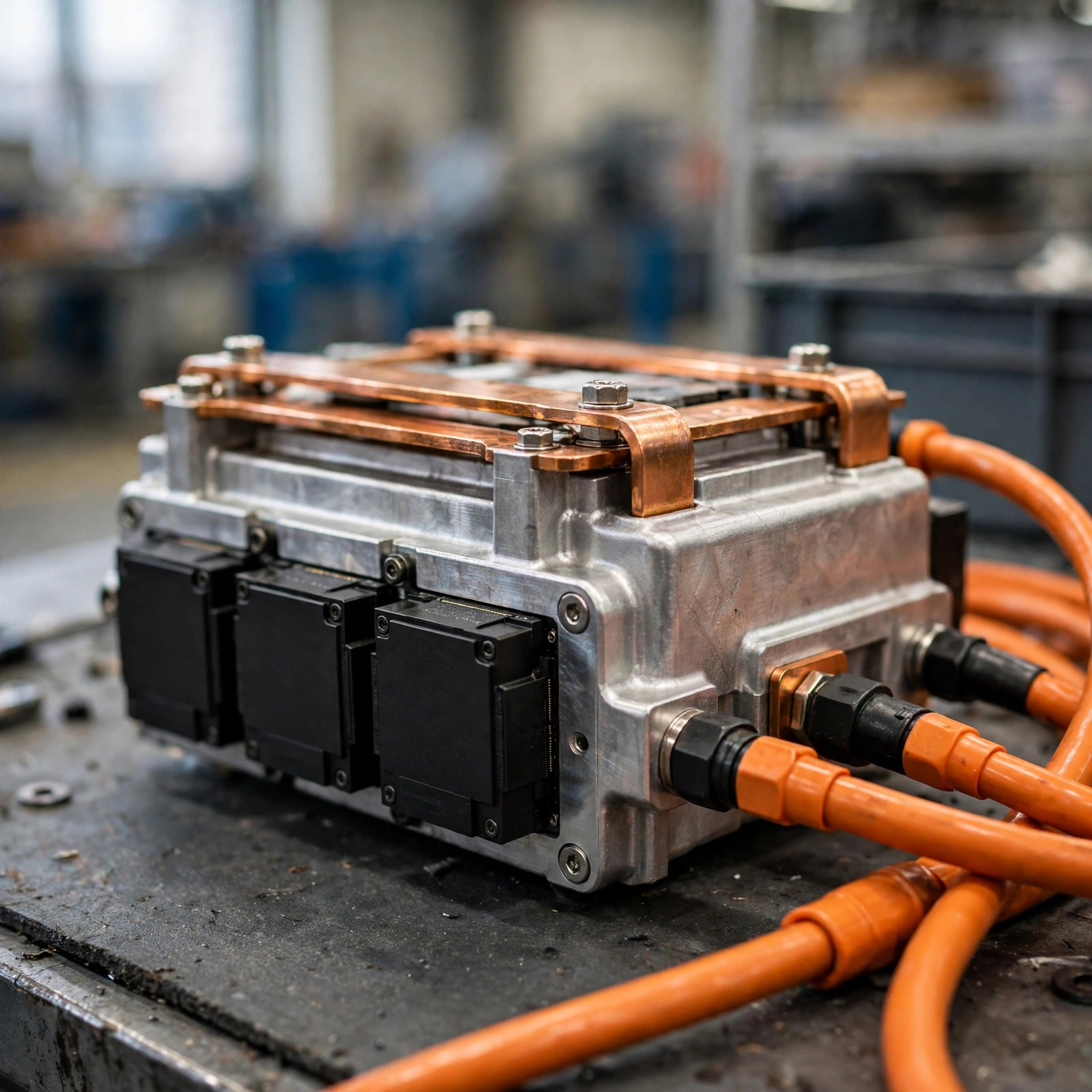
Inside an electric car, the traction inverter acts like that toll booth. Your battery stores direct current (DC), which flows steadily in one direction at 350 to 800 volts. Your electric motor needs three-phase alternating current (AC), which flips direction rapidly to spin the wheels. The inverter converts battery DC into motor AC thousands of times per second.
Every flip creates a small burst of wasted heat. Older EVs use silicon insulated-gate bipolar transistors (IGBTs), which are power switches made from standard silicon. When a silicon IGBT switches off, leftover electrical charges linger inside the chip for a split second. Engineers call this lingering trickle a minority-carrier tail current, and it turns useful battery energy straight into heat.
A silicon carbide metal-oxide-semiconductor field-effect transistor (SiC MOSFET) avoids that trap. Silicon carbide is a compound semiconductor made from silicon and carbon atoms bonded tightly together. Because a SiC MOSFET is a unipolar device, it uses only one type of charge carrier. When it turns off, current stops cleanly with no tail current.
Less heat at every switch adds up over a full drive. Peak inverter efficiency moves from roughly 96–97% with silicon IGBTs to about 98–99% with SiC MOSFETs. That extra efficiency pairs directly with your car’s battery management system to stretch every kilowatt-hour (kWh) further. The pack holds the exact same energy, yet more of it reaches the tires instead of warming the cooling loop.
Myth Buster: Do not mistake a single-switch lab number for a car-level result. Textbooks often show a rough illustrative switch loss of about 120 millijoules (mJ) for an IGBT versus 3 mJ for a SiC MOSFET. That 40-to-1 ratio describes one isolated switching event on a lab bench, so you should never claim a SiC inverter makes an EV 40 times more efficient on the road.
Why does the 7% range claim shrink to 2–5% on real roads?
Real-world driving typically gives you a 2–5% range gain from a SiC inverter, while claims above 7% come from specific supplier test setups. Think of a diet supplement ad promising you will lose seven kilograms in a month. Read the tiny print at the bottom, and you find that result came from a narrow group under strict lab conditions.
In automotive engineering, the standard yardstick is the Worldwide Harmonized Light Vehicles Test Procedure (WLTP), a laboratory drive cycle that mixes city, suburban, and highway speeds. Across typical EVs on the WLTP cycle, swapping a silicon IGBT inverter for a SiC MOSFET inverter adds 2–5% to total driving range. On a car rated for 500 kilometers (about 310 miles), that equals roughly 10 to 25 extra kilometers per charge.
Where do the bigger headlines come from? British motorsport supplier McLaren Applied reported that its IPG5 800V SiC inverter can extend EV range by over 7% compared to an IGBT baseline. Hyundai also noted an approximate 5% efficiency and range gain when upgrading the Ioniq 5 front motor inverter to SiC. Both numbers reflect specific hardware baselines and single-model upgrades rather than a universal guarantee across every electric car.
Your driving style also dictates how much energy SiC actually saves. Based on BorgWarner’s Viper 800V inverter data, SiC cuts inverter power losses by 40–70% compared to silicon depending on the drive cycle. The savings peak during steady, partial-load highway cruising, where switching losses dominate the inverter’s total waste. During full-throttle peak acceleration, conduction losses take over, so the gap between SiC and silicon shrinks to its smallest point.
| Driving Condition | SiC Loss Reduction | What Happens Inside the Inverter |
|---|---|---|
| Partial-load highway cruising | Highest (upper end of 40–70%) | Steady light current means switching waste dominates, giving SiC its biggest edge. |
| Stop-and-go city driving | Moderate | Frequent regenerative braking and low-speed pulls keep switching efficiency valuable. |
| Peak full-throttle acceleration | Smallest | Heavy current pushes conduction heat up, narrowing the gap with silicon IGBTs. |
Why do budget 400V cars still pick silicon IGBTs over SiC?
Automakers keep silicon IGBTs in mass-market 400V electric cars because SiC costs more to buy and harder to engineer. Think of kitchen knives. An expensive Damascus steel blade excels at precision work in a high-end restaurant, yet a sturdy stainless steel knife beats it on price and durability for everyday home cooking.
Voltage decides which blade wins. Silicon has a bandgap of 1.12 electronvolts (eV), which measures how much energy it takes to push electrons into conduction. Silicon carbide has a bandgap of 3.26 eV. SiC also tolerates a critical breakdown electric field of 3.0 megavolts per centimeter (MV/cm), roughly ten times higher than silicon’s 0.3 MV/cm.
That physics gap explains why high-voltage cars need SiC. An 800V EV architecture requires power switches rated for 1,200 volts to leave a safe margin against voltage spikes. When you push standard silicon IGBTs up to 1,200-volt ratings, their internal electrical resistance climbs steeply and heat losses pile up. SiC handles 1,200 volts effortlessly in a much thinner chip.
Down at 400 volts, the math flips back in silicon’s favor. Silicon IGBTs rated for 650 to 750 volts run cool enough and cost a fraction of SiC wafers. SiC also brings hidden engineering headaches that rarely show up on marketing slides. Because SiC switches at pulse-width modulation (PWM) carrier frequencies of 20–40 kilohertz (kHz). Silicon IGBTs switch at 8–15 kHz. Engineers must design tougher gate-drive circuits, add negative turn-off voltage bias, and shield against extra electromagnetic interference (EMI). For an affordable 400V commuter car, paying that engineering bill rarely pays off.
| Metric | Silicon IGBT | SiC MOSFET |
|---|---|---|
| Peak inverter efficiency | ~96–97% | ~98–99% |
| Typical PWM carrier frequency | 8–15 kHz | 20–40 kHz |
| Bandgap energy | 1.12 eV | 3.26 eV |
| Critical breakdown field | 0.3 MV/cm | 3.0 MV/cm (~10x higher) |
| 800V platform fit | On-resistance rises steeply at high voltage | Ideal match (requires 1,200V SiC devices) |
| 400V mass-market cost and value | Strong advantage | Higher chip and gate-drive engineering cost |
Is Wolfspeed bankrupt, saved, or stuck in between?
Both viral headlines about Wolfspeed miss the truth: the silicon carbide pioneer is out of bankruptcy today, yet its factory economics are still bleeding money. Picture a patient wheeled into an intensive care unit. The emergency surgery worked and saved the patient’s life, yet the patient still cannot walk out of the hospital under their own power.
Check the exact dates before believing social media rumors. Wolfspeed filed for prepackaged Chapter 11 bankruptcy protection on June 30, 2025, rather than in 2026. The company completed its restructuring and emerged from Chapter 11 on September 29, 2025. That deal slashed roughly 70% of its debt load and pushed remaining debt maturities out to 2030.
Survival on paper does not automatically fix factory margins. In its fiscal quarter ended September 2026 (Q1 FY2027), Wolfspeed still posted a negative non-GAAP gross margin of roughly -13% (specifically -12.8%). Underused wafer fabs and tough SiC pricing continue to weigh on profitability.
Then came another widely misread headline on October 7, 2026. Wolfspeed announced a conditional 30-year, $1.5 billion loan commitment from the U.S. Department of War’s Office of Strategic Capital. Read the wording carefully: that letter is conditional and non-binding. The government has promised a potential loan if milestones are met, so the $1.5 billion is not cash sitting in Wolfspeed’s bank account today.
Meanwhile, automakers spread their supply risk across multiple major SiC chipmakers, including STMicroelectronics, onsemi, Infineon, and Wolfspeed. Engineers are also exploring ways to blend both chip types in one box. Tesla published an international patent application (WO 2026/010828-A1) in January 2026 describing a hybrid traction inverter combining SiC and IGBT switches. Treat that as a glimpse of future R&D rather than confirmed production hardware on dealership lots.
Wolfspeed Timeline (2025–2026): Filed prepackaged Chapter 11 on June 30, 2025. Emerged on September 29, 2025 with ~70% less debt and maturities extended to 2030. Reported ~-13% non-GAAP gross margin for the September 2026 quarter. Received a conditional, non-binding $1.5 billion U.S. Department of War loan commitment on October 7, 2026.
Should SiC matter when you buy your next EV?
Before getting excited about “SiC” on an electric car brochure, ask one question first: is the car built on 800 volts or 400 volts? Shopping for an inverter by itself is like judging a house solely by its wall insulation. Great insulation helps, yet your heating furnace, window quality, and floor plan still decide how comfortable and affordable the home feels.
SiC earns its keep if you buy an 800V vehicle, log regular highway miles, and rely on public fast chargers. That matches the exact conditions where 1,200V SiC switches trim 40–70% of inverter heat losses and deliver steady WLTP range gains. Just like moving from 12V wiring to a 48V electrical system for low-voltage accessories, high-voltage SiC pays off most when the entire car architecture is designed around it.
If you are shopping for a budget-friendly 400V commuter EV, put silicon carbide near the bottom of your priority list. Battery capacity, local charging access, and out-the-door price matter far more than a 2–5% inverter gain. A well-priced 400V car with a reliable silicon IGBT inverter will serve you just fine.
Four quick questions to check before you sign
- Is it an 800V platform? High-voltage 800V cars need 1,200V SiC chips to shine, whereas 400V budget models work efficiently on silicon IGBTs.
- Which axle gets the SiC inverter? Some dual-motor EVs put SiC on the primary cruising motor and keep a cheaper silicon IGBT on the secondary axle.
- What is the certified WLTP or EPA range? Judge the final tested range number rather than assuming a SiC badge automatically beats a larger battery.
- How often do you take highway road trips? Partial-load highway cruising is where SiC recovers the most energy per charge.
Key takeaways
A silicon carbide inverter does not add a single kilowatt-hour to your battery pack. Instead, it stops your car from throwing stored electricity away as heat during high-speed DC-to-AC switching. On real roads, that efficiency upgrade delivers a reliable 2–5% WLTP range increase, with the biggest payoff during steady highway cruising.
Keep marketing numbers and industry rumors in perspective. Claims above 7% belong to specific supplier baselines. Silicon IGBTs still hold a clear cost edge in 400V mass-market cars. Wolfspeed’s post-bankruptcy turnaround remains a work in progress as of late 2026. If you are shopping for an 800V road-tripper, SiC is worth checking on the spec sheet.
If this breakdown changed how you read EV spec sheets, bookmark it or share it with a friend shopping for their next electric car. Does your current EV run a SiC inverter or a silicon IGBT? Drop your model and real-world highway range in the comments.
Sources
- Viper – 800 Volt Silicon Carbide Inverter — BorgWarner, accessed Nov 2026
- Silicon carbide (SiC) inverter extends EV range by over 7% — Power Electronics News, April 4, 2023
- Hyundai’s E-GMP EVs To Get Better Range And Improved Charging Speeds — InsideEVs, December 9, 2022
- Wolfspeed Takes Next Step to Implement Restructuring Support Agreement and Proactively Strengthen Capital Structure — Wolfspeed, June 30, 2025
- Wolfspeed Successfully Completes Financial Restructuring — BankruptcyData, October 23, 2026
- Wolfspeed Q4 FY26 Earnings Release (Chapter 11 Emergence Reference) — Wolfspeed Investor Relations, August 19, 2026
- Wolfspeed (WOLF) Q1 FY2027 Earnings Call Transcript & Summary — BigGo Finance, November 3, 2026
- Wolfspeed Announces Conditional 30-Year, $1.5 Billion Loan Commitment from U.S. Department of War — Wolfspeed, October 7, 2026
- Department of War’s Office of Strategic Capital Announces $1.5 Billion Conditional Loan Commitment to Wolfspeed, Inc. — U.S. Department of War, October 7, 2026
- WO/2026/010828: Hybrid Traction Inverters for Electric Traction Motors — WIPO PATENTSCOPE, January 8, 2026