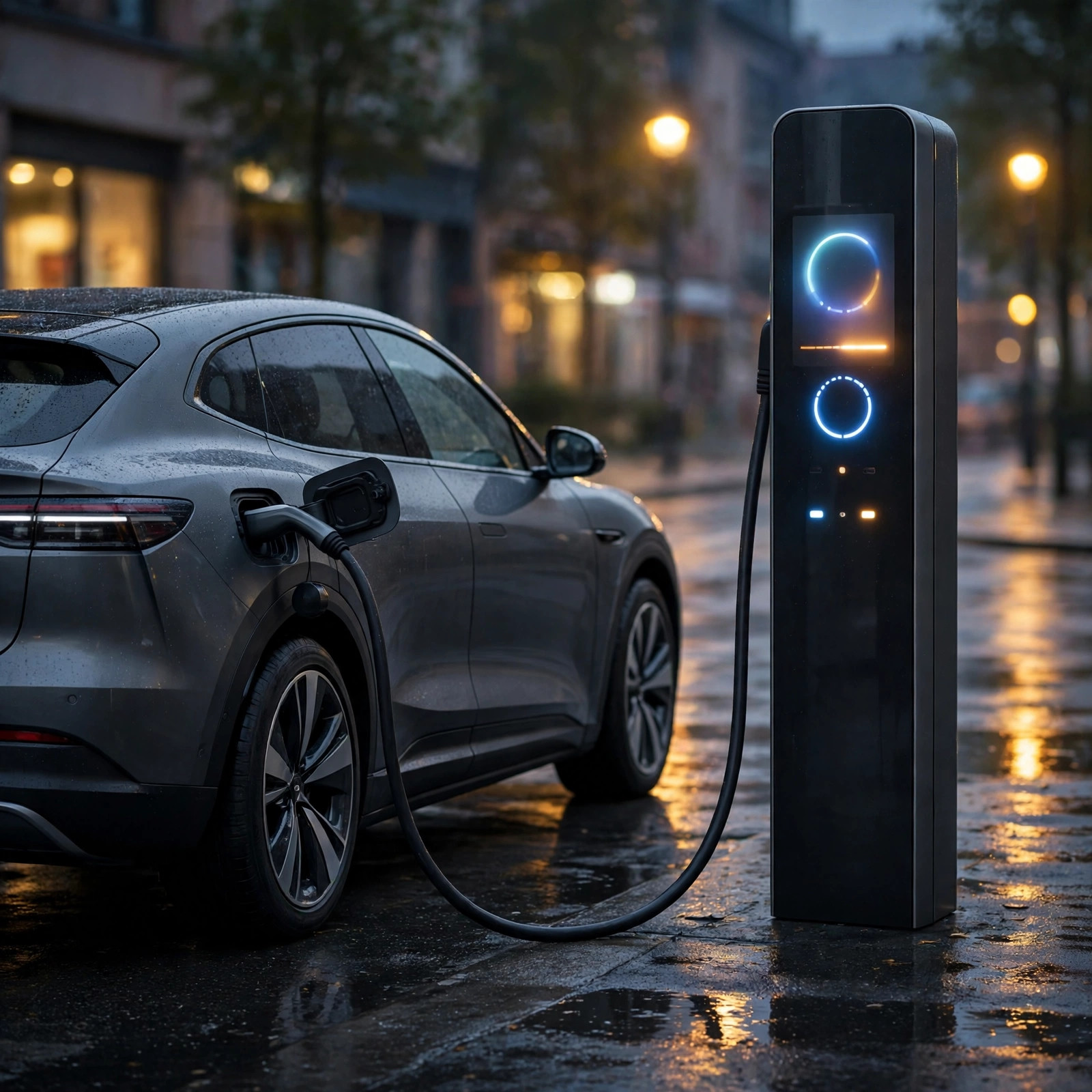
Hi, this is Datumdraft. Picture yourself pulling into a highway rest stop on a rainy Friday night and plugging your electric car into a shiny 350 kW ultra-fast charger. Your screen promises a quick trip, yet you sit there for 40 minutes while a Hyundai IONIQ 5 next to you hits 80% in the time it takes to buy a coffee. The secret behind that gap is the 800V EV architecture, which beats older 400V cars by cutting wire heat to one-quarter so the battery can hold high charging power without cooking the cables.
At a Glance
- Doubling system voltage to 800V delivers twice the charging power at the exact same electric current.
- Cutting electric current in half reduces cable and battery heat loss by 75%.
- Lower heat lets the Hyundai IONIQ 5 charge from 10% to 80% in about 18 minutes.
- An 800V car needs an onboard voltage booster to charge quickly at older 400V stations.
Why did 400V hit a wall when charging handles got as thick as your forearm?
The dumbest way to double electric car charging speed is to force twice as much electric current through the same cable. Doing that turns the charging cord into a giant space heater that is too heavy for a driver to lift.
Think about filling a backyard swimming pool with a garden hose. If you try to double the water flow by making the hose wider, the rubber pipe swells until it is as thick and heavy as a fire hose. If you double the water pressure instead, you can shoot twice as much water through the original thin hose without breaking your back.
In electricity, water pressure is voltage, measured in volts (V). Water flow volume is current, measured in amperes or amps (A). Total charging power, measured in watts (W) or kilowatts (kW), is simply voltage multiplied by current: P = V × I.
For the past decade, most electric cars ran on a 400V system. To push 240 kW of fast-charging power into a 400V battery, the charger has to pump 600A of current through the cable (400V × 600A = 240 kW). Pushing 600A through copper wire triggers a brutal physics problem called Joule heating.
Joule heating is the heat created when electrons rub against atoms inside a wire. The formula for this wasted heat is current squared times resistance: P_loss = I²R. Because current is squared in that equation, doubling the current does not just double the heat.
Doubling the current quadruples the heat inside the cable and battery pins. By switching to an 800V EV architecture, engineers double the electrical pressure to 800V and cut the current in half to 300A for the exact same 240 kW of power. Cutting the current in half drops the heat loss to one-quarter, which is a 75% reduction in wasted heat.
This exact same physics explains why automakers are replacing old 12V car batteries with a 48V electrical system to run power-hungry computers and steering motors. Raising voltage is the only practical way to move more power without melting the wires.
Why does the Hyundai IONIQ 5 finish in 18 minutes when a 250 kW catalog number is a mirage?
The maximum kilowatt number printed on a car brochure is a marketing mirage that often lasts only a few minutes. What actually gets you back on the highway fast is how long the car can hold high power before heat forces it to slow down.
Imagine two runners racing a 5-kilometer course. The first runner sprints the opening 200 meters at top speed, runs out of breath, and walks the rest of the track. The second runner starts slightly slower but holds a steady, fast pace all the way to the finish line.
In electric cars, that pace across the race is called the charging curve, which plots charging power in kilowatts against your battery percentage, known as State of Charge (SoC). A 400V vehicle connected to a Tesla V3 Supercharger can hit an impressive peak of 250 kW. However, because pushing that power at 400V requires huge current, heat builds up fast inside the cables and battery pack.
To prevent damage, the car’s battery management system steps in and throttles the current down early in the session. By contrast, Hyundai’s E-GMP platform in the Hyundai IONIQ 5 peaks at around 230 to 240 kW on a 350 kW charger, which is actually lower than a 250 kW Supercharger peak. Yet the Hyundai IONIQ 5 charges from 10% to 80% in about 18 minutes when the battery is preconditioned.
The Hyundai IONIQ 5 wins the race because its 800V system runs at half the current, keeping the internal components much cooler. Instead of spiking briefly and dropping off a cliff, the 800V charging curve stays flat across a wide plateau before tapering down near 80%. Porsche proved this exact physics advantage when it launched the Porsche Taycan on the J1 platform in September 2019 as the world’s first production 800V electric vehicle.
Early Porsche Taycan models reached up to 270 kW and charged from 5% to 80% in 22.5 minutes. With the 2024 facelift, Porsche pushed the Taycan’s peak charging capability up to 320 kW while holding a remarkably wide high-power plateau.
| Specification | 400V EV Architecture | 800V EV Architecture |
|---|---|---|
| Current Required for 240 kW | 600 A (400V × 600A) | 300 A (800V × 300A) |
| Relative Heat Loss (I²R) | 100% baseline thermal load | 25% thermal load (75% less heat) |
| High-Voltage Cable Gauge | Thick, heavy copper bundles | Slimmer, lighter copper wiring |
| Primary Power Semiconductor | Silicon IGBT (Insulated-Gate Bipolar Transistor) | SiC (Silicon Carbide) MOSFET |
| Charging Curve Shape | Brief peak followed by early thermal taper | Sustained high-power plateau across mid-SoC |
| Verified 10% to 80% / 5% to 80% Time | Varies by thermal limits; longer taper tail | Hyundai IONIQ 5: ~18 min (10–80%) / Porsche Taycan: 22.5 min (5–80% early models) |
How does an 800V EV architecture trim copper wiring and upgrade the inverter?
Moving to 800V shrinks the bright orange high-voltage cables snaking underneath the car floor and forces a major upgrade in the computer chips that control the motor. Because the system carries half the electric current, engineers can use thinner copper wires and smaller connectors throughout the vehicle.
Think of an old highway toll plaza where human cashiers hand out paper tickets one car at a time. Cars have to slam on their brakes, wait in line, and burn extra fuel idling before accelerating again. Now picture a modern multi-lane electronic toll gantry where cars breeze through at highway speed without touching the brakes.
In an electric car, that toll plaza is the traction inverter, the device that converts direct current (DC) from the battery into alternating current (AC) to spin the drive motor. Inside the inverter sit tiny electronic switches called power semiconductors that flip on and off thousands of times every second. Older 400V cars usually rely on pure silicon switches known as Insulated-Gate Bipolar Transistors (IGBTs).
Silicon IGBTs work well at 400V, but they waste energy as heat every time they flip on and off at higher voltages. To make an 800V EV architecture work efficiently, automakers replace silicon switches with Silicon Carbide (SiC) semiconductors. Silicon Carbide is a crystal compound of silicon and carbon that handles high voltage and high temperatures with far less switching loss.
When Hyundai engineered the E-GMP platform, it placed SiC power modules inside the rear drive inverter to cut energy wasted during both highway driving and fast charging. This hardware shift works alongside modern domain vs zonal wiring layouts to strip unnecessary copper out of the chassis. Even when next-generation solid-state battery packs arrive later this decade, they will still depend on 800V wiring and SiC inverters to move energy without overheating the car.
What happens when you plug a cutting-edge 800V car into an older 400V charger?
Plug a high-voltage electric car into an older 400V fast charger at your local supermarket, and charging can crawl to a frustrating trickle unless the car has a built-in voltage pump. Electricity only flows from higher voltage to lower voltage, so a 400V station cannot naturally push electrons into an 800V battery pack.
Imagine trying to fill a water tank on the second floor of your house using city water pressure that only reaches the first floor. Unless you install a booster pump between the first-floor pipe and the upstairs tank, not a single drop of water will climb up the pipe.
Automakers have solved this 400V compatibility headache in two verified ways, while one luxury automaker shows how painful the problem remains when the booster is weak.
1. The Dedicated Onboard Booster (Early Porsche Taycan)
When Porsche launched the Taycan on the J1 platform, engineers installed a separate piece of hardware called an onboard DC-DC voltage booster. When you plug into a 400V charger, this box steps the incoming 400V power up to 800V so the battery can charge. However, adding a standalone high-voltage converter adds extra weight and cost, and early Taycan models came standard with a booster capped at just 50 kW unless the buyer paid extra for a higher-capacity option.
2. The Rear Motor and Inverter Trick (Hyundai E-GMP Multi-Charging)
Hyundai solved the exact same problem on the E-GMP platform without adding a single separate booster box. Instead, when a Hyundai IONIQ 5 plugs into a 400V fast charger, its patented multi-charging system routes the incoming 400V electricity straight through the rear drive motor’s copper windings and the rear SiC inverter. By rapidly switching the inverter transistors while the car is parked, the motor coils act as giant inductors that pump 400V up to 800V using parts the car already carries for driving.
3. The Compatibility Shadow (Lucid Air 900V+ at 400V Superchargers)
To see what happens when a high-voltage car meets a 400V charger without a high-capacity booster, look at the Lucid Air. The Lucid Air runs on a 900V+ electrical architecture — even higher than 800V — and can pull over 300 kW on compatible ultra-fast chargers. Yet when connected to a 400V Tesla Supercharger, the Lucid Air’s onboard Wunderbox booster limits charging speed to roughly 50 kW, turning a flagship luxury sedan into a slow charger at older stations.
Does doubling voltage to 800V double the risk of electric shock in a crash or rainstorm?
Doubling a car’s battery voltage to 800V does not make it twice as dangerous to touch in a rainstorm or a highway crash. That is because the high-voltage wires never use the metal car body as a return path, and tiny explosive switches sever the battery connection in milliseconds during an accident.
Think of the circuit breaker box in your home bathroom, which cuts the power the instant a hairdryer falls into a sink. Now imagine a breaker that does not just flip a plastic switch, but fires a tiny gunpowder charge to slice the copper bar in half before you can even blink.
Every 800V passenger car must pass strict international electrical safety rules known as ISO 6469-3, which covers road vehicles operating up to 1,500V DC. First, the 800V circuit is completely isolated from the metal chassis, and onboard sensors check the insulation resistance continuously while you drive and charge. Second, if the airbag computer detects a crash or a short circuit, it triggers a pyrotechnic fuse — called a pyro-fuse — that physically blows apart the internal battery connection within milliseconds, leaving the orange cables outside the pack completely dead.
Q. Is electrocution risk doubled at 800V?
No. Under international safety standard ISO 6469-3, 800V systems use full galvanic isolation from the vehicle body, continuous insulation monitoring, and a pyrotechnic disconnect (pyro-fuse) that physically severs the high-voltage loop inside the battery pack within milliseconds of a collision.
What should you check before buying your next EV?
An 800V EV architecture is not a luxury trim package for impatient drivers; it is an engineering fix that solves three physical bottlenecks at once. By doubling voltage and cutting current in half, it slashes I²R heat loss by 75%, trims heavy copper wiring out of the chassis, and pairs with Silicon Carbide inverters to waste less energy on the road.
When you shop for your next electric vehicle, look past the peak kilowatt number on the window sticker and ask two questions instead: what is the battery’s system voltage, and how does the car boost voltage when plugged into an older 400V station? Bookmark the comparison table above for your next test drive, and let me know in the comments whether your current EV runs on 400V or 800V.
Sources
- World premiere of the Porsche Taycan: Sports car, sustainably redesigned (First production 800V system, 270 kW peak, 5 to 80% in 22.5 minutes) — Porsche Newsroom, 2019-09-04
- Hyundai EV Charging Innovation Guide (E-GMP 800V architecture, 10 to 80% in ~18 minutes, multi-charging rear motor/inverter system) — AutoEdgeView
- Lucid Air Grand Touring: A long-distance champion with plenty of power (900V+ architecture and 300 kW+ fast charging) — electrive, 2026-11-12
- Lucid Air Gets Tesla Supercharger Access, at Nissan Leaf Speeds (50 kW limit on 400V Superchargers via onboard booster) — The Drive, 2025-07-22
- Lucid Air becomes world’s fastest-charging EV (900V+ architecture and 300 kW peak charging specifications) — CarExpert, 2020-08-20
- ISO 6469-3: Electrically propelled road vehicles — Safety specifications — Part 3: Electrical safety — International Organization for Standardization (ISO)