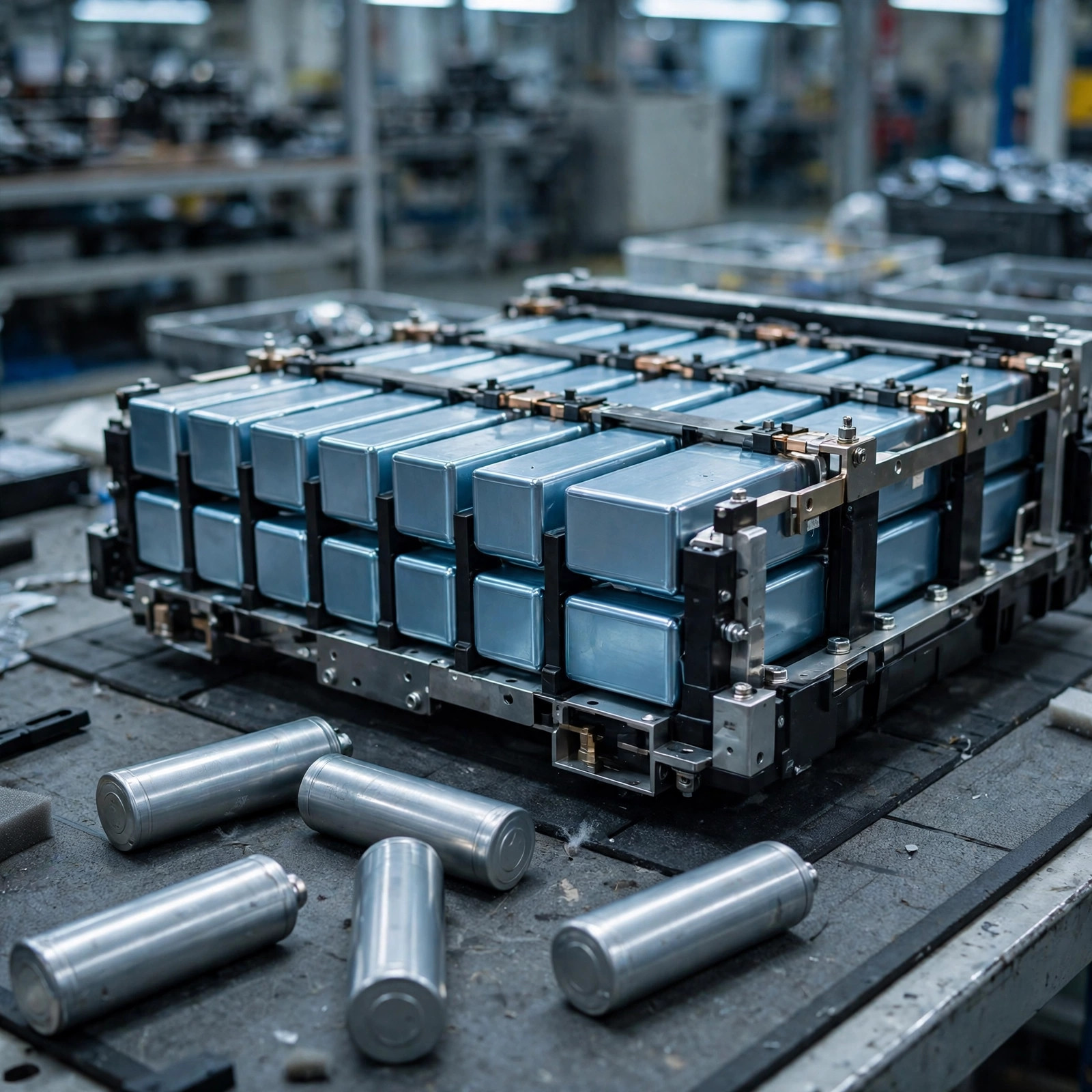
Hi, this is Datumdraft. Headlines have promised for years that cheap “salt batteries” will cut electric car prices in half. Yet in late 2026, a sodium-ion battery costs nearly twice as much as a standard lithium battery, and stores about 30% less energy. If you are shopping for an electric car or tracking the sodium-ion battery vs LFP race, the real story in November 2026 looks very different from the viral headlines.
At a Glance
- Sodium-ion batteries still cost nearly double LFP today, averaging $153/kWh in recent grid storage bids.
- At the pack level, sodium-ion stores roughly 30% less energy than lithium batteries, capping long-range highway use.
- Extreme cold is sodium-ion’s killer edge, keeping 90% capacity in deep-freeze winter tests where LFP struggles.
- Changan’s Nevo A06 is the first mass-production sodium-ion car, with over 400 km of range, while BYD still waits.
Why does a “salt battery” cost nearly double LFP today?
Cheap raw salt does not make a cheap battery until massive factories run at full speed. Picture a small neighborhood bakery making bread from cheap flour. Next door, a huge automated factory bakes bread from pricier rice flour, churning out ten thousand loaves an hour. The automated factory still sells its loaf for half the price.
That exact factory gap explains battery pricing in late 2026. Buyers measure battery prices in dollars per kilowatt-hour ($/kWh), which is the cost for one unit of stored electricity. In September 2026, a public grid storage tender in China (Renqiu, Hebei) put real prices on the table. A grid storage tender is a bidding auction where power companies buy giant battery banks to store electricity.
In that September 2026 tender, sodium-ion battery bids averaged about $153/kWh. Bids for LFP (lithium iron phosphate, the workhorse battery in most affordable electric cars) averaged about $79/kWh. Put into everyday car scale, a 50 kWh battery pack at those rates would cost roughly $7,650 for sodium-ion versus about $3,950 for LFP. That is an approximate gap of $3,700 on the same size pack.
LFP enjoys two huge advantages right now. First, battery makers already run hundreds of gigawatt-hours of mature LFP factories with dialed-in supply chains. Second, falling lithium prices over the past two years erased sodium-ion’s short-term cost pitch. Cheap sodium is a future scale argument, not today’s sticker price.
Myth vs. Fact: The “Cheap Salt” Claim
Myth: Sodium comes from salt, so sodium-ion batteries are already cheaper than LFP.
Fact: In the September 2026 Renqiu, Hebei grid storage tender, sodium-ion averaged ~$153/kWh while LFP averaged ~$79/kWh. Small factory scale keeps sodium-ion at nearly double the price today.
Data basis: September 2026 Renqiu, Hebei grid storage tender results. Car-scale comparison is an approximate illustration based on tender averages.
How much range do you lose when comparing cells vs. full packs?
Half the battery charts on the internet compare a naked sodium-ion cell to a fully armored LFP pack, which makes sodium-ion look far stronger than it is. Imagine weighing a sleeping bag by itself, then comparing that weight to a friend’s entire packed backpack with its metal frame, straps, and water bottles. The sleeping bag looks impressively light only because you left out the rest of the gear.
In electric cars, a single battery unit is a cell. When engineers bolt hundreds of cells together with cooling tubes, wiring, and a crash-proof metal box, that finished unit is a battery pack. Energy density measures how much electricity fits into one kilogram of weight, written as watt-hours per kilogram (Wh/kg).
Look at apples-to-apples cell numbers from the International Energy Agency’s Global EV Outlook 2026. Sodium-ion cells reach up to 175 Wh/kg. LFP cells reach up to 205 Wh/kg, and NMC (nickel manganese cobalt, the high-range battery in premium EVs) reaches up to 265 Wh/kg. If you want a deeper look at how those two lithium options split the market, see our LFP vs NMC battery breakdown.
Once engineers build those cells into full car battery packs, sodium-ion stores roughly 30% less energy than lithium chemistries. Many blogs mistakenly compare a 175 Wh/kg sodium-ion cell against a 140 to 160 Wh/kg LFP pack and claim sodium-ion has caught up. Physics prevents that shortcut, because sodium atoms are larger and heavier than lithium atoms.
Watch the timeline on CATL’s announcements as well. CATL launched its Naxtra brand on 21 April 2025 as the “world’s first mass-produced sodium-ion battery” (a CATL company claim). The launch release already claimed 175 Wh/kg, 500 km of range, and over 10,000 cycles. In September 2025, CATL confirmed the next-generation cell passed China’s GB 38031-2025 safety standard and said mass supply would begin in 2026.
Data basis: IEA Global EV Outlook 2026 cell-level benchmarks and pack-level comparisons. Never compare cell-level density directly against pack-level density.
| Category | Sodium-Ion (2026) | LFP | NMC |
|---|---|---|---|
| Cell-Level Energy Density (IEA, Global EV Outlook 2026) | ~175 Wh/kg (CATL claim) | ~205 Wh/kg | ~265 Wh/kg |
| Pack-Level Energy Comparison | ~30% less energy than lithium packs | Baseline mainstream pack (~140-160 Wh/kg) | Highest pack energy for long-range EVs |
| Real-World Price (Sep 2026 Tender) | ~$153/kWh (Renqiu tender avg) | ~$79/kWh (Renqiu tender avg) | Higher than LFP due to nickel and cobalt |
| Cold-Weather Performance (-40°C) | 90% capacity at -40°C; charges at -30°C (CATL Feb 2026 test) | Sharp range drop and slow charging in deep freeze | Better than LFP in cold, still loses range below -20°C |
| Cycle Life (Company Claims Labeled) | 10,000+ cycles (CATL Naxtra / TENER Sodium claim); up to 15,000 (TENER Sodium claim); up to 10,000 (BYD claim) | Typically 3,000 to 6,000+ cycles in commercial EVs | Typically 1,500 to 2,500 cycles in commercial EVs |
| Commercial EV Status (Nov 2026) | Changan Nevo A06 unveiled Feb 2026, launch targeted mid-2026; BYD Seagull not on sale | Dominant global EV chemistry | Standard for long-range and performance EVs |
Note: Always compare cell-to-cell or pack-to-pack. Comparing a 175 Wh/kg sodium-ion cell against a 140-160 Wh/kg LFP pack mixes two different units.
Why do automakers pay extra for sodium-ion in -40°C winters?
Park an LFP electric car overnight in a -30°C blizzard, and you will see fast why automakers are willing to pay more for sodium. Put a jar of honey and a cup of salt water in your home freezer overnight. By morning, the honey turns stiff and barely pours, while the salt water stays liquid far longer.
Inside a freezing battery, LFP acts like thick honey. Ions move slowly through cold liquid electrolyte, which slashes driving range and slows fast charging to a crawl. Sodium-ion acts like salt water, letting ions keep moving smoothly even in deep sub-zero weather.
CATL rates its Naxtra sodium-ion battery for an operating window from -40°C to 70°C. In winter test results announced in February 2026, CATL reported that the pack kept 90% of its usable capacity at -40°C. The same test showed the battery could still accept a charge while frozen at -30°C and deliver stable power down to -50°C.
Battery makers also highlight cycle life, which is the number of full drains and recharges a battery survives before wearing out. CATL claims 10,000+ cycles for Naxtra and TENER Sodium, and up to 15,000 cycles for TENER Sodium grid units. To put that in human scale, one full cycle every single day for 10,000 cycles equals roughly 27 years of daily use (approximate). Treat those numbers carefully, because every single one is a CATL company claim rather than multi-year independent field data.
Data basis: CATL Naxtra operating specs (April 2025) and winter test results (announced February 2026).
Can you actually buy a sodium-ion car in November 2026?
You still cannot walk into a dealership and buy a sodium-ion BYD Seagull. The first mass-production sodium-ion car, the Changan Nevo A06, was unveiled in February 2026. As of October 2026, no confirmed customer deliveries had been reported. Picture two new restaurants on the same block. One has printed its menu and set an opening date (CATL). The other finished building its kitchen and is watching street traffic before flipping the sign to open (BYD).
The first mass-produced sodium-ion passenger car is the Changan Nevo A06, built with CATL. Changan and CATL revealed the car on 5 February 2026 with a 45 kWh Naxtra battery pack. It delivers over 400 km of driving range, with a market launch targeted for mid-2026. As of October 2026, no confirmed customer deliveries had been reported.
BYD took a much more cautious route. BYD broke ground on a 30 GWh sodium-ion factory in Xuzhou in January 2024 and claims up to 10,000-cycle cell life (a BYD company claim). However, BYD ties mass production directly to customer demand. As of November 2026, CATL is shipping while BYD is holding mass production to demand.
Large headline contracts can also confuse readers about real factory volume. CATL and grid integrator HyperStrong signed a 60 GWh sodium-ion supply agreement, which is a signed multi-year contract, not batteries already shipped into the field. Meanwhile, fleet operators exploring EV battery swapping are watching sodium-ion packs for cold-climate city stations. You can track live EV and battery deployment trends across major automakers on our Global Mobility Market Dashboard.
Myth vs. Fact: Showrooms and Giant Deals
Myth: BYD is already selling a sodium-ion Seagull, and 60 GWh of sodium-ion packs have already shipped.
Fact: No sodium-ion BYD Seagull is on sale as of November 2026. Changan’s Nevo A06 is the first mass-produced passenger EV, and CATL’s 60 GWh deal with HyperStrong is a signed supply contract, not shipped volume.
Data basis: Commercial rollout status verified as of November 2026 across CATL, Changan, BYD, and HyperStrong announcements.
Sodium-ion battery vs LFP: who should care today, and what changes next?
Sodium-ion batteries take the freezing, short-range jobs that LFP struggles with, while LFP keeps the mainstream road. Think of LFP as all-season tires and sodium-ion as dedicated snow tires. Snow tires never killed all-season tires, because each tire solves a different driving condition.
Long-range highway cars and heavy electric trucks will stay on lithium batteries (LFP and NMC) for years. Heavy freight haulers that plug into a megawatt charging system need maximum energy packed into every kilogram of truck weight. Giving up 30% of pack energy does not work for cross-country hauling.
Sodium-ion makes sense right now in three focused niches. First, short-range commuter cars in freezing regions where temperatures drop below -20°C. Second, low-speed city vehicles and battery-swap fleets that prioritize cold reliability over long highway range. Third, stationary power grid storage in sub-zero climates.
For sodium-ion to finally beat LFP on price, two market shifts must happen together. Sodium-ion gigafactories must ramp up to high utilization so fixed factory costs drop per cell. At the same time, raw lithium prices must rebound from their recent lows to widen the material cost gap again.
Pick LFP today if:
- You want the lowest upfront battery cost in a mainstream electric car right now.
- You drive long highway trips and need maximum range per kilogram of battery pack.
- You live in a mild or moderate climate where winter temperatures rarely stay below -20°C.
Watch sodium-ion closely if:
- You commute short distances in harsh winters where LFP range drops sharply.
- You manage city delivery fleets or battery-swap stations in sub-zero regions.
- You build stationary grid storage in freezing climates and want to track future factory scale.
Diagram caption: 2026 market coexistence framework and the two economic triggers required for sodium-ion to undercut LFP pricing.
Key takeaways
As of November 2026, sodium-ion batteries have officially left the research lab and reached a real production car, the Changan Nevo A06. Even so, the chemistry is neither cheaper than LFP nor ready to match lithium’s long-range highway reach. Today’s bids still sit near $153/kWh against LFP’s $79/kWh, and full packs hold about 30% less energy.
The real battleground is sub-zero winter performance and factory scale. Keeping 90% capacity at -40°C solves one of electric driving’s toughest headaches, even before prices fall. If you have ever watched your EV range shrink in a freezing winter, here is a question. Would you trade about 30% of summer range to keep 90% of your battery working in deep cold? Bookmark the Global Mobility Market Dashboard to follow how factory scale and lithium prices shift this race in 2027.
Sources
- Sodium-ion battery momentum grows, but challenges remain — International Energy Agency (IEA), 17 February 2026
- IEA Global EV Outlook 2026, Electric Vehicle Batteries chapter — latest cell energy density: sodium-ion up to 175 Wh/kg, LFP up to 205 Wh/kg, NMC up to 265 Wh/kg, May 2026
- Why Sodium-Ion Won 2026 and All-Solid-State Is Still a 2027 Bet — Battery-Tech Network, Renqiu, Hebei tender data (CNESA, September 2026)
- Naxtra Battery Breakthrough & Dual-Power Architecture: CATL Pioneers the Multi-Power Era — CATL / PR Newswire, 21 April 2025
- CATL says next-gen sodium-ion battery supports 500 km range, readies for 2026 mass production — CarNewsChina, 18 September 2025
- First sodium-ion battery EV debuts and it could be a game changer — Electrek, 5 February 2026
- Which EVs Use Sodium-Ion Batteries — EVBattery.us, November 2026 (delivery status of the Nevo A06 sodium version)
- Clarifying CATL TENER Sodium, with new specifications and availability — pv magazine Australia, 17 November 2026
- Chinese battery maker CATL signs first major sodium-ion deal for energy storage — Reuters, 28 April 2026
- BYD’s 1st sodium-ion battery facility begins construction — CnEVPost, 5 January 2024