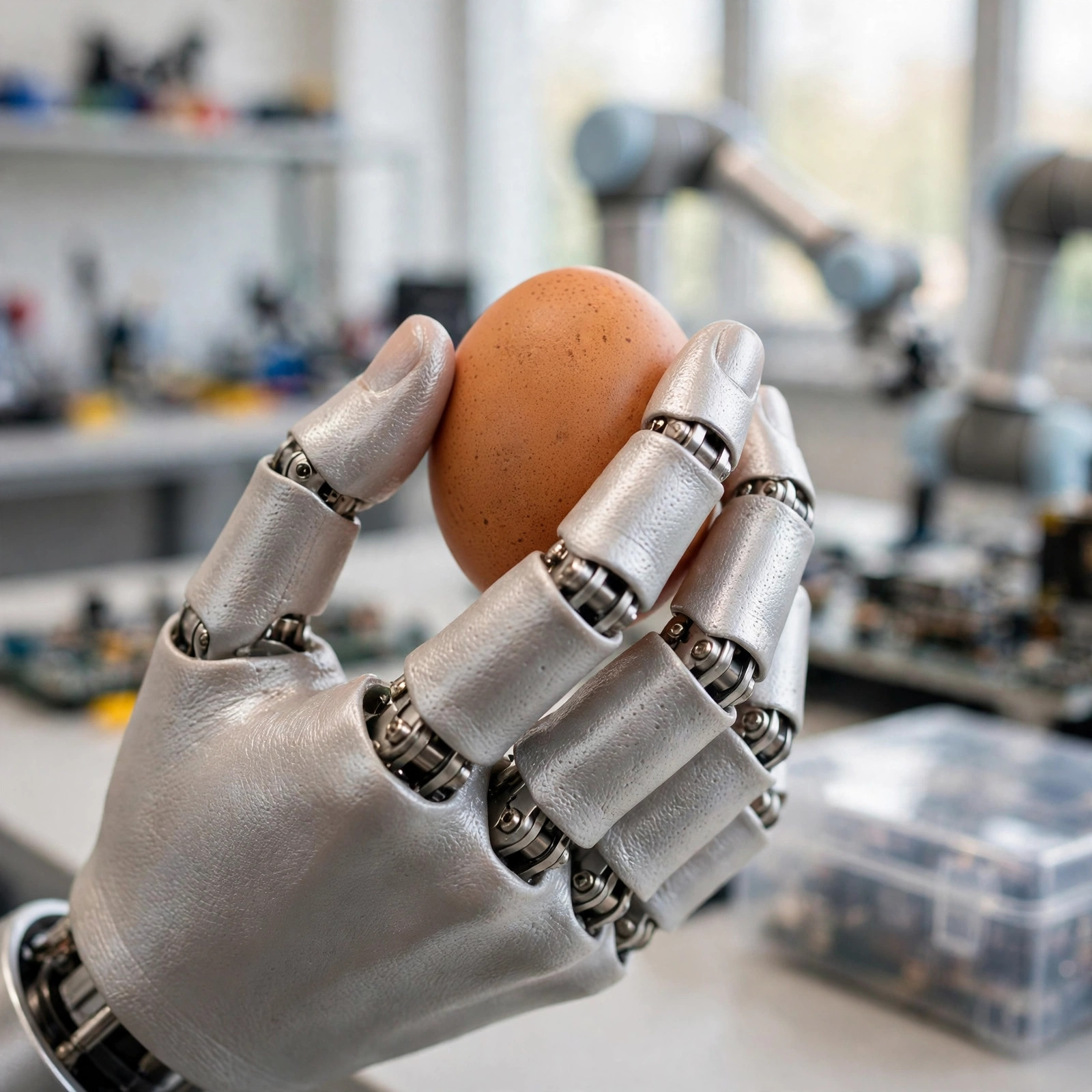
Hi, this is Datumdraft. Humanoid robots can already sprint up stairs, catch their balance after a hard shove, and land backflips on camera. Yet place one raw egg or a crumpled T-shirt on a table in front of them, and the whole industry breaks into a sweat. That gap is the real story behind humanoid robot hand dexterity today.
At a Glance
- A human hand moves with 27 degrees of freedom, while robots pack motors and sensors into a tiny frame.
- Tesla’s current Optimus hand is a 22-degree-of-freedom redesign (patent and teardown basis), with motors moved to the forearm.
- The tendon vs direct-drive debate is still open, with the industry split across tendon, direct-drive, hydraulic, and artificial-muscle designs.
- High hand cost and frequent failures push factories to simple grippers first, while general home robots wait.
Why Does Humanoid Robot Hand Dexterity Stumble Over One Raw Egg?
Walking looks dramatic on social media, but picking up a fragile object is a far harder physics problem. Imagine trying to pull a single thin coin out of your wallet while wearing thick winter ski gloves. Your arms reach the wallet just fine, yet your fingers feel clumsy, blind, and oversized. That exact mismatch explains why humanoid robot hand dexterity lags years behind robotic legs.
Engineers measure how freely a joint moves using a metric called degrees of freedom, or DoF. Each independent bend, twist, or sideways wiggle counts as one degree of freedom. According to neuroscience literature, a single human hand operates with 27 degrees of freedom. That range lets you spin a pen, button a collar, and crack an egg without thinking.
Nature also cheated on the packaging problem in a brilliant way. Neuroscience literature shows that more than 30 muscles power your hand. Most of those muscles do not sit inside your palm at all. They live safely up in your forearm and pull your finger bones with long, thin tendons.
Touch matters just as much as motion. Neuroscience literature estimates roughly 17,000 specialized tactile receptors sit beneath the skin of one human hand. Those tiny biological sensors detect pressure, skin stretch, vibration, and temperature all at once. Because of them, you feel a wet glass starting to slip before your eyes even notice.
Now picture the packaging headache roboticists face when they build a machine body. A humanoid leg has plenty of hollow volume inside the thigh and shin for large, powerful humanoid robot actuators. Actuators are the motor-and-gear units that turn electricity into physical movement. A robot hand has no such luxury, because dozens of joints, wires, and sensors must fit into a few centimeters of palm and fingers.
That packaging crunch creates a trap that fools casual observers every week. People often hear a high DoF number and assume the hand has that many motors inside. In reality, degrees of freedom do not equal actuator count. Many robot hands use an underactuated design, where mechanical links couple several finger joints to one single motor.
Think of a spring-loaded claw where one pull curls the base, middle, and tip of a finger together. That finger technically bends at three joints, yet the robot cannot move the fingertip independently. Whenever a robotics company boasts about a high DoF headline, ask one sharper question. Ask how many of those degrees of freedom are actively driven by their own independent motors.
Still Quoting 11 Degrees of Freedom? Inside the 2026 Optimus Hand Redesign
If you still read that Tesla’s robot hand has 11 degrees of freedom, you are judging today’s market with a three-year-old spec sheet. To understand what changed, picture a marionette puppet on a wooden stage. You never bolt heavy electric engines onto the puppet’s tiny hands. Instead, you hide the heavy pulling mechanisms backstage and send only light strings down to the fingers.
Back in December 2023, Tesla’s official Gen 2 video showed an earlier hand architecture. That older generation featured 11 degrees of freedom per hand. Engineers packed 6 motors directly inside the hand body and added tactile sensors across all fingertips. It handled an egg gently on camera, but cramming motors into the palm left no room to scale up.
This year, the Optimus hardware story shifted dramatically. A Tesla official video from March 2026, a patent published in April 2026, and detailed Chinese teardown analysis revealed a major redesign. Tesla has never published these specs as an official datasheet, so every figure below rests on patent and teardown analysis. Still, the physical layout tells a crystal-clear engineering story.
In the redesign, engineers moved the heavy motors out of the palm and up into the forearm. Patent and teardown analysis points to 22 degrees of freedom per hand. That breaks down into 4 degrees of freedom per finger plus 2 at the wrist. Of those 22 joints, 17 are active DoF driven independently, while 5 are passive coupled joints.
The internal component count shows just how dense a modern robot hand has become. According to the same teardown analysis, the forearm houses 17 compact motors. Inside the hand structure, engineers placed 22 Hall sensors, which are tiny magnetic chips that track exact joint angles. Across the gripping surfaces, the teardown counted 94 tactile contact points to read touch pressure.
Moving motors into the forearm solves the palm-size problem, yet it creates a brutal new bottleneck at the wrist. Every tendon cable, sensor signal wire, and power line must squeeze through a narrow rotating joint. Every time the wrist twists or bends, those cables flex and rub under tension. Over thousands of cycles, metal fatigue and chafed insulation become constant threats.
Heat and electrical current pile onto that same narrow passage. Running dozens of sensors and motors at low voltage requires higher electrical current, which demands thicker copper wires and generates extra heat. That is why engineers across robotics and electric vehicles look closely at stepping up to a 48V electrical system to trim wire bulk and thermal buildup. Even with smarter power routing, keeping a high-DoF wrist cool and durable remains an unforgiving engineering puzzle.
| Hand | Degrees of Freedom (DoF) | Motors (Count & Location) | Tactile Sensing | Source Character |
|---|---|---|---|---|
| Human Hand | 27 DoF | 30+ muscles (mostly in forearm) | ~17,000 tactile receptors | Neuroscience literature |
| Optimus Gen 2 (Dec 2023) | 11 DoF | 6 motors inside the hand | Tactile sensors on all fingers | Tesla Dec 2023 official video |
| Optimus Redesign (2026) | 22 DoF (17 active, 5 passive) | 17 motors moved to forearm | 94 tactile contacts + 22 Hall sensors | Mar 2026 video, Apr 2026 patent & teardown analysis (not official Tesla spec) |
“The Worst Engineering Decision in Four Years”: Is the Tendon Hand Finished?
In August 2026, the loudest moment in humanoid robotics was not a flashy product launch, but a blunt public confession. Picture an old bicycle brake cable that has survived three rainy winters. The steel wire inside rubs against its outer plastic tube, stretches slightly, and sticks when you squeeze the lever. Pull the handle the exact same distance, and the brakes no longer bite with the same force.
That exact friction problem sits at the heart of the tendon hand debate. On August 13, 2026, Figure CEO Brett Adcock called his company’s tendon-driven hand “the worst engineering decision in the last 4 years.” He went further and labeled tendon hands a “complete local maximum,” meaning a design that looks promising early on yet hits a hard ceiling. Figure announced it is moving to a 7th-generation hand with the stated company ambition of matching the human hand, though no verified specs exist for that new unit yet.
Pushback arrived almost immediately from rival roboticists. Esposito at Foundation argued that Figure’s early hand was an 11 DoF design hampered by Bowden-tube friction. A Bowden tube is a flexible hollow sheath that guides a pulling cable around bends, just like that bicycle brake sleeve. In Esposito’s view, Figure suffered a failure of one specific implementation, not a death sentence for tendon hands overall.
Look across the industry right now in late 2026, and you see zero consensus. Four competing drive architectures are racing side by side, each trading one painful compromise for another. Tendon-driven camps like 1X Neo—which claims a 25 DoF tendon hand—and veteran builder Shadow Robot still bet on slim, lightweight fingers. Direct-drive and rigid linkage camps, including Figure’s new direction, trade extra hand bulk for crisp, predictable force without cable stretch.
Meanwhile, Sanctuary AI pushes miniature hydraulics, using pressurized fluid to deliver strong, fast grips inside tight finger joints. Clone Robotics takes the most biological route of all, using fluid-filled artificial muscles that contract like human tissue. None of these approaches has won the mass-production race yet. Treating tendon design as dead today misses the point: engineers are still discovering which compromise survives real factory and home abuse.
| Architecture | Notable Players | Key Strength | Key Weakness |
|---|---|---|---|
| Tendon | 1X Neo (25 DoF company claim), Shadow Robot | Light, slim fingers; keeps heavy motors out of the palm | Cable stretch, sheath friction, and fatigue over time |
| Direct-drive / linkage | Figure (Gen 7 direction) | Rigid, predictable force control with no cable slack | Harder to pack high DoF into a compact palm |
| Hydraulic | Sanctuary AI | Very high grip force and speed in small joints | Requires pumps, valves, and strict leak prevention |
| Artificial muscle | Clone Robotics | Natural compliance and biomimetic movement | Unproven durability and difficult mass manufacturing |
What Is Hiding Just Outside the Camera Frame in Most Hand Demos?
Before you marvel at a viral clip of a robot gently lifting an egg, suspect what sits just outside the camera frame. Imagine trying to pick up a block of silken tofu with wooden chopsticks while wearing a blindfold and thick earplugs. You cannot see the edge, you cannot hear it tear, and you only guess how hard you are squeezing. That is what autonomous grasping feels like for a robot with poor touch feedback.
Here is the second big myth that trips up viewers online. Most impressive robot-hand demo videos rely on teleoperation, not autonomy. Teleoperation means a skilled human operator stands nearby wearing a VR headset and motion-tracking gloves, puppeteering the robot hand in real time. A teleoperated demo proves the mechanical hand can survive the motion, not that the robot’s AI decided how to do it.
Even when engineers turn off the VR gloves and hand control to onboard AI, a massive sensory wall remains. Compare the human baseline to the sharpest hardware analyzed this year. Your hand reads pressure, shear force—the sideways drag that signals an object is slipping—temperature, and vibration across roughly 17,000 receptors (neuroscience literature). By contrast, even advanced robot hands carry only dozens of sensors, up to 94 tactile contacts per hand on the Optimus teardown basis.
That resolution gap creates a severe force-control problem. A camera mounted in a robot’s head cannot tell whether an opaque paper cup is empty or brimming with hot coffee. If the robot squeezes with one fixed force, it crushes the empty cup or drops the full one. Reliable autonomy requires a closed-loop control system—a fast feedback cycle that feels microscopic slip within milliseconds and tweaks finger pressure instantly.
Until tactile skins grow sharper, cheaper, and tougher, vision models have to guess weight and friction from pixels alone. Guessing works surprisingly well in a curated lab clip with familiar props. In a cluttered kitchen where a mug handle is slick with dish soap, guessing fails fast.
Why Do Factories Get Robots First While Your Laundry Keeps Waiting?
The two smallest, lightest-looking parts of a humanoid body are actually its most expensive glass components—the first to visit the repair bench. Think about strapping a delicate Swiss mechanical watch movement onto the striking head of a carpenter’s hammer. One job demands microscopic precision, while the other demands surviving daily impacts. Robot hands are forced to play both roles on every shift.
Look at what sits inside a pair of high-dexterity hands. Engineers pack in tiny coreless motors, miniature gearboxes, ball screws or tendons, Hall sensors, and fragile tactile pads. Industry cost estimates often place both hands together at roughly 15 to 25 percent of a humanoid robot’s total material cost. Because cables fray, tiny gears develop backlash—unwanted slop between gear teeth—and sensor skins tear on sharp edges, hands rank among the most failure-prone parts on the whole machine.
That brutal math splits the commercial rollout into two completely different timelines. Factories are structured worlds where metal trays, cardboard boxes, and car parts arrive in predictable spots with known weights. On a factory line, you rarely need a 22-joint mechanical marvel to move a stamped panel. A proven, rugged 2-finger or 3-finger industrial gripper—or a simpler multi-finger hand—handles the job cheaply and deploys first.
Your living room and kitchen are the exact opposite: chaotic, unstructured obstacle courses. Folding soft laundry, rinsing soapy dishes, pulling a stuck jacket zipper, and turning a stiff brass doorknob all demand completely different grips. A general-purpose home robot cannot wait for just one breakthrough. It has to wait until engineers deliver high DoF, sharp touch sensing, long durability, and low mass-production cost all in the same hand.
Next time a slick humanoid video crosses your feed, you do not need a PhD to separate hype from real progress. Run the clip through these five quick checks:
- Autonomous or teleoperated? Check whether the company explicitly states the robot ran on its own onboard policy without a human wearing VR gloves off-camera.
- Total DoF or active DoF? Look past the headline joint count and ask how many joints have their own independent motors.
- Real time or sped up? Look for a tiny “2x” or “4x” badge in the corner, because slow, hesitant grasping looks effortless when sped up.
- Rigid props or deformable mess? Picking up a dry cardboard box is far easier than untangling wet clothes, gripping an egg, or lifting a slick glass.
- One lucky take or repeat-run stats? A single clean clip proves best-case capability, whereas a company sharing failure rates over hundreds of trials proves real reliability.
Can Robots Finally Conquer the Last Inch of the Human Body?
The race in humanoid robotics is no longer about whether a machine can walk across a stage on two legs. Engineers have largely solved walking, and now the entire industry is staring at the last few inches at the end of the arm. The real prize goes to whoever can mass-produce a hand that is cheap, rugged, and delicate enough for everyday life.
Look at how fierce the debate has grown as we approach the end of 2026. Tesla moved its motors into the forearm for a 22 DoF redesign (patent and teardown basis), while Figure publicly rejected its own tendon hand and pivoted to a seventh generation. That clash is not a sign that robotics has stalled—it is proof that the hand is the final unconquered frontier.
Try the five-question checklist on the very next humanoid demo video you watch this week. And tell us in the comments which side you think wins the mass-production standard: slim tendon hands or rigid direct-drive linkages?
Key Takeaways
- Walking is solved; grasping is not: Legs offer roomy frames for big actuators, while hands must cram high precision and touch sensing into a few centimeters.
- Count active motors, not just joints: Underactuated fingers couple multiple joints to one motor, so active DoF matters far more than headline DoF.
- Optimus moved past 11 DoF: The 11 DoF hand belongs to December 2023. March and April 2026 patent and teardown analysis points to a 22 DoF forearm-driven redesign (17 active, 5 passive). Tesla has not published it as an official spec.
- No drive architecture has won yet: Figure’s August 2026 rejection of its tendon hand sparked an open four-way contest across tendon, direct-drive, hydraulic, and artificial-muscle designs.
- Demos prove hardware, not brains: Most viral hand clips use human teleoperation, and closing the gap between 94 robot tactile contacts and 17,000 human receptors remains a major hurdle.
- Factories come before living rooms: Structured factory floors work with simple grippers today, while chaotic home chores wait for hands that are simultaneously dexterous, tough, and affordable.
Sources
- Tesla, “Optimus – Gen 2” Official Demonstration Video, Tesla (YouTube / X), December 2023.
- Tesla, Official Optimus Hand Update Video, Tesla, March 2026.
- Tesla, Inc., Robotic Hand and Forearm-Mounted Actuator Mechanism Patent Publication, April 2026.
- Chinese Robotics Supply-Chain Teardown Analysis of the 2026 Optimus 22 DoF Hand (17 motors, 22 Hall sensors, 94 tactile contacts), 2026.
- Brett Adcock (Figure AI CEO), Public Statement on Tendon Hand Architecture and 7th-Generation Hand Direction, August 13, 2026.
- Esposito (Foundation Robotics), Public Response on 11 DoF Tendon Implementation and Bowden-Tube Friction, August 2026.
- 1X Technologies, 1X Neo Product Overview and 25 DoF Tendon Hand Claims, 1X Technologies, 2026.
- Shadow Robot Company, Dexterous Hand Technical Overview, Shadow Robot.
- Sanctuary AI, Hydraulic Robotic Hand Architecture Overview, Sanctuary AI.
- Clone Robotics, Biomimetic Artificial Muscle Hand Overview, Clone Robotics.
- Johansson, R. S., & Flanagan, J. R., “Coding and use of tactile signals from the fingertips in object manipulation tasks,” Nature Reviews Neuroscience, 2009 (human hand tactile receptor baseline, ~17,000 mechanoreceptors).
- ElKoura, G., & Singh, K., “Handrix: Animating the Human Hand,” ACM SIGGRAPH / Eurographics Symposium on Computer Animation, 2003 (27 DoF human hand kinematic baseline).