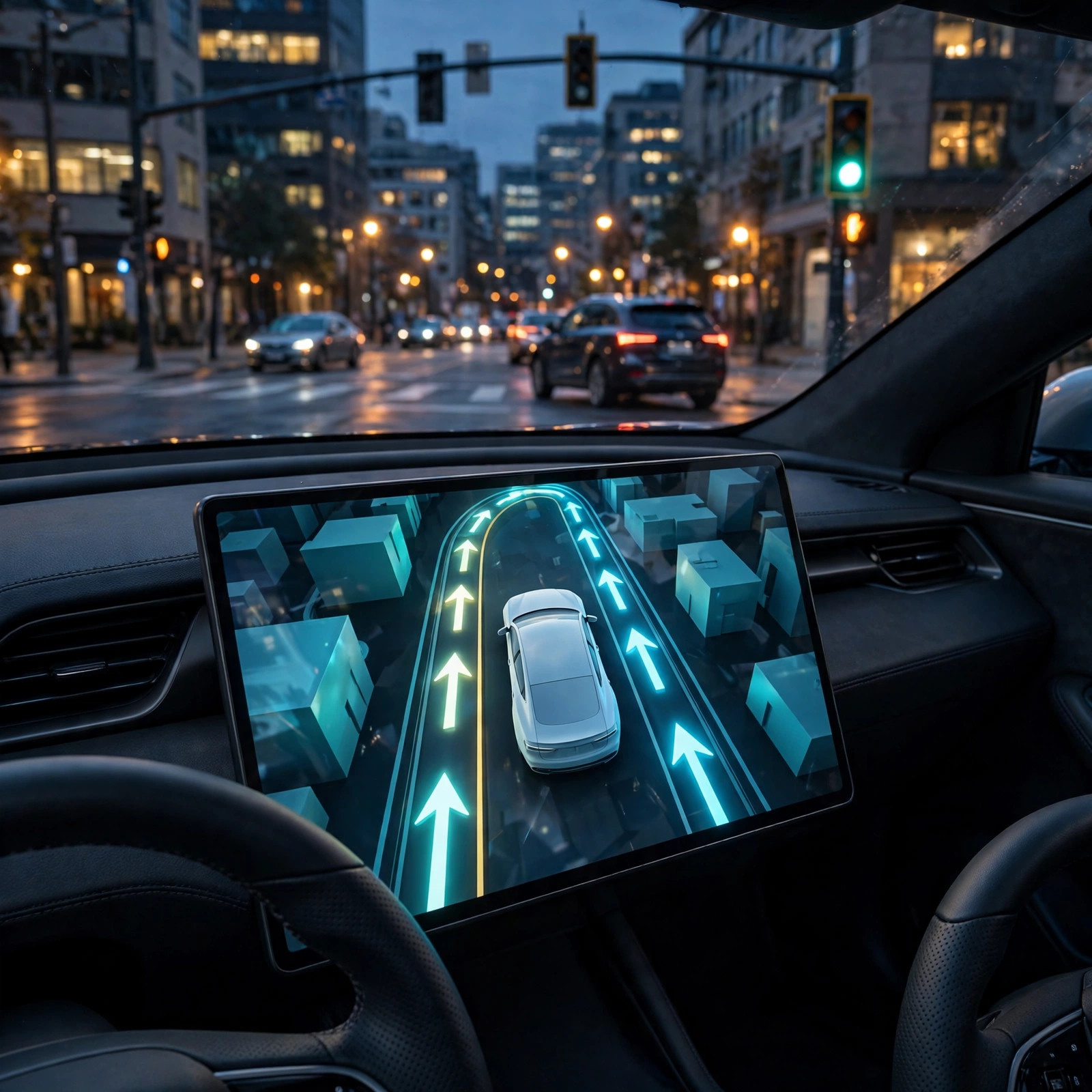
Tesla FSD v15 Turns Your Center Screen Into GTA—Now Prove That “25x Safer” Claim
Hi, this is Datumdraft. What would you do if your car’s center screen suddenly transformed morning gridlock into a live, photorealistic video game? Drivers testing Tesla FSD v15 are watching their familiar gray dashboard lines vanish into a glowing aerial world. Yet right beside that dazzling new interface sits a bold safety claim that Tesla still refuses to back up with raw numbers.
At a Glance
- Tesla FSD v15 replaces flat dashboard graphics with a live aerial view called Reality View.
- Company release notes claim a 25x critical intervention gain, but Tesla keeps the baseline rate secret.
- Community tracking sites show American AI4 vehicles received the initial download first, before December’s wider rollout.
- Italy granted provisional national approval ahead of Brussels, becoming the twelfth European country to clear the system.
Watching Your Commute Play Out Like Grand Theft Auto?
Early testers tapped their drive stalks on November 21 and watched flat gray street sketches dissolve into a rich third-person camera. Imagine trading a bare black-and-white subway map for playing Grand Theft Auto with a floating drone hovering behind your bumper. That everyday video-game jump captures what Tesla officially calls Reality View. Inside the car’s own release notes, engineers give this exact same visual feature the name Tesla Augmented Reality.
For years, Tesla drivers stared at minimalist wireframe cartoons filled with gray blocks and generic traffic cones. Humans had to squint at clunky shapes to guess whether the car recognized a delivery truck or a double-parked van. Reality View replaces those rough polygons with textured asphalt, crisp painted stripes, brick storefronts, and distinct vehicle shapes. Drivers can glance down for a split second and immediately confirm what the onboard cameras actually see.
Most automakers build dashboard graphics with a separate rendering engine that merely draws guesses from a sensor list. Tesla took a radically different route by using one shared end-to-end model for both driving and display. In plain words, an end-to-end model is a single neural network that takes raw camera video and directly outputs steering and pedal commands. Here, that exact same driving brain also paints the top-down virtual camera view on your center screen.
Because one unified neural network handles both tasks, you are watching the software draw its own live mental map. Elon Musk highlighted this design on social media, comparing the live screen experience to playing Grand Theft Auto in real life. Musk explained that the car generates this photorealistic video feed in real time using artificial intelligence rather than pre-built map tiles. When a pedestrian steps off a curb, the rendering reflects the car’s real-time perception without any translation layer in between.
Generating live video inside a moving car demands serious silicon horsepower. Musk stated that running Reality View consumes about half of one AI4 TRIP accelerator. In simple terms, a TRIP accelerator is the specialized math chip inside Tesla’s fourth-generation driving computer that crunches neural network calculations. To put that load in human scale, imagine dedicating roughly half of a gaming laptop’s graphics card just to draw your navigation map.
Tesla did not spend all that computing muscle purely for visual eye candy. Reality View overlays bright directional arrows and destination pins directly onto the live asphalt ahead. Drivers can see exactly which lane the car plans to merge into before the steering wheel even twitches. When pulling into a crowded shopping plaza, the glowing pins highlight the exact parking stall the software intends to claim.
That visual transparency tackles one of the hardest human problems in assisted driving. People feel nervous when a computer steers their family through busy intersections without explaining its next move. Showing clear turn arrows and parking targets lowers driver stress during complex urban maneuvers. You stop wondering if the car spotted the exit ramp because you can literally see the path painted onto the screen.
Tesla also hinted at direct touch controls inside its official promotional footage. In Tesla’s demo, a rider taps directly on the photorealistic screen to point out a preferred parking spot or pull-over zone. Because reporters have confirmed this tap-to-direct feature only in Tesla’s demo so far, everyday buyers should wait for real-world customer videos before assuming it works everywhere. Even without touch steering, turning the dashboard into a live window into the car’s mind is an unmistakable leap forward.
“25x Better Safety”—25 Times What, Exactly?
Every driver wants safer software, yet Tesla’s headline safety statistic immediately triggers an obvious question about missing math. Picture an airline running commercials claiming its new jets are twenty-five times safer while refusing to reveal how often the old planes suffered close calls. A giant multiplier without a starting denominator is clever marketing copy, not scientific proof. That exact missing starting line defines the controversy around this update’s safety claims.
Open the official release notes, and you will find a very specific technical statement. Tesla writes that its newly upgraded vision encoder improves the critical intervention rate by 25x. In plain English, the critical intervention rate tracks how often a human driver must grab the steering wheel or stomp the brake to prevent a serious mistake or crash. Slashing urgent human rescues by twenty-five times would represent an extraordinary engineering milestone.
The catch is what Tesla left completely blank in those release notes. The company published only the dramatic multiplier while withholding the actual baseline intervention rate. In simple terms, a baseline is the starting measurement you compare a new result against. Without that starting figure from the previous software generation, outside engineers cannot calculate how often the new version actually makes a dangerous error.
Soon after the release notes hit the web, a top company leader pushed the claim even further. Tesla artificial intelligence executive Phil Duan reposted the stronger phrase that v15 is 25x safer than v14 across the fleet. Notice the subtle jump from improving a technical intervention metric to declaring the entire fleet twenty-five times safer. Even with that bolder executive paraphrase, the underlying baseline rate remains completely unpublished.
To translate a twenty-five-fold jump into everyday human scale, think about an annoying daily glitch during your weekday commute. Roughly speaking, as an illustrative approximation, cutting a once-a-day mistake by twenty-five times turns it into a once-a-month headache. That sounds wonderful on paper, yet it still fails to tell you whether the mistake is a minor lane drift or a near-miss with oncoming traffic. Numbers only build real trust when companies show both the starting point and the testing rules.
Safety researchers also care deeply about how an automaker defines a critical intervention behind closed doors. Does Tesla count only moments when a driver jerks the wheel milliseconds before impact? Or does it also count cautious drivers who take over early because the car hesitated at a confusing left turn? Because Tesla has not published its fleet dataset or scoring methodology, nobody outside the company can check those definitions.
Tesla has long argued that raw disengagement statistics mislead the public because driving difficulty varies wildly by city and weather. That concern holds real merit when comparing sunny suburban highways against snowy downtown streets. Still, you cannot hide your raw numbers for fairness reasons and then broadcast a giant unverified safety multiplier to the press. Until Tesla releases audited fleet data or independent testers log extensive mileage, smart drivers should treat the headline multiplier as an unproven claim.
What Changed When Tesla FSD v15 Swapped Out the Car’s “Eyes”?
Strip away the flashy dashboard visuals and marketing debates, and you find a genuine technical shift inside the car’s perception system. Imagine a teenager learning to drive by reading a single local driving-school handbook, compared to studying millions of hours of wild road footage from every corner of the planet. That massive leap in real-world education explains how engineers rebuilt the vision encoder powering Tesla FSD v15. In plain words, a vision encoder is the front-end artificial intelligence module that converts raw camera pixels into recognizable objects, distances, and road hazards.
According to Tesla’s release notes, engineers trained this upgraded vision encoder on millions of internet videos rather than relying strictly on Tesla dashcam clips. Studying massive libraries of public online video exposes the neural network to weird, rare situations that a typical commuter sees once in a lifetime. Fallen cargo, bizarre construction signage, and erratic street scenes suddenly become familiar patterns rather than shocking surprises. Broadening the training diet helps the software generalize across unfamiliar neighborhoods.
Even more striking is how Tesla plans to deploy this single visual foundation across its entire product lineup. The release notes state that the exact same vision encoder powers customer FSD vehicles, the robotaxi fleet, and humanoid Optimus robots. Sharing one visual brain across cars and walking machines creates a powerful engineering flywheel. Whenever researchers teach the encoder to recognize subtle textures or cluttered spaces, both sedans and factory robots get smarter simultaneously.
Drivers will notice the benefits of these sharper eyes most clearly when dealing with messy, unpredictable street surfaces. The release notes highlight stronger detection of road signs, small animals darting across lanes, scattered road debris, and loose tire chains. Instead of barreling straight over crumbling asphalt, the car now reads fine surface details to steer smoothly around potholes and deep standing water. Spotting a deep puddle or a stray raccoon early directly prevents sudden, jarring steering jerks.
Engineers also added thoughtful quality-of-life upgrades aimed squarely at everyday tickets and weekend errands. The software now respects school-zone speed limits and automatically eases off the accelerator when approaching speed cameras. Weekend cyclists also gain a dedicated Bike Rack Mode so the rear sensors stop panicking whenever a bicycle blocks the trunk camera. Small details like these often matter more to daily owners than grand autonomy speeches.
Alongside better perception, Tesla introduced a clever new feature called fleet path learning. In plain words, fleet path learning pools anonymized driving paths from other Teslas so your car knows how local humans navigate tricky driveways. Right now, this shared memory covers only the departure and arrival segments of a trip, such as pulling out of a tight garage or entering a strange office park. Tesla notes that full route learning across entire journeys will arrive in later point releases.
Training these unified neural networks on millions of video clips requires astronomical data-center budgets. Automakers pursuing this approach must balance massive server spending against the limits of compact chips sitting inside each dashboard. Readers curious about how these unified driving networks scale can explore our deep dive on end-to-end architecture and its compute economics. That infrastructure investment explains why Tesla is betting everything on one shared visual engine.
Who Gets the Keys Today—and Who Gets Left in the Slow Lane?
Two neighbors can park identical-looking Teslas side by side tonight, yet only one will wake up to a video-game dashboard tomorrow morning. Think of a blockbuster smartphone operating system upgrade that delivers dazzling new features to flagship phones while leaving older working handsets stuck on security patches. That exact silicon divide is splitting Tesla’s customer base right now. Figuring out who gets the update requires separating official company timelines from independent fleet tracking.
Tesla started rolling out the new software to a first customer group on November 21. According to Elon Musk, the full rollout to the broader fleet will arrive with Tesla’s annual December holiday update. That staggered schedule gives engineers roughly a few weeks to monitor real-world edge cases before millions of cars download the code. Even after the holiday push lands, the system remains strictly Supervised rather than driverless or fully autonomous.
Curiously, Tesla has not officially announced which onboard vehicle computers qualify for the first wave of downloads. Instead, independent owner tracking websites offer the clearest evidence of how the rollout is actually unfolding. Community tracking sites show that the very first vehicles to receive the update on November 22 were American cars running AI4 hardware. In plain terms, AI4 is Tesla’s fourth-generation driving computer, equipped with sharper cameras and far faster neural network chips than older cars.
Popular fleet tracker Teslascope expects AI4 vehicles to stay at the front of the queue as the rollout widens. Meanwhile, many secondary automotive reports say that cars running older HW3 computers will remain on a lighter software branch called v14 Lite. In simple words, HW3 is Tesla’s third-generation onboard computer installed in millions of vehicles built before the newer silicon arrived. Remember that Tesla has not officially confirmed this hardware split, so owners are watching fleet trackers closely for clues.
The physical math behind that suspected hardware split is easy to understand once you look at computing limits. If Reality View alone demands roughly half of an AI4 accelerator chip, older HW3 silicon faces an impossible memory and speed bottleneck. Squeezing a giant internet-trained vision encoder plus real-time video rendering onto older processors would likely cause dangerous lag. For loyal owners who paid thousands of dollars upfront for older cars, being left in the slow lane stings deeply.
This gap also reminds drivers to keep their expectations grounded regardless of which computer sits under their glovebox. Whether your car runs the newest video-game interface or an older branch, you remain the legally responsible human behind the wheel. Hands-free marketing buzzwords never erase the need for constant human attention on unpredictable public streets. Keeping your eyes on the road stays mandatory even when the dashboard looks like next-generation science fiction.
Why Did Rome Say Yes While Brussels Is Still Waiting?
Twenty-four hours before American drivers began downloading the new update, Italy handed Tesla a surprise regulatory win across the Atlantic. Imagine one large household signing its own permission slip to build a backyard deck instead of waiting months for the whole homeowners association to vote. That independent shortcut explains exactly how Rome cleared Tesla’s driver-assistance software ahead of European Union regulators in Brussels.
On November 20, Italian regulators granted provisional national approval for Tesla’s Assisted Driving system. In plain words, provisional national approval means a single country lets a new vehicle technology operate within its own borders temporarily while continental rules catch up. Italian Transport Minister Matteo Salvini announced the approval directly on X, welcoming the technology onto local highways. Tesla Europe quickly confirmed the news online, posting that the system is now approved in Italy and that rollout begins soon.
That single signature carries huge symbolic weight for Tesla’s European ambitions. Italy becomes the twelfth European country to approve the software, following mostly smaller national markets across the region. More importantly, Italy stands as the very first large European Union automotive market to grant this green light. Winning over a major European manufacturing hub puts fresh political pressure on slower neighbors.
Normally, automakers seeking to launch advanced driving software across Europe must wait for centralized approval from Brussels. That bloc-wide decision rests with the Technical Committee on Motor Vehicles, a regulatory group known as TCMV. In plain terms, TCMV is the official European Union panel of national experts that votes on shared vehicle safety rules. Because the TCMV committee will not vote until December at the earliest, Italian officials refused to sit in the waiting room.
Even with Salvini’s public endorsement, Italian drivers cannot switch the feature on this afternoon. Tesla has not yet announced a concrete launch date for customers in Italy. When the software finally activates, it will legally operate as a Level 2 system. In simple words, Level 2 automation means the car can steer and control speed, but the human driver must supervise constantly and carries full legal liability for any crash.
European owners who want to try the software must pay a recurring monthly subscription of €99. Translated into everyday household terms, that fee is roughly comparable to a couple of tanks of gasoline or several streaming plans combined, as a rough approximation. Crossing national borders also creates a patchwork driving experience until Brussels harmonizes the rules across all member states. You can track every national milestone in our full breakdown of Tesla’s FSD approval map in Europe.
Key takeaways
Separating real engineering progress from unverified hype means looking closely at what drivers can see today versus what Tesla still owes the public. Picture a popular restaurant unveiling a gorgeous newly renovated dining room and expanding into a second city while still waiting on the health inspector’s final score. That contrast between visible craft and pending proof sums up this entire release.
- Reality View is a real, tangible upgrade: Turning the center screen into a live third-person camera powered by the driving neural network helps humans read the car’s intentions instantly.
- Treat the 25x claim as an unproven hypothesis: Without a published baseline intervention rate or testing methodology, a bare multiplier cannot verify real-world safety.
- Hardware and borders still draw sharp lines: Early downloads favor American AI4 vehicles while older cars wait on the sidelines, and European rollout remains a country-by-country patchwork under Level 2 rules.
- Watch December for the real verdicts: Independent real-world road tests during the December holiday rollout and the European TCMV committee vote will reveal how well Tesla’s promises hold up.
Sources
- Tesla Official Release Announcement — Tesla Official X Post (November 21, 2026)
- Tesla FSD v15 Rollout and Hardware Tracking Coverage — InsideEVs (November 22, 2026)
- Tesla FSD v15 Release Notes and Reality View Breakdown — TeslaNorth (November 21, 2026)
- Italy Grants Provisional National Approval for Tesla Assisted Driving — Electrek (November 20, 2026)
- Italy Approves Tesla Assisted Driving Ahead of EU Committee Vote — Reuters via Channel News Asia (November 20, 2026)
Suggested Meta Description: Tesla FSD v15 brings a GTA-style Reality View screen and a bold 25x intervention claim—here is what is verified, what is missing, and why Italy just approved it.