Hi, this is Datumdraft. You can pay extra for a car that steers itself through city intersections, yet that button dies the moment you cross the wrong European border. Even if your country just approved the Tesla FSD Europe approval rollout this week, an older computer chip inside your dashboard can still block you from ever getting the download.
At a Glance
- Finland became the 11th EU country to approve Tesla Assisted Driving via software update 2026.39.100.
- Only vehicles equipped with HW4 (AI4) hardware qualify, leaving older HW3 cars completely excluded.
- Tesla capped the maximum speed offset at 10% instead of 50%, resetting to 0 every restart.
- Full EU rollout requires 15 countries and 65% population backing at the December TCMV vote.
Why did Finland rush before the snow, and which 11 EU countries let Tesla drive today?
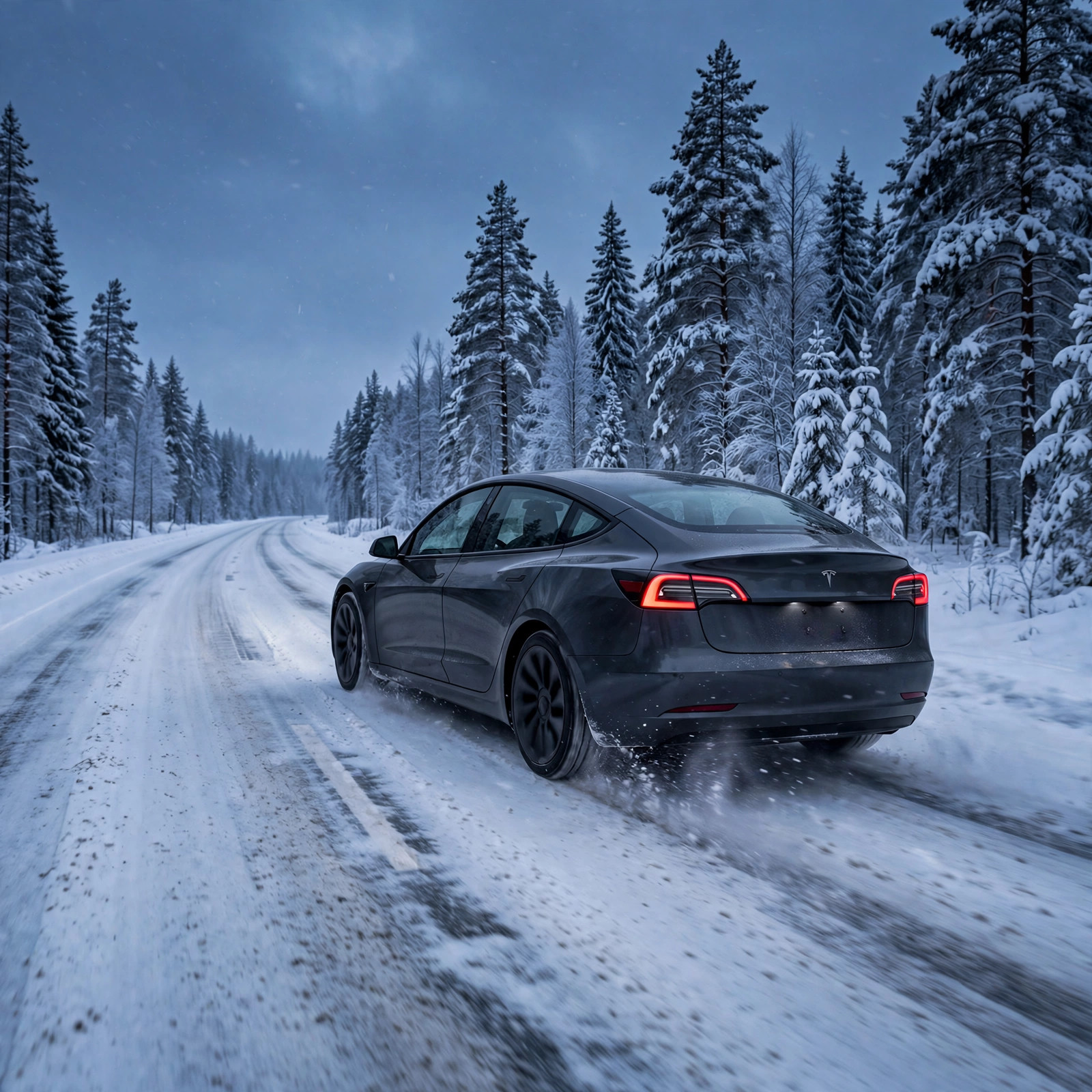
Finland opened its roads to Tesla’s city-street steering right before heavy winter blizzards arrive, bringing the total to 11 European Union countries. Think of the current Tesla FSD Europe approval process like a nightclub line. The main VIP pass is still printing, so bouncers in certain neighborhoods let you in if you show a temporary wristband from the club next door.
That temporary wristband comes from the Netherlands. The Dutch vehicle authority, known as the RDW (Netherlands Vehicle Authority), granted Tesla a provisional type approval earlier on. Type approval is the official safety stamp a government gives a car or software system before it is allowed on public roads.
Instead of waiting for the entire European Union to agree at once, individual countries can choose to recognize that Dutch safety stamp inside their own borders. On November 10, 2026, the Finnish Transport and Communications Agency (Traficom) officially accepted the Dutch provisional approval for immediate use in Finland.
Why did Finnish regulators hurry right before winter? Traficom wanted local drivers to learn where the software struggles before deep snow and ice cover the pavement. Software update 2026.39.100 began rolling out shortly after the November 11, 2026 announcement.
With Finland on board, 11 European Union nations now allow the feature. Globally, Finland is the 19th country where the system operates. If you drive in one of the 11 approved EU countries listed below, the legal gate is open as of November 2026.
| Country / Market Group | National Rollout Status | Regulatory Mechanism & EU Vote Stance |
|---|---|---|
| Netherlands | Approved (Active) | Issued the original RDW provisional type approval. |
| Lithuania, Estonia, Denmark, Belgium, Slovenia, Czechia, Croatia, Slovakia, Latvia | Approved (Active) | Recognized the Dutch RDW provisional approval for national roads. |
| Finland | Approved (Nov 10, 2026) | 11th EU country (19th globally) via Traficom recognition; software 2026.39.100 rollout; does not bind December EU vote. |
| Germany & Italy | Not Approved Nationally | No domestic opt-in yet, but publicly backed EU-wide approval (Germany on Oct 6, 2026; Italy on Oct 29, 2026; ~31.5% combined EU population). |
| France & Spain | Not Approved Nationally | No national opt-in granted as of November 14, 2026. |
Why did “Full Self-Driving” disappear from the screen, and what did Tesla give up to win over regulators?
Tesla unlocked European roads by erasing the words “Self-Driving” from the screen and locking down how fast the car can go. Imagine a gym treadmill. You set the speed to a sprint yesterday. But every time you step back on today, the machine forces you back to a slow walk and blocks the top speed buttons.
That treadmill reset is exactly how Tesla’s European software now handles speed limits. Under older settings, drivers could set a maximum speed offset of up to 50% above the detected speed limit. To satisfy European safety regulators, Tesla slashed that maximum speed offset from 50% down to 10%.
Even that 10% buffer does not stay saved overnight. Every time you restart the car, the speed offset resets to 0. If you want the car to drive slightly above the posted sign, you have to dial it in manually on every single trip.
The name on the screen changed too. What North American drivers know as FSD Supervised is now called Tesla Assisted Driving in Europe. Removing “Full Self-Driving” from the label makes it clear that the car is not driving itself legally.
Under international rules, Tesla Assisted Driving is an SAE Level 2 (Society of Automotive Engineers Level 2) driver assistance system. SAE Level 2 means the car can steer, accelerate, and brake at the same time. But the human in the driver’s seat must watch the road constantly and take over immediately if something goes wrong. You are legally responsible for every move the car makes.
| Rule / Feature | Previous FSD Supervised Baseline | Current European Approval Standard |
|---|---|---|
| Official System Name | FSD (Supervised) | Tesla Assisted Driving |
| Maximum Speed Offset | Up to 50% above speed limit | Capped at 10% above speed limit |
| Default Offset at Startup | Kept prior driver setting | Resets to 0 every time the car restarts |
| Automation Driving Tier | SAE Level 2 (Driver responsible) | SAE Level 2 (Driver responsible, not autonomous) |
| Supported Computer Hardware | Varies by region | HW4 (AI4) vehicles only (HW3 excluded) |
Why Europe gets a cautious helper while US cities see robotaxis
This strict European rulebook stands in sharp contrast to what happens in the United States. In American cities, Tesla has already pushed ahead with a Tesla Robotaxi 24/7 push and expanded its Tesla robotaxi footprint, while rivals like Waymo build out dedicated autonomous fleets.
European regulators require proof that human drivers will not treat a hands-on helper like a hands-off chauffeur. Traficom also warned drivers that snow, mud, or dirt on the car’s exterior cameras can degrade or shut down the system during tough winter traffic.
11 countries down, only 4 more to go? Why the 65% population rule makes December the real gate
Winning 11 countries makes it look like Tesla only needs 4 more yes votes to reach 15, but the European Union’s population rule makes the math much harder. Imagine an apartment building vote. A rule only passes if 15 apartment units say yes, and those 15 units also own at least 65% of the building’s total floor space.
If 15 tiny studio apartments vote yes while the big penthouse families abstain, the motion still fails. That two-key lock is how the TCMV decides on continent-wide car software. The TCMV is the Technical Committee — Motor Vehicles, the EU committee that votes on vehicle rules across all 27 member states.
To win full EU-wide approval at the TCMV, Tesla must clear two hurdles at the same time:
- At least 15 out of 27 EU member countries must vote yes.
- Those supporting countries must represent at least 65% of the total European Union population.
Most of the 11 countries that approved Tesla Assisted Driving so far are smaller or medium-sized EU nations. Even if four more small countries joined tomorrow to hit 15 nations, they would fall far short of the 65% population threshold without Europe’s heavyweights.
Two plot twists inside the December committee room
The TCMV met on October 6, 2026, and adjourned without holding a vote. The earliest possible date for the next TCMV vote is December 2026. If the committee votes yes in December, EU-wide approval takes effect roughly three weeks later.
Before you count the votes, watch out for two twists. First, Traficom explicitly stated that Finland’s national approval on November 10, 2026 does not bind how Finland will vote at the December EU committee meeting. Allowing drivers to use the Dutch permit today is separate from signing off on permanent EU-wide rules.
Second, two of Europe’s largest countries have already signaled support for the EU-wide vote without turning the feature on at home. Germany backed EU-wide approval on October 6, 2026, and Italy followed with its support on October 29, 2026.
Together, Germany and Italy account for roughly 31.5% of the entire European Union population, which is nearly half of the 65% population requirement from just two countries. Yet as of November 14, 2026, Germany, France, Italy, and Spain still have not granted individual national approvals inside their own borders.
Is your Tesla actually ready? The 3-minute eligibility and road readiness check
Even if all 27 European Union countries approve the software tomorrow, a Tesla with an older Hardware 3 computer will never get the download. Waiting for European Tesla Assisted Driving on a Hardware 3 car is like refreshing the app store on a five-year-old phone hoping a brand-new 3D console game will suddenly install.
Tesla restricted the European rollout strictly to vehicles built with Hardware 4, also called HW4 or AI4 (Tesla’s fourth-generation onboard computer and camera suite). Cars equipped with older Hardware 3 (HW3) computers are completely excluded from the rollout, regardless of which country the car is registered in.
The 4-step owner checklist and winter camera alert
Winter Camera & Weather Warning (Traficom Advisory)
Tesla Assisted Driving relies on exterior optical cameras. Snow, slush, mud, or road grime covering the camera lenses will restrict or disable the system. Difficult winter traffic and faded lane markings also limit performance, and the human driver remains 100% responsible under SAE Level 2 rules.
Run through these four checks to see if your car can run the software today:
- Step 1 — Check your country: Confirm you are driving inside one of the 11 approved EU nations (Netherlands, Lithuania, Estonia, Denmark, Belgium, Slovenia, Czechia, Croatia, Slovakia, Latvia, or Finland).
- Step 2 — Check your hardware: Open your touchscreen menu and verify your car has HW4 (AI4) hardware. If your car runs HW3, it is excluded from this release.
- Step 3 — Check your software version: Look for software update 2026.39.100, which carries the latest European rollout activation.
- Step 4 — Check your startup habits and cameras: Remember that the maximum speed offset is capped at 10% and resets to 0 on every restart. Also wipe snow or mud off your camera housings before winter drives.
Key takeaways before the December EU vote
Finland becoming the 11th European Union country to approve Tesla Assisted Driving gives HW4 owners in Northern Europe immediate access via software update 2026.39.100. Still, country-by-country opt-ins leave out drivers in Germany, France, Italy, and Spain, and leave every HW3 owner on the sidelines.
The real test arrives in December 2026 at the TCMV committee table. At least 15 EU member states must vote yes together. Those states must also cover 65% of the European Union population. Until both locks open, Europe stays split between 11 approved countries and the rest of the continent. Even after a yes vote, full rollout takes roughly three weeks.
Does your Tesla run HW4 or HW3? Share which European country you live in and whether software update 2026.39.100 has arrived on your car in the comments below. Bookmark this tracker page so you can check back as soon as the December 2026 TCMV vote results come in.
Sources
- Tesla FSD Gains Ground in Europe: Is EU-Wide Approval Near? — Zacks, November 12, 2026
- Tesla Assisted Driving (TAD) European Approval & TCMV Vote Tracker — TAD Tracker, November 2026
- Finnish Transport and Communications Agency (Traficom) Official Release on Provisional Type Approval Recognition for Tesla Assisted Driving — Traficom, November 11, 2026