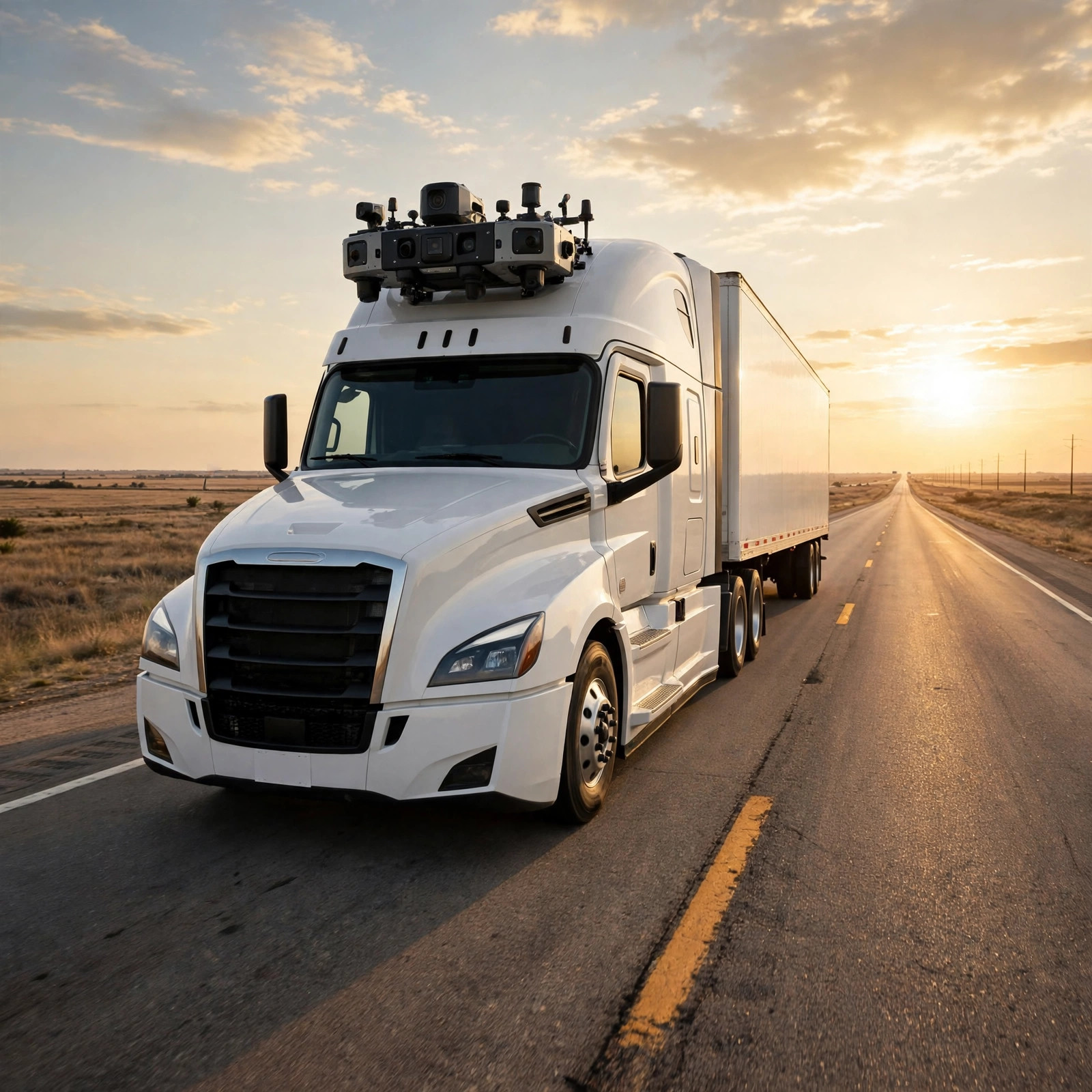
Hi, this is Datumdraft. Tech headlines keep claiming that driverless semis have taken over American highways, yet every 18-wheeler you pass on your commute still has a human behind the wheel. In late 2026, earnings reports and fleet deals from Aurora Innovation and Kodiak AI made autonomous truck hub-to-hub freight harder to read.
Some trucks already run empty today. Others still wait for a green light. Knowing the difference matters if you track logistics costs, invest in mobility stocks, or simply want the real story behind the freight moving your groceries.
At a Glance
- Hub-to-hub freight puts driverless trucks on long highways while local humans handle city streets and docks.
- Aurora passed 500,000 commercial driverless miles by October 2026, yet still posted a $234 million quarterly loss.
- Kodiak’s 99% readiness score tracks its internal safety checklist, while federal regulators issued no approval.
- Separating oilfield sites from public highways and signed orders from deployed trucks reveals real freight progress.
Why Do Autonomous Trucks Stop at the Highway Exit?
Think of how a high-speed bullet train works with local taxis. A bullet train never lays steel tracks down neighborhood alleys to drop you at your front door. It runs fast between major stations, and local drivers handle the messy first and last miles.
Autonomous truck hub-to-hub freight copies that exact relay system. A transfer hub, also called a handoff yard, is a fenced parking lot built right beside a major highway on-ramp. Human drivers haul trailers from cramped retail loading docks to the yard, unhook them, and head home to their families every night.
Driverless tractors then hook up to those same trailers and run the long, straight interstate miles through the night. At the destination exit, another local human driver picks up the trailer and backs it into the final warehouse bay. This split skips the hardest part of city driving: narrow turns, cyclists, and unpredictable loading yards.
Companies pick Sun Belt corridors like Interstate 45 between Dallas and Houston for their first lanes. Those roads feature wide lanes, mild weather, and steady freight demand. With long-haul driver shortages frequently cited across the industry, keeping humans on short local shifts while software handles overnight interstate runs makes practical sense.
Why Did a Human Climb Back Into Aurora’s “Driverless” Cab?
Less than three weeks after launching driverless commercial trucks on Texas highways in spring 2025, Aurora Innovation put a human right back into the driver’s seat. Imagine passing every inspection to move into a brand-new apartment, only for the elevator maker to station a technician inside the cab for months to watch a prototype part. The building did not collapse, yet calling it a fully automated move-in felt awkward until the technician finally stepped out.
First, let us fix a common timeline error. Aurora did not start commercial driverless trucking in 2026. The company began commercial driverless runs on I-45 between Dallas and Houston in late April 2025 and officially announced the launch on May 1, 2025.
Its launch customers were Uber Freight and Hirschbach Motor Lines. By the day of that May 2025 announcement, Aurora had already logged more than 1,200 driverless miles. Then came the twist that confused casual observers for over a year.
Under three weeks after launch, truck manufacturer PACCAR requested that Aurora place an observer in the driver’s seat because the launch trucks used certain prototype components. Aurora stated publicly that its software, the Aurora Driver, kept driving the trucks and that its own safety case did not require a human on board. Still, having a person sit in the seat blurred the line for outside watchers.
That gray zone ended in July 2026. Aurora rolled out its second-generation International LT trucks and began running them with nobody in the driver’s seat. By its Q3 2026 shareholder letter on October 28, 2026, Aurora reported crossing 500,000 cumulative commercial driverless miles. That equals roughly 20 trips around Earth’s equator.
According to that same October 28, 2026 filing, Aurora has now built more than 20 driverless trucks. The fleet operates across 10 lanes after tripling its route network in February 2026. Those lanes include Dallas to Houston, Fort Worth to El Paso, El Paso to Phoenix, and Dallas to Laredo.
What Does Kodiak’s 99% Readiness Score Actually Mean?
A 99% score on a school exam earns top honors, yet in autonomous trucking it means the truck still cannot leave the yard for a driverless highway run. Picture an airline captain completing 99 out of 100 pre-flight cockpit checks. The plane stays parked at the gate until the final box gets signed.
Kodiak AI calls this metric the Kodiak Autonomy Readiness Measure (ARM). It tracks the share of claims and evidence in Kodiak’s internal safety case that the company considers substantially complete. A safety case is the structured proof document a company builds to show its self-driving system is safe enough for public roads.
Kodiak’s 99% figure does not mean the software handles 99% of driving situations. Federal regulators did not award that score, and it is not a crash-safety rating. The score climbed from 93% in early September 2026 to 96% in late September, reaching 99% on October 30, 2026.
Finishing that safety case is a strict requirement before Kodiak launches driverless highway freight. As of late November 2026, that final step remains open. Launching before year-end 2026 is a company target rather than a locked-in date.
To read Kodiak news accurately, you have to separate its three distinct business tracks:
- Private oilfield hauling (Atlas Energy): Kodiak already runs driverless trucks on Permian Basin oilfield roads for Atlas Energy, adding two Western Star 49X trucks on November 4, 2026. These industrial dirt roads have no mixed passenger-car highway traffic.
- First public highway launch partner (IKEA): Announced on September 29, 2026. IKEA plans to start driverless runs on the 219-mile I-45 lane between Dallas and Houston. Five trucks will start once Kodiak closes its safety case.
- First large binding order (DTL): Announced on October 28, 2026, this binding commitment covers 75 driverless trucks. DTL will own and operate the vehicles and pay Kodiak per mile under a Driver-as-a-Service (DaaS) software subscription, starting with Dallas to El Paso and Dallas to Atlanta lanes.
Watch out for one big misunderstanding on that DTL contract. Kodiak has not disclosed the delivery or rollout schedule for all 75 trucks, so those semis are not hauling freight on interstates today. Likewise, when Kodiak’s Q3 2026 earnings call cited 58,000 cumulative paid driverless hours and 396,000 tons of freight, those are company-reported totals driven largely by its existing oilfield operations. For context, 396,000 tons equals roughly 19,800 full semi-truck cargo loads, while 58,000 hours equals about 6.6 continuous years of driving.
| Metric (as of Nov 24, 2026) | Aurora Innovation | Kodiak AI |
|---|---|---|
| Highway Driverless Launch | Started late April 2025 (announced May 1, 2025) on I-45. | Not yet launched on public highways; pending 100% safety case completion. |
| Empty Driver’s Seat Status | Running truly empty cabs on Gen-2 International LT trucks since July 2026. | Empty cabs running in Permian Basin oilfields; highway cabs awaiting safety case close. |
| Key Lanes & Partners | 10 active lanes (Dallas-Houston, Fort Worth-El Paso, El Paso-Phoenix, Dallas-Laredo). Launch customers: Uber Freight, Hirschbach. | Atlas Energy (oilfield), IKEA (I-45 219-mile launch, 5 trucks planned), DTL (75-truck binding DaaS deal for Dallas-El Paso and Dallas-Atlanta). |
| Cumulative Volume | 500,000+ commercial driverless miles; 20+ driverless trucks built (SEC Q3 filing, Oct 28, 2026). | 58,000 paid driverless hours and 396,000 tons hauled (company-reported on Q3 call, largely oilfield). |
| Primary Bottleneck | Q3 net loss of $234M on $3M revenue; ~6-week truck production delay; FY2026 revenue cut to ~$9M. | Closing the final 1% of ARM safety case; undisclosed delivery schedule for DTL’s 75 trucks. |
Why Does 500,000 Driverless Miles Still Produce a $234 Million Quarterly Loss?
Picture building a high-tech automated highway rest stop for hundreds of millions of dollars, only to watch 20 trucks pull through in your entire first year. The gates lift, the sensors work, and the freight arrives on time. Yet fixed overhead dwarfs every dollar coming in at the register.
Aurora’s Q3 2026 shareholder letter from October 28, 2026 lays out that math bluntly. The company booked $3 million in quarterly revenue against a net loss of $234 million. That works out to roughly $2.5 million burned every single day during the quarter.
Management also lowered its full-year 2026 revenue outlook to roughly $9 million and disclosed a truck production delay of about six weeks. Building and upfitting self-driving Class 8 tractors takes time. With just over 20 driverless trucks on the road, mileage revenue cannot come close to covering engineering payroll, transfer hub leases, and remote monitoring centers.
These ground costs mirror the heavy depot overhead seen in robotaxi fleet operations. Large staging yards, sensor cleaning crews, and remote support teams eat cash long before fleets hit scale. That is why both Aurora and Kodiak are leaning into Driver-as-a-Service (DaaS). Under a DaaS model, like Kodiak’s 75-truck DTL agreement, the trucking carrier buys and maintains the physical rigs and pays the tech company a per-mile software fee.
Shifting vehicle ownership onto carriers keeps autonomous developers from sinking billions into depreciating steel. Still, DaaS only works when trucks stay rolling. That utilization math explains why today’s hub-to-hub autonomous fleets run on diesel rather than batteries.
A diesel tractor refuels in roughly 15 minutes at a transfer hub and jumps straight back onto I-45. Plugging an electric semi into a charger can park a pricey sensor-packed rig for much longer. Even as the industry deploys the Megawatt charging system, real-world stations currently deliver 1 MW rather than the 3.75 MW headline ceiling.
Some logistics planners have floated EV battery swapping as a way to keep electric hub turnarounds fast. The business model has seen sharp wins in China. It has also seen major commercial failures in the United States. Until heavy-duty electric hubs match diesel speed, diesel remains the default engine for driverless highway freight.
How Can You Tell Real Driverless Scale from Press-Release Hype in 2027?
Smart car buyers ignore flashy launch-day pre-order numbers and wait six months to count real license plates rolling down the street. You should apply that same filter to every autonomous trucking headline hitting your feed in 2027. Four quick checks will separate real commercial progress from marketing noise in seconds.
- Check the driver’s seat and truck generation: Ask whether the cab is completely empty or carries a safety observer. Note whether the company is running prototype hardware or production-grade trucks like Aurora’s Gen-2 International LT.
- Separate safety case completion from launch targets: Watch for Kodiak to move from 99% to a closed 100% safety case. Then check whether its five planned IKEA trucks run on I-45 with empty cabs. Until that happens, target dates remain goals.
- Track deployed trucks, not signed orders: Binding commitments like DTL’s 75-truck deal prove customer interest, yet revenue only starts when trucks hit the road. Watch whether Kodiak publishes DTL delivery dates and whether Aurora clears its six-week production delay to scale past 20 trucks into the hundreds.
- Split private oilfields from public interstates: When companies announce cumulative hours or tons hauled, check where those miles happened. Private Permian Basin dirt roads carry very different technical and regulatory hurdles than 70-mph public highways.
| Common Headline Phrase | Exact Fact to Check Next |
|---|---|
| “Commercial driverless launch” | Is the driver’s seat empty today, and did a hardware partner require an observer? |
| “99% autonomy readiness” | Has the internal safety case hit 100%, and are public highway runs live? |
| “Binding commitment for 75 trucks” | How many trucks have been delivered, and when do monthly rollouts start? |
| “Hundreds of thousands of tons hauled” | What share came from private oilfield roads versus public interstates? |
Key Takeaways for Late 2026 and Beyond
Autonomous truck hub-to-hub freight works because companies stopped chasing perfection on every side street and focused on straight highway miles. As of November 24, 2026, Aurora is already fighting the battle of fleet scale and quarterly losses on public interstates. Kodiak is trying to close the final 1% of its safety case to move from private oilfields onto Texas highways.
Both companies have proven that driverless semis can move real freight, yet neither has proven that the math works at tiny fleet sizes. Turning $3 million in quarterly revenue into a profitable business requires hundreds of trucks running reliably with minimal human babysitting.
Bookmark this page, as I will update the comparison table in the first half of 2027 once Kodiak launches its IKEA I-45 runs and Aurora reports fresh build numbers. When do you think per-mile DaaS pricing will start moving the needle on a major carrier’s bottom line? Drop your view in the comments.
Sources
- Third Quarter 2026 Shareholder Letter — Aurora Innovation (SEC Filing), October 28, 2026
- Aurora Begins Commercial Driverless Trucking in Texas — Aurora Innovation (SEC Filing), May 1, 2025
- Kodiak AI Reports Third Quarter 2026 Results — Kodiak AI Investor Relations, November 6, 2026
- Kodiak AI and DTL to Deploy 75 Unsupervised Autonomous Trucks — Kodiak AI, October 28, 2026
- Kodiak and IKEA to Launch Driverless Freight in 2026 — Kodiak AI, September 29, 2026
- Uber Outlines Autonomous-Truck Hub-to-Hub Freight Model — TruckingInfo, August 8, 2022