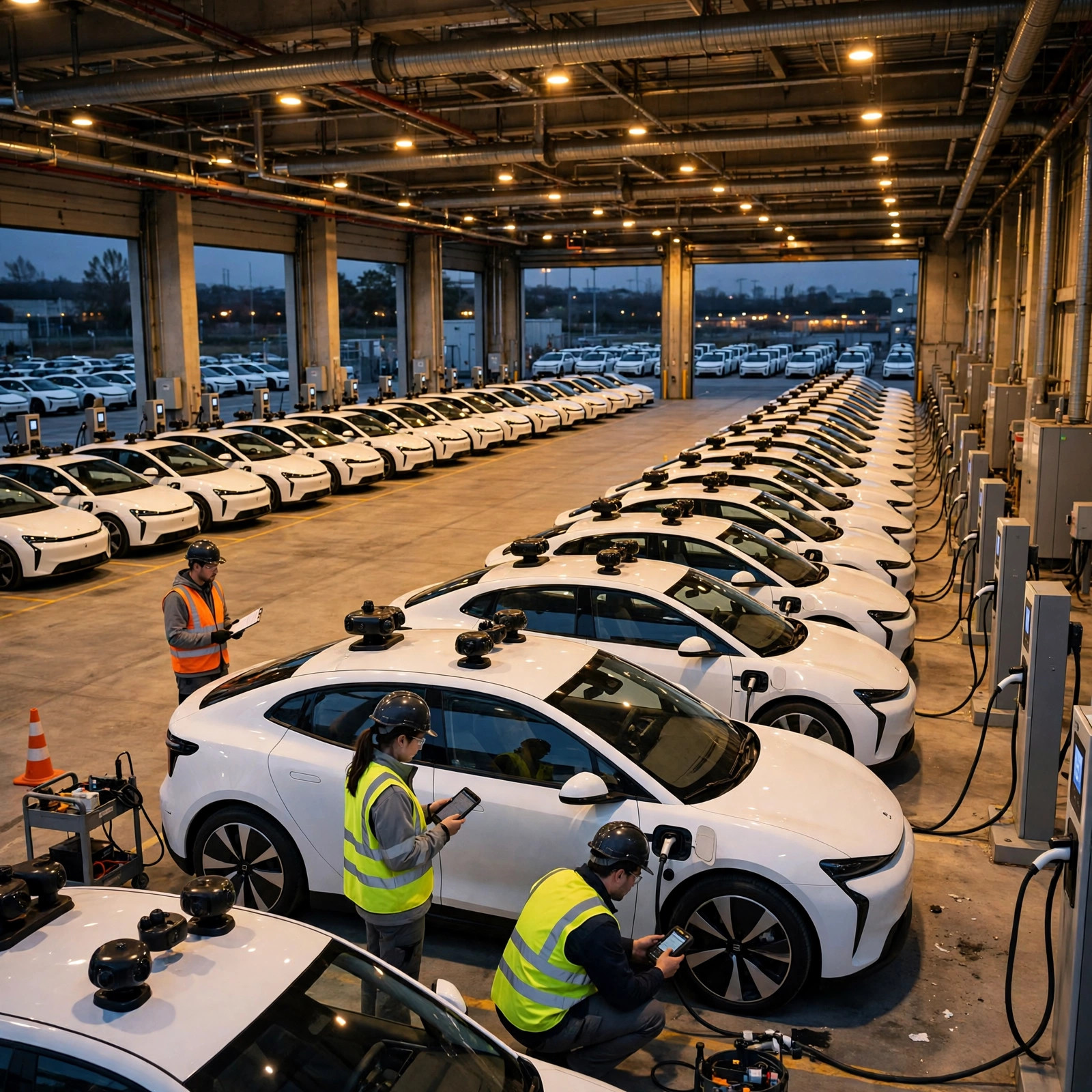
Hi, this is Datumdraft. When you step into a driverless car and see an empty front seat, a simple question pops into your head. If nobody is behind the wheel, who is actually running this vehicle? More importantly, what happens when the car gets confused by roadwork, runs low on battery, or needs a cabin cleanup after a messy passenger?
Taking the human out of the front seat does not eliminate human work. Instead, modern robotaxi fleet operations move that work into two places: specialized software support desks and huge physical service depots.
To understand how robotaxi fleet operations work in November 2026, we need to look at verified operational numbers. First, remote human agents give advice during tricky road situations, and they never steer the car. In February 2026, Waymo disclosed that roughly 70 remote support agents worldwide back up a fleet of about 3,000 vehicles at any given time. That equals a 1:43 support ratio. Second, physical ground crews handle high-voltage charging, sensor calibration, and cabin cleaning. By September 2026, Waymo scaled past 4,000 vehicles across 14 markets, relying on massive ground hubs like Lyft Flexdrive’s 80,000-square-foot depot in Nashville.
Diagram 1: Overview of the remote software assistance and physical depot infrastructure powering 2026 robotaxi fleets. Data as of October 2026.
The biggest myth in robotaxi fleet operations: remote drivers vs. advice, not control
No human in a remote call center ever steers, brakes, or accelerates a commercial Waymo robotaxi. The popular internet rumor that workers sit in office cubicles with racing wheels to pilot confused driverless cars is false.
Instead, commercial operators use a system called tele-assistance, which Waymo calls Fleet Response. Tele-assistance means remote human specialists give high-level pathing advice when a car runs into an unusual road puzzle, while the car’s onboard computer stays in full control of driving. Waymo describes this system with three simple words: “Advice, Not Control.”
Think of a remote Fleet Response agent like an air traffic controller talking to a plane. An air traffic controller can tell a pilot which runway is open and which taxiway is blocked. Still, the controller does not reach into the cockpit to pull the yoke or work the pedals. Or think of a chess second during a tournament adjournment: the advisor can suggest a strategy, but the player at the board makes the move and checks if it is legal.
How a road puzzle gets solved in real time
Imagine a driverless car approaches an unmapped construction zone where workers placed orange cones in a confusing pattern. The car sees that its planned lane is blocked, so it comes to a safe stop. It does not hand over its steering wheel to a remote worker.
Instead, the onboard computer sends a help request with camera snapshots and sensor maps to a Fleet Response agent. The agent looks at the screen and confirms that the left lane is closed, or drops a suggested waypoint line around the cones. The car’s onboard computer receives that suggestion, checks the path with its own real-time sensors, and drives itself around the cones. If a pedestrian steps out or the human suggestion looks unsafe, the onboard safety computer rejects the human advice right away.
Diagram 2: Workflow of Waymo’s Fleet Response system showing how remote advice is validated by the onboard computer.
In February 2026, Waymo gave U.S. Senator Ed Markey exact numbers on how many people run this system. At that time, the company had roughly 70 remote support agents on duty worldwide at any moment for a fleet of about 3,000 vehicles. That works out to roughly 1 human agent for every 43 autonomous vehicles.
That 1:43 ratio proves that agents are not watching live video feeds to drive cars. One person cannot steer 43 cars at once. Instead, the cars drive themselves 100% of the time, and the 70 agents act like a shared help desk when a single vehicle asks a question.
| Operational Question | Viral Internet Myth | Verified 2026 Reality (Waymo Disclosure) |
|---|---|---|
| Who steers the car in a traffic jam? | A remote worker in a call center steers the car with a gaming wheel and pedals. | Never a human. The onboard computer always controls steering, braking, and speed. |
| What does the remote agent actually do? | Watches live video feeds nonstop to pilot the vehicle through traffic. | Answers specific pathing or context questions only when the car asks for advice. The car can accept or reject the advice. |
| How many humans are watching the fleet? | One or more remote operators are assigned to every single car on the road. | About 70 agents are on duty worldwide for roughly 3,000 vehicles (about a 1:43 ratio, per Feb 2026 Senate disclosure). |
Scale check: what 4,000+ vehicles and 500,000+ weekly trips demand on the ground
Scaling a robotaxi business is easy in software, but keeping thousands of physical electric cars clean, charged, and calibrated is a tough daily factory job. Every autonomous car carries expensive sensors that get covered in dust, bugs, and road grime every single shift.
First, let us define the three core sensors on an autonomous vehicle. LiDAR (Light Detection and Ranging) uses eye-safe laser pulses to build a 3D map of the road around the car. Radar uses radio waves to measure the speed and distance of moving objects in rain or fog, while cameras read street signs, lane lines, and traffic lights.
In a regular Uber or Lyft, the human driver handles dozens of invisible chores without anyone noticing. Between rides, a human driver wipes a muddy backup camera, vacuums French fries off the back seat, checks tire pressure, and plugs the car in at home overnight. When you remove the driver, robotaxi fleet operations must turn all of those little chores into an assembly line inside dedicated service depots.
The physical footprint required for these chores is growing fast, as tracked in our Global Mobility Market Dashboard. Waymo grew its fleet from about 3,000 vehicles in March 2026 to more than 4,000 vehicles across 14 markets as of September 2026. On the demand side, as of March 2026, Waymo completed 500,000+ paid trips per week, with no update since. That milestone was announced on March 27, 2026, and reconfirmed during Alphabet’s Q1 2026 earnings call on April 29, 2026. The company has stated a goal of reaching 1 million trips per week by the end of 2026.
Why we do not divide weekly trips by fleet size: You might be tempted to divide 500,000 weekly trips by 3,000 or 4,000 vehicles to guess how many rides each car gives per day. Good analysts never do that. First, “500,000+ per week” is a lower-bound milestone from March 2026, and no newer weekly figure has been released since. Second, the “4,000+ vehicles” figure comes from September 2026 and includes vehicles in maintenance bays, new city testing, and ramp-up phases across 14 markets. Mixing numbers from different months and counting test cars alongside active passenger cars creates fake math.
Chart 1: Comparison of Waymo’s verified fleet expansion (March to September 2026) and weekly paid trip figures (as of March 2026 vs. year-end target).
How different robotaxi operators manage territory and testing
Every autonomous operator has to solve the ground game before scaling up passenger trips. For example, the Zoox robotaxi program sends sensor-equipped Toyota Highlanders into new overseas cities first to map streets and set up local depot routines before deploying purpose-built bidirectional shuttles.
Service boundaries and airport rules also shape daily depot logistics. When you look at how a Tesla robotaxi zone operates across a 274-square-mile territory with specific airport pickup rules, fleet managers must place charging hubs close to high-demand passenger corridors so cars do not waste battery driving empty back to base.
There is also a huge difference between running a 4,000-car commercial fleet and running early engineering tests. In early testing, such as the Cybercab validation fleet where about two dozen test vehicles run in Detroit with temporary steering wheels and human test drivers riding along, engineers can babysit each car by hand. Once a fleet removes the steering wheel or the human safety driver across thousands of vehicles, automated depot workflows become mandatory.
Inside an 80,000-sq-ft robotaxi depot: the Lyft Flexdrive Nashville blueprint
To see how physical robotaxi fleet operations work on the ground, look at the Lyft Flexdrive autonomous vehicle depot in Nashville, Tennessee. This 80,000-square-foot facility shows that running driverless cars requires heavy industrial real estate, high-voltage power, and fast physical turnaround.
Lyft’s fleet management subsidiary, Flexdrive, officially cut the ribbon and opened this Nashville depot on October 2, 2026. Just ten days later, on October 12, 2026, Waymo autonomous vehicles began arriving at the site to prepare for Nashville passenger service. Located in the Donelson neighborhood right near Nashville International Airport, the building covers 80,000 square feet (about 7,432 square meters).
To picture 80,000 square feet, imagine one and a half American football fields placed under a single roof. Think of a modern robotaxi depot like a commercial airline turnaround gate combined with a Formula 1 pit lane. When an airliner lands, ground crews refuel the wing tanks, restock the cabin, and inspect the landing gear in 40 minutes so the plane can get back in the air. A robotaxi depot does the exact same thing for hundreds of electric cars every single day.
Diagram 3: Operational layout and core zones inside the 80,000-sq-ft Lyft Flexdrive AV depot in Donelson, Nashville.
Three daily workflows inside the Nashville hub
First, the depot runs high-speed DC (Direct Current) charging queues. DC fast charging sends high-voltage power straight to the car’s battery so it can recharge in minutes rather than hours. Because autonomous cars run energy-hungry onboard computers alongside their electric motors, the Nashville hub uses dozens of fast chargers to cycle hundreds of vehicles per day.
Second, technicians work in dedicated high-voltage EV and sensor bays. A smudge of bug splatter or a slight bump on a bumper can throw a LiDAR dome or camera out of alignment by a fraction of a degree. Technicians service high-voltage battery packs, pull replacement parts from on-site storage, and clean and recalibrate every external sensor before a car leaves the building.
Third, turnaround crews handle rapid cabin care between shifts. Because no driver sits inside the car to notice a spilled coffee or a forgotten phone, depot crews inspect, vacuum, and sanitize the passenger cabin every time a vehicle rotates through the hub.
| Facility Attribute | Verified Specification (Lyft Flexdrive Nashville AV Depot) |
|---|---|
| Location | Donelson neighborhood, Nashville, Tennessee (near Nashville International Airport). |
| Physical Footprint | 80,000 square feet (approximately 7,432 square meters), roughly 1.5 football fields under one roof. |
| Key 2026 Timeline | Opened October 2, 2026 (ribbon-cutting); Waymo autonomous vehicles arrived starting October 12, 2026. |
| Charging & Maintenance | Dozens of DC fast chargers supporting hundreds of vehicles, high-voltage EV repair bays, sensor calibration zones, and on-site parts storage. |
| Workforce Plan | 70+ full-time employees planned in 2026, with former Lyft rideshare drivers prioritized for hiring. |
From rideshare driver to depot technician: how robotaxi fleet operations reshape jobs
Autonomous driving software replaces the person steering in traffic, but physical robotaxi fleet operations create full-time, shift-based technical and logistics jobs at local depots. Instead of working gig hours in their own personal cars, workers clock into structured maintenance, charging, and fleet dispatch roles.
At the Nashville Flexdrive facility alone, Lyft announced plans to hire more than 70 full-time employees in 2026. More importantly, Lyft is prioritizing former Lyft rideshare drivers for these depot roles.
Recruiting experienced rideshare drivers makes strong operational sense. Veteran drivers already understand local Nashville rush-hour patterns, airport pickup bottlenecks, common passenger messes, and how daily city driving wears down tires and brakes. By training those drivers to run charging queues, inspect cabins, and assist with sensor checks, fleet operators turn gig experience into steady depot careers.
Diagram 4: Comparison of traditional solo rideshare labor versus specialized team roles in commercial robotaxi fleet operations.
Takeaways: why physical execution decides the robotaxi race
Winning in autonomous mobility is no longer just an artificial intelligence software contest. It is an industrial robotaxi fleet operations challenge. When you take the human driver out of the front seat, the center of gravity shifts to two places: a 1:43 remote “Advice, Not Control” support network and 80,000-square-foot physical depots staffed by trained technicians.
The verified 2026 numbers tell a clear story:
- Remote agents advise, never drive: Waymo’s February 2026 disclosure shows roughly 70 remote agents worldwide supporting about 3,000 vehicles (a 1:43 ratio), answering specific questions while the onboard computer makes every driving decision.
- Commercial scale requires industrial hubs: Scaling past 4,000 vehicles across 14 markets (as of September 2026) and serving 500,000+ weekly paid trips (as of March 2026, with no update since) demands high-speed DC charging and daily sensor calibration.
- Local depot jobs replace solo chores: Facilities like Lyft Flexdrive’s 80,000-square-foot Nashville depot (opened October 2, 2026, with Waymo vehicles arriving from October 12, 2026) create 70+ full-time local jobs and recruit experienced rideshare drivers to run the physical fleet.
Does knowing that a 70-person global response team and an 80,000-square-foot local maintenance hub back up your ride make you feel more comfortable taking a driverless car to the airport? Share your thoughts in the comments below, and bookmark this page as we track the next wave of autonomous depot launches.
Sources
- Flexdrive Opens 80,000-Square-Foot Nashville Autonomous Vehicle Depot — Lyft Official Blog, October 2, 2026
- No, Waymos Are Not Remote-Controlled: Examining Waymo’s February 2026 Senate Disclosure (~70 Agents for ~3,000 Vehicles) and “Advice, Not Control” — Ride AI, February 2026
- Waymo Statistics and 2026 Fleet Milestones: 500,000+ Weekly Trips (March 2026), Alphabet Q1 2026 Earnings Confirmation (April 29, 2026), and 4,000+ Vehicles Across 14 Markets (September 2026) — Axis Intelligence, 2026