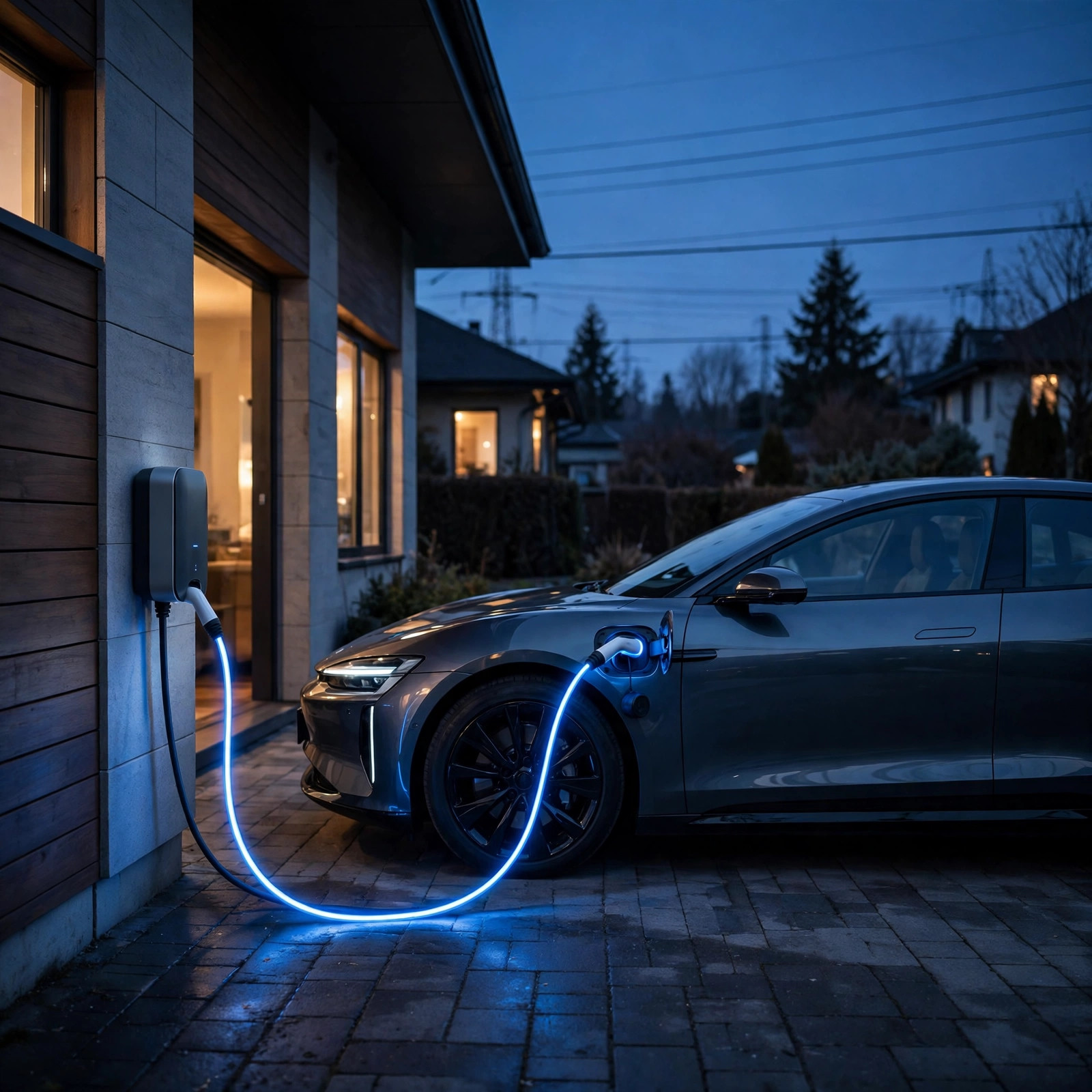
Hi, this is Datumdraft. Your car sits parked for about 23 hours a day. Some utilities want to rent that idle battery like a spare room and pay you for the power.
The pitch sounds easy: plug in, sell power back at peak prices, and pocket the difference. Before you spend thousands on a bidirectional charger, you need to check three hard limits: charging standards, energy loss, and battery warranty rules. Here is how vehicle-to-grid (V2G) power actually works in late 2026, and who actually makes money from it.
At a Glance
- V2G lets a parked EV sell power back to the utility grid, unlike V2H home backup or V2L appliance plugs.
- DC bidirectional chargers place the inverter on your wall, while AC systems convert power inside the car.
- General estimates put round-trip efficiency at 80–90%, meaning 10–20% of your energy disappears each cycle.
- Shallow cycling and thermal control limit battery wear, and LFP packs handle V2G stress best.
Your EV is not just charging in reverse. How does it talk to the grid?
Think of V2G like a session musician playing inside a large orchestra. You cannot just play loudly whenever you feel like it. You wait for the conductor’s cue, match the exact tempo, and stop the second the conductor raises a hand.
In power terms, the utility grid operator is the conductor. Many drivers assume V2G simply runs a home charger backward during a blackout. That mixes up three completely different technologies.
- V2L (Vehicle-to-Load) is like plugging a portable speaker into a battery bank at a campsite. Your car powers a coffee maker, a laptop, or power tools through a standard outlet, with no connection to your house wiring.
- V2H (Vehicle-to-Home) is like playing guitar alone in your living room. During a power outage, a transfer switch disconnects your house from the street lines, and your car runs your home circuits on its own.
- V2G (Vehicle-to-Grid) synchronizes your car directly with the public power grid. The utility pulls small bursts of power to stabilize grid frequency or shave afternoon demand peaks, then pays you or credits your bill.
To join that orchestra safely, the car and charger must speak the same digital language. Early V2G trials relied heavily on CHAdeMO, a Japanese DC fast-charging plug that supported two-way power years before its rivals.
For modern Combined Charging System (CCS) cars in Europe and North America, the rulebook is ISO 15118-20:2022. ISO 15118-20 is a communication and negotiation standard, not a piece of charger hardware. It tells the car and wall box how to shake hands securely and agree on how much power to send.
Behind the wall box sits another layer of software called Open Charge Point Protocol (OCPP). OCPP 2.0.1 connects the charging station to the utility or fleet backend system, and OCPP 2.1 added dedicated controls for ISO 15118-20 bidirectional power flows. Without both layers working together, two-way hardware sits idle.
Wall box or car trunk: where does the power translator sit?
Your EV battery speaks direct current (DC), while your home and the street grid speak alternating current (AC). Every time power moves in or out, an inverter has to translate between those two languages.
Where engineers put that translator decides both the price of your wall box and how much electricity vanishes as heat. You can put the translator inside the car, or you can bolt it to the garage wall.
In an AC bidirectional setup, the car’s built-in onboard charger does the translating. That keeps the wall box cheap and simple, because the wall box only passes AC power through. The trade-off is that every car must carry a heavier, pricier bidirectional inverter everywhere it drives.
In a DC bidirectional setup, the inverter sits inside the wall charger. The car speaks its native DC directly to the wall box, which skips the car’s onboard hardware limits. In an industry interview, the CEO of charger maker Tellus Power argued that off-board DC conversion avoids onboard bottlenecks. He claimed it also cuts conversion losses. His claim: onboard conversion can lose around 15% round-trip. That is a vendor interview claim, not an independent lab standard.
Even with good hardware, you never get 100% of your electricity back. General industry estimates place total V2G round-trip efficiency between 80% and 90%, depending on charger design and power level. A field study by Dutch testing group ElaadNL measured 23 real V2G cycles and recorded efficiencies from 79.1% to 87.8%, peaking around 87% at full current.
Put that into everyday money. If you buy 10 kilowatt-hours (kWh) of cheap night power and sell it back at dinner time, 1 to 2 kWh disappears as heat during the round trip. The evening utility payout must beat both that 10–20% energy tax and the cost of your equipment.
| Feature | DC Bidirectional Charging | AC Bidirectional Charging |
|---|---|---|
| Inverter location | Inside the wall or ground charger | Inside the vehicle (onboard charger) |
| Current sent to car | Direct current (DC) | Alternating current (AC) |
| Main advantage | Avoids onboard vehicle limits; easier for fleets to control grid compliance at the charger | Lower wall-box hardware cost for home installations |
| Main drawback | Expensive, bulky wall box with built-in power electronics | Requires automaker to build bidirectional hardware into the car; grid certification varies by region |
| Best fit | School bus depots, commercial fleets, high-power home backup kits | Mass-market passenger EVs once AC grid codes and ISO 15118-20 mature |
Will selling power wreck your battery? It depends on how hard you pull
Picture your EV battery as a thick rubber band. Pull it lightly and let go, and it keeps its snap for years. Stretch it to the snapping point in hot weather over and over, and it goes slack fast.
That is why flat claims that “V2G ruins batteries” or “V2G never hurts batteries” both miss the mark. The damage depends on how deep you drain the pack, how fast you push current, and how hot or cold the cells are.
Shallow cycling keeps the rubber band healthy. When a V2G system only moves energy inside the middle of the pack, cell wear stays small. Think of a 40% to 50% or 30% to 70% state of charge. SoC is the battery’s fuel gauge. Grid frequency regulation moves tiny bursts of energy in and out, so it stresses cells far less than draining a pack from 90% down to 10% every evening.
Two chemical side effects cause the real trouble when dispatch goes wrong. Deep cycles and high heat speed up solid electrolyte interphase (SEI) growth, a crust that builds up inside the cell and locks away usable lithium. Fast recharging in cold weather below 10°C can trigger lithium plating, where metallic lithium coats the anode instead of storing cleanly.
Keeping pack temperatures steady during two-way power flows is where strong EV thermal management protects your range over the long haul. Without good cooling in summer and preheating in winter, V2G aging speeds up fast.
Battery chemistry also changes the math. Industry engineers widely view lithium iron phosphate (LFP) cells as the best match for V2G. They handle far more charge cycles. They also resist heat better than nickel manganese cobalt (NMC) cells. If you want to compare how cell chemistry changes longevity and cost, see our breakdown of LFP battery trade-offs.
| Operating Factor | Low Battery Wear (Friendly to V2G) | High Battery Wear (Damaging to V2G) |
|---|---|---|
| State of charge (SoC) | Shallow middle window (roughly 40–50% or 30–70%) | Deep swings (above 90% down to below 20%) |
| Grid service type | Frequency regulation (small, brief energy pulses) | Daily deep arbitrage (draining large chunks every evening) |
| Temperature | Moderate, actively cooled or preconditioned pack | Hot cycling (accelerates SEI growth) or cold fast recharge below 10°C (lithium plating risk) |
| Battery chemistry | LFP (high cycle life, strong thermal stability) | High-energy NMC pushed through deep, hot cycles |
Check your warranty before turning V2G on. Do not assume every EV warranty covers grid export. Secondary industry summaries note that some automakers are updating warranties to allow approved V2G control algorithms, yet rules still vary by brand, model, and country. Read your exact battery warranty terms before enrolling in any utility program.
Why yellow school buses beat Teslas at the grid-money game
In the United States, the vehicles actually earning grid money today are rarely personal sedans. They are yellow electric school buses.
Think of an electric school bus as a seasonal summer worker. On hot August afternoons, everyone cranks up their air conditioners and the electric grid strains. At that exact hour, school is out, and the buses are sitting plugged in at the depot with full batteries.
Now compare that to a personal EV, which acts like a busy office commuter. At 5 PM, when electricity prices spike, you are either stuck in traffic or running errands. You cannot sell power to the grid if your car is not plugged into a V2G charger.
Size matters too. An electric school bus carries a massive 150 to 220 kWh battery pack, which is roughly two to three times the size of a typical family EV pack. Utilities love dealing with one school district that controls 50 giant buses on a fixed schedule instead of chasing 500 individual homeowners.
So how much money is actually on the table? Secondary summaries of V2G pilot programs across the UK, California, and Scandinavia cite a broad range. The range is $800 to $1,800 per vehicle per year. That is a pilot range from secondary compilations, not a guaranteed payout. In specialized cases, payouts can climb higher. An August 2026 World Resources Institute (WRI) report noted one such case. California school districts using state-funded V2G buses earn roughly $5,000 per bus per year during emergency grid events.
Those fleet numbers do not translate automatically to your home driveway. Your battery is smaller, your schedule changes on weekends, and a single home charger rarely qualifies for wholesale utility auctions on its own.
| Condition | Electric School Bus (V2G Textbook Fit) | Personal Passenger EV (Harder Fit) |
|---|---|---|
| Battery capacity | 150–220 kWh (about 2–3x a typical family EV) | Typically 60–80 kWh |
| Daily schedule | Fixed routes; predictable idle windows | Irregular commutes, errands, and weekend trips |
| Summer peak availability | Parked at depot during hot afternoon peaks | Often driving home during 4 PM – 7 PM peaks |
| Revenue economics | Stronger unit math; depot chargers aggregated by fleet | Small payouts often offset by charger cost and 10–20% energy loss |
Five checks before you buy a bidirectional charger
Installing V2G at home is a lot like putting solar panels on your roof. Buying the panels is the easy part. First you have to check your roof angle, your local utility rate, and whether the city will let you connect to the street lines.
Today, V2G sits in the transition between pilot trials and early commercial rollout. The hardware works, yet standards, utility payouts, and car warranties are still catching up. Run through these five checks before spending money.
- Confirm your car’s bidirectional standard. Check whether your EV supports V2G or only V2H/V2L, and verify if it uses ISO 15118-20 over CCS or older CHAdeMO hardware.
- Price the full hardware stack. Ask whether the setup needs a pricey DC wall box or an AC charger, plus a transfer switch if you want home blackout backup.
- Read your OEM battery warranty. Verify in writing whether bidirectional discharging is allowed and whether you must use a manufacturer-approved control app.
- Check your local utility tariff. Confirm that your power company actually pays for exported energy, peak shaving, or frequency services at your address.
- Do your own outage backup math. Ignore vague ads claiming an EV powers a house “for days,” and calculate your real hours using your home’s actual load.
That fifth check stops the most common disappointment. To see how long your EV will keep the lights on during a blackout, use one simple formula: Usable Battery (kWh) divided by Home Load (kW) equals Backup Hours.
Home Outage Math Example: Suppose your EV has a 60 kWh battery, and you keep half of it in reserve for emergency driving. That leaves 30 kWh for your house. If your home draws an average of 2 kW (fridge, lights, Wi-Fi, and a few outlets), 30 kWh divided by 2 kW gives you 15 hours of backup—not three days. Turn on central air conditioning at 4 kW, and that drops to 7.5 hours.
Hardware is also evolving at the vehicle voltage level. Higher-voltage packs like 800V EV architecture move power with less current and lower heat losses in the cables, which helps both fast charging and high-power discharging.
At the heavy commercial end of the grid, depots are already planning for much larger energy flows alongside the megawatt charging system for electric trucks. For everyday homeowners, though, the smartest move in late 2026 is waiting until your local utility publishes a clear V2G payout rate and your carmaker puts warranty coverage in writing.
Key takeaways
V2G is no longer a lab experiment, yet it is still moving from pilot trials into early commercial service. The hardware works today, while pricing rules, utility programs, and automaker warranties are still settling down.
- Know what you are buying: V2L runs appliances, V2H backs up your house during an outage, and V2G sells synchronized power to the utility grid.
- Account for the energy tax: General estimates put round-trip efficiency at 80–90%, so your utility payout must beat that 10–20% loss plus charger costs.
- Protect the battery with shallow cycles: Staying near the middle of the pack with good thermal control limits wear, and LFP batteries handle extra cycling best.
- Watch where the economics actually work: Large, fixed-schedule fleets like electric school buses earn real V2G revenue today, while personal EVs face tougher math.
- Check the numbers before signing: Confirm your standard, warranty, and utility tariff, and always use the kWh-divided-by-kW formula to judge home backup time.
Which use case matters more to you: keeping your house running during a storm (V2H), or earning bill credits by selling power back to the grid (V2G)? Drop your thoughts in the comments, and keep that kWh backup formula handy next time you see a charger ad.
Sources
- ISO 15118-20:2022 — Road vehicles — Vehicle to grid communication interface — Part 20: 2nd generation network layer and application layer requirements (International Organization for Standardization, 2022).
- ISO 15118-20 (Second-Generation Vehicle-to-Grid Communication Standard) — AMPECO
- Open Charge Point Protocol (OCPP 2.0.1 and OCPP 2.1 Overview) — Open Charge Alliance
- Certification OCPP 2.0.1 — Open Charge Alliance
- Empirical Evaluation of V2G Round-trip Efficiency — ElaadNL / FLEET, 2020
- Vehicle-to-Grid: Future of Electric Energy Integration — Schaltbau, August 29, 2025
- Vehicles-to-Grid Integration Assessment Report — U.S. Department of Energy, January 2025
- A Comprehensive Review on the Characteristics and Modelling of Lithium-Ion Battery Ageing — IEEE Transactions on Transportation Electrification (TU Delft repository)
- How Vehicle-to-Grid Technology Helps Electric School Buses Power Communities — World Resources Institute (WRI), August 20, 2026
- Roadmap on Smart and Bidirectional Charging (GRPE-95-12e) — UNECE, October 5, 2026