Hi, this is Datumdraft.
Millions of Tesla owners have spent the past year holding off on a new car, waiting for the company’s next-generation brain. If you are sitting on older Hardware 3 silicon and stalling your upgrade for AI5, Elon Musk just ended your wait. The Tesla AI5 Optimus plan now leaves passenger cars out of the equation entirely.
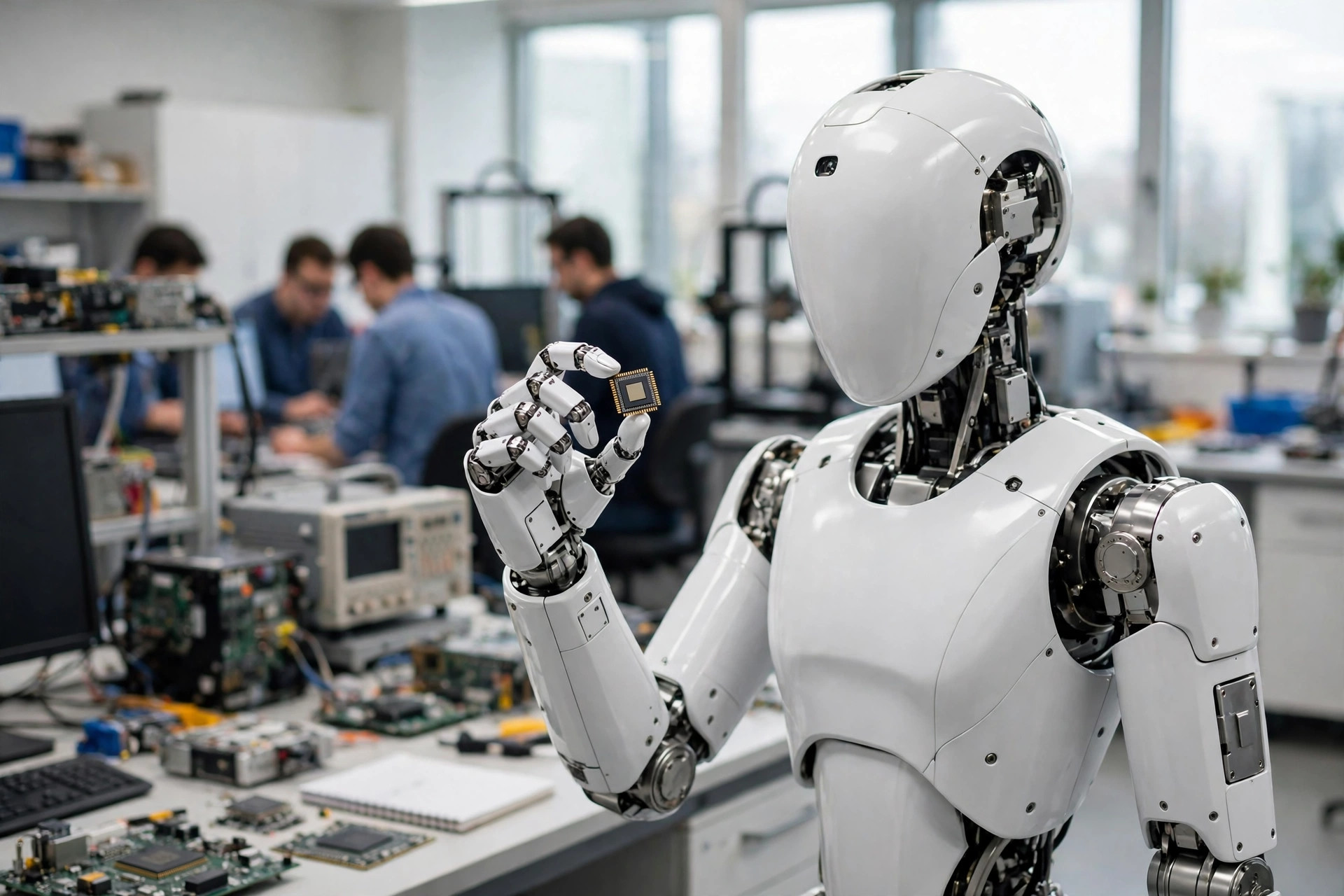
On November 22, 2026, Musk replied to an owner on X with a blunt verdict: AI5 is going to the Optimus humanoid robot, not to cars. Passenger vehicles will stay on AI4 instead. That single reply reshapes the hardware roadmap for every current buyer, every Hardware 3 owner, and Tesla’s own Full Self-Driving software team.
Yet this shift did not appear out of thin air. Musk’s public comments across 2026 quietly laid the tracks for this moment, even as buyers hoped otherwise. Separating what Musk actually confirmed from what remains an unverified boast is now essential for anyone tracking Tesla’s silicon.
At a Glance
- Musk confirmed on November 22 that AI5 goes to Optimus, leaving cars on AI4 with no stated end date.
- April’s tape-out already signalled this shift, with Optimus deployment targeted for April 2027 and volume ramp in late 2027.
- Musk’s “roughly 12X” compute claim lacks independent benchmarks, and AI5 memory estimates shifted from 72GB back to 96GB.
- AI4.5 trims RAM to 24GB, forcing FSD v15 to reach unsupervised driving on today’s vehicle compute budget.
The chip that came to save cars went to a robot instead — what one Nov 22 X reply changed
Imagine a Formula 1 team spending years designing a revolutionary engine, only to bolt it into a pit-crew exoskeleton instead of the race car. Drivers waiting for extra speed on Sunday suddenly learn their current engine must win the championship on its own. That is the exact position Tesla drivers find themselves in after one late-November exchange on X.
On November 22, 2026, a Tesla owner driving a Hardware 3 vehicle asked Musk a direct question. Should buyers hold out for a car equipped with the upcoming AI5 computer? Musk did not hedge or offer a distant release window.
“It’s going to Optimus. Cars will remain at AI4. That’s enough to solve superhuman driving,” Musk replied. In the same thread on the same day, he raised the stakes even higher. “AI5 is a gigantic improvement. Roughly 12X more compute,” he added.
Read those two quotes side by side and the tension jumps off the screen. Musk is simultaneously hyping a massive leap in silicon capability while telling car buyers they are not getting it. For owners who treated AI5 as the guaranteed safety net for unsupervised autonomy, the ceiling just dropped.
The exclusion does not stop at AI5, either. According to Electrek’s reporting on Tesla’s silicon roadmap, the next generation after that—AI6—is also slated for Optimus rather than passenger vehicles. Tesla is not just delaying one chip cycle for cars. It is dedicating its flagship compute pipeline to humanoid robotics and data-center clusters.
Notice what Musk left out of his November 22 reply. He attached no expiration date to the statement that cars will remain at AI4. He gave no timeline for Hardware 3 retrofits, which thousands of early Full Self-Driving buyers still await.
He also did not clarify whether “AI4” covers the minor AI4.5 refresh or which models will receive it. Assuming cars will stay on AI4 forever would stretch his words too far. Assuming AI5 will quietly slip into a Model Y next year ignores what he just put in writing.
What does “12X” actually mean?
Picture an engine builder standing beside a covered prototype in a garage, with no dynamometer readout anywhere in sight. Last month he told investors it makes roughly ten times the horsepower of the old block. This month, in a casual hallway chat, he calls it roughly twelve times instead.
Until someone bolts that engine to a test bench, both numbers are marketing claims rather than engineering measurements. That is the exact status of Musk’s latest AI5 performance headline. On November 22, 2026, Musk claimed AI5 delivers “roughly 12X more compute” than AI4.
No independent lab has benchmarked AI5 silicon. Tesla has published no standardized throughput charts, power-draw figures, or latency numbers for the chip. Treating “12X” as a verified hardware spec would mislead readers.
The moving target becomes even clearer when you check Tesla’s own calendar. Just one month earlier, on the October 21, 2026 Q3 earnings call, Musk described AI5’s gain as an “order of magnitude.” In plain English, an order of magnitude means roughly 10X.
It is tempting to blend those two remarks into a tidy range, yet doing so hides the real story. Musk did not publish a formal spec band of ten to twelve. Instead, his verbal estimate jumped from roughly 10X in October to roughly 12X in November, with zero third-party data published in between.
In chip engineering, raw compute multipliers also depend heavily on how you count. A chip can multiply theoretical math operations by shrinking numerical precision, which makes small numbers faster to process at the cost of fine detail. Without knowing which workload Musk measured, “roughly 12X” tells us his ambition, not real-world frame rates.
The memory picture looks just as fluid. Right now, AI5 is expected to carry roughly 96GB of RAM based on Musk’s recent statements, though that figure has already bounced around. As Electrek documented, reports in October indicated Tesla cut AI5 memory down to 72GB, only for Musk to revert back to 96GB a single day later.
To put roughly 96GB into human terms, that is about six times the working memory inside a standard high-end laptop. A chip with that much memory can hold massive neural networks—the digital brain models that interpret sight and motion—without constantly shuffling data. Still, because Tesla altered that memory figure overnight in October, readers should treat roughly 96GB as a working target rather than a locked production spec.
This goodbye was signalled in April, not invented in November
Suppose a factory manager posts a memo in April stating that every new backup generator will power the main robotics plant, not the delivery vans. When he repeats that exact rule in November, drivers have every right to feel disappointed—but nobody should call it a sudden change of mind.
That is the real timeline behind Tesla’s AI5 split. Musk did not wake up on November 22 and abruptly redirect a finished automotive chip. He had already put investors and fans on notice seven months earlier.
Back on April 15, 2026, Tesla reached a major milestone called tape-out—the final blueprint stage where a chip design is locked and sent to factories for manufacturing. While celebrating that milestone, Musk explicitly named AI5’s primary destinations. “Optimus and our supercomputer clusters. AI4 is enough to achieve much better than human safety for FSD,” he stated.
He echoed that same priority order during Tesla’s Q1 2026 earnings call. Optimus robots and internal training data centers stood at the front of the line, ahead of passenger cars. November 22 simply turned an early priority list into a flat declarative sentence for car shoppers.
Looking at the production schedule explains why Tesla had to ration early silicon anyway. After the April 2026 tape-out, Musk told investors on the Q3 call that Tesla targets April 2027 to put AI5 into Optimus. That leaves roughly one full year between locking the blueprint and booting the first chips inside working robots.
Full-scale manufacturing takes even longer to build momentum. Tesla expects its broader AI5 production ramp to unfold across 2027. According to Electrek, volume production at Samsung’s Texas fab is not scheduled to start until the second half of 2027.
Electrek also noted that this late-2027 volume window runs roughly two years behind Musk’s original timeline. In human terms, a two-year manufacturing slip is almost half the typical lease of a new car. When high-end chips arrive late and in limited batches, management must decide which product line gets fed first.
Tesla builds millions of cars every year, which would swallow initial AI5 wafer output almost instantly. Optimus production starts far smaller, meaning early AI5 batches can supply robots and data-center racks without starving the assembly line. April’s tape-out set the clock, and late-2027 volume realities sealed the priority order.
What do AI4 owners get now?
Imagine trying to build a complex model airplane on a desk whose storage drawer just shrank by a quarter. Worse yet, a brand-new visualization tool now claims half of your entire tabletop before you even pick up the glue. That is the exact compute squeeze facing Tesla’s vehicle software engineers today.
Because AI5 is skipping cars, every software promise for passenger vehicles must fit inside the AI4 and AI4.5 envelope. Do not mistake AI4.5 for a mini-AI5 rescue mission, either. Musk himself described AI4.5 as a “relatively small performance improvement, mostly due to needing to upgrade RAM to LPDDR5X.”
LPDDR5X is simply a newer, faster generation of low-power mobile memory commonly found in modern smartphones. Switching to faster memory helps data move quicker between storage and the processor. However, Tesla did not increase memory capacity during that transition—it actually cut it.
AI4.5 reduces system RAM from 32GB down to 24GB. That is a 25 percent drop in total working memory, trimming 8GB off the board. Musk offered a blunt four-word explanation for the cut: “RAM is super expensive.”
In the same wave of comments, Musk claimed that surging memory and storage prices have doubled the cost of AI4 hardware. Keep that claim strictly in perspective, though. Musk cited no dollar amount, gave no baseline start date, and drew zero connection to retail car prices, FSD subscription fees, or retrofit pricing.
He was talking about internal component bills, not announcing a sticker-price hike for buyers. Still, cutting RAM by a quarter proves that cost pressure is actively shaping what goes under the dashboard. Engineers are optimizing for tight margins rather than adding generous hardware headroom.
Now layer Tesla’s latest driving software on top of that tighter hardware budget. Look at how FSD v15’s Reality View renders the rich, photorealistic world on the center screen. According to Electrek’s technical breakdown, Reality View runs on a separate diffusion model—an AI image generator that paints scenes from scratch—and it consumes half of one AI accelerator all by itself.
An AI accelerator is the specialized math engine inside the car’s computer that runs neural networks. Giving half of one accelerator to screen visuals means the core driving stack has far less spare compute left over. With AI5 off the table for cars, FSD v15 cannot wait for a hardware bailout. It has to reach true unsupervised driving right here, right now, on AI4.
Why does the Tesla AI5 Optimus program get the best chip first?
Think of a school with one world-class private tutor and two very different students. The first student already drives safely along painted lanes and follows predictable traffic signs. The second student is learning to walk upright, balance on stairs, and thread a needle with ten fingers at the same time.
You give the best tutor to the student facing the harder physical exam. That is the core engineering logic behind the Tesla AI5 Optimus allocation. From Tesla’s perspective, passenger cars on AI4 have already crossed the hardware threshold needed for superhuman road safety.
Driving looks complex to humans, yet it takes place in a structured world. Cars roll on four wheels along paved roads governed by lanes, curbs, and traffic rules. A vehicle essentially solves a two-dimensional navigation problem at high speed.
A humanoid robot faces a far messier challenge. Optimus operates in unstructured three-dimensional spaces—cluttered kitchens, narrow factory aisles, and uneven staircases where no two rooms match. Every millisecond, its onboard brain must coordinate whole-body balance while adjusting grip pressure across two articulated hands.
Controlling humanoid robot actuators requires continuous real-time feedback across dozens of joints at once. A car only steers two front wheels, pushes one accelerator, and presses one brake. Optimus must stabilize ankles, knees, hips, shoulders, and fingers simultaneously without tipping over.
That physical complexity demands both massive raw compute and huge local memory. Holding multimodal models—systems that blend vision, touch, and motor control—is why Optimus badly needs AI5 and its roughly 96GB memory target. Unlike a car, a robot cannot easily offload split-second balance decisions to a cloud server without falling flat on the floor.
Power and thermal limits raise the bar even higher. While Tesla’s vehicles benefit from a modern 48V electrical system and liquid-cooled trunks, a walking robot carries its battery pack inside its torso. Every watt wasted on inefficient compute steals minutes of working battery life from Optimus.
Because initial AI5 supply will be tight through 2027, routing those chips to Optimus and AI training clusters makes strategic sense for Tesla. With AI6 also pointed at Optimus per Electrek, Tesla is making a clear bet. Cars are now a software optimization problem on AI4, while robotics is the frontier that requires every drop of next-generation silicon.
Key takeaways
Elon Musk’s November 22 reply closed a long-running guessing game for Tesla buyers, even if it left key details unanswered. Cars are staying on AI4 with no stated end date, while AI5—and later AI6—head straight to Optimus and Tesla’s data centers. April’s tape-out already pointed in this direction, so November was confirmation rather than an overnight pivot.
At the same time, separate confirmed strategy from unverified numbers. Keep three Musk claims flagged until independent data arrives:
- Compute jump: Musk’s latest “roughly 12X” claim on November 22 sits above his October 21 Q3 call estimate of an “order of magnitude” (roughly 10X), with zero independent benchmarks for either figure.
- Memory capacity: AI5’s roughly 96GB RAM figure shifted down to 72GB and back to 96GB within a day in October, making it a moving target rather than a final spec.
- AI4 cost spike: Musk claimed component inflation doubled AI4 hardware costs, yet provided no dollar figures and no link to vehicle or subscription pricing.
Two concrete watchpoints will prove whether Tesla’s bet pays off across 2026 and 2027. First, watch whether FSD v15 can deliver true unsupervised driving on AI4 while its Reality View diffusion model claims half an accelerator and AI4.5 trims RAM to 24GB. Second, track whether Tesla hits its April 2027 Optimus deployment target and late-2027 volume ramp without further delays.
Sources
- Electrek — Coverage of Elon Musk’s November 22, 2026 X reply, AI5/AI6 Optimus allocation, AI5 RAM revisions, FSD v15 Reality View accelerator usage, and Samsung Texas fab H2 2027 volume timeline (November 22, 2026).
- eletric-vehicles.com — Report on Elon Musk confirming AI5 skips cars for Optimus and AI4 remains vehicle hardware (November 22, 2026).
- CryptoBriefing — Summary of Musk’s November 22, 2026 X thread quoting AI5’s “roughly 12X more compute” claim and Optimus priority (November 22, 2026).
- Autopilot Review — Analysis of AI4, AI4.5 LPDDR5X RAM reduction, and HW3 owner implications following Musk’s X confirmation (November 23, 2026).
- Tesla Q3 2026 Earnings Call — Elon Musk’s “order of magnitude” AI5 compute remark and April 2027 Optimus deployment target (October 21, 2026).