Hi, this is Datumdraft.
If you scroll past electric vehicle news, you see two opposite headlines about dead batteries. One calls them a toxic landfill bill, while the next calls them a 95% goldmine. The real answer comes down to what sits inside the pack, how a plant pulls those metals out, and which EU laws lock the math in place.
At a Glance
- NMC batteries carry valuable cobalt and nickel, while LFP packs leave recyclers with razor-thin margins.
- Whole-battery recycling efficiency (65%) and per-metal recovery targets measure completely different things.
- Chemical leaching recovers more lithium than smelting, but brings higher operating costs and sodium sulfate wastewater.
- By August 2031, EU law forces new EV batteries to contain legally mandated recycled metals.
Why can two identical dead EV batteries sit on opposite sides of profit?
The metals inside a retired pack decide whether a recycler makes money or barely covers labor. Think of it like scrapping two broken watches on a workbench. A broken luxury watch holds gold and platinum that easily pay for your time. A plastic digital watch takes the same effort to open and leaves almost nothing valuable behind.
Electric vehicle packs follow that exact split across two main chemistries. NMC stands for Nickel Manganese Cobalt, a battery chemistry packed with expensive metals. LFP stands for Lithium Iron Phosphate, a cheaper chemistry made with iron and phosphate.
Early recycling businesses built their financial models around NMC packs. Cobalt and nickel fetch high prices on metal markets, so pulling them out paid for shipping, shredding, and refining. Today, automakers put LFP packs into millions of affordable models, which changes the LFP vs NMC battery math for every plant downstream.
LFP packs contain almost no cobalt or nickel. Recyclers still have to transport, discharge, and crush the heavy battery pack. Because the leftover metals carry far less market value, LFP recycling leaves operators with razor-thin margins.
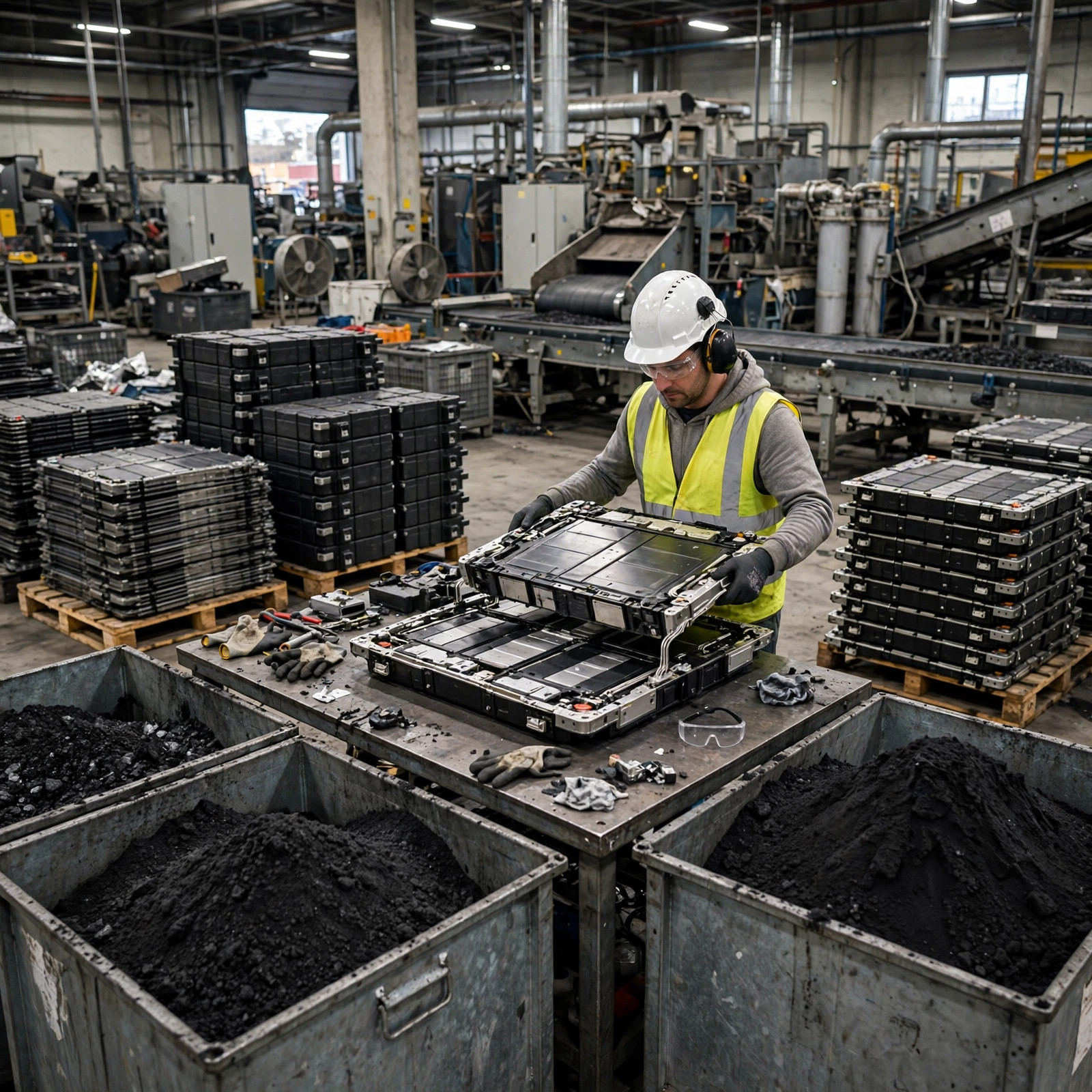
Plants shred dead batteries into a dark, metallic powder called black mass. That powder holds the lithium, cobalt, nickel, and other active materials ready for refining. Black mass prices swing wildly alongside global commodity markets, which makes thin-margin LFP processing even harder to budget.
Furnace or acid bath: why do both recycling bills hurt?
Getting metals out of a dead battery forces plants to pick between extreme heat and heavy chemistry, and both options drain cash. Imagine two ways to strip a tangled jewelry box. You can toss the whole box into a roaring smelter to grab the heaviest metals quickly. Or you can wash every single bead in a chemical bath to save more pieces. That costs extra soap and leaves a tub of salty dirty water to deal with afterward.
The smelter approach is pyrometallurgy, a process that melts battery modules in a furnace at 1,200 to 1,400°C. That temperature is roughly five to six times hotter than a home kitchen oven (approximate, based on a typical 220°C oven). High heat handles mixed battery scrap fast, yet it burns off plastics and leaves lithium harder to recover.
The chemical bath approach is hydrometallurgy, a process that dissolves shredded black mass in liquid acids to separate individual metals. Industry estimates place hydrometallurgy at roughly 90% of global battery recycling capacity. Keep in mind that 90% is an industry estimate rather than a legal rule.
Hydrometallurgy recovers more lithium than traditional smelting, which looks great on a presentation slide. In daily operations, chemical leaching carries higher operating costs for reagents and energy. The reactions also leave behind large volumes of sodium sulfate wastewater, a salty chemical byproduct that plants must treat or dispose of at extra cost.
Higher metal recovery on paper does not automatically produce higher profit at the plant gate. When reagent bills and wastewater treatment climb, a facility can pull out more lithium and still lose money on thin-margin packs.
| Method | How It Works | Estimated Market Role | Key Advantage | Economic and Waste Trade-Off |
|---|---|---|---|---|
| Pyrometallurgy | Melts battery scrap in a furnace at 1,200-1,400°C | Smaller share; often used for mixed feedstock | Processes mixed packs fast with less sorting | High heat energy cost; lower lithium recovery |
| Hydrometallurgy | Dissolves crushed black mass in chemical baths | Roughly 90% (industry estimate) | Higher lithium and target-metal recovery | Higher operating cost and sodium sulfate wastewater |
What does a 95% battery recycling claim actually hide?
When a press release claims 95% battery recycling, it is almost never talking about the whole battery, and it is not quoting the law. Confusing whole-battery recycling with single-metal recovery is like claiming you recycled 95% of Thanksgiving dinner when you saved 95% of the gravy and threw half the plate in the trash.
European law draws a strict line between two separate numbers. Recycling efficiency measures the share of the entire battery pack’s weight that a plant recovers. Under EU Battery Regulation 2023/1542, lithium-based batteries must reach 65% whole-pack recycling efficiency by the end of 2025, which equals roughly two-thirds of the pack’s total weight.
Material recovery measures something completely different. It tracks the percentage of one specific metal pulled out during recycling. By the end of 2027, EU rules require plants to recover 50% of lithium. That lithium floor jumps to 80% by the end of 2031.
Heavier metals carry higher legal targets because they are easier to extract. For cobalt, copper, lead, and nickel, EU law sets the material recovery floor at 90% by the end of 2027. That target climbs to 95% by the end of 2031.
Any headline claiming a blanket 95% recovery with no metal name and no target date is a company claim, not a legal rule or an industry average. For example, individual hydrometallurgical plants sometimes report around 90% lithium recovery in their own facilities. In the smelting camp, Young Poong has claimed 90% lithium recovery through a dry smelting process. Those figures describe specific company processes, while the legal standard applies across the entire European market.
Headline Red-Flag Checker
- Did the article name a specific metal, or did it mean whole-battery mass?
- Did it state an exact compliance deadline?
- Is it citing a binding law, or repeating a single company’s claim?
Why can turning a retired EV pack into home storage backfire legally?
Turning a retired EV battery into a cheap home wall unit sounds like easy profit until European law treats you like a brand-new factory. Repurposing a used EV pack in the EU works like rebuilding a salvaged car from spare parts. Then you must pass full crash-testing and issue a brand-new factory warranty yourself.
Under EU Battery Regulation 2023/1542, repurposed second-life batteries count as legally new products. Any company that converts a retired vehicle pack into stationary home or grid storage legally becomes the battery manufacturer. That label brings full legal liability for safety, testing, and compliance.
The repurposer must also issue a separate battery passport. A battery passport is a digital record that tracks a battery’s history, material composition, and regulatory compliance. Building that compliance paper trail adds legal and administrative overhead to every repurposed unit.
Physical inspection costs stack up on top of the paperwork. Before reusing a pack, technicians must read cell-level health data through the battery management system, which gets expensive when modern packs glue cells tightly into structural frames. Once you combine testing, re-certification, legal liability, and passport duties, sending a retired pack straight to recycling often makes cleaner business sense.
Drivers and fleet operators can still capture grid value without triggering new-manufacturer rules. Using vehicle-to-grid V2G lets an EV discharge power to a home or grid while the battery stays inside the car. Keeping the pack in its original vehicle avoids the legal reset that hits second-life repurposers.
Why Second-Life Is Not Free Money in the EU
Retired EV Pack to Repurposed for Home Storage to Legally a “New Product” to Repurposer Becomes “Manufacturer” to Separate Battery Passport Required.
How does EU law force recycling to work even when metal prices drop?
Even if raw metal prices drop tomorrow, automakers selling EVs in Europe cannot walk away from recycling because the law locks recycled metal into every new car. Without mandates, battery recycling acts like collecting aluminum cans for pocket change, where people stop bothering whenever scrap prices dip. EU law replaces that optional scrap trade with a mandatory bottle-deposit system written straight into the automaker’s factory blueprint.
EU Battery Regulation 2023/1542 builds a strict staircase of deadlines from 2025 through 2036. The first step hit at the end of 2025 with the 65% whole-pack recycling efficiency rule for lithium-based packs. The second step arrives at the end of 2027, setting recovery floors of 50% for lithium and 90% for cobalt, copper, lead, and nickel.
The biggest commercial shift takes effect on August 18, 2031, less than five years from November 2026. Starting on that date, every new EV battery placed on the EU market must contain mandatory minimum shares of recycled metals: 16% cobalt, 85% lead, 6% lithium, and 6% nickel. By the end of 2031, per-metal recovery floors also rise to 80% for lithium and 95% for cobalt, copper, lead, and nickel.
In 2036, those mandatory recycled-content minimums step up again. Automakers must lock in recycled metal supply chains ahead of time to keep selling cars in Europe. That legal demand creates a floor under recycling volumes even when mining prices fall.
Chemistry shifts will keep testing this business model over the next decade. Newer ultra-cheap options in the sodium-ion battery vs LFP race remove even lithium from the cell, leaving recyclers with almost zero high-value scrap. As battery materials get cheaper, regulatory compliance and producer fees will matter more than commodity resale value.
| Deadline | Metric Type | Legal Requirement (EU 2023/1542) |
|---|---|---|
| End of 2025 | Whole-battery recycling efficiency | 65% of lithium-based battery mass |
| End of 2027 | Per-metal material recovery | 50% lithium; 90% cobalt, copper, lead, and nickel |
| August 18, 2031 | Mandatory recycled content in new EV batteries | 16% cobalt, 85% lead, 6% lithium, 6% nickel |
| End of 2031 | Per-metal material recovery | 80% lithium; 95% cobalt, copper, lead, and nickel |
| 2036 | Mandatory recycled content in new EV batteries | Minimum recycled-content thresholds step up again |
Key takeaways
EV battery recycling is a margin-sensitive industrial business shaped by chemistry, processing bills, and legal mandates rather than scrap value alone. NMC packs still anchor metal recovery revenue, while LFP packs and future sodium-ion cells squeeze plant margins. Chemical leaching pulls out more lithium than smelting, yet it forces operators to pay for reagents and sodium sulfate wastewater treatment.
In Europe, regulation now carries the heaviest weight. Repurposing retired packs for home storage triggers full manufacturer liability and separate battery passport requirements. Meanwhile, mandatory recycled-content rules starting in August 2031 lock recycling into European EV production regardless of raw metal swings.
Bookmark the EU compliance table above for quick reference, and share this guide with anyone quoting a blanket 95% recovery headline without context. In the comments, tell me where you think thin-margin LFP recycling costs will land: will automakers absorb the bill, or will recyclers charge higher gate fees?