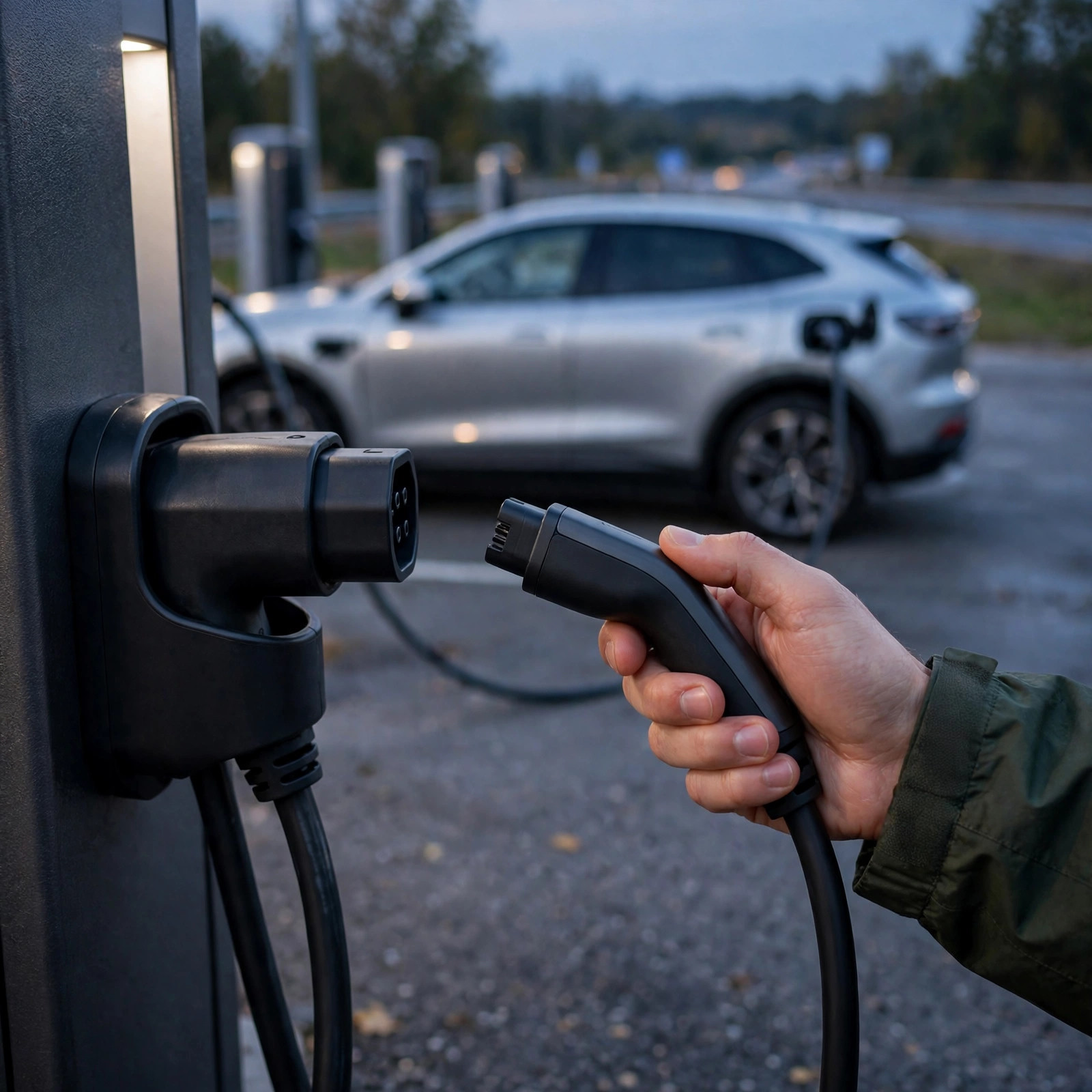
Hi, this is Datumdraft. Picture a freezing January night at a highway rest stop in Michigan. One driver grips a thick, stiff charging cable with both hands and wrestles the heavy handle into a car port. Two stalls away, a Tesla driver clicks a slim plug into place with one hand and walks off to buy hot coffee. That everyday contrast explains the NACS vs CCS charging standard shift better than any engineering spec sheet ever could.
At a Glance
- NACS won North America through compact ergonomics and Supercharger access, not raw charging speed.
- Both NACS and CCS1 handle 1,000V, while chargers and batteries decide real charging speeds.
- Stellantis joined the NACS lineup in 2026, completing North America’s major automaker shift.
- Global charging now splits into North American NACS, European CCS2, and Asian ChaoJi targeting 900kW.
Why Did the NACS vs CCS Charging Standard Battle End Without a Speed Winner?
Many drivers assume North America switched plugs because NACS charges faster than CCS1. That belief is half-true in daily life yet completely wrong on electrical physics. To see why, picture watering a dry lawn with a garden hose. Changing the brass nozzle on the end changes how easy the hose feels in your hand. It does not magically upgrade the water pump or enlarge the storage tank behind the wall.
In electric vehicle charging, the plug is just the nozzle. The charging cabinet is the water pump, and your car’s battery pack is the storage tank. Both NACS and CCS1 are rated to handle up to 1,000 volts of direct current. Neither connector holds a secret electrical speed advantage over the other.
Confusion spreads because headlines constantly mix two completely different measurement units. Commentators often quote a 350kW figure for CCS alongside a 500-amp rating for NACS. That 350kW number describes a charging station’s power output, not a connector limit. Meanwhile, the 500-amp continuous current rating under SAE J3400 describes the connector hardware itself.
If you multiply 1,000 volts by 500 amps, you get a theoretical NACS ceiling of 500kW. However, real highway stalls rarely match a connector’s theoretical ceiling. Most existing Tesla V3 Superchargers peak at 250kW in actual daily operation. Comparing a theoretical connector spec against an active charger rating creates a false speed gap.
Your car’s internal electrical layout matters far more than the plastic handle outside. A vehicle’s voltage class determines how much energy flows without overheating the wires. Cars built on an 800V EV architecture can push high power with half the current of older 400V designs. Less current means less waste heat inside the cables and battery pack.
Inside the pack, battery chemistry acts as the second major bottleneck. Automakers rely primarily on two cell formulas that accept fast charging very differently. Comparing an LFP vs NMC battery shows why two cars at the exact same charger finish minutes apart. Cold weather slows lithium ions further, regardless of whether you plug in NACS or CCS1.
If speed did not decide the winner, why did North American automakers abandon CCS1 so quickly? Two practical advantages broke the stalemate: physical ergonomics and network reliability. CCS1 combines a round AC socket on top with two heavy DC pins underneath. That stacked design produces a bulky handle that feels awkward for many drivers.
NACS solves that clutter by running both AC and DC power through the same two primary pins. Internal vehicle switches safely route the power depending on what you plug in. The result is a compact, lightweight handle roughly half the size of a CCS1 plug. Drivers can easily latch it with one hand, even in freezing rain.
The second reason mattered even more to car buyers: Tesla’s Supercharger network. For years, non-Tesla drivers faced broken CCS screens, payment glitches, and long queues at small highway stations. Tesla built a dense, highly reliable network with large multi-stall hubs along major interstates. Automakers realized that adopting the plug was the fastest ticket onto that network.
| Feature | NACS (SAE J3400) | CCS1 (North America) |
|---|---|---|
| Max DC Voltage | Up to 1,000V DC | Up to 1,000V DC |
| Pin Layout | Shared AC and DC primary pins | Separate J1772 AC top plus DC bottom |
| Continuous DC Current | 500A (J3400 spec) | Up to 500A (liquid-cooled cables) |
| AC Rating | Up to 80A at 277V | Up to 80A at 240V (J1772) |
| Handle Ergonomics | Compact, single-hand operation | Bulky, heavier latch assembly |
| Primary Driver of Adoption | Ergonomics and Supercharger access | Legacy non-Tesla public infrastructure |
How Did One Company’s Private Plug Become the Official SAE J3400 Standard?
For a full decade, industry veterans dismissed Tesla’s connector as a walled garden that rivals would never touch. Picture a private toll highway built by one company with smoother asphalt and zero potholes. At first, only that company’s cars could pass through the gates. Then the owner opened the tollbooths, and every rival automaker rushed to buy transponders.
Tesla did not invent this connector recently. The company introduced the plug back in 2012 alongside the original Model S sedan. For ten years, it remained a proprietary hardware choice for Tesla owners alone. The turning point arrived in November 2022, when Tesla opened the design specification and named it the North American Charging Standard.
At first, rival automakers stayed quiet and watched from the sidelines. Then Ford broke the ice in May 2023 by announcing a deal for Supercharger access and future native ports. General Motors followed just weeks later in June 2023. That same month, SAE International launched a fast-track committee to turn the design into an open standard called SAE J3400.
Standardization moved at a pace rarely seen in automotive engineering. SAE published its Technical Information Report on December 18, 2023. Ford drivers gained live access to over 15,000 Tesla Supercharger stalls on February 29, 2024. Rivian drivers joined the network the following month in March 2024.
Formal governance caught up quickly. On September 30, 2024, SAE upgraded J3400 from an early report to a full Recommended Practice. The committee also updated the official name to the North American Charging System. Changing “Standard” to “System” signaled that J3400 covers cables, inlets, and safety tests rather than just a plug tip.
Two companion documents locked down the hardware details the following spring. SAE published J3400/1 in April 2025 to define strict safety rules for charging adapters. In May 2025, SAE released J3400/2 covering exact dimensions for connectors and vehicle inlets. Automakers like Hyundai and Kia began shipping recent models with native ports straight from the factory.
One major holdout remained until early this year. Stellantis joined the NACS coalition in March 2026, dropping the final domino in North America. With every major passenger automaker aligned, CCS1 is now effectively a legacy format on the continent. Existing CCS1 stations will keep running for years, yet new North American cars are built around J3400.
One stubborn myth still lingers around this transition: people often credit the NACS plug shape for seamless “Plug & Charge” billing. Think of a mailed letter instead. The plug shape is the paper envelope, while the software protocol is the language written inside. Changing the envelope does not teach the post office a new language.
Automatic billing runs on a separate digital communication layer called ISO 15118. That software standard lets your car authenticate itself and start billing the moment you plug in. ISO 15118 works across both CCS and SAE J3400 hardware. It also lays the software groundwork for bidirectional power flow, including vehicle-to-grid V2G systems that send energy back to your home or utility.
In short, Tesla’s smooth billing experience came from tight software integration between its cars, chargers, and customer accounts. Putting a NACS port on another brand’s car does not automatically create that magic. Automakers and charging networks must still configure ISO 15118 certificates properly behind the scenes.
Will the World Ever Share One EV Plug Like USB-C?
After watching North America rally behind one plug, many drivers wonder if the whole world will unify like USB-C phones. The short answer is no. Imagine packing for an international trip from New York to Berlin and Tokyo. You toss three different wall outlet adapters into your suitcase because regional electrical grids rarely throw away working infrastructure.
Electric vehicle charging follows that exact same regional logic. By late 2026, the global passenger car market has settled into three distinct charging blocs. North America chose NACS, Europe stayed firmly with CCS2, and China and Japan are advancing ChaoJi. None of these regions has any financial incentive to rip out hundreds of thousands of working chargers.
Europe never faced North America’s charging reliability crisis. European regulators mandated CCS2 years ago, building on the continent’s Type 2 AC connector. Because European homes commonly use three-phase alternating current, Type 2 carries extra pins that NACS simply lacks. Even Tesla ships its European vehicles with CCS2 ports and fits European Superchargers with CCS2 cables.
Meanwhile, Asia is building a next-generation high-power system called ChaoJi. The China Electricity Council and Japan’s CHAdeMO Association signed a joint development agreement on August 28, 2018. Their goal was to create one backward-compatible plug uniting China’s GB/T lineage and Japan’s CHAdeMO lineage. The partners published the initial technical specification under the CHAdeMO 3.0 banner in April 2020.
ChaoJi’s electrical ambitions look striking on paper. Engineers designed the connector for up to 1,500 volts. Its current ceiling reaches 600 amps. Together, those specs aim for a target 900kW output.
Drivers should treat that target 900kW figure strictly as a design ceiling, not an everyday roadside speed. China has folded ChaoJi into its national standard framework, while Japan advances it through CHAdeMO 3.0. Engineers are also developing a higher-power Ultra-ChaoJi variant on a separate track. Even so, most public chargers in Asia still serve legacy GB/T and CHAdeMO vehicles today.
Commercial heavy-duty trucks sit outside this passenger car debate entirely. Long-haul electric semis carry massive battery packs that need far more power than passenger ports can safely deliver. Industry group CharIN developed the megawatt charging system for freight vehicles, reaching up to 3.75MW on paper. Truck stops will deploy MCS hardware alongside highway depots without replacing NACS or CCS2 at passenger plazas.
| Region / Segment | Primary Standard | Voltage / Power Target | Key Technical Context |
|---|---|---|---|
| North America (Cars) | NACS (SAE J3400) | 1,000V DC / 500A | Unified standard replacing CCS1 |
| Europe (Cars) | CCS2 | 1,000V DC | Built on three-phase Type 2 AC plug |
| China & Japan (Cars) | ChaoJi | 1,500V DC / Target 900kW | Bridges GB/T and CHAdeMO lineages |
| Global Heavy Trucks | MCS (CharIN) | Up to 3.75MW class | Separate commercial freight track |
Buying an EV or Adapter in Late 2026: What Should You Check Before Plugging In?
Buying a small plastic adapter does not unlock every Supercharger on the map. Picture traveling to a vintage hotel that still has old two-prong 110V wall outlets in the rooms. Even if you pack a neat travel plug, it will not let you run a heavy European hair dryer safely. Charging adapters face strict hardware and software limits of their own.
As of November 2026, North American drivers fall into two distinct groups. Newer EVs roll off assembly lines with native SAE J3400 ports built straight into the fender. Millions of used and recent CCS1 vehicles, however, rely on portable NACS-to-CCS1 adapters for highway trips. Knowing the difference between native access and adapter access prevents frustrating surprises on road trips.
If you drive a CCS1 vehicle and plan to use an adapter, run through three practical checks before leaving home. First, verify the Supercharger generation at your planned stop. Tesla only opened V3 and V4 Supercharger stalls to non-Tesla adapter vehicles. Older V2 Superchargers use legacy Tesla-only communication hardware and will not charge a CCS1 car, even if the plug fits.
Second, inspect your adapter’s safety certification before buying one online. Cheap, uncertified adapters can overheat when carrying hundreds of amps of direct current. Look specifically for adapters tested to the SAE J3400/1 standard published in April 2025, or buy directly from your automaker. Never confuse an AC destination charger adapter with a DC fast-charging adapter, because they wire completely different pins.
Third, confirm your vehicle brand’s live software access and app setup. Automakers opened Supercharger access on staggered schedules, and each brand handles billing slightly differently. Some cars activate automatically through the automaker’s own charging app, while others require starting sessions inside the Tesla app. Check your navigation filter before a long trip so your route planner excludes incompatible V2 sites.
Cable length adds one final physical quirk at older V3 Supercharger stations. Tesla designed V3 cables to reach the rear-left corner of its own cars. If your car’s charging port sits on the front-right fender, you may have to park awkwardly across stall lines. Newer V4 dispensers solve this headache with much longer cables that comfortably reach any corner of the vehicle.
If you are shopping for a new EV today, a native NACS port removes daily friction and keeps resale value strong. Yet you should not pass up a great deal on a discounted CCS1 model out of fear. With a certified J3400/1 adapter in the trunk, a CCS1 car still accesses both legacy highway stations and open V3 and V4 Superchargers. Just remember that your car’s battery pack and voltage design—not the plug shape—will still decide how long you wait for coffee.
Key Takeaways
- Ergonomics and network beat speed: NACS and CCS1 both handle 1,000V DC, so North America switched for lighter handles and reliable Supercharger hubs rather than faster electrical flow.
- Watch the units: Never compare a 350kW CCS charger cabinet against a 500A NACS connector spec, and remember Tesla V3 stalls peak at 250kW in real-world use.
- North America is now unified: From Tesla’s 2012 plug to SAE J3400 in 2024 and Stellantis joining in March 2026, major passenger automakers have completed the regional shift.
- Plug shape is not software: ISO 15118 Plug & Charge and bidirectional V2G capabilities run on a communication layer shared by both CCS and J3400.
- Global standards stay regional: Europe stays on CCS2 for three-phase AC compatibility, China and Japan advance ChaoJi with a target 900kW ceiling, and heavy trucks use MCS separately.
- Adapters come with rules: CCS1 drivers need a certified J3400/1 adapter, confirmed brand software access, and V3 or V4 Supercharger stalls (V2 stalls remain excluded).
Sources
- SAE J3400 (NACS) Standard Overview and Timeline — JointCharging
- NACS vs CCS: The Connector War Explained — EVTechnica
- NACS and SAE J3400 Explained: Which EVs Can Supercharge — TrendingTesla
- ChaoJi Charging Standard Technical Overview — Wikipedia