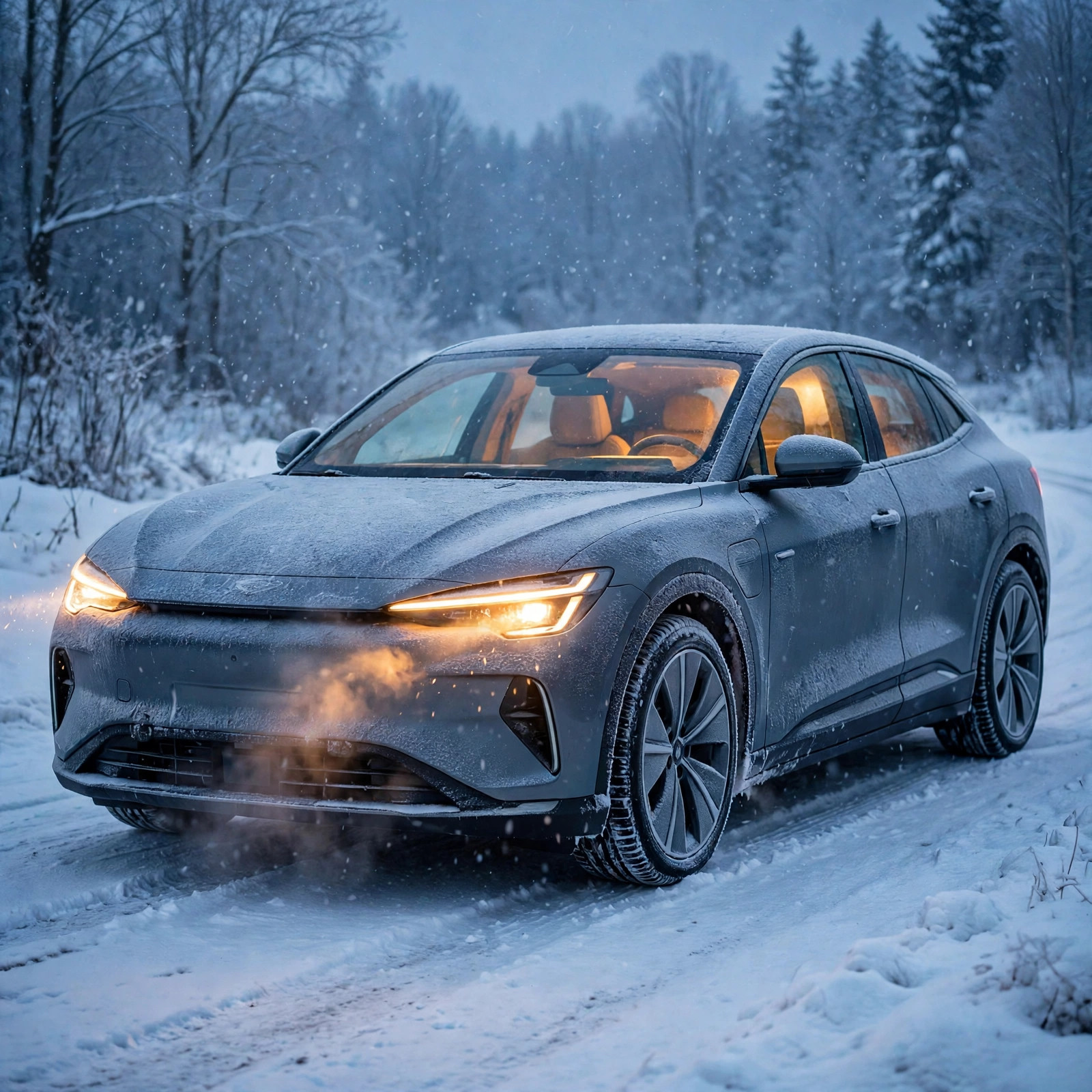
Hi, this is Datumdraft. Stepping into your electric car on a freezing November morning only to watch your range estimate drop the second you turn on the cabin heater feels like a betrayal. Most drivers blame a frozen battery. But the cabin heater is actually stealing more than half of your lost winter miles. That is why modern EV thermal management decides whether you make it home without an extra charging stop.
Gasoline engines waste roughly 70% of their fuel as heat, giving drivers free cabin warmth all winter. Electric motors are around 90% efficient, so they barely generate enough spare heat to warm your hands. Older resistive heaters burn battery power directly at a 1-to-1 ratio. Modern heat pumps and advanced EV thermal management work differently. They scavenge waste heat from the outside air, motors, and inverters. That delivers 2.0 to 4.0 times more warmth per kilowatt. It saves 8 to 10 percentage points of winter range. And it keeps fast-charging speeds intact.
At a Glance
- Turning the cabin heater on in 20°F lab tests slashes EV range by 41%, making heating the biggest winter drain.
- Real-world data from 30,000+ EVs shows cars retain 78% of their normal range at freezing temperatures (32°F).
- Heat pumps move waste heat instead of burning electricity, delivering 2.0–4.0x more warmth per kilowatt than resistive heaters.
- Below 0°F (-18°C), heat pump efficiency drops sharply, forcing EVs to rely on backup resistive heaters and preconditioning.
Why does turning on the cabin heater slash lab range by 41% while real drivers keep 70% to 78%?
Blaming cold battery chemistry for all your winter range loss is like blaming a leaky faucet when someone left the garden hose wide open. Cold slows down battery chemistry, but the heater inside your dashboard is the real energy thief.
Think about the difference between roasting marshmallows next to a roaring campfire and heating a bedroom with a hair dryer. A gasoline engine is a giant campfire that wastes about 70% of its fuel as heat, so blowing that leftover warmth into the cabin costs nothing. An electric motor runs like an LED lightbulb that stays cool to the touch. So the car must run a giant electric hair dryer off the main battery just to keep your toes warm.
Laboratory tests show just how hungry that electric heater really is. In dynamometer testing by the American Automobile Association (AAA) at 20°F (-7°C), driving an electric car with the cabin heater turned off reduced range by only 12%.
Flipping the cabin heater switch on in that exact same 20°F lab test caused average range loss to jump to 41%. More recent 2026 AAA cold-weather tests at 20°F compared to 75°F (24°C) showed an average range drop of 39%. A 2025 Tesla Model Y lost 47% under harsh laboratory test cycles.
Real-world driving tells a much calmer story than laboratory stress tests. A November 2025 winter study by battery analytics firm Recurrent tracked over 30,000 electric vehicles across 34 models in the United States. At freezing temperatures of 32°F (0°C), real drivers kept an average of 78% of their normal range.
Even when outdoor temperatures dropped to 20°F (-7°C), those 30,000 vehicles retained 70% of their normal driving range. You should never mix up worst-case laboratory numbers with everyday highway driving.
Why AAA says -41% while real drivers see -22% to -30% range loss
- AAA lab tests (-39% to -41% at 20°F): Conducted on indoor rollers starting from a cold soak with aggressive heater settings and zero sunlight.
- Recurrent real-world data (-22% at 32°F, -30% at 20°F): Measured across 30,000+ daily drivers who use garage parking, seat heaters, and pre-warmed cabins.
- The takeaway: Cold battery chemistry alone costs about 12% range in lab tests, while cabin heating accounts for nearly three-quarters of total winter loss.
How does moving heat instead of making heat cut cabin energy use in half?
A traditional electric car heater is basically a giant toaster wired straight into your car’s main battery. Replacing that toaster with a heat pump cuts cabin heating electricity consumption by half or more.
Imagine trying to warm your upstairs living room by setting one-dollar bills on fire. Burn one dollar, and you get exactly one dollar’s worth of heat. Now imagine spending that same one dollar to power a small elevator that hauls three or four boxes of free warmth up from the basement. You paid for one unit of electricity, but your room gets up to four units of warmth.
In automotive engineering, the dollar-burning toaster is called a Positive Temperature Coefficient (PTC) resistive heater. A resistive heater pushes high-voltage electricity through a ceramic element to generate heat directly. Engineers measure heating efficiency using a number called the Coefficient of Performance (COP), which tracks how many units of heat you get for every unit of electricity you spend. A resistive heater has a COP of roughly 1.0, meaning 1 kilowatt of battery power produces 1 kilowatt of cabin heat.
An electric vehicle heat pump works like a refrigerator running in reverse. Instead of creating new heat from scratch, it uses a chemical refrigerant loop. The loop absorbs existing thermal energy from the outside air and compresses it into hot gas for the cabin. Because electricity is only used to run the compressor and pumps rather than generate heat directly, an automotive heat pump achieves a COP between 2.0 and 4.0.
What real-world telemetry reveals about heat pump range retention
Delivering two to four units of heat for every unit of electricity cuts cabin heating energy draw by at least 50% compared to a resistive heater. Automakers recognized this advantage early on, with the first-generation 2014 Kia Soul EV becoming one of the first mass-market electric cars to offer a heat pump.
Real-world driving records confirm how much battery capacity this hardware saves. Recurrent’s 2025-26 winter telemetry tracked more than 30,000 vehicles. It found that heat-pump cars retain roughly 10% more range at freezing temperatures (32°F / 0°C) than cars relying on resistive heaters. An earlier Recurrent analysis covered 18,000 vehicles across 20 models. Heat-pump EVs retained an average of 83% of their range in freezing weather. Cars without heat pumps dropped to 75%.
| Heating System | How It Works | Efficiency (COP) | Freezing Range Retention (Recurrent) | Extreme Cold Behavior (Below 0°F / -18°C) |
|---|---|---|---|---|
| Resistive Heater (PTC) | Passes high-voltage current through ceramic resistors to create heat directly. | COP ≈ 1.0 (1 kW power yields 1 kW heat) | 75% average in freezing conditions (baseline in 32°F comparisons) | Consistent output, but drains battery rapidly on highway trips. |
| Standard EV Heat Pump | Compresses refrigerant to move heat from outside air into the cabin. | COP 2.0 to 4.0 (cuts heating energy by 50%+) | 83% average in 18k-car study (~10% more range kept at 32°F) | Efficiency drops near COP 1.0; requires backup resistive heater. |
| Waste-Heat Scavenging (Octovalve / E-GMP) | Combines heat pump with coolant loops harvesting motor, inverter, and battery heat. | COP 2.0 to 4.0 + drivetrain waste heat recovery | Saves ~30% cabin heating energy vs. older PTC Model 3 (Tesla engineering figures) | Harvests motor/inverter heat while driving and pre-warms battery for 24–35°C fast charging. |
How do Tesla’s Octovalve and Hyundai’s E-GMP scavenge every watt of waste heat?
Even an ultra-efficient electric motor sweats a little, and modern EV thermal management refuses to let a single drop of that heat go to waste. By linking the cabin, battery, and drivetrain into one shared plumbing network, today’s electric cars steal warmth from their own spinning parts.
Picture a clever plumber designing a studio apartment next to a busy computer server room. While the living room is freezing, the server room next door is hot from running processors all day. Instead of paying for a massive gas furnace, the plumber connects air ducts and water pipes. Every bit of heat from the computers then flows straight under the living room floor and into the hot water tank.
In an electric car, the motors, power inverters, and onboard chargers are that warm server room. Early electric vehicles kept their battery cooling loops, motor cooling loops, and cabin heating pipes completely separate. If the motor got hot on the highway, the radiator simply dumped that heat into the winter wind while the cabin heater burned fresh battery power to warm your feet.
Inside Tesla’s 8-port Octovalve manifold
Tesla solved this plumbing waste by introducing the Octovalve in the 2020 Model Y. The system is now standard across the entire lineup, including the 2024 Model 3 Highland update as well as the Model S and Model X. The Octovalve is an 8-port rotary valve manifold mounted against a compact heat exchanger assembly.
By rotating an internal stepper-motor valve across eight coolant ports, the computer routes warm liquid between the battery pack, drive motors, power electronics, heat pump chiller, and cabin heater core. When you drive in freezing weather, the Octovalve captures heat coming off the inverter and stator windings. It feeds that heat into the heat pump refrigerant loop and pushes the warmth into the cabin. According to secondary industry reports citing Tesla engineering presentations, this integrated heat pump architecture reduces cabin heating energy consumption by roughly 30% compared to the older PTC-only Model 3.
How Hyundai and Kia blend heat pumps with hybrid cooling loops
Hyundai Motor Group takes a slightly different plumbing path on its Electric-Global Modular Platform (E-GMP), which underpins vehicles like the Hyundai Ioniq 5 and Kia EV6. According to Hyundai’s official technical documentation, the E-GMP heat pump does not just pull warmth from outside air. It actively collects waste heat given off by the drive motors, power inverters, onboard chargers, and the slow-warming battery pack itself.
The Hyundai Ioniq 5 pairs this waste-heat scavenging loop with two dedicated coolant circuits—one for the drivetrain and one for the high-voltage battery—linked through a central chiller and valve block. Extreme sub-zero mornings can still overwhelm a heat pump during the first few minutes of driving. So E-GMP vehicles pair the heat pump with an auxiliary PTC resistive heater. It handles instant windshield defrosting and deep-freeze backup.
Why does a freezing battery ruin your 18-minute fast charge without preconditioning?
Pulling into a 350-kilowatt fast charger with a freezing battery is like trying to chug a thick milkshake through a coffee stirrer. Until the battery warms up, your car will refuse to accept full charging speed.
Think of an Olympic sprinter stepping onto an icy track in December. If that athlete tries to run a 100-meter dash at full speed with ice-cold muscles, a hamstring will tear immediately. Instead, the sprinter spends 20 minutes jogging in a tracksuit before the race so their muscles reach the right temperature to fire safely at maximum power.
Inside a lithium-ion battery, cold liquid electrolyte turns sluggish and slows down lithium ions moving between the electrodes. If a direct-current (DC) fast charger forces high electrical current into a freezing anode, the lithium ions cannot slip smoothly into the graphite structure. Instead, metallic lithium piles up on the outside of the anode in sharp microscopic spikes—a permanent, capacity-killing damage known as lithium plating. To prevent this damage, your car’s battery management system throttles DC charging power down to a trickle until the cells warm up.
Hitting the 75°F to 95°F (24°C to 35°C) fast-charging sweet spot
This thermal bottleneck hits ultra-fast charging cars the hardest. First-generation Hyundai and Kia E-GMP vehicles built between 2021 and 2024 use an 800V EV architecture. Cars like the Ioniq 5 and EV6 can charge from 10% to 80% in just 18 minutes under optimal conditions.
However, unlocking that 18-minute sprint requires the battery cells to sit inside a narrow thermal window between 75°F and 95°F (24°C to 35°C). If you arrive at a winter highway charger with a battery sitting at 25°F (-4°C), the car first has to warm the pack. Only then do charging speeds begin to climb.
Automakers solve this delay with navigation-linked battery preconditioning. Select a DC fast-charging station as your destination in the car’s built-in navigation system. The thermal controller then activates the battery coolant heater while you are still driving down the highway. By the time you plug in, the cells are already sitting in the 24°C to 35°C sweet spot, allowing full charging speeds from the first minute. Even next-generation solid-state battery designs face low-temperature ion conductivity hurdles, making active preconditioning a permanent fixture of electric driving.
Where do heat pumps fail around 0°F (-18°C), and how can you save winter range for free?
A heat pump is clever physics, not magic, and around 0°F (-18°C), even the smartest heat pump hits a brick wall. When the air outside gets that cold, or when you only drive for ten minutes, hardware alone cannot save your battery.
Trying to extract heat from 0°F (-18°C) winter air is like trying to wring water out of a bone-dry towel. Because the outside air holds almost no accessible thermal energy at that temperature, the refrigerant loop struggles to absorb warmth. Around 0°F (-18°C), a heat pump’s efficiency drops down near a resistive heater’s 1-to-1 ratio. Most electric vehicles must then switch on backup resistive heaters just to keep the cabin warm.
Short errands create a second trap for heat pumps. When you drive 10 to 15 minutes to the grocery store, your car spends a massive burst of energy. It must warm up frozen refrigerant lines, cold coolant, and an icy cabin interior. Because you park the car before the system settles into steady, efficient cruising, a heat pump offers very little range savings on short winter hops.
Three zero-cost habits that beat hardware limits
Beating these two physical limits is like filling a thermos with boiling coffee at your kitchen stove. Do that before walking out into a blizzard, rather than burning camp stove fuel in the snow. You can protect your winter range for free by shifting that initial heating load off your battery:
- Precondition while plugged into wall power: Start your car’s cabin and battery warmup via your smartphone app 15 to 20 minutes before departure while the charging cable is still connected. The heavy initial heating spike draws electricity from your house outlet instead of your battery pack.
- Warm your body, not the empty air: According to Tesla and major automaker owner manuals, seat heaters and heated steering wheels use a fraction of the watts required to heat the entire cabin air volume. Drop your climate control thermostat by 3 to 5 degrees and turn on the seat warmers instead.
- Always route to fast chargers using built-in navigation: Third-party phone apps like Apple Maps or Google Maps often do not trigger your car’s battery heater. Enter the DC fast charger directly into the factory navigation system so the battery reaches 75°F to 95°F (24°C to 35°C) before you arrive.
Winter EV Pre-Flight Checklist
- 15 minutes before leaving: Keep the car plugged into your home charger and trigger cabin/battery preconditioning from your phone app.
- Once inside the cabin: Turn on seat and steering wheel heaters first, and set the cabin air temperature a few degrees lower than usual.
- On winter road trips: Select your DC fast-charging stop inside the car’s native navigation system at least 20 to 30 minutes before arrival.
Key takeaways for winter electric driving
Laboratory stress tests show up to 41% range loss with the cabin heater blasting. But real-world telemetry from over 30,000 vehicles tells a calmer story. Everyday drivers keep roughly 78% of their range at freezing (32°F) and 70% at 20°F.
Heat pumps and integrated EV thermal management architectures like Tesla’s Octovalve and Hyundai’s E-GMP cut cabin heating electricity in half under normal winter conditions. They also pre-warm your battery to 75°F–95°F (24°C–35°C), so 18-minute fast charges stay fast. Still, when temperatures plunge toward 0°F (-18°C) or when you only drive for ten minutes, even the best heat pump needs help from backup resistive heaters and smart driver habits.
If temperatures are dropping below freezing tonight, leave your EV plugged into its wall charger. Then set your smartphone app to precondition the cabin 15 minutes before you walk out the door tomorrow morning. Pair that pre-warmed cabin with your seat heaters, and watch how much extra battery percentage stays on your dashboard.
Sources
- EV Range in Winter: Recurrent 2025–2026 Winter Range Study (30,000+ EVs, 34 Models) — Carveeta, Nov 2025
- Are Electric Cars Reliable in Cold Weather? AAA 2026 Cold-Weather Testing and Recurrent Telemetry Analysis — Dragon Trans Rent Car, Nov 2026
- Tesla Octovalve Thermal System Review: How the 8-Port Manifold Scavenges Waste Heat — AutoEdgeView, 2026
- Tesla Heat Pump Cold-Weather Range: COP Efficiency and 0°F Operating Limits — AutoEdgeView, 2026
- How Does the Heater Work in an Electric Car? PTC Resistive Heaters vs. Heat Pumps and Hyundai/Kia E-GMP Systems — EV Compared, 2025
- Hyundai E-GMP Battery Preconditioning Technical Manual (Optimal 24–35°C Charging Window & Navigation Integration) — Ioniq 5 CAN Community Archive