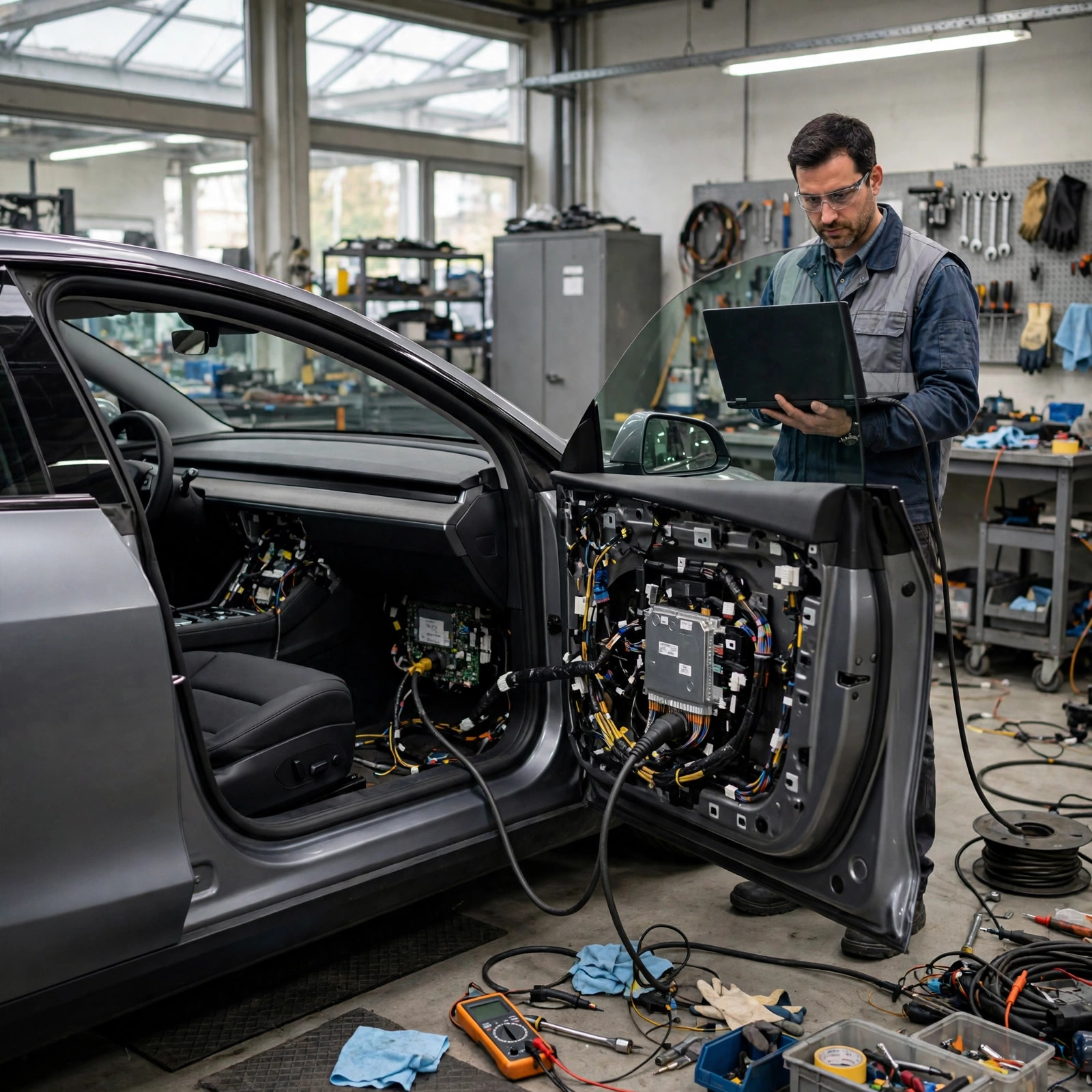
Hi, this is DatumDraft. Imagine driving down a highway at 70 miles per hour when your air conditioning blasts on by itself and your brakes stop working. Two security researchers made that nightmare real in 2015 by hacking a Jeep Cherokee from their living room couch, forcing Fiat Chrysler to recall 1.4 million vehicles. Today, rules around automotive cybersecurity UN R155 and UN R156 change that. Automakers can no longer treat software bugs as simple dealership fixes. One missing management certificate will block a brand-new car from ever leaving the port.
At a Glance
- All new cars sold in the EU require a certified security management system since July 7, 2024.
- Every new EU whole vehicle must run a certified software update system as of July 7, 2026.
- Passing voluntary ISO/SAE 21434 engineering audits does not grant mandatory UN R155 vehicle type approval.
- UN R155 and R156 apply across 54 Agreement countries, while the US uses self-certification.
Why can a hack-proof prototype related to automotive cybersecurity UN R155 still be illegal to sell in Europe, Japan, and Korea?
Even if your engineers build a car that stops every hacker on Earth, customs officials will still block it. They will stop it at a European port if your company lacks one specific binder of management paperwork. Think of a Michelin-starred restaurant applying for a city health permit. The health inspector does not just test one plate of steak for bacteria and hand over a license. The inspector audits the kitchen temperature logs, supplier records, and staff hygiene rules first.
Many people assume UN R155 is a penetration test that a car passes on a test track. In reality, UN R155 requires a Cybersecurity Management System (CSMS). A CSMS is a company-wide set of rules, documents, and audits. It governs how an automaker designs, builds, and retires vehicles safely. Type approval is the legal permission to sell a car model, and an automaker can only win type approval after auditors certify its CSMS first.
This two-step gate changes how hardware and software teams work together. As automakers replace dozens of scattered wiring harnesses with Automotive Ethernet TSN inside modern zonal layouts, auditors check whether the company tracks security risks across every single zone. If the corporate process fails the audit, the car cannot get a license plate.
The legal reach of UN R155 covers a wide range of road machines. It applies to passenger cars (Category M) and commercial trucks or vans (Category N). It also covers trailers (Category O) if they carry at least one electronic control unit (ECU). An ECU is a small computer that controls a specific vehicle part. It also covers light vehicles (Categories L6 and L7) equipped with automated driving features above Level 3.
Did the whole world really ban non-compliant cars on the exact same day?
Dozens of security blogs claim that cybersecurity laws became mandatory across the entire planet in January 2021, which is false. Imagine the United Nations writing a new treaty on international road signs. The day diplomats put that treaty in the official rulebook is completely different from the day local police in your hometown actually start writing tickets to drivers.
To read the timeline accurately, you must separate United Nations paperwork dates from European Union enforcement dates. The World Forum for Harmonization of Vehicle Regulations (UNECE WP.29) adopted UN R155 and UN R156 in June 2020. Both regulations officially entered into force on January 22, 2021, as annexes to the 1958 Agreement.
How the 54 Agreement countries differ from the United States
An entry-into-force date simply means signatory countries can begin issuing approvals under that rule. The 1958 Agreement includes 54 contracting parties, covering the European Union, the United Kingdom, Japan, and South Korea. That is roughly one-quarter of the countries on Earth, representing major car-buying markets outside North America.
The United States is not a signatory to the 1958 Agreement. Because of this, UN R155 and UN R156 are not US law. Instead, the US relies on manufacturer self-certification paired with voluntary guidance from the National Highway Traffic Safety Administration (NHTSA).
Even when vehicles share wireless hardware for V2X vehicle communication to talk to traffic lights, legal compliance splits across the Atlantic. An automaker selling the same electric SUV in Berlin, Seoul, and Detroit faces two tracks. It must prepare formal UN R155 and R156 type-approval packages for Europe and Korea. For the US, it manages self-certification records instead.
The real European Union enforcement dates through July 2026
In the European Union, hard sales bans arrived in stages. Under the EU General Safety Regulation (EU) 2019/2144, UN R155 became mandatory for all new vehicle types on July 6, 2022. Two years later, on July 7, 2024, UN R155 became mandatory for all new vehicles sold and registered across the EU, even for older models still rolling off assembly lines.
Software update rules under UN R156 followed a stepped path through Commission Delegated Regulation (EU) 2022/2236. That rollout reached its final milestone on July 7, 2026, making UN R156 mandatory for all new whole vehicles in the EU. Sitting here in November 2026, every new car leaving a European dealership lot operates under both regulations.
If our team follows ISO/SAE 21434 to the letter, do we automatically pass UN R155?
Following ISO/SAE 21434 does not give your car automatic UN R155 legal approval. Think of ISO/SAE 21434 as a textbook written by top medical professors on how to perform heart surgery. UN R155 is the state medical board license required to operate on patients legally. Studying the textbook helps you pass the board exam, but owning the book is not a license to practice medicine.
In automotive engineering, regulations and standards serve two distinct masters. UN R155 and UN R156 are mandatory government regulations that define what an automaker must prove to sell vehicles in 1958 Agreement markets. Only an official Approval Authority or designated Technical Service can grant type approval after inspecting your evidence.
ISO/SAE 21434:2021 is a voluntary engineering standard for road vehicle cybersecurity. It gives engineers a step-by-step method for how to identify threats, score risks, and verify code security during product development. ISO/SAE 21434 is not the legal text of UN R155, and an internal ISO certificate cannot replace a government type-approval certificate.
The exact same relationship exists for software updates. UN R156 is the binding regulation that tells automakers what their update system must achieve. ISO 24089 is the companion engineering standard that explains how to build that update pipeline safely. Carmakers now consolidate dozens of legacy chips into central car computers. Engineering teams use ISO/SAE 21434 and ISO 24089 daily to organize the proof that UN R155 and R156 auditors demand.
| Attribute | UN R155 | UN R156 | ISO/SAE 21434 & ISO 24089 |
|---|---|---|---|
| Legal Status | Mandatory regulation for type approval | Mandatory regulation for type approval | Voluntary engineering standards |
| Core Role | Defines what cybersecurity management is required | Defines what update management is required | Explains how to engineer security (21434) and updates (24089) |
| Required System | Certified CSMS (Cybersecurity Management System) | Certified SUMS (Software Update Management System) | Engineering risk assessment and update workflows |
| Vehicle Scope | Categories M, N, O (with 1+ ECU), and L6/L7 (Level 3+ automation) | Categories M, N, O, R, S, and T that permit software updates | Electrical, electronic, and software systems in road vehicles |
| EU Mandatory Dates | July 6, 2022 (new types); July 7, 2024 (all new vehicles) | Reached all new whole vehicles on July 7, 2026 | No statutory deadline; adopted voluntarily by industry |
When a security flaw appears, how does UN R156 govern both wireless OTA and dealership USB patches?
Your phone can silently update an app at 3 a.m. without asking the government, but a car cannot patch its braking code without strict legal tracking because a bad update could alter certified stopping distances. Think of a hospital pharmacy logbook. Whether a nurse delivers medicine through an intravenous drip or hands the patient a pill at the counter, the rule is the same. The hospital must record the exact dose, batch number, and doctor approval every single time.
A common misconception is that UN R156 only regulates wireless Over-the-Air (OTA) updates. In fact, UN R156 governs every single software update method, including wireless OTA transfers, USB flash drives, diagnostic cables, and local dealership service tools. If a mechanic in a repair bay plugs a laptop into a car to flash new code, that update falls under UN R156.
To manage this legally, automakers must run a certified Software Update Management System (SUMS). Like CSMS, SUMS is an organizational management framework rather than a single software test. It forces the manufacturer to verify update authenticity. It also requires a check that the vehicle has enough battery power to finish the installation safely. If an update fails mid-transfer, the car must recover to a safe state.
The vehicle category scope for UN R156 is even wider than UN R155. UN R156 covers any vehicle capable of software updates. That spans Categories M (passenger cars), N (trucks), and O (trailers). It also covers R (agricultural trailers), S (interchangeable towed equipment), and T (agricultural and forestry tractors). Modern vehicles running AUTOSAR Adaptive middleware rely on this SUMS audit trail to prove that patching an infotainment or driver-assist bug never corrupts type-approved safety settings.
How can engineering and planning teams audit their compliance pipeline today?
Reading a UN regulation PDF is easy, but proving to an auditor that every supplier and update server follows the rules requires a clear checklist. Think of a pilot walking around an airliner with a clipboard before takeoff. The pilot does not rely on memory to check the wing flaps and fuel valves; the pilot ticks off each item in sequence so nothing slips through the cracks.
When Fiat Chrysler recalled 1.4 million vehicles after Charlie Miller and Chris Valasek hacked a Jeep Cherokee in 2015, the industry learned how expensive retrofitting security after launch can be. To avoid similar recalls or type-approval delays in 2026, vehicle program managers and compliance engineers should verify five concrete checkpoints.
- Separate your corporate system audit from your vehicle audit: Confirm that your organization holds an active CSMS Certificate of Compliance under UN R155. Also confirm a SUMS certificate under UN R156. Do this before scheduling vehicle-level type-approval tests.
- Map ISO engineering outputs to UN legal clauses: Use ISO/SAE 21434:2021 risk assessments and ISO 24089 update documentation as engineering evidence. Make sure your type-approval submission explicitly answers every requirement in UN R155 and R156.
- Lock down dealership USB and diagnostic updates inside SUMS: Audit your service bays and diagnostic tools. Wired mechanic updates must follow the exact same version tracking and integrity rules as wireless OTA patches.
- Verify trailer and specialty vehicle categories: Check whether trailers (Category O with at least one ECU) trigger R155 or R156 obligations. Do the same for automated L6/L7 models and agricultural vehicles (Categories R, S, and T) in your lineup.
- Split certification tracks between 1958 Agreement markets and the US: Maintain formal Approval Authority type-approval packages for the 54 contracting parties. That includes the EU, UK, Japan, and Korea. Organize separate self-certification records aligned with NHTSA guidance for the United States.
Key takeaways for shipping software-defined vehicles
Automotive cybersecurity is no longer just a coding task for firewall engineers. Under UN R155 and UN R156, one thing decides market access. It is how an automaker manages security risks and software updates across its entire organization. That determines whether it can legally sell cars across the 54 countries of the 1958 Agreement.
- Organizational certification comes first: Automakers must maintain an audited CSMS (for UN R155) and SUMS (for UN R156) at the corporate level to obtain vehicle type approval.
- Every EU deadline is now active: UN R155 rolled out in July 2022 and July 2024. Then UN R156 reached all new whole vehicles in the EU on July 7, 2026.
- Engineering standards support—but do not replace—type approval: Use ISO/SAE 21434:2021 and ISO 24089 to build rigorous engineering processes. Then submit that evidence to Approval Authorities for UN R155 and R156 certification.
- Every update channel counts: Keep dealership USB sticks and workshop diagnostic updates inside the same SUMS tracking pipeline as wireless OTA updates.
Which part of UN R155 and R156 compliance has created the biggest bottleneck for your team: aligning Tier-1 supplier documentation or tracking non-OTA workshop updates? Share this guide with your engineering group and leave a comment below with your experience.