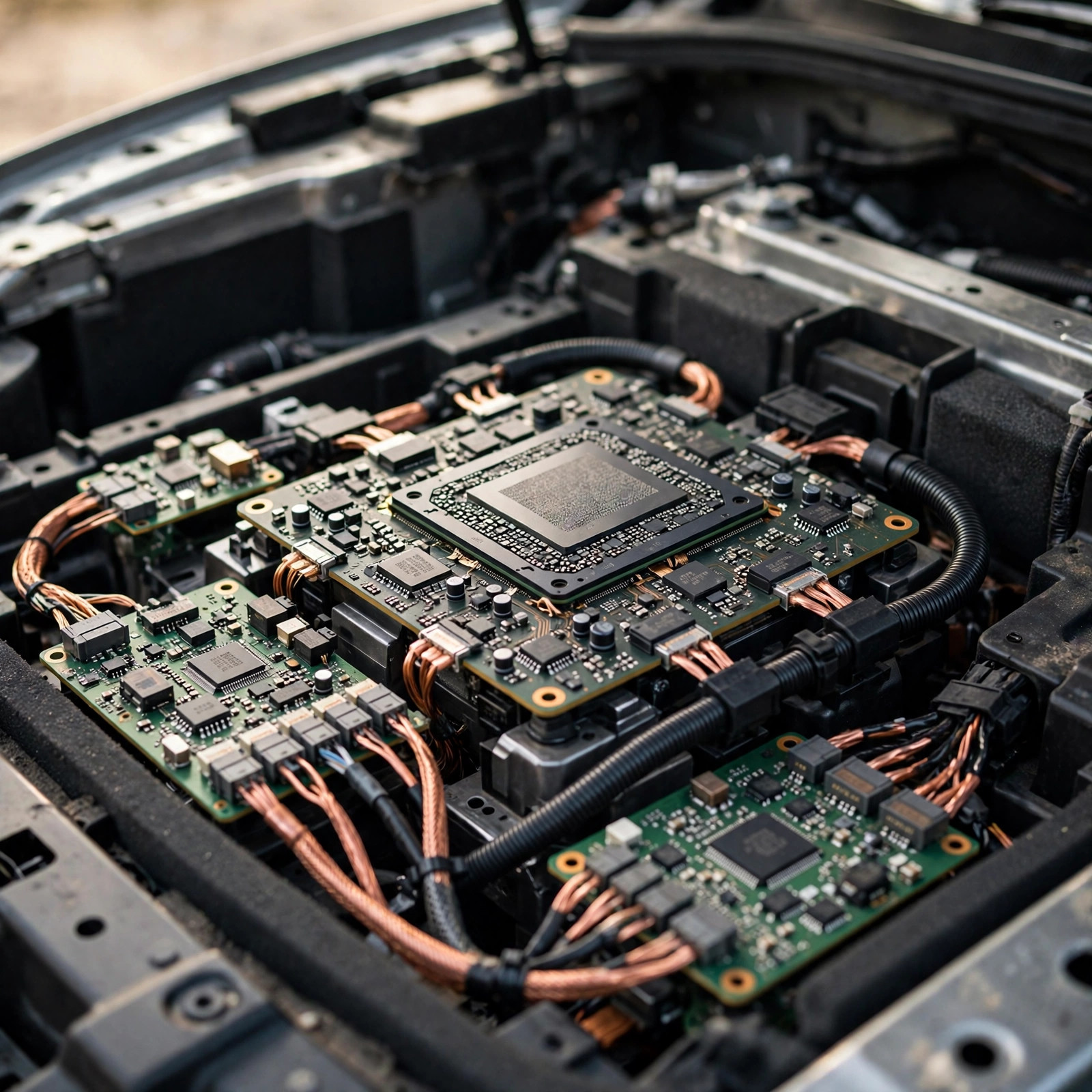
Hi, this is Datumdraft. Your new electric vehicle might look like a rolling smartphone on the outside, but underneath the floor mats, it still carries up to 60 kilograms of 1990s-style copper wire. That hidden bundle of cables exists because over 100 tiny, separate computers control everything from your brakes to your window switches, and a new wave of Drive Thor Snapdragon Ride central computers is finally rewiring that tangle from the inside out.
Centralized compute in cars replaces dozens of separate domain controllers—like ADAS, infotainment, and digital cockpits—with a single system-on-chip (SoC) such as NVIDIA Drive Thor or Qualcomm Snapdragon Ride Flex, cutting wiring weight, copper costs, and software update complexity.
At a Glance
- Some premium models pack 150 or more ECUs (McKinsey estimate), pushing wiring harness weight up to 60 kg.
- Rivian cut 17 ECUs down to 7 in its Gen 2 R1 vehicles, removing 2.6 km of wiring.
- NVIDIA Drive Thor delivers up to 1,000 INT8 TOPS on a single 4nm chip, quadrupling its Drive Orin predecessor.
- Qualcomm Snapdragon Ride Flex (SA8775P) merges ASIL-D safety ADAS and cockpit functions onto one 5nm SoC (9 design wins, company claim).
Why does your car carry 60 kilograms of copper wire?
Your car’s wiring harness is heavier than a full-grown golden retriever, and it is the third most expensive part in the entire vehicle, right behind the engine and chassis. For decades, every time carmakers added a new feature like heated seats or lane-keeping cameras, engineers took the easy route and bolted on another tiny box with its own dedicated wires.
Imagine building a house where every new toaster, television, or ceiling fan required you to drill through the living room wall and run a separate copper cable all the way to a dedicated generator in the backyard. After thirty years of renovations, your walls would be so stuffed with copper that you could barely open the front door. That is exactly what happened inside modern automobiles with the electronic control unit (ECU), a small single-purpose computer that manages one specific task inside a car.
According to component supplier Bosch, a compact car today carries between 30 and 50 of these separate ECUs. Step up to a luxury vehicle, and Bosch notes that the count easily passes 100 units. Consulting firm McKinsey estimates that some high-end premium models pack 150 or more separate ECUs under their metal skin.
All those tiny boxes have to talk to each other, and they do it through the wiring harness, the thick bundle of power and data cables snaking through the vehicle body. Market intelligence firm CRU estimates that a typical car’s wiring harness weighs between 25 and 42 kilograms. In the latest luxury vehicles, that copper bundle hits roughly 60 kilograms—about the weight of an average adult passenger riding in your back seat for the life of the car.
According to engineering data from Siemens, a single vehicle harness contains more than 3,000 individual wires and roughly 700 physical connectors. Because robots still struggle to bend and clip flexible cables into tight corners, human workers assemble most of these harnesses by hand. Worse yet, when an automaker wants to send an over-the-air (OTA) wireless software update to fix a bug, engineers have to coordinate patches across dozens of different chips made by different suppliers.
Automakers are now ripping out that copper weight by consolidating their electronics. When Rivian redesigned its second-generation R1T and R1S vehicles in June 2024, engineers cut the internal ECU count from 17 down to just 7 units. That single change stripped out 1.6 miles (2.6 kilometers) of wiring—roughly the length of 28 football fields—and shaved 44 pounds (20 kilograms) off each truck.
Legacy automakers are achieving similar weight savings. In its Neue Klasse platform, BMW divided the vehicle into four physical zones—front, center, rear, and roof—cutting 600 meters of wiring and reducing harness weight by roughly 30 percent compared to the previous generation.
| Manufacturer / Platform | Architecture Change | Wiring Length Removed | Weight Reduction |
|---|---|---|---|
| Industry Luxury Baseline (Bosch / McKinsey / CRU) | 100 to 150+ distributed ECUs with ~700 connectors (Siemens) | 3,000+ separate wires across the cabin | 25 to 42 kg typical; up to 60 kg in luxury models |
| Rivian Gen 2 R1T / R1S (June 2024) | Consolidated internal ECUs from 17 down to 7 units | Removed ~1.6 miles (2.6 km) of copper harness | Saved ~44 lbs (20 kg) per vehicle |
| BMW Neue Klasse | 4-zone architecture (front, center, rear, roof) | Shortened wiring harness by 600 meters | ~30% harness weight reduction vs. prior generation |
Does one superchip really replace 100 tiny computers?
Despite the flashy headlines, plugging a single superchip into your dashboard will not magically make 100 tiny computers vanish overnight. Instead, modern cars split the job between a central brain that does the heavy thinking and local neighborhood managers that handle the physical switches and motors.
Think of how a national retail company runs its delivery network. The chief executive at corporate headquarters decides inventory budgets and pricing strategy, but the CEO does not personally drive to your neighborhood to hand-deliver a cardboard box. Instead, regional warehouses in each city gather local packages and connect back to headquarters through a single express highway.
In automotive electrical and electronic (E/E) engineering, that corporate headquarters is the central compute module, while the regional warehouses are zonal controllers. Earlier vehicles grouped computers by job—creating a domain controller for Advanced Driver Assistance Systems (ADAS, the cameras and radars that help steer and brake) and a separate domain controller for the cabin screens. If you want to see how carmakers first grouped these functions before moving to physical regions, check out our comparison of domain vs zonal architectures.
When an automaker adopts a Drive Thor Snapdragon Ride central computer, it merges those big domain brains—specifically the ADAS computer and the digital cockpit computer—onto one high-powered chip. However, physical zones still remain in the corners of the car. Local zonal microcontrollers like NXP’s S32K5 sit near the doors, bumpers, and seats to collect raw signals from simple sensors and power the window motors.
Those regional zonal boxes then send all their bundled data to the central superchip over a single high-speed digital backbone called Automotive Ethernet. So the central superchip does not replace 100 edge switches by itself; rather, zonal controllers absorb the small edge ECUs while the central computer absorbs the heavy domain controllers.
Even with these breakthroughs, the global auto industry is transitioning in stages rather than flipping a switch all at once. In a 2023 industry forecast, McKinsey projected that while the market for traditional single-function ECUs will shrink by 1 percent per year, demand for zonal and central controllers will grow by 30 to 40 percent annually.
By 2030, McKinsey expects full zonal architectures to account for roughly 18 percent of new vehicles sold worldwide. Domain-based architectures will represent about 48 percent of new cars in 2030, while traditional distributed layouts will still hold roughly one-third (33 percent) of the market, mostly in entry-level models.
How does NVIDIA Drive Thor pack 77 billion transistors into one cabin brain?
NVIDIA Drive Thor crams 77 billion transistors onto a single piece of silicon—enough raw muscle to run autonomous highway driving, parking assist, and four passenger gaming screens at the exact same time. It acts as a unified kitchen for the entire vehicle.
Picture a massive hotel kitchen where one side prepares a delicate Michelin-starred tasting menu where a single mistake ruins the evening, while the other side fries chicken tenders for a noisy birthday party of thirty kids. Instead of building two separate restaurants, the head chef uses partitioned prep stations inside one giant room so both meals come out hot without ever mixing up the plates. That is how NVIDIA designed its flagship centralized car computer.
Built on TSMC’s 4-nanometer (4nm) manufacturing process, Drive Thor integrates the Blackwell graphics processing unit (GPU) architecture alongside a 14-core Arm Neoverse V3AE central processing unit (CPU). Inside that GPU sit 2,560 CUDA cores and 96 Tensor cores equipped with a dedicated Transformer Engine. For readers who want a foundational primer on how neural network accelerators process camera feeds, see our guide to autonomous driving chips.
When reading spec sheets for Drive Thor Snapdragon Ride platforms, you have to watch out for how chipmakers quote computing speed. A chip’s AI performance is measured in Tera Operations Per Second (TOPS, meaning one trillion integer calculations per second) or Tera Floating-Point Operations Per Second (TFLOPS, meaning one trillion decimal-based calculations per second).
Spec Sheet Trap: Don’t Confuse 1,000 TOPS with 2,000 TFLOPS
Marketing headlines often state that NVIDIA Drive Thor delivers “2,000 TOPS,” mixing up two different mathematical yardsticks. Drive Thor delivers up to 1,000 INT8 TOPS using 8-bit integer precision, and up to 2,000 FP4 TFLOPS using 4-bit floating-point precision. Because 4-bit numbers are sliced in half compared to 8-bit numbers, the chip can process twice as many of them per second. Always compare chips at the same precision: at INT8, Drive Thor’s 1,000 TOPS is roughly 4 times faster than its predecessor, NVIDIA Drive Orin (254 INT8 TOPS).
That 4-bit (FP4) and 8-bit (FP8) support is not a marketing trick; NVIDIA added the Transformer Engine specifically to run large language models (LLMs) and vision-language-action (VLA) neural networks inside the car. Instead of relying on hand-coded rules for every traffic cone, modern self-driving systems use massive transformer models that benefit directly from FP4 and FP8 math.
Memory bandwidth, power draw, and two-chip scaling
Feeding 77 billion transistors requires a massive data pipe, so the Jetson Thor configuration pairs the chip with up to 128 gigabytes (GB) of LPDDR5X memory running at 273 gigabytes per second (GB/s) of bandwidth. To put 273 GB/s in human terms, that is fast enough to transfer roughly 55 full-length 4K movies every single second.
All that computing power generates heat. According to NVIDIA’s developer documentation, the Drive Thor developer kit has a thermal design power (TDP, the maximum heat a cooling system must handle) of 350 watts—roughly the power draw of a high-end desktop gaming PC, though actual power draw inside production cars varies by automaker configuration. If an automaker wants even more muscle for robotaxis, two Thor chips can be linked via NVIDIA’s NVLink-C2C interconnect to operate as a single 2,000 INT8 TOPS system. By comparison, industry teardowns estimate that Tesla’s AI4 (Hardware 4) computer runs at roughly 100 to 150 TOPS across a dual-SoC board.
| Feature / Metric | NVIDIA Drive Thor | Qualcomm Snapdragon Ride Flex | Tesla AI4 (Hardware 4) |
|---|---|---|---|
| Process Node | TSMC 4nm (77 billion transistors) | 5nm (SA8775P single SoC) | Proprietary OEM Dual-SoC Board |
| Compute Performance | Up to 1,000 INT8 TOPS / 2,000 FP4 TFLOPS (Up to ~2,000 TOPS via dual-chip NVLink-C2C) | Scalable tier; Supreme Edition claims up to 2,000 TOPS total effective platform compute | ~100 to 150 TOPS (Industry teardown estimate) |
| CPU & GPU Architecture | 14-core Arm Neoverse V3AE CPU + Blackwell GPU (2,560 CUDA, 96 Tensor cores) | Heterogeneous compute with dedicated hardware Safety Islands & hypervisor | Custom neural network accelerators + integrated safety cores |
| Safety & Mixed Criticality | Multi-domain isolation across ADAS, cluster, and cabin infotainment | Hardware virtualization + ASIL-D safety islands on single SoC | Dedicated dual-chip redundancy for full self-driving pipeline |
| Confirmed Production Models (Nov 2026) | Lynk & Co 900 (launched Q2 2025 in China); wins at Li Auto, ZEEKR, BYD, Hyper, XPeng | SA8775P: Arcfox V9, Alpha T5, Alpha S5 (9 model wins total); Dual SA8797P: Leapmotor D19 | In mass production across Tesla Model S, X, 3, Y, and Cybertruck |
What happens if Netflix crashes while the same chip is steering your car?
What happens if your passenger’s video streaming app freezes while the exact same silicon chip is steering your car at 70 miles per hour on the highway? Qualcomm solved that life-or-death problem by building digital watertight bulkheads directly inside its Snapdragon Ride Flex processor.
Think of how engineers design a deep-sea submarine. The crew’s entertainment lounge and the main steering room sit inside the same steel hull, separated by heavy watertight doors. Even if a pipe bursts and floods the lounge, those sealed bulkheads keep a single drop of water from reaching the navigation controls.
In automotive engineering, combining entertainment apps and life-critical braking on one chip is called a mixed-criticality workload. Your center karaoke screen only needs basic consumer reliability, known as Quality Management (QM). Your automatic emergency brakes, however, must meet Automotive Safety Integrity Level D (ASIL-D), the strictest functional safety standard in the auto industry, where a hardware glitch cannot be allowed to cause a fatal crash.
When Qualcomm unveiled the 5nm Snapdragon Ride Flex (part number SA8775P) at CES 2023, the company described it as the world’s first single SoC to unify digital cockpit and ADAS functions on one piece of silicon. To keep a frozen Android app from stalling the steering wheel, Qualcomm built hardware virtualization and dedicated “Safety Islands” into the chip. These isolated hardware partitions lock the ASIL-D driving software in its own protected memory and processing vault, completely immune to whatever happens on the infotainment side.
That single-chip fusion strategy is already paying off in commercial factories. At the Qualcomm Automotive Summit in June 2026, the company announced that the Snapdragon 8775 (SA8775P) had entered mass-production deployment, securing design wins across 9 vehicle models according to company figures.
Looking beyond single-chip mainstream cars, Qualcomm also announced at CES 2026 that Chinese EV maker Leapmotor selected a dual-SA8797P configuration for its flagship Leapmotor D19, creating what the company claims is the world’s first cross-domain integrated central controller of its kind. At the very top of Qualcomm’s lineup, the company claims its Supreme Edition platform reaches up to 2,000 TOPS of total effective computing power across the entire platform—not from a single standalone chip, but by pooling all heterogeneous processors across the system.
Which 2026 cars actually ship with Drive Thor and Snapdragon Ride?
In the automotive chip race, a press release “design win” and a car you can actually buy at a dealership are often years apart. Understanding the current Drive Thor Snapdragon Ride rollout requires separating early customer announcements from cars already parked in consumer driveways.
Think of the difference between an architect unveiling a glossy blueprint for a new apartment tower and a family actually moving their sofa into a finished fourth-floor unit. In the semiconductor world, announcing that a platform is “ready for mass production in 2025” means the chipmaker has started shipping silicon to factories—not that every partner automaker has launched its finished car on the street.
For NVIDIA Drive Thor, platform mass production began in 2025. NVIDIA has secured design wins with major electric vehicle makers including Li Auto, ZEEKR, BYD, Hyper, and XPeng. As of November 2026, the confirmed mass-production vehicle shipping to customers with Drive Thor is the Lynk & Co 900, which launched in China during the second quarter of 2025.
On the Qualcomm side, while the company reported 9 model design wins for the SA8775P in June 2026, three specific mass-production vehicles are confirmed on the road today: the Arcfox V9, the new Arcfox Alpha T5, and the Arcfox Alpha S5. On those three Arcfox models, the single SA8775P chip runs both the cabin displays and Level 2+ (L2+) highway and urban Navigate on Autopilot (NOA) alongside memory parking. Meanwhile, the Leapmotor D19 represents the confirmed production flagship running Qualcomm’s dual-SA8797P central controller, while secondary industry reports also list broader Qualcomm automotive adoption across GM Ultra Cruise, Sony-Honda Afeela, BMW, and Volkswagen Group.
Key takeaways on centralized car computers
Shifting to a centralized car computer is not about winning a bragging-rights war over raw chip numbers; it is a structural overhaul that strips up to 60 kilograms of copper wire out of modern vehicles and turns fragmented electronics into a true software-defined vehicle. Whether an automaker chooses NVIDIA’s 1,000 INT8 TOPS Drive Thor powerhouse or Qualcomm’s safety-isolated Snapdragon Ride Flex, the goal is identical: merge the heavy domain brains into one central module while letting local zonal controllers handle the physical corners of the car.
- Central superchips merge domains, not every edge switch: Drive Thor and Snapdragon Ride Flex combine ADAS and cockpit domain controllers, while regional zonal controllers stay in place to wire up sensors and actuators.
- Watch the precision label on TOPS numbers: NVIDIA Drive Thor’s 1,000 TOPS is measured at INT8 precision (4 times Drive Orin’s 254 TOPS), whereas its 2,000 TFLOPS figure uses 4-bit FP4 math; Qualcomm’s 2,000 TOPS Supreme Edition claim covers total effective platform compute rather than a single standalone chip.
- Hardware isolation keeps entertainment bugs away from brakes: Qualcomm’s SA8775P uses hardware virtualization and ASIL-D safety islands so a frozen cabin screen never interrupts highway steering.
If you want to understand how data travels between these central superchips and the four corners of the vehicle without a millisecond of brake lag, read our deep dive on Automotive Ethernet and our breakdown of domain vs zonal vehicle architectures.
Sources
- NVIDIA DRIVE AGX Thor Platform for Developers — NVIDIA Official Documentation, 2025
- Self-Driving Supercomputer Showdown: NVIDIA Drive Thor vs Tesla FSD Hardware 4 vs Qualcomm Snapdragon Ride Flex — TS2.tech, 2025
- Cockpit-Driving Fusion: Qualcomm Unveils Another Major Move — Gasgoo Automotive News, June 2026
- Qualcomm Celebrates Snapdragon Advances at CES — FuturRide, January 5, 2026
- Analysis of E2E Delay and Wiring Harness in In-Vehicle Network with Zonal Architecture — MDPI Sensors, May 2024
- Luxury Cars Wired with Over 100 Separate ECUs — GCN, Industry Report
- Zonal Architecture [Explained]: Wiring Harness, ECUs, and OEM Transitions — Automotive Cloud Watch (Substack), 2024