Hi, this is Datumdraft.
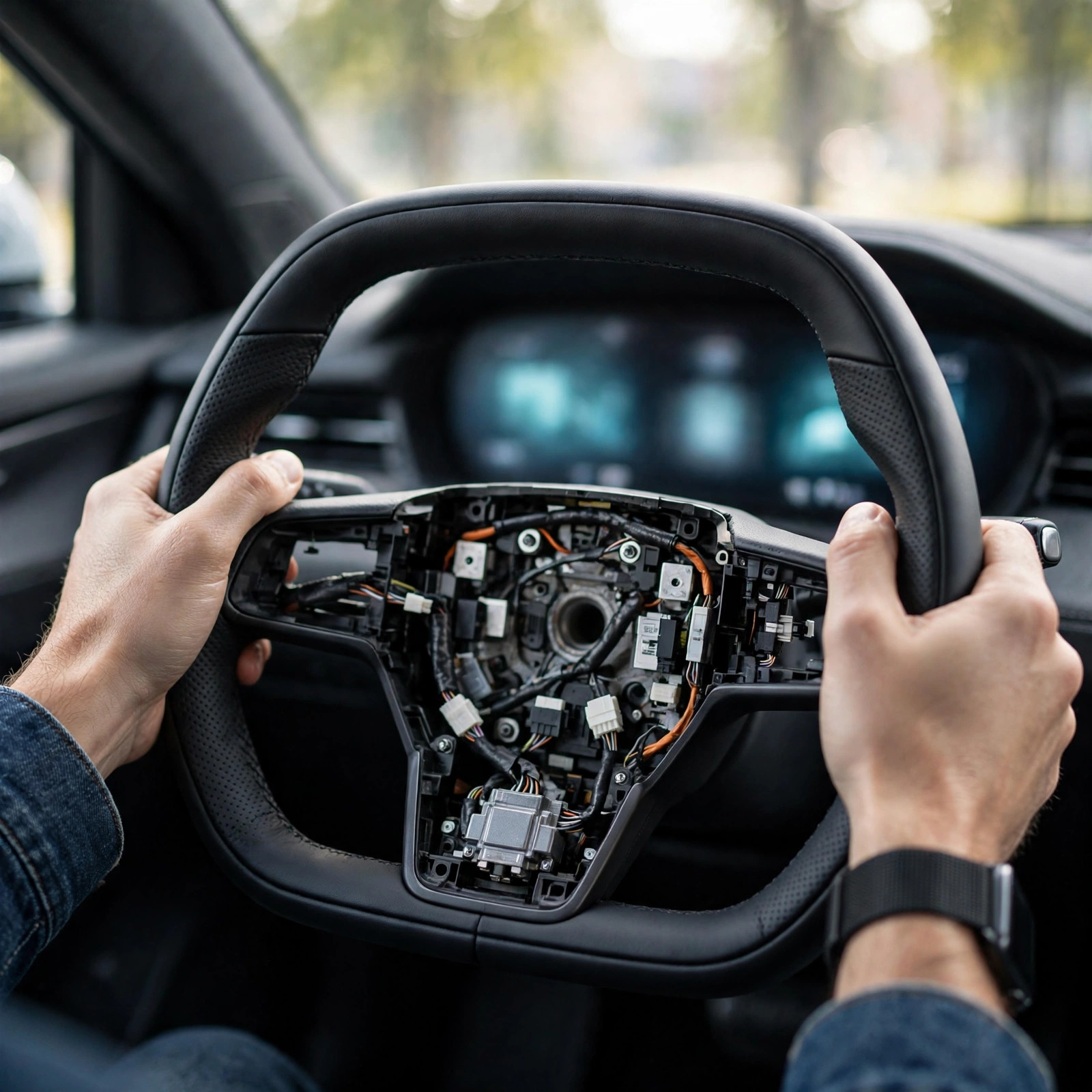
Watch a driver turn the rectangular yoke in a Tesla Cybertruck or a 2026 Lexus RZ, and one terrifying question pops into your head. What happens at highway speed if a computer crashes and there is no metal shaft connecting your hands to the front tires? Most people assume strict steer-by-wire regulation blocked automakers from removing that steel column until recently, yet the law actually opened the door over two decades ago.
For your next car, that means steering safety no longer rests on one steel rod. It rests on dual-circuit math that keeps the wheels listening, even if a wire burns out.
At a Glance
- Legal since 2003: UN R79 legalized shaftless Full Power Steering in 2003, proving hardware costs—not laws—delayed adoption.
- First vs. truly shaftless: The 2014 Infiniti Q50 kept a backup clutch, while the 2023 Cybertruck eliminated mechanical backups entirely.
- 400-degree production steering: The 2026 Lexus RZ widened its steering rotation to 400 degrees lock-to-lock for calmer driver control.
- The Annex 6 fail-safe rule: Under UN R79 Annex 6, a single power or signal fault must never jerk the wheels or kill steerability.
Did Steer-by-Wire Regulation Hold Automakers Back? The 2003 UN R79 Plot Twist
Blaming slow government paperwork for the late arrival of shaftless steering gets automotive history backward, because regulators legalized the technology in 2003. Automakers waited twenty years not for legal permission, but for the ability to build affordable, lightweight backup electronics that met the law’s tough survival rules.
Think of high-rise elevators in the nineteenth century. Cities did not ban tall buildings because elevator rope laws were missing. Builders simply lacked a cheap, automatic double-brake that could catch a heavy cabin the instant a steel cable snapped.
In the car world, that legal green light lives inside UN Regulation No. 79, the international rulebook governing steering equipment across Europe, the UK, and dozens of other countries. Way back in 2003, regulators updated UN R79 to legalize what the rulebook calls Full Power Steering. That was four years before the first iPhone went on sale. The update was Supplement 3 to the 01 series of amendments.
Full Power Steering means a steering system where electric wires and motors do all the work, with zero mechanical rod linking the driver’s wheel to the tires. Today, UN R79 sits in its 04 series of amendments. Its core promise stays the same. You can remove the steel shaft if you prove your electronics will not fail all at once.
Still, a rule in Geneva does not work the same way everywhere on the planet. Countries that signed the 1958 UN Agreement require prior type approval. That includes European Union members and the UK. Government inspectors must test a car’s steering blueprints before a single customer buys one.
The United States is not a party to that 1958 Agreement, so UN R79 is not US law. Instead, the US uses manufacturer self-certification, allowing Tesla to put the shaftless Cybertruck on American highways in late 2023 by certifying its own safety compliance.
Three Production Cars, Three Fail-Safe Answers: Infiniti Q50, Cybertruck, and the 2026 Lexus RZ
Ask three carmakers what happens when a steering wire loses power, and you get three distinct engineering blueprints. Early pioneers hid a physical safety net under the floor, while newer electric trucks and SUVs threw away the net and installed twin hearts instead.
Picture two ways to jump off a high bridge. The 2014 Infiniti Q50 jumped with a main parachute but tied a backup bungee cord to its ankle just in case. The Tesla Cybertruck and the 2026 Lexus RZ cut the bungee cord completely and strapped on two independent jetpacks wired so both cannot flame out at the same time.
To see why “a cut wire means you cannot steer” is a myth, look at how a steer-by-wire system actually moves your car. Instead of twisting a metal bar, your hands turn a torque actuator. It is a motor behind the wheel. It reads your steering angle and pushes back against your palms to mimic road bumps.
That signal travels through an Electronic Control Unit (ECU). An ECU is a small onboard computer that makes split-second decisions. The signal ends at a control actuator on the front axle, which pushes the tires left or right. Every production model builds its fail-safe—a backup defense that keeps the car controllable during a breakdown—around this loop differently.
Infiniti went first in 2014 with the Q50 sedan and its Direct Adaptive Steering (DAS), making it the world’s first production steer-by-wire passenger car. During normal driving, three separate ECUs watched each other while turning the wheels electronically. However, Infiniti kept a physical steering column inside the car with an electromagnetic clutch held open by electricity. If power died or the computers disagreed, the clutch snapped shut and locked the wheel back to the tires like an ordinary car.
Even with that mechanical safety net, early software bugs gave Infiniti a tough lesson. In November 2013, NHTSA recall 13V-588 covered 23 early 2014 Q50 sedans because freezing temperatures could make the software shut off electric steering and delay the mechanical clutch engagement. In June 2016, a second recall (16V-430) called back 28,182 cars.
It covered model year 2014 to 2016 Q50 and Q50 Hybrid cars. The fix reprogrammed an ECU startup error that could distort the steering angle.
Nearly a decade later, the Tesla Cybertruck began customer deliveries on 30 November 2023 as the world’s first production car with no mechanical steering backup at all. Instead of a backup clutch, Tesla mounted two independent electric motors on the front steering rack. If one motor dies, the second keeps steering. A rear-wheel steering motor turns the back tires up to 10 degrees.
Tesla paired this setup with a 48V electrical system. It pushes heavy truck tires fast without thick copper cables. The system replaces the 12V car battery standard, which dates back roughly 70 years to the 1950s. Tesla announced on 6 November 2026 that Cybertruck production will wind down around mid-2027.
The factory space will go to the Cybercab. Even so, its shaftless hardware proved that dual-motor redundancy works in daily traffic.
Then came Lexus with its One Motion Grip system in the updated RZ electric SUV—the first steer-by-wire car from Lexus and Toyota. After a world premiere in Brussels on 11 March 2025, European orders opened in October 2025. First customer deliveries began in early 2026. UK driveways got the first cars in Q1 2026.
The system comes standard on the RZ 550e F SPORT and optional on the RZ 500e Luxury. Lexus also removed the mechanical column completely. A steering torque actuator sits behind the yoke, and a control actuator sits on the axle.
Two fully duplicated ECUs and dual power supplies back them up. If one circuit fails, its twin takes over without a hiccup.
| Feature | Infiniti Q50 (2014) | Tesla Cybertruck (2023) | Lexus RZ (2026 Delivery) |
|---|---|---|---|
| System Name | Direct Adaptive Steering (DAS) | Steer-by-Wire | One Motion Grip |
| Mechanical Column | Yes, separated by a clutch during normal driving | None (world’s first production car without mechanical backup) | None (Toyota and Lexus first shaftless system) |
| Fail-Safe & Redundancy | 3 monitoring ECUs + fail-safe mechanical backup clutch | Dual front rack motors + rear steering motor (up to 10°) + 48V architecture | Separate torque and control actuators + 2 redundant ECUs + dual power |
| Wheel & Steering Angle | Standard round wheel | Variable-ratio rectangular yoke | Yoke wheel; ~200° centre-to-lock (400° lock-to-lock) |
| Regulatory & Launch Context | NHTSA recalls 13V-588 (23 units) and 16V-430 (28,182 units) | US self-certification; deliveries from Nov 2023; wind-down set for mid-2027 | Passed UN R79 type approval; unveiled Mar 2025, deliveries early 2026 |
Inside UN R79 Annex 6: How Regulators Certify an Invisible Steering Shaft
European safety inspectors do not care whether a car has a steel rod under the dashboard. They care about proof. The automaker must prove mathematically that a single fried chip will never jerk the front tires or leave the driver helpless. That proof is audited under a strict section of the law called UN R79 Annex 6.
Think of a bank inspector certifying a new underground vault. The inspector never trusts a single “unbreakable” padlock. Instead, they audit the blueprints line by line. They confirm that if Door 1 is blown open, Door 2 locks itself and the alarm rings.
In UN R79, Annex 6 is titled Special Requirements to be Applied to the Safety Aspects of Complex Electronic Vehicle Control Systems. Engineers must hand over three thick dossiers. They cover the Safety Concept, the Failure Strategy, and the verification test results. This applies whether an automaker seeks full European mass-market type approval or brings a single car into the UK for Individual Vehicle Approval (IVA).
To back up those documents, the manufacturer must run two formal engineering audits. The first is an FMEA (Failure Mode and Effects Analysis). It is a bottom-up checklist that examines every wire or sensor that could break, and what happens next.
The second is an FTA (Fault Tree Analysis). It is a top-down logic map that starts with a disaster like “loss of steering” and traces every combination of faults that could cause it.
Above all, UN R79 failure provisions enforce two unbreakable physical laws on the test track. First, a failure in the energy supply or signal transmission must never cause an immediate change in the steering angle. That means the front tires cannot suddenly twitch toward a guardrail if a circuit shorts out.
Second, the car must remain steerable so the driver can guide it safely to a stop. That is why shaftless cars like the Lexus RZ and Cybertruck must carry dual ECUs, dual motor windings, and isolated dual power supplies.
UN R79 Annex 6 Compliance Checklist for Shaftless Steering
- Zero Sudden Angle Jump: A single power or signal fault must not cause an immediate jump in wheel angle.
- Maintained Steerability: After any single electronic or power failure, the driver must still be able to steer the vehicle safely.
- Audited Math (FMEA & FTA): The manufacturer must document its Safety Concept and Failure Strategy, backed by formal Failure Mode and Effects Analysis and Fault Tree Analysis reports.
From 150 to 200 Degrees: What Changing the Steering Ratio Reveals About Why Not Every Car Uses By-Wire Yet
Cutting the metal steering shaft freed engineers from a fixed mechanical gear ratio. But it handed them a harder human problem. They must tune software so a twitchy sneeze at highway speed does not send the car into the next lane. Even after solving the safety laws, high component costs, power-hungry motors, and tricky road-feel software still keep steer-by-wire out of budget cars.
Anyone who plays PC games knows this trap. Turn your mouse sensitivity (DPI) up to the maximum. A tiny flick of your wrist now crosses the whole monitor. But you suddenly cannot click a small desktop icon without overshooting it three times.
With a mechanical shaft gone, software can change the steering ratio—how much the tires turn for every degree you turn your hands—on the fly. At parking lot speeds, a small turn of the yoke swings the front tires wide so you never have to cross your arms hand-over-hand. At highway speeds, the computer calms the ratio down so the car tracks straight.
Lexus learned firsthand how easy it is to make that ratio too sharp. When Lexus first previewed its One Motion Grip prototype in 2022, engineers set the centre-to-lock angle at roughly 150 degrees. Centre-to-lock means how far you turn the wheel from straight ahead to a full left or right turn. That is 300 degrees lock-to-lock, from full left all the way to full right.
By the time the 2026 production Lexus RZ reached showrooms, Lexus widened that rotation to roughly 200 degrees centre-to-lock, or 400 degrees lock-to-lock. Chief Engineer Yasuyuki Terama explained the change simply: in real-world driving, the original 150-degree setup felt “too direct.”
If UN R79 allows it and drivers love skipping hand-over-hand turns in tight parking garages, why doesn’t every family hatchback use a by-wire architecture today? Three practical roadblocks stand in the way:
- Hardware Cost and Redundancy Weight: Replacing one stamped steel column requires buying a torque actuator, a control actuator, dual motors, two separate ECUs, and twin power harnesses. That drives up the bill of materials for affordable cars.
- 12-Volt Power Limits: Turning heavy front tires rapidly by wire demands high electrical current. That current strains the ~70-year-old 12V battery standard. So automakers move toward 48V architectures or dedicated backup capacitor banks first.
- Synthetic Road Feel and Software Risk: Filtering out harsh pothole jolts takes years of tuning. The motor must send only realistic tire grip cues. And turning steering into code means automakers must lock down every update under strict rules like automotive cybersecurity UN R155.
Key Takeaways: What Shaftless Steering Means for Your Next Car
The real breakthrough of steer-by-wire is not the bravery of sawing off the steering column. It is the dual-circuit engineering that passes UN R79 Annex 6. That engineering keeps a car in control even during a blackout. Twelve years passed from the clutch-backed Infiniti Q50 in 2014 to the dual-motor Tesla Cybertruck in 2023.
Then came the 400-degree Lexus RZ, delivered in early 2026. Automakers have proven that redundant computers can steer safely within the law. What remains is no longer a legal battle, but an engineering race to make dual-actuator hardware cheap and natural enough for everyday commuters.
Would you trust dual electric motors and twin ECUs on your morning highway commute tomorrow? Or do you still sleep better knowing a solid steel rod connects your hands to the front wheels? Drop your take in the comments below, and bookmark or share this breakdown with a friend who still thinks shaftless steering is illegal.
Sources
- Regulation No 79 of the Economic Commission for Europe of the United Nations (UN/ECE) – Uniform provisions concerning the approval of vehicles with regard to steering equipment — Official Journal of the European Union (EUR-Lex)
- Assessing the Compliance of Steer-by-Wire Systems for Individual Vehicle Approval — UK Vehicle Certification Agency (VCA)
- 2014 Infiniti Q50 First Drive and Direct Adaptive Steering Review — MotorTrend
- 2014 Infiniti Q50 Recalled for Direct Adaptive Steering Issue — AutoGuide, November 2013
- Tesla Cybertruck Specifications, Steer-by-Wire and 48V Architecture — TeslaCarFacts
- Tesla Cybertruck Production Wind-Down Set for Mid-2027 to Make Way for Cybercab — Paul Tan’s Automotive News, 6 November 2026
- Lexus Leads on BEV Technology Innovation, Launching Steer-by-Wire and Virtual Manual Gear Shifting — Lexus UK Media
- The New Lexus RZ Press Pack (One Motion Grip Technical Specifications) — Lexus UK Media, October 2025
- Steer-by-Wire: How Does Lexus One Motion Grip Work? — Lexus UK Magazine
- VM Test Drive: Lexus RZ 550e F SPORT – Steer-by-Wire Now in Series — Vision Mobility