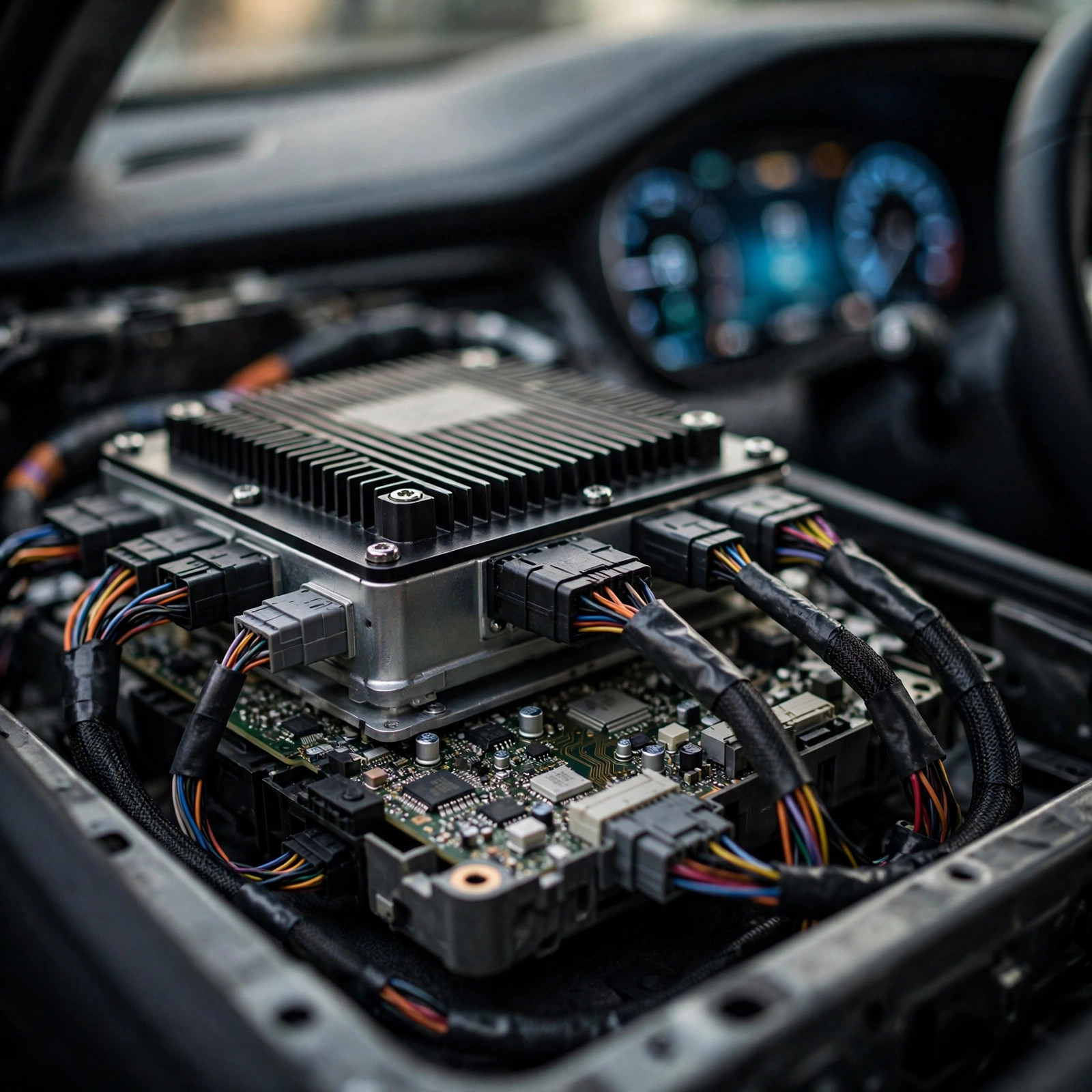
Hi, this is Datumdraft. Automakers talk about building their own “Car OS” almost every week. You hear promises about downloading new driving features over the air just like installing an app on your smartphone. Yet very few explanations show how a vehicle actually connects a Linux or QNX operating system kernel to a lane-keeping or automated parking application. The missing link sitting right in the middle of that software stack is AUTOSAR Adaptive middleware.
What the industry casually calls a “Car OS” is actually a combination of an operating system, middleware, and an application framework. At the center of this stack sits AUTOSAR, which stands for AUTomotive Open System ARchitecture. Modern software-defined vehicles rely on two distinct standards working side by side inside the same car. AUTOSAR Classic handles hard real-time control on small microcontrollers with 1 to 8 megabytes of flash memory. Meanwhile, AUTOSAR Adaptive middleware runs on high-performance chips to manage service-oriented communication and individual app updates over the air.
The Car OS Myth: How Automotive Software Layers Actually Work
Automotive software runs in four distinct layers from the physical silicon chip up to the user-facing application, with middleware acting as the central translator.
Think of your smartphone for a second. When you tap a weather app, the app does not talk directly to the phone’s Wi-Fi antenna or screen pixels. An operating system and a layer of system services sit in between to manage memory, security, and network requests. Cars work the same way, except a vehicle has to manage both high-resolution cabin screens and physical brakes that must respond in milliseconds.
When headlines mention a “Car OS,” they usually bundle four separate layers into one phrase:
- Hardware Layer: The physical computing chips. These range from small Microcontrollers (MCUs, single-chip computers built for simple, repetitive control tasks) to massive Systems-on-Chip (SoCs, multi-core processors that combine CPU, GPU, and AI accelerators on one silicon die).
- Operating System (OS) Kernel: The foundational software that schedules tasks and manages hardware memory. Depending on the chip, this is either a tiny Real-Time Operating System (RTOS) or a full POSIX-compliant operating system like Linux or QNX. POSIX is a global technical standard that makes sure operating systems use compatible interfaces for running programs.
- Middleware Layer: The software plumbing between the OS and the applications. Middleware lets different software programs talk to each other, even if they run on completely different chips across the vehicle network.
- Application Layer: The actual features that control the car or interact with the driver, such as adaptive cruise control, battery thermal management, or cabin climate logic.
How this middleware layer is built depends entirely on whether the computer is a traditional controller or a modern central computer. This hardware split is closely tied to how automakers transition their electrical wiring from domain vs zonal architectures.
In a traditional Electronic Control Unit (ECU, a small embedded computer that controls a specific vehicle function), the software follows the AUTOSAR Classic architecture. Right above the microcontroller hardware sits the Microcontroller Abstraction Layer (MCAL). The MCAL hides the chip-specific wiring details so higher software layers do not care which chip vendor made the silicon. Above the MCAL sits the Basic Software (BSW), which handles network communication, memory management, and diagnostics. Above the BSW sits the Runtime Environment (RTE), a static switchboard that routes data between the base software and the top layer: the Application Software Components (App SWC).
High-performance central computers use a completely different structure called AUTOSAR Adaptive. Instead of compiling everything into one fixed block of code, Adaptive sits on top of a POSIX operating system like Linux or QNX. Individual vehicle applications run as separate, isolated processes. A standardized set of middleware tools called Functional Clusters (written in code under the ara::* namespace, which stands for AUTOSAR Runtime for Adaptive Applications) manages how these independent apps start up, store data, and communicate.
AUTOSAR Adaptive middleware vs Classic: Why Legacy Stacks Struggled With OTA and Autonomy
AUTOSAR Classic and AUTOSAR Adaptive are built for completely different computing classes: Classic locks down code at compile time for tiny microcontrollers, while Adaptive dynamically manages services at runtime on high-performance chips.
When leading automakers and suppliers formed the AUTOSAR consortium in 2003, cars did not have high-definition cameras, radar fusion, or cellular over-the-air updates. They needed a standardized way to write software for dozens of small microcontrollers handling fuel injection, anti-lock brakes, windshield wipers, and door locks. That effort produced AUTOSAR Classic.
AUTOSAR Classic is written in C and runs on an OSEK/VDX real-time operating system. It targets microcontrollers that carry just 1 to 8 megabytes of flash memory and 256 kilobytes to 2 megabytes of RAM. Because memory is so tight and timing must be exact, Classic uses static compile-time configuration. Engineers define every software task, memory address, and communication message before the car ever leaves the factory. On the vehicle network, Classic ECUs communicate over CAN, LIN, FlexRay, or Ethernet using signal-based communication.
Signal-based communication works like a fixed radio broadcast. An engine sensor broadcasts a specific voltage or RPM number onto the wire at a set interval, whether any other computer is listening or not. Every wire path and message ID is hardcoded in advance.
By 2017, advanced driver-assistance systems (ADAS), autonomous driving sensors, V2X (Vehicle-to-Everything connectivity), and rich cockpit displays made static coding hit its limit. Automakers needed to process gigabytes of camera data and push frequent software updates without recalling vehicles. To solve this, the consortium introduced AUTOSAR Adaptive in 2017.
AUTOSAR Adaptive is written in C++14 and C++17 and runs on POSIX operating systems, primarily Linux or QNX. Instead of small microcontrollers, it runs on high-performance Systems-on-Chip (SoCs) such as NVIDIA Orin, Qualcomm Snapdragon Ride, Renesas R-Car, and NXP S32G. These chips power ADAS, autonomous driving, V2X, infotainment, and central compute modules.
The Two Decisive Differences: App-Level OTA and Service-Oriented Communication
The gap between Classic and Adaptive comes down to how they handle software updates and how they send data across high-speed networks like Automotive Ethernet.
First, look at Over-The-Air (OTA) updates. In AUTOSAR Classic, all application code, runtime routing, and base software are compiled together into one monolithic firmware image. If an engineer changes three lines of code to tweak how a cabin light dims, the automaker must recompile and reflash the entire ECU memory block. In AUTOSAR Adaptive, applications run as independent processes on top of the POSIX OS. Engineers can deploy a new app or update a single feature over the air without reflashing the entire ECU.
Second, Adaptive replaces static signal broadcasting with a Service-Oriented Architecture (SOA) managed by its communication module, ara::com, running over protocols like SOME/IP (Scalable service-Oriented MiddlewarE over IP) or DDS (Data Distribution Service). Think of SOA like ordering food through a delivery app instead of listening to a radio broadcast. A radar sensor offers a “Detected Objects Service.” When the automated parking app wakes up, it uses runtime service discovery to find that radar service and subscribes to the data only while parking. Once the car is parked, the subscription stops, saving network bandwidth and computing power.
| Feature / Spec | AUTOSAR Classic Platform | AUTOSAR Adaptive Platform |
|---|---|---|
| Release Year | 2003 | 2017 |
| Primary Language | C | C++14 / C++17 |
| Operating System | OSEK/VDX Real-Time OS (RTOS) | POSIX-compliant OS (primarily Linux or QNX) |
| System Configuration | Static compile-time configuration (fixed before build) | Dynamic runtime configuration (flexible during operation) |
| Communication Model | Signal-based over CAN, LIN, FlexRay, Ethernet | Service-Oriented Architecture (SOA) via ara::com over SOME/IP or DDS with runtime service discovery |
| Software Updates (OTA) | Requires reflashing the entire monolithic ECU image | Apps run as separate processes; enables app-level deployment and OTA without full ECU reflashing |
| Target Hardware | Microcontrollers (MCUs) with 1–8 MB Flash and 256 KB–2 MB RAM | High-performance SoCs (NVIDIA Orin, Qualcomm Snapdragon Ride, Renesas R-Car, NXP S32G) |
| Target Vehicle Domains | Powertrain, chassis, body control, sensor-actuator ECUs | ADAS, autonomous driving, V2X, infotainment, central compute |
| Functional Safety (ISO 26262) | Hard real-time guarantees; main path for high-ASIL certification | Dynamic structure makes high-ASIL certification harder; primarily used for QM to ASIL-B workloads |
Inside the 8 Core Functional Clusters (ara::*) and Why Classic Is Not Disappearing
AUTOSAR Adaptive manages vehicle applications through eight core software toolkits called Functional Clusters, while leaving hard real-time braking and steering tasks to AUTOSAR Classic.
When an engineer writes a C++ application for an Adaptive central computer, the code does not manage raw Linux system calls directly. Instead, it calls standardized programming interfaces grouped under the ara::* prefix. Eight core Functional Clusters handle the heavy lifting inside the middleware:
ara::com(Communication Management): Handles Service-Oriented Architecture (SOA) communication. It lets apps find each other at runtime and exchange data over SOME/IP or DDS, whether the two apps sit on the same chip or across an Ethernet cable.ara::exec(Execution Management): Controls the lifecycle of every application. It starts apps up, allocates processor resources, and shuts them down cleanly.ara::sm(State Management): Coordinates the overall operating state of the machine—such as switching the computer between driving mode, parking mode, diagnostic mode, or an OTA update state.ara::per(Persistency): Provides safe, non-volatile storage so apps can save user preferences, calibration data, or learned driving parameters across ignition cycles.ara::diag(Diagnostics): Manages standard automotive diagnostic protocols (such as UDS), allowing service technicians or cloud monitors to read fault codes and health status.ara::crypto(Cryptography): Supplies hardware-backed encryption, digital signature verification, and secure key storage to protect vehicle communications and OTA packages from tampering.ara::iam(Identity and Access Management): Acts as an internal security guard. It checks permissions so an infotainment app cannot accidentally or maliciously send commands to a driving controller.ara::log(Logging and Tracing): Records system events and error logs in a standardized format so engineers can debug software behavior.
Correcting Two Common Misconceptions: Coexistence and ISO 26262 Safety
A common misconception in generalist tech articles is that AUTOSAR Classic is an older technology being phased out in favor of Adaptive. That is factually wrong. In a modern vehicle, Classic and Adaptive are designed to coexist and divide labor.
Central computers running Adaptive handle perception, route planning, and service orchestration. However, when the car needs to clamp a brake caliper or turn a steering rack within a strict millisecond window, dedicated microcontrollers running AUTOSAR Classic execute the physical command. This division of labor is essential as automakers adopt by-wire architecture for braking and steering. Furthermore, the AUTOSAR R24-11 release specifically strengthened service-oriented communication between Classic and Adaptive platforms, making it easier for a small Classic sensor ECU to publish data directly to an Adaptive central computer.
Engineering Reality Check — Can AUTOSAR Adaptive Achieve High ASIL Ratings?
Automotive functional safety is governed by the ISO 26262 standard, which ranks hazard levels from QM (Quality Management, no special safety requirement) up to ASIL-A, ASIL-B, ASIL-C, and ASIL-D (Automotive Safety Integrity Level D, the strictest tier reserved for systems like steering and braking). Because AUTOSAR Adaptive allocates memory and discovers services dynamically at runtime, proving 100% deterministic behavior to safety auditors is much harder than on a static system. As a result, Adaptive is primarily used for QM to ASIL-B workloads, while AUTOSAR Classic remains the main path for high-ASIL, hard real-time safety certification. Do not assume Adaptive can never be part of a high-safety system, but recognize why engineers rely on Classic as the primary workhorse for life-critical actuation.
2026 Global OEM Software Strategies: How 4 Major Automaker Camps Are Tackling the Stack
Building a unified software and middleware stack across dozens of vehicle models has proven so difficult and expensive that global automakers have shifted in 2026 toward joint ventures, cross-border architectures, and multi-company alliances.
Writing clean middleware diagrams on a whiteboard is easy. Integrating those layers across millions of production cars without delaying vehicle launches has tested the biggest balance sheets in the auto industry. Here is where four major automaker camps stand as of November 2026.
1. Volkswagen Group: From CARIAD Delays to the Rivian JV and China’s CEA
Volkswagen originally tried to build a single, unified software platform in-house through its software subsidiary, CARIAD. However, CARIAD struggled with severe timeline delays and integration bottlenecks while trying to build a group-wide platform from scratch.
To break the gridlock, Volkswagen pivoted to external partnerships and regional architectures:
- The Rivian Joint Venture (Up to $5.8 Billion): In June 2024, Volkswagen announced a major investment agreement with US electric automaker Rivian. By November 2024, the two companies officially established their 50:50 joint venture, Rivian and VW Group Technology, backed by a total deal size of up to $5.8 billion.
- 2026 Winter Testing and 2027 ID.EVERY1 Launch: In March 2026, the joint venture completed winter testing on vehicles equipped with its production-intent zonal architecture, validating hardware-software integration and over-the-air (OTA) update capabilities. The first Volkswagen model scheduled to launch with this new architecture is the entry-level ID.EVERY1 in 2027, which also pairs zonal consolidation with next-generation microcontrollers like the NXP S32K5.
- Qualcomm Long-Term Supply Agreement: Alongside the Rivian software push, Volkswagen signed a long-term Letter of Intent (LOI) with Qualcomm to supply high-performance SoCs for its SDV architecture, starting with infotainment systems in 2027.
- Evaluating China’s CEA for Europe (October 2026 Reports): Meanwhile, Volkswagen developed a separate zonal architecture specifically for the Chinese market called CEA (China Electrical Architecture). According to reports in late October 2026, Volkswagen executives are internally considering expanding CEA to European vehicles, a move cited as potentially saving between 4 billion and 5 billion euros. However, no final decision has been made on bringing CEA to Europe.
2. Hyundai Motor Group: Separating Pleos Connect Infotainment From Vehicle Middleware
In May 2026, Hyundai Motor Group debuted its new Pleos Connect system in the refreshed Grandeur sedan. According to industry reports, Hyundai aims to deploy Pleos Connect across roughly 20 million vehicles by 2030.
Crucial Terminology Distinction — What Pleos Connect Actually Is:
When reading coverage of Hyundai’s software roadmap, do not confuse cabin infotainment with whole-vehicle middleware. Pleos Connect is an Android Automotive-based infotainment system that runs the center touchscreen, navigation, media apps, and voice assistant. It is not the underlying real-time vehicle control or AUTOSAR middleware that governs chassis braking, powertrain torque, or safety-critical zonal routing.
3. Mercedes-Benz: Early Move With MB.OS and the CLA
Mercedes-Benz took an early architectural stance in February 2023 when it first unveiled MB.OS, its proprietary chip-to-cloud architecture designed to decouple hardware development cycles from software updates. Mercedes named the new CLA as its first production software-defined vehicle running on the MB.OS platform.
4. Honda and Nissan: Canceling Standalone EVs in March 2026, Forming a Software Alliance in August 2026
The sheer cost of developing independent electric platforms and software stacks forced a dramatic course correction in Japan during 2026.
On March 12, 2026, Honda officially canceled development of three upcoming electric models: the 0 Series SUV, the 0 Series sedan, and the Acura RSX. Honda cited slowing electric vehicle demand in the United States, tariff pressures, and intense price competition from Chinese automakers.
Five months later, in late August 2026, Honda and Nissan agreed to pool their engineering resources. Targeting next-generation vehicles launching from fiscal year 2029 onward, the two automakers agreed to jointly develop core ECUs, an automotive operating system, select middleware components, and vehicle control software specifications.
Practical Architecture Guide: A 5-Second Checklist for Choosing Classic vs Adaptive
You can determine whether a vehicle function belongs on AUTOSAR Classic or AUTOSAR Adaptive in five seconds by checking four engineering criteria: memory budget, update frequency, communication style, and safety criticality.
Whether you are an automotive product planner writing system requirements or an investor evaluating a semiconductor supplier’s chip portfolio, apply these four questions to map any vehicle subsystem to the right platform:
- What is the hardware memory and processor budget? If the target board is a low-power microcontroller with 1 to 8 MB of flash and 256 KB to 2 MB of RAM, it belongs on AUTOSAR Classic. If the function runs on a multi-core SoC like NVIDIA Orin, Qualcomm Snapdragon Ride, Renesas R-Car, or NXP S32G with gigabytes of DRAM, it belongs on AUTOSAR Adaptive.
- How are software updates delivered? If the component runs stable control loops that rarely change and can tolerate full-image ECU reflashing during maintenance, use Classic. If product managers want to deploy new features or update individual applications over the air without touching the rest of the ECU, use Adaptive.
- Does the feature broadcast fixed signals or request on-demand services? If the controller sends periodic physical measurements (wheel speed, coolant temperature, window switch state) over CAN, LIN, or FlexRay, use Classic. If the software needs runtime service discovery over SOME/IP or DDS via
ara::com, use Adaptive. - What is the ISO 26262 safety path? If the module directly actuates powertrain, chassis braking, or steering and requires a straightforward, static path to high-ASIL certification with hard real-time guarantees, choose Classic. If the module handles QM to ASIL-B computing tasks like perception fusion, V2X messaging, or central compute coordination, choose Adaptive.
Key Takeaways: What Defines the SDV Middleware Transition
The transition to software-defined vehicles is not about replacing every computer in the car with a smartphone chip or slapping a bigger screen on the dashboard. It is about orchestrating two very different computing worlds inside the same vehicle.
- A “Car OS” is a multi-layer stack: It combines an OS kernel (OSEK/VDX RTOS or POSIX Linux/QNX), middleware (AUTOSAR Classic or Adaptive), and an application framework. Infotainment systems like Hyundai’s Android Automotive-based Pleos Connect must be distinguished from underlying vehicle control middleware.
- Coexistence beats replacement: AUTOSAR Classic (C-based, static configuration on 1–8 MB flash MCUs) remains the primary path for hard real-time control and high-ASIL safety certification. AUTOSAR Adaptive (C++14/17 on POSIX OS and high-performance SoCs) enables dynamic service discovery via
ara::comand app-level OTA updates without reflashing the entire ECU, primarily serving QM to ASIL-B workloads. - Automakers are sharing the burden in 2026: The cost and complexity of middleware and E/E integration drove Volkswagen into its up to $5.8 billion joint venture with Rivian (completing winter testing in March 2026 ahead of the 2027 ID.EVERY1) while internally weighing whether to bring its Chinese CEA architecture to Europe. Meanwhile, Honda and Nissan responded to market headwinds in August 2026 by teaming up to co-develop core ECUs, operating systems, and middleware for FY2029 vehicles.
If you work in automotive E/E architecture or analyze mobility and semiconductor supply chains, bookmark the specification comparison table and the 2026 OEM timeline above. To see how these software layers interact with physical vehicle wiring and silicon, explore our companion deep dives linked throughout this analysis on zonal controllers, Automotive Ethernet TSN, by-wire chassis systems, and next-generation zonal microcontrollers.
Sources
- AUTOSAR Classic vs Adaptive developer guide — agnile.com
- AUTOSAR architecture series — wasilzafar.com
- AUTOSAR vs Classic comparison — embedcrest.com
- Software-defined vehicle explained (Hyundai Pleos, VW CARIAD, Rivian JV, Honda cancellation) — Automotive Cloud Watch
- Qualcomm to power Volkswagen’s SDV architecture — Automotive World
- Volkswagen considers Chinese electronics for Europe — AutoScout24, 2026-10-28