Hi, this is Datumdraft.
Investors watching luxury electric vehicle startups often ask one simple question: how does a company losing hundreds of millions of dollars every quarter survive? On November 9, 2026, Lucid Group released its third-quarter financial results after the market closed. Revenue came in at $350.3 million. That missed the LSEG analyst consensus estimate of $407 million. The company also posted a net loss of $830.9 million and delivered 3,806 vehicles during the quarter. Yet the biggest story on the earnings call was not retail car sales.
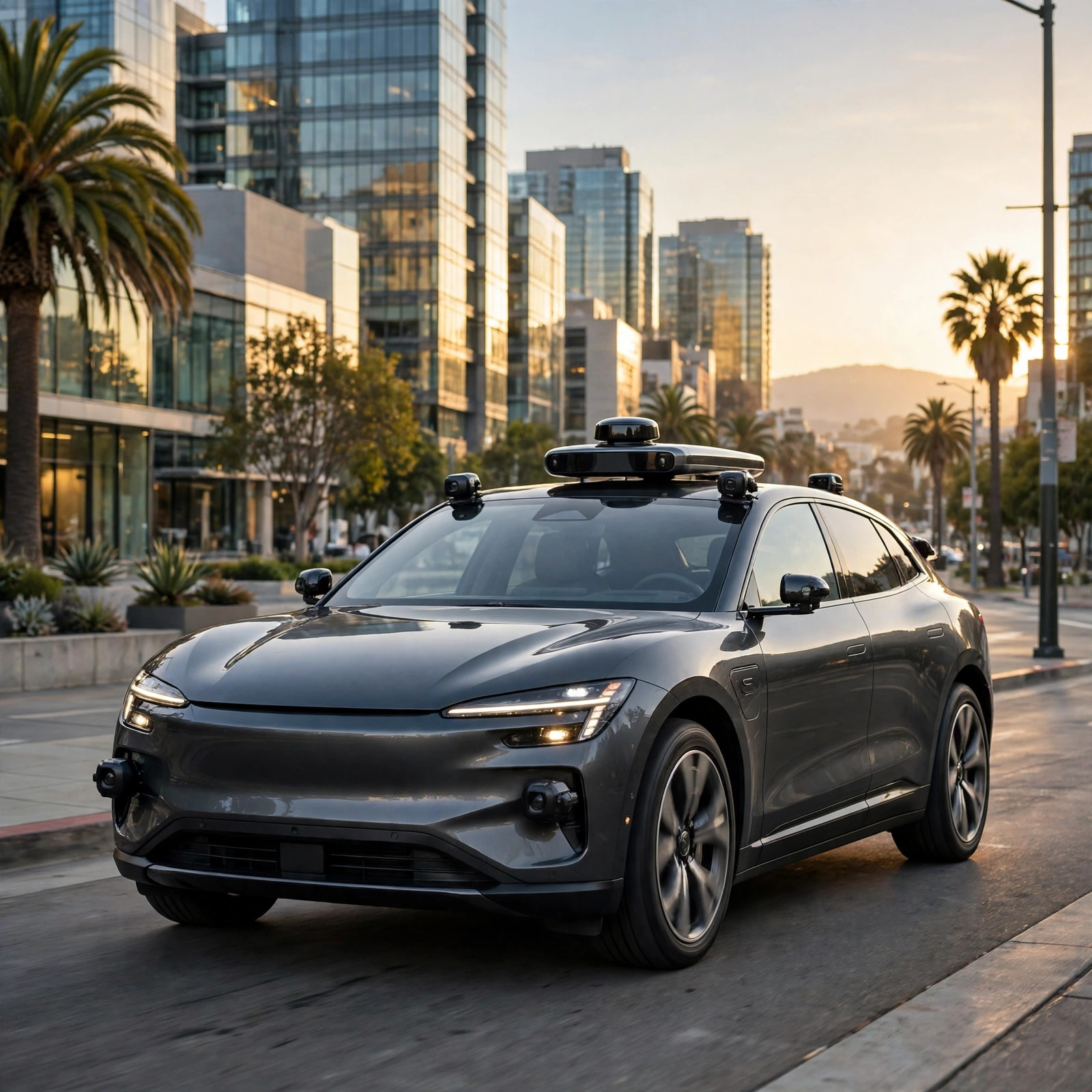
Lucid robotaxi manufacturing has officially moved onto a commercial track. In October 2026, Lucid began building pre-production robotaxi vehicles used for regulatory certification and testing. During the fourth quarter of 2026, the company will start manufacturing commercial-launch vehicles and begin driverless road testing. The first commercial service in the San Francisco Bay Area is now scheduled for the first quarter of 2027. This puts a new third camp into the autonomous vehicle race, combining Uber’s ride-hailing network, Nuro’s self-driving software, and Lucid’s factory production line.
From selling luxury cars to supplying robotaxi fleets: Q3 2026 reality check
Supplying tens of thousands of vehicles to corporate ride-hailing fleets gives Lucid a much faster path to high factory volume than selling expensive cars one by one to individual buyers. Selling luxury electric vehicles to individual drivers requires expensive showrooms, big marketing budgets, and slow word-of-mouth growth. Fleet supply works like wholesale: one corporate contract locks in years of assembly line demand.
Lucid’s third-quarter numbers from November 9, 2026 show why this wholesale shift matters right now. Third-quarter revenue rose 4.1% year-over-year to $350.3 million, up from $336.6 million a year earlier. Even with that slight growth, revenue fell short of the $407 million Wall Street consensus tracked by LSEG. Loss per share came in at -$2.74, wider than the expected -$2.28 loss.
The company is still losing large sums of money as it scales up its factories. Lucid recorded a third-quarter net loss of $830.9 million, though that narrowed from a $978.4 million loss in the same quarter last year. Its adjusted EBITDA loss was $726 million. EBITDA stands for earnings before interest, taxes, depreciation, and amortization, which is a standard measure of a company’s operating cash performance before accounting and financing costs.
On the factory floor, Lucid produced 2,954 vehicles and delivered 3,806 vehicles in the third quarter. Under CEO Silvio Napoli, who took the helm in June 2026, the company has focused heavily on slowing down its cash burn. Free cash outflow dropped to $1.04 billion in the third quarter. That is a 30% reduction compared to the previous quarter. Year-to-date, Lucid has achieved $800 million in cash flow improvements toward its full-year 2026 target of $1.4 billion.
To buy time for this turnaround, Saudi Arabia’s Public Investment Fund (PIF) increased Lucid’s delayed-draw term loan credit facility by $1.75 billion. This raised Lucid’s pro forma liquidity from $2.0 billion to $3.75 billion. That cash cushion funds Lucid’s operations through the fourth quarter of 2027. Look at the contrast in the numbers. Lucid fought hard to deliver 3,806 cars in three months. Yet its business-to-business (B2B) agreements point to at least 60,000 autonomous vehicles in future fleet demand. Uber accounts for at least 35,000 vehicles. European mobility platform Bolt adds an initial goal of at least 25,000 vehicles.
Inside Lucid robotaxi manufacturing: AMP-1 line integration and the 450-mile Gravity
Building robotaxis directly on the primary assembly line eliminates the high cost and slow speed of tearing apart finished cars to add sensors later. Most early autonomous vehicle programs bought standard cars from a dealership, took them to a garage, stripped out the wiring, and bolted laser sensors onto the roof by hand. Think of that old retrofit method like buying a finished house and knocking down the walls to add plumbing. Direct factory integration is like laying the pipes while the house is being framed.
Lucid robotaxi manufacturing takes place at the company’s AMP-1 (Advanced Manufacturing Plant 1) facility in Casa Grande, Arizona. Workers install the Nuro Driver Level 4 hardware directly onto the vehicle while it moves down the assembly line. Level 4 (L4) autonomy means the car can handle all driving tasks by itself without a human backup driver inside a designated service area.
The base vehicle for this program is the Lucid Gravity, a seven-passenger luxury electric SUV. Its standout technical advantage for fleet operators is its battery efficiency. The Lucid Gravity offers an EPA-estimated range of up to roughly 450 miles on a single charge. In ride-hailing, every hour a car spends plugged into a charger is an hour it cannot pick up paying passengers. A 450-mile range means the robotaxi spends far less time sitting at charging stations and much more time generating fares on the street.
The engineering progression over the past year shows steady hardware execution. Lucid delivered the first engineering test vehicle to Nuro in September 2025. In January 2026, the partners unveiled the production-intent robotaxi design at CES. By May 2026, the California Department of Motor Vehicles (DMV) expanded Nuro’s driverless testing permit to include the Lucid Gravity SUV.
Testing ramped up quickly over the summer. By August 2026, more than 100 vehicles in the robotaxi program were already operating on public roads. In October 2026, Lucid started building pre-production units at AMP-1 specifically for certification and homologation. Homologation is the official government approval process confirming that a vehicle meets all safety and technical standards required to operate legally on public roads.
Now, in the fourth quarter of 2026, Lucid is moving into manufacturing the actual commercial-launch vehicles. Driverless testing for the program is also set to begin during the fourth quarter of 2026.
The Q1 2027 timeline slip: what really happened to the late 2026 target?
On the third-quarter earnings call, management said the robotaxi program is “progressing as per plan.” But the actual Bay Area commercial launch has slipped by one quarter. It moved from late 2026 to the first quarter of 2027. Tracking schedule changes honestly is essential when evaluating autonomous vehicle announcements.
Uber, Lucid, and Nuro first announced their partnership on July 17, 2025. The announcement followed a July 16 Form 8-K filing. They promised to launch their first commercial service in a major U.S. city in “late 2026”. All three companies held onto that year-end target for more than a year. As recently as October 15, 2026, public updates from the partners still pointed to a late 2026 commercial debut in the San Francisco Bay Area.
That timeline shifted on November 9, 2026. During Lucid’s third-quarter earnings call, CEO Silvio Napoli confirmed that commercial deployment in the Bay Area is now targeted for the first quarter of 2027. Rather than hitting the streets with paying riders before December 31, the fourth quarter of 2026 will be spent building the commercial-launch fleet and running driverless tests.
Fact-Check Timeline: Lucid × Uber × Nuro Robotaxi Milestones
• July 17, 2025: Partnership announced (8-K filed July 16) with $300M Uber investment and original “late 2026” launch target.
• September 2025: First Lucid Gravity engineering vehicle delivered to Nuro.
• January 2026: Production-intent robotaxi revealed at CES 2026.
• May 2026: California DMV expands Nuro’s driverless testing permit to cover Lucid Gravity.
• June 17, 2026: Houston announced as second market (mid-2027 target) with a 50,000 sq ft depot.
• August 2026: Over 100 program vehicles operating on roads.
• October 2026: Pre-production manufacturing begins for homologation; late-2026 target still maintained as of October 15.
• November 9, 2026 (Q3 Call): Commercial vehicle manufacturing and driverless testing set for Q4 2026; Bay Area commercial launch officially moves to Q1 2027 (a one-quarter slip).
When the Bay Area service opens in the first quarter of 2027, it will run “fully driverless from day 1” with no safety driver behind the wheel. To manage risk, Uber and Nuro will initially open rides to an approved user group before expanding access to the broader public. The three companies have not disclosed the exact launch date, specific neighborhood boundaries inside the Bay Area, or the number of vehicles shipped for launch.
Meanwhile, preparations for the second commercial market are already underway. On June 17, 2026, the partners announced Houston, Texas as their second city, targeting a mid-2027 launch. They have already secured a 50,000-square-foot depot in Houston to house, charge, and service the vehicles. As we previously broke down in our analysis of robotaxi fleet operations, massive physical depots matter as much as the self-driving software itself. They handle fast charging, sensor cleaning, and remote support teams.
The $500M blueprint: how the Uber-Nuro-Lucid alliance scales to 2028
The partnership between Uber, Nuro, and Lucid is backed by $500 million in direct capital from Uber and multi-year vehicle purchase agreements stretching through the end of the decade. This is not a small city pilot that disappears after a few months of publicity. It is structured around two distinct vehicle platforms and two global factories.
Under the initial deal announced on July 17, 2025, Uber invested $300 million into Lucid and committed to deploying at least 20,000 Lucid Gravity SUVs over six years. In April 2026, Uber doubled down. Uber invested an additional $200 million, bringing its total capital investment in Lucid to $500 million. At the same time, Uber expanded its total deployment commitment to at least 35,000 vehicles across both the Gravity SUV and Lucid’s upcoming Midsize platform.
That April 2026 expansion also included a second, separate agreement specifically for a “Midsize Plus” robotaxi model. Under this second agreement, Uber committed to deploying at least 25,000 Midsize Plus robotaxis, with production targeted for late 2028.
| Phase / Partner | Announcement Date | Uber Capital Investment | Committed Volume & Vehicle Platform | Target Timeline & Manufacturing Hub |
|---|---|---|---|---|
| Phase 1: Initial Uber Deal | July 17, 2025 (8-K July 16) | $300 Million | At least 20,000 Lucid Gravity 7-seater SUVs (over 6 years) | Q1 2027 Bay Area commercial launch; built at AMP-1 (Arizona) |
| Phase 2: Uber Expansion | April 2026 | +$200 Million ($500M Total) | Expanded to at least 35,000 total units (Gravity + Midsize); separate contract for at least 25,000 Midsize Plus robotaxis | Midsize Plus production targeted for late 2028 |
| European Expansion: Bolt | Confirmed through 2026 updates | Commercial fleet partnership | Initial goal of at least 25,000 autonomous vehicles on the Midsize platform | European deployment aligned with Midsize platform rollout |
| AMP-2 Factory Ramp | Q3 2026 Call (Nov 9, 2026) | PIF $1.75B credit line (overall liquidity) | Midsize platform commercial vehicle manufacturing | AMP-2 (Saudi Arabia) inauguration early 2027; Midsize production H2 2027 |
Lucid is also taking this blueprint to Europe. Through a partnership with European ride-hailing operator Bolt, the companies have set an initial goal to deploy at least 25,000 autonomous vehicles built on Lucid’s Midsize platform across European cities.
To build tens of thousands of lower-cost Midsize vehicles, Lucid needs its second factory online. During the November 9 earnings call, management confirmed that the AMP-2 facility in Saudi Arabia will hold its official inauguration ceremony in early 2027. Production of the Midsize vehicle platform at AMP-2 is scheduled to begin in the second half of 2027. Lucid plans to announce detailed unveiling and production dates for the Midsize platform during the first quarter of 2027. Full 2027 financial guidance and medium-term plans will follow at the company’s full-year earnings release.
The third camp in autonomous mobility: Waymo vs. Tesla vs. Uber-Nuro-Lucid
The Uber-Nuro-Lucid alliance splits up the massive costs across three specialized companies. Ride-hailing apps, self-driving AI, and car factories each have their own owner. Together, they form a third major camp to challenge Waymo and Tesla. Think of the robotaxi industry like building a smartphone ecosystem. One company can try to make the chips, write the operating system, and run the retail stores all by itself. Or three specialists can team up. Then none of them goes broke carrying the entire bill alone.
Right now, Alphabet’s Waymo holds a massive lead in real-world commercial scale. As of October 28, 2026, Waymo operates a fleet of more than 4,000 autonomous vehicles across 15 cities. Waymo has logged over 300 million autonomous miles and was already completing more than 500,000 paid rides per week as of its March 27, 2026 milestone update. Waymo develops its own AI driver in-house and partners with outside automakers for vehicle bodies.
The second camp consists of vertically integrated players that build both the vehicle hardware and the self-driving stack under one roof. Tesla began paid commercial service with its Cybercab in Austin in September 2026. At the same time, the company is adjusting other parts of its EV lineup. That includes a planned Cybertruck production cut in mid-2027. Amazon’s Zoox robotaxi program also follows an independent path with its own purpose-built vehicle and proprietary software stack.
The third camp—Uber, Nuro, and Lucid—solves the capital problem through division of labor. Uber brings its massive existing rider base and $500 million in investment capital, so Nuro and Lucid do not have to build a ride-hailing app from scratch. Nuro supplies the Level 4 autonomous software and sensor architecture. Lucid provides a 450-mile electric vehicle platform and direct assembly line installation at AMP-1 and AMP-2.
Key takeaways: what to watch in Q4 2026 and Q1 2027
For Lucid Group, robotaxi manufacturing is a core survival strategy rather than a side experiment. Lucid holds $3.75 billion in pro forma liquidity. That funds the company through the fourth quarter of 2027. It has roughly a one-year financial window to prove the transition. It must move from a low-volume retail luxury carmaker to a high-volume B2B fleet manufacturer.
Because the Bay Area commercial launch slipped one quarter from late 2026 to the first quarter of 2027, execution during the current fourth quarter of 2026 is critical. Investors and industry watchers should track three concrete milestones over the next few months:
- Q4 2026 Commercial Production & Driverless Testing: Watch for confirmation that commercial-launch Gravity robotaxis are rolling off the AMP-1 line in Arizona and running fully driverless test routes.
- Q1 2027 Bay Area Driverless Launch: Track how quickly Uber and Nuro expand access beyond the initial approved user group once “day 1” driverless rides begin.
- Q1 2027 Midsize Platform & AMP-2 Updates: Look for Lucid’s first-quarter announcement detailing the unveiling and production schedule for the Midsize platform, alongside the early 2027 inauguration of the AMP-2 plant in Saudi Arabia.
Bookmark this page or leave a comment below with your view on whether the three-way Uber-Nuro-Lucid alliance can catch up to Waymo’s 4,000-car lead. We will update our coverage as soon as Lucid releases its Q1 2027 Midsize production schedule and Bay Area launch metrics.
Sources
- Lucid Group (LCID) Q3 2026 Earnings Call Transcript — The Motley Fool, November 10, 2026
- Transcript: Lucid Group Q3 Earnings Call Highlights — MarketBeat, November 9, 2026
- Lucid Says Another Uber-Nuro Robotaxi Shipment Is Headed to the Bay Area — Electric Vehicles (eletric-vehicles.com), 2026
- Nuro Announces Product Chief as Lucid-Uber Robotaxi Debut Nears — Electric Vehicles (eletric-vehicles.com), October 15, 2026
- Lucid Gravity Robotaxi Houston Expansion with Uber and Nuro — InsideEVs, June 17, 2026