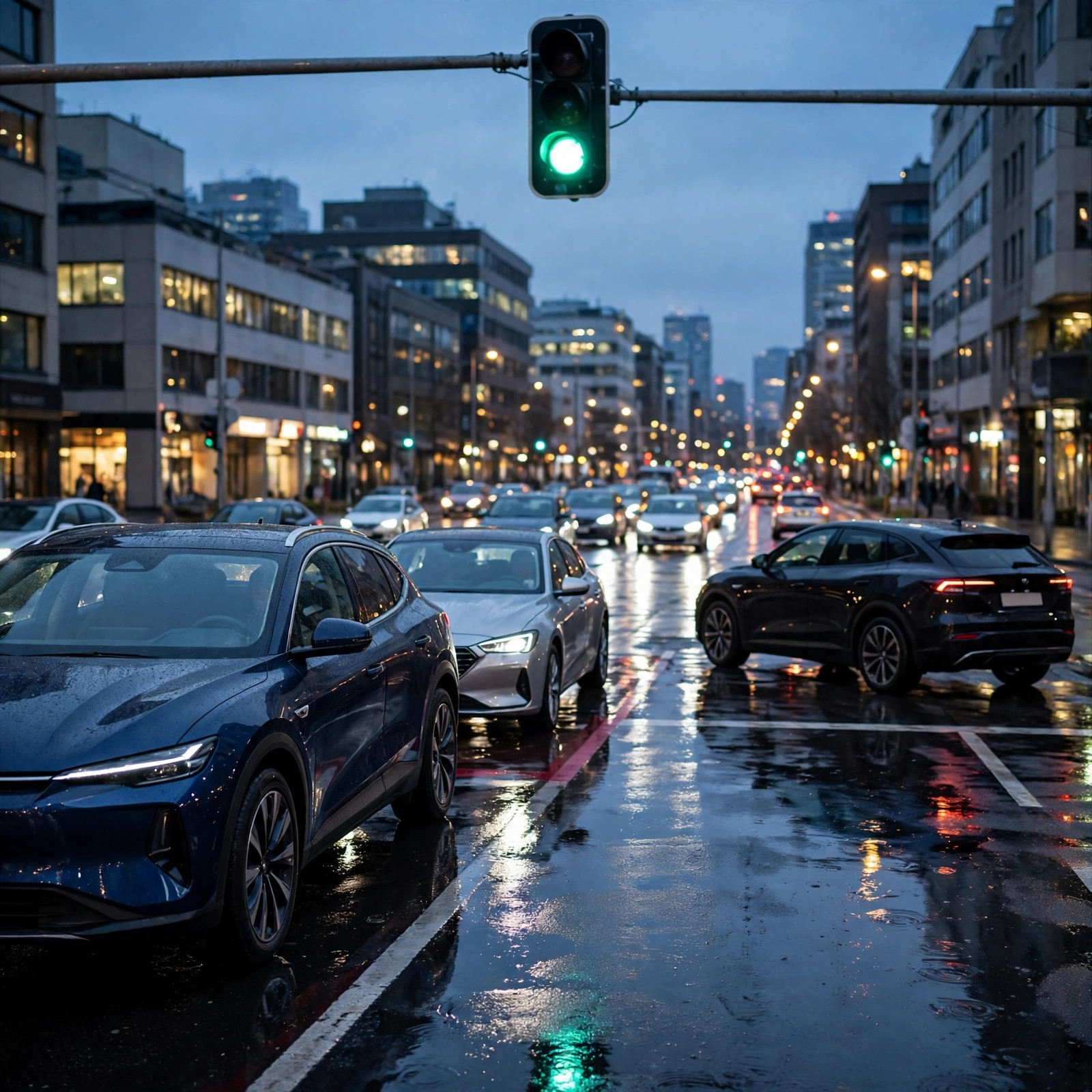
Hi, this is Datumdraft. An autonomous car packed with top-tier cameras and LiDAR (Light Detection and Ranging, a laser sensor that measures distance) still has a fatal blind spot. It cannot see another car speeding through a red light from behind a concrete building at an intersection. Sensors only see in straight lines. The only way to fix this is for cars to talk directly to other vehicles, traffic lights, and pedestrian smartphones over radio waves.
This wireless system is called V2X vehicle communication, which stands for Vehicle-to-Everything. V2X vehicle communication exchanges speed, position, and brake status across vehicles, road infrastructure, pedestrians, and cloud networks to warn drivers about hidden dangers around corners. For twenty years, engineers fought over which wireless language cars should speak: Wi-Fi-based DSRC or cellular-based C-V2X. In the United States, that fight is officially over, and the shutoff date for the losing technology is just weeks away.
At a Glance
- The US FCC settled the standard war in Nov 2024, allocating 30 MHz to C-V2X; DSRC ends Dec 14, 2026.
- China allocated 20 MHz for C-V2X in 2018, but its mandatory national standard is still a draft, not law.
- The EU stays technology-neutral with 70 MHz, using both cellular C-V2X and Wi-Fi-based ITS-G5 across road corridors.
- The 5GAA projects widespread commercial 5G-V2X production models to reach the market between 2026 and 2029.
What is V2X vehicle communication? The four conversations your car has
V2X vehicle communication is a two-way wireless network that gives a car ears and a voice where cameras and radar only act as eyes. Optical cameras and laser sensors rely on line-of-sight, meaning a solid brick wall or a large semi-truck blocks them completely. Radio waves bend around buildings and pass through fog, rain, and traffic queues. When every car and traffic pole broadcasts its position ten times per second, your car hears a hazard long before its cameras can see it.
V2X is a conversation network split into four specific links based on who your car is talking to. Each link handles a different driving distance and hazard type.
- V2V (Vehicle-to-Vehicle): This is direct car-to-car communication. When a car three vehicles ahead slams on its brakes on a foggy highway, it broadcasts an emergency brake signal. Your car receives that alert milliseconds before the brake lights directly in front of you even turn red. It also shares blind-spot positions during lane changes.
- V2I (Vehicle-to-Infrastructure): This connects your car to traffic lights, toll booths, and school zones equipped with an RSU (Roadside Unit, a wireless transceiver mounted on traffic poles). A traffic light can tell your car that it will turn green in three seconds. Your car can then coast smoothly instead of braking hard and idling at the line.
- V2P (Vehicle-to-Pedestrian): This links vehicles with smartphones, strollers, and bicycles carried by people on foot or two wheels. If a cyclist is hidden behind a parked delivery van, their phone or bike transponder pings approaching cars with their exact trajectory.
- V2N (Vehicle-to-Network): This connects the car to cloud servers over standard cellular mobile networks. It delivers macro route information like highway pileups five miles ahead, black ice reports, and high-definition map updates.
DSRC vs C-V2X: Wi-Fi vs cellular and why the US already picked a winner
The twenty-year battle between DSRC and C-V2X is over in the United States, and cellular-based C-V2X won by regulatory knockout. For years, online articles have treated these two radio standards as an ongoing rivalry. That view is outdated.
First, let us define the two contenders. DSRC stands for Dedicated Short-Range Communications, a wireless system built on the IEEE 802.11p Wi-Fi standard first drafted over two decades ago. C-V2X stands for Cellular Vehicle-to-Everything, a radio standard developed by 3GPP (the 3rd Generation Partnership Project, the global body that writes 4G and 5G mobile rules). The fight was never just about raw packet speed. It was about which hardware and telecom ecosystem would survive long enough to cover millions of miles of public road.
Key Regulatory Verdict: The US standards war is settled. The FCC allocated 30 MHz (5.895 to 5.925 GHz) exclusively to C-V2X. All DSRC operations in the United States must shut down by December 14, 2026.
Misconception 1: DSRC and C-V2X are still competing in the US
In November 2024, the FCC (Federal Communications Commission, the agency that regulates radio spectrum in the United States) issued its Second Report and Order in the 5.9 GHz band proceeding. That rule took legal effect on February 11, 2025. The FCC assigned the upper 30 MHz of the band, running from 5.895 GHz to 5.925 GHz, to C-V2X technology. At the same time, the FCC set a hard sunset date for legacy systems. Every remaining DSRC roadside transmitter and vehicle unit in the US must cease operation by December 14, 2026.
Misconception 2: C-V2X requires a 5G cell tower and a monthly data plan
Many drivers assume “Cellular V2X” means your brakes stop working if you drive into a mountain canyon with zero cell bars. That is false. C-V2X is a family of standards that started with 4G LTE-V2X and is now evolving into 5G-V2X. More importantly, C-V2X uses two separate radio interfaces.
For cloud alerts (V2N), it uses the Uu interface, which talks to standard telecom towers. For safety-critical conversations (V2V, V2I, and V2P), it uses the PC5 interface (a direct sidelink radio connection between devices). Think of PC5 like a pair of construction walkie-talkies. Two cars in the middle of an empty desert can talk directly to each other over the 5.9 GHz band via PC5. They need no cell tower, SIM card subscription, or mobile carrier signal.
The differences between the two technologies explain why automakers and telecom regulators shifted away from DSRC in North America and China.
| Feature | DSRC (Legacy Wi-Fi Lineage) | C-V2X (Cellular Lineage) |
|---|---|---|
| Technology Lineage | IEEE 802.11p (Wi-Fi derivative) | 3GPP Cellular (4G LTE-V2X to 5G-V2X) |
| US Spectrum Band | Losing access in the 5.9 GHz band | 5.895–5.925 GHz (30 MHz dedicated) |
| Direct Communication | Ad-hoc Wi-Fi radio broadcast only | PC5 sidelink (works without cell towers) + Uu cloud link |
| Evolution Path | IEEE 802.11bd (limited commercial traction outside EU) | Forward-compatible roadmap from LTE-V2X to 5G-V2X |
| US Regulatory Status | Operations must end by December 14, 2026 | Sole authorized standard (FCC order effective Feb 11, 2025) |
| Primary Regions | Selected European corridors (as ITS-G5), Japan (760 MHz) | United States, China, proposed in India, shared in Europe |
The world hasn’t decided: China, Europe, and India’s three different answers
While the United States chose C-V2X exclusively, global V2X regulation remains divided across China, Europe, and India. Automakers building cars for global sale still have to navigate different radio bands and legal timelines in every major market.
China: Fast infrastructure rollout, a 4.03% fitment rate, and a standard that is still a draft
China moved earliest on spectrum. In October 2018, China allocated a dedicated 20 MHz block from 5905 to 5925 MHz for C-V2X operations. Since then, Chinese cities and highway operators have built out massive roadside hardware. According to the Ministry of Industry and Information Technology (MIIT), China had deployed more than 11,000 intelligent roadside units (RSUs) nationwide by late 2025. That roadside coverage directly supports municipal autonomous pilots and robotaxi fleet operations in major smart-city zones.
Vehicle installation numbers are also climbing. Data from the Gaogong Intelligent Automotive Research Institute shows strong growth. China Daily reported the figures in November 2026. In the first half of 2026, 344,000 new passenger cars sold in China came with factory-installed C-V2X. That figure represents a 13.63% increase year-over-year. The China Academy of Information and Communications Technology (CAICT) tracks the active fleet. As of August 2026, China had roughly 2 million C-V2X terminals. It also had about 16 million 5G vehicle terminals.
Fact-Check Callout: Did China make C-V2X mandatory? No. China’s mandatory national C-V2X standard (Ministry of Transport Plan No. 20254333-Q-348) is still a draft. Its public comment window closed on August 29, 2026, and the regulation remains under technical review. It has not been issued as law.
Here lies the central paradox of V2X. Even in China, the fastest-moving C-V2X market in the world, those 344,000 factory-equipped cars in H1 2026 equaled a fitment rate of just 4.03%. Over 95% of new passenger cars rolling off Chinese assembly lines still lack direct C-V2X radios. V2X only protects everyone when most cars on the road can talk to each other, proving that ecosystem coordination and regulation matter far more than radio chip specs alone.
Europe and India: Technology neutrality vs proposed mandates
Europe took the opposite regulatory path from the United States. The European Union allocated 70 MHz of spectrum, from 5855 to 5925 MHz, under a strict policy of technology neutrality. That means EU telecommunications rules do not mandate a single radio standard. Instead, ITS-G5 (Europe’s Wi-Fi-based DSRC standard) continues to run on major highway corridors alongside newer C-V2X deployments. Because Europe did not pick one winner, automakers selling in Europe often have to account for split roadside infrastructure.
India recently entered the policy arena as well. In August 2026, Indian authorities published a draft regulation proposing mandatory C-V2X V2V equipment on all new vehicles starting October 1, 2028. Like China’s national standard, India’s rule is currently a formal proposal, not enacted law.
| Region | Allocated Spectrum | Regulatory Status (Nov 2026) | Deployment & Market Reality |
|---|---|---|---|
| United States | 5.895–5.925 GHz (30 MHz) | FCC 2nd Report & Order effective Feb 11, 2025; DSRC ends Dec 14, 2026 | C-V2X won exclusively; legacy DSRC units being decommissioned |
| China | 5905–5925 MHz (20 MHz, since Oct 2018) | Mandatory standard (20254333-Q-348) is still a draft under review (comments ended Aug 29, 2026) | 344,000 H1 2026 cars (+13.63% YoY, 4.03% fitment); ~2M C-V2X fleet; over 11,000 RSUs |
| European Union | 5855–5925 MHz (70 MHz) | Technology-neutral policy; no single standard mandated | ITS-G5 (DSRC-based) still active in corridors alongside C-V2X |
| India | Under consultation | Aug 2026 draft proposes mandatory C-V2X V2V from Oct 1, 2028 (proposal, not law) | Early policy stage focused on vehicle-to-vehicle collision avoidance |
When will your car talk? The 2026-2029 roadmap and buyer’s checklist
The 5GAA (5G Automotive Association, a global group of automakers and telecom suppliers) tracks this rollout. Mass-market passenger cars with 5G-V2X will roll out in volume between 2026 and 2029.
Market researchers agree that the industry is growing, though their revenue totals differ widely based on whether they count only radio chips or full telematics control units. MarketsandMarkets projects the global V2X market to grow from $0.50 billion in 2026 to $4.05 billion by 2035. In contrast, Radial Insights estimates the market at $1.36 billion in 2025, rising to $7.24 billion by 2035.
Think of it this way. Driving a car without V2X is like driving with noise-canceling earplugs on: you can only react to what stays inside your windshield frame. Driving a car with V2X is like giving every driver on the highway an open walkie-talkie channel that automatically calls out black ice and sudden stops.
If you are shopping for a new vehicle between 2026 and 2029, do not trust vague marketing brochures that promise “connected services.” Check the hardware specifications against these four items.
| Checklist Item | What to Look For on the Spec Sheet | What to Avoid / Red Flags |
|---|---|---|
| 1. Radio Standard | Explicit mention of “C-V2X”, “LTE-V2X”, or “5G-V2X” direct PC5 communication | “DSRC” labels (sunsetting in the US on Dec 14, 2026) or basic 4G infotainment modems |
| 2. Supported Band | US: 5.895–5.925 GHz (30 MHz); China: 5905–5925 MHz (20 MHz); EU: 5855–5925 MHz | Vehicles lacking dedicated 5.9 GHz safety antennas and relying only on cellular towers |
| 3. V2I Integration | Turn-key Traffic Light Information (TLI) and intersection movement assist features | Features restricted to a single test track or requiring paid proprietary city apps |
| 4. OTA Expansion | Over-the-Air (OTA, wireless software updates) support for the telematics and V2X module | Locked hardware modules that cannot add new V2P or V2I message dictionaries later |
Why V2X alone isn’t enough: The in-car network bottleneck
Catching a wireless warning on a rooftop antenna cannot prevent a crash if the car’s internal wiring is too slow to trigger the brakes. V2X is only the first half of the relay race. The second half happens inside the vehicle’s own electronic nervous system.
When a red-light runner broadcasts a PC5 radio packet at an intersection, that signal lands on the roof shark-fin antenna and enters the telematics unit. From there, the warning must travel across the car’s internal wiring to the central autonomous driving computer. That computer fuses the radio alert with camera and radar data. It then sends an emergency command to the brake actuator. If the internal car network suffers from data congestion or high latency, precious milliseconds vanish before the brake pads ever touch the rotor.
Suppose a firefighter sprints up to the front door of an apartment building and yells “Fire!” at the top of their lungs. If the building intercom inside is broken and takes ten minutes to pass the message to the top floor, the fast warning at the front door does not help. A car’s internal network works the exact same way.
Older vehicles wire their electronics using dozens of isolated controllers connected by slow CAN (Controller Area Network) buses. Passing a V2X message from the roof antenna to the brakes across multiple gateway translations introduces unpredictable delay. To fix this, automakers are redesigning their E/E architecture (Electrical/Electronic architecture, the layout of computers and wiring harnesses inside a vehicle) into physical zones.
In a modern zonal layout, the V2X module feeds directly into a high-speed backbone. That backbone runs Automotive Ethernet with TSN. TSN stands for Time-Sensitive Networking. It is a set of IEEE rules that gives safety packets an express VIP lane over video and music data. Deterministic internal networking is also becoming a focal point for regulators. They are writing type approval rules for steering-wheel-free autonomous vehicles. Under those rules, every millisecond from external radio perception to mechanical braking must be verifiable.
Key takeaways: What to check before your next car purchase
V2X vehicle communication gives cars the ability to hear hazards around blind corners where cameras and LiDAR are physically blocked. The technology is no longer a theoretical testbed, but the reality on the ground depends heavily on where you live and what sits under the car’s sheet metal.
- The US fight is over: The FCC allocated 30 MHz (5.895–5.925 GHz) to C-V2X, effective February 11, 2025, and all US DSRC operations must shut down by December 14, 2026.
- Global rules remain split: China has 344,000 H1 2026 factory-fit C-V2X cars (4.03% fitment rate). It also has roughly 2 million C-V2X terminals and over 11,000 RSUs. But its mandatory standard (20254333-Q-348) is still an unissued draft. Europe stays technology-neutral across 70 MHz. It keeps ITS-G5 alive alongside C-V2X. India’s October 1, 2028 mandate is still a draft proposal.
- Ecosystem and internal wiring decide safety: A C-V2X antenna only saves lives when roadside infrastructure, regulatory mandates, and a fast internal Zonal Ethernet network move together.
Bookmark this guide and check the specification sheet for C-V2X and 5.9 GHz PC5 support the next time you test-drive or order a new vehicle.
Sources
- Spectrum Supply and Allocation for Intelligent Transport Systems (US FCC Nov 2024 Second Report and Order, China and EU V2X Bands) — Office of the Communications Authority (OFCA), 2026
- China’s C-V2X Passenger Car Installation and Smart Road Deployment Report (Gaogong & MIIT Data) — China Daily, November 2, 2026
- V2X Market Worth $4.05 Billion by 2035 — MarketsandMarkets via PR Newswire, 2026
- Automotive V2X Communication Market Size and Forecast Report ($1.36B in 2025 to $7.24B by 2035) — Radial Insights, 2026
- China Academy of Information and Communications Technology (CAICT) Fleet Terminal Statistics via CnEVPost — August 2026
- Ministry of Transport of the People’s Republic of China Mandatory National Standard Draft Plan No. 20254333-Q-348 — Public Comment Period Closed August 29, 2026
- 5G Automotive Association (5GAA) Global 5G-V2X Commercialization Roadmap (2026–2029 Projections)