Hi, this is Datumdraft.
Have you ever sat at a highway fast charger for 30 minutes and wondered why cars cannot just swap batteries like a flashlight? You are not alone. By November 2026, EV battery swapping has split into two opposite realities: China runs over 6,700 swap stations, while America’s top swap startup just liquidated. Whether you drive a suburban family crossover or a city taxi decides which side of this divide matters to you.
At a Glance
- Nio surpassed 130 million cumulative battery swaps in November 2026 across 4,254 Chinese stations.
- CATL’s Choco-SEB network grew from zero to 2,520 stations by September 2026, targeting 6,000 in 2027.
- US swap pioneer Ample entered Chapter 7 liquidation in October 2026 after burning over $330 million.
- Swapping wins for dense urban taxis and trucks, while 800V fast charging wins for suburban home-chargers.
Three Minutes vs. Eighteen: What Happens Underneath Your Car in a Swap Bay?
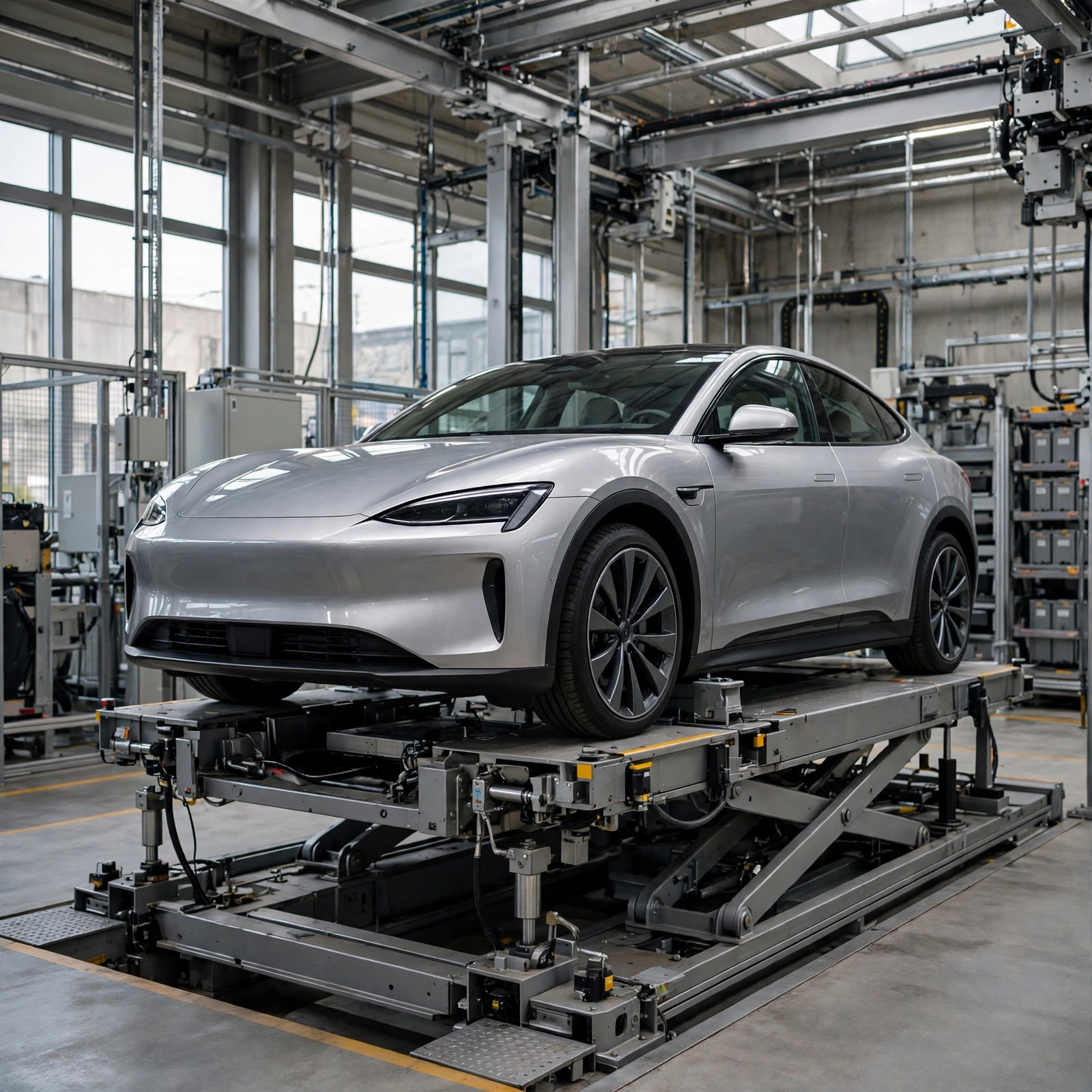
Pull into a CATL swap bay in Shanghai today, stay in your seat, and 99 seconds later your car rolls out with a full battery. That is faster than brewing a cup of gas-station coffee.
Think of a camping propane tank exchange outside a grocery store. You do not wait for a clerk to refill your empty cylinder. You drop off the empty tank, grab a fresh one that was already inspected, and walk back to your car.
EV battery swapping applies that exact logic to a 1,000-pound pack bolted under your car floor. Instead of pumping electricity through a thick cable, a robotic garage unbolts your empty battery and snaps in a charged one.
Here is what happens under the floor while you check your phone:
- Auto-alignment: Your car parks itself on a steel platform that locks the wheels into position.
- Unbolting: Automated wrenches underneath the floor release the bolts or quick-lock latches holding the pack.
- Pack removal: A hydraulic lift lowers your drained battery and slides it into a temperature-controlled charging rack.
- Fresh install: The lift grabs a fully charged battery from the rack and locks it into your chassis.
- Safety check: The car runs a quick electrical and thermal scan before the bay door opens.
Speed varies by hardware generation. CATL’s Choco-SEB stations finish a swap in 99 seconds. Nio’s fourth-generation Power Swap Station (PSS 4.0) takes 144 seconds, or two minutes and 24 seconds. Ample’s modular system in the United States took under five minutes before the company shut down.
There is a hidden perk that rarely makes the headlines. Every time your pack enters the bay, the station runs a full diagnostic check on the cells and the battery management system. That system is the software brain that tracks temperature, voltage, and cell health.
If a battery ages early or loses capacity, the station pulls it out of rotation automatically. Because you lease the battery instead of owning it, the operator absorbs the degradation risk instead of you.
Why Did China Build 6,700+ Swap Stations While America’s $330M Leader Just Liquidated?
On October 14, 2026, a Texas bankruptcy court converted Ample into Chapter 7 liquidation. Three weeks later, Nio celebrated its 130 millionth battery swap in China.
Think of shared smartphone power bank kiosks in dense Asian malls and train stations. Those kiosks work because thousands of people walk past them every hour and use the same two charging cables. Put that same kiosk in a quiet American strip mall where everyone drives a car with a USB port, and it collects dust.
That density gap explains the entire split between China and the West. According to the HyperSwap and Open Energy 2026 report, China already held about 58.3% of the world’s EV swap stations in 2025. In 2026, the gap grew even wider.
Nio’s 130 million swaps and neighborhood density
As of November 13, 2026, Nio operates 4,254 swap stations across China, including 1,081 along expressways. On November 3, 2026, the company crossed 130 million cumulative swaps.
To put that number in human terms, Nio logged its latest 10 million swaps in just 88 days. That averages more than 110,000 swaps every day, or roughly one swap every second across China.
Nio reached that volume by blanketing dense residential areas. About 84.5% of Nio owners in China now live or work within 3 kilometers (under two miles) of a swap station.
CATL’s standardized Choco-SEB blitz
Nio built its network mostly for its own cars, but battery giant CATL took a broader approach. CATL created Choco-SEB, short for Swapping Electric Block, named because the standardized packs look like chocolate bars.
Any automaker can design a car around two standard CATL pack sizes: the smaller #20 block or the larger #25 block. Both sizes come in either cheaper LFP (lithium iron phosphate) or longer-range NMC (nickel manganese cobalt) chemistry, giving automakers the full LFP vs NMC battery trade-off inside one physical shell.
CATL’s rollout speed is staggering. The company went from zero Choco-SEB stations in early 2025 to 1,020 by the end of 2025. By June 2026 it hit 2,000, and by September 29, 2026 it reached 2,520 stations across 200 cities.
CATL plans to pass 3,000 stations by the end of 2026 and hit 6,000 passenger-car stations in 2027 (5,000 in cities and 1,000 on highways).
How Ample burned $330 million and hit Chapter 7
San Francisco startup Ample tried to crack Western markets with a clever modular design. Instead of swapping one giant pack, Ample broke batteries into shoebox-sized modules that could fit different car models.
Investors poured more than $330 million into the idea. Ample launched pilot programs with Uber in San Francisco. In Madrid, it ran Fiat 500e cars with Stellantis, Free2move, and Repsol, backed by a 9.76 million euro Spanish government grant. In Tokyo, it ran a 150-vehicle truck pilot with Mitsubishi Fuso and Yamato.
Pilots never turned into mass volume. In December 2025, Ample filed for Chapter 11 bankruptcy protection (a court process to restructure debt) in Texas under case number 4:25-bk-90817. In April 2026, it sold its intellectual property for just $2 million. On October 14, 2026, the court converted the case to Chapter 7 liquidation. That means selling off remaining assets to close the business.
| Metric | Nio Power Swap | CATL Choco-SEB | Ample (US) |
|---|---|---|---|
| Active Stations (Nov 2026) | 4,254 in China (1,081 highway) | 2,520 in 200 cities (as of Sep 29) | 0 (operations shut down) |
| Swap Time | 144 seconds (PSS 4.0) | 99 seconds | Under 5 minutes |
| Battery Format | Full-size Nio packs (75 / 100 kWh) | Standard #20 (42 kWh) & #25 (70 kWh) | Shoebox-sized modular blocks |
| 2026-2027 Trajectory | 130M+ swaps; 110k+ daily average | 3,000+ end of 2026; 6,000 in 2027 | Chapter 7 liquidation (Oct 14, 2026) |
What Does a Swap Station Actually Cost, and Who Pays for the Idle Batteries?
A single Nio Power Swap Station 4.0 is a $610,000 real-estate and battery-inventory bet sitting in a parking lot. Roughly the price of a suburban American home goes into one automated bay before a single car drives in.
Think of a major airport rental car branch. The company does not just pay for the building and the wash bay. It has to own dozens of extra cars sitting idle in the lot so that when you land, one is clean and ready for your keys.
A swap station faces the exact same inventory problem. Building a Nio PSS 4.0 unit costs around 3 million RMB, or roughly $430,000. On top of the building and robots, the station holds 20 to 23 spare battery packs inside its racks.
Those waiting batteries represent roughly $180,000 in idle inventory per station. Every extra pack sitting on a shelf ties up capital that only pays off if dozens of cars swap there every single day. Nio’s PSS 4.0 can handle up to 480 swaps per day, which keeps the unit math viable in dense Chinese cities.
How BaaS subscriptions pass that cost to drivers
To make EV battery swapping affordable upfront, operators use BaaS (Battery as a Service). Under BaaS, you buy the car body at a steep discount and pay a monthly subscription fee to rent the battery.
Here is what drivers in China pay in late 2026:
- Nio 75 kWh pack: 728 RMB per month (about $102).
- Nio 100 kWh pack: 1,128 RMB per month (about $158).
- CATL #20 LFP (42 kWh): 369 RMB per month (about $52).
- CATL #25 NMC (70 kWh, unlimited swaps): 599 RMB per month (about $84).
Take the GAC Aion UT Super, a compact EV built for CATL’s Choco-SEB network. Buying the whole car with the battery included costs 89,900 RMB. Buying just the car body under BaaS drops the sticker price to 49,900 RMB, saving 40,000 RMB upfront.
You then pay 499 RMB per month for the battery subscription. Divide the 40,000 RMB upfront savings by 499 RMB per month, and you reach the breakeven point at roughly 80 months. That is six years and eight months.
If you sell the car after four or five years, BaaS leaves you ahead on cash flow. If you keep the car for ten years, buying the battery outright is cheaper.
Why 800V fast charging keeps closing the gap
Swapping also has to beat a fast-moving rival. Modern EVs built on an 800V EV architecture (higher-voltage wiring that pushes more power with less heat) already charge from 10% to 80% in 15 to 18 minutes.
An 800V fast charger works with almost any brand, requires no moving robots, and carries zero idle battery inventory. Swapping saves you roughly 12 to 15 minutes per stop, but it locks you into a special car chassis, a monthly fee, and one station network.
Where Does EV Battery Swapping Actually Win, and Where Should You Skip It?
If you park in a suburban driveway with a home wall charger, EV battery swapping solves a problem you do not have. If you drive a city taxi 350 kilometers a day, it protects your paycheck.
Think of a home capsule coffee machine versus a high-speed vending machine in a crowded subway station. At home, waking up to fresh coffee in your kitchen beats walking down the street every time. For a taxi driver on a 12-hour shift, spending 40 minutes hunting for an open fast charger means losing paid fares.
That split divides the road into three clear winners for swapping and two places where plugging in wins easily.
Three segments where swapping wins
- Urban taxis and ride-hailing fleets: Commercial drivers run multiple shifts and cannot park overnight at a private charger. Swapping in 99 seconds keeps the car earning money instead of idling at a plug.
- Heavy-duty electric trucks: Big rigs haul massive packs that take a long time to recharge unless they have access to a megawatt charging system (ultra-high-power truck chargers). In China, dedicated heavy-truck swap stations are projected to hit 900 by the end of 2026 and 2,000 in 2027, letting quarry and port trucks swap packs in minutes.
- Electric two-wheelers and three-wheelers: Delivery riders on scooters can lift a 20-pound battery out by hand and slide it into a sidewalk cabinet in 30 seconds. No robots or parking lots required.
Two places where swapping loses
- Suburban passenger cars: If you plug in at home while you sleep, your daily refueling time is ten seconds to grab the cable. Paying a monthly battery lease to save 15 minutes on two road trips a year rarely adds up.
- Structural CTC (cell-to-chassis) car designs: Automakers like Tesla and BYD increasingly glue battery cells directly into the car’s structural floor to cut weight and manufacturing cost. Swappable packs need heavy protective frames and quick-release bolts, which work against that cost-cutting trend.
| Driver Profile | Recommended Choice | Decision Check |
|---|---|---|
| Home garage + under 80 km/day | Home Level 2 + 800V DC | You wake up full every morning and avoid monthly battery rent. |
| Apartment + no private plug | Swapping (if within 3 km) | Beats sitting at public chargers twice a week in winter. |
| Taxi or fleet (300+ km/day) | Battery Swapping | Downtime directly cuts revenue; BaaS also shifts battery wear off your books. |
| Long-term owner (8+ years) | Buy Battery + Fast Charge | Past month 80, BaaS subscription costs exceed buying the pack outright. |
So Should You Wait for a Swap Station or Plug In?
The 2026 numbers settle a decade-long debate. EV battery swapping is a proven industrial success in high-density Chinese cities with standardized packs and commercial fleets, and a capital trap for standalone startups in suburban Western markets.
Here are the four takeaways to keep in mind:
- Density decides survival: Nio’s 4,254 stations and CATL’s 2,520 stations work because millions of apartment dwellers and taxis share tight urban footprints.
- Capital math is unforgiving: At roughly $610,000 per bay including idle packs, low traffic kills the business fast, as Ample’s October 2026 Chapter 7 liquidation proved.
- Check the 80-month line: On vehicles like the Aion UT Super, BaaS saves cash upfront but costs more than ownership if you keep the car past six years and eight months.
- Pick for your parking spot: Home chargers paired with 15-minute 800V fast charging still win for most suburban drivers, while swapping owns high-mileage commercial work.
Given your daily mileage and where you park at night, would you pay a monthly fee for 3-minute battery swaps or stick with 800V fast charging? Drop your daily commute and charging setup in the comments.
Sources
- Nio surpasses 130 million cumulative battery swaps — CnEVPost, November 3, 2026
- CATL targets 6,000 passenger-car swap stations in 2027 (includes Nio station count) — CnEVPost, November 13, 2026
- CATL is building more than 200 battery swap stations every month — Electrek, July 4, 2026
- CATL Choco-SEB standardized battery swapping ecosystem announcement — CATL Official News
- Ample, Inc. Bankruptcy Case Analysis (Chapter 11 to Chapter 7 conversion) — ElevenFlo, November 18, 2026
- Ample, Inc. Bankruptcy Docket (Case No. 4:25-bk-90817) — PACER Monitor
- EV Battery Swap 2026 Global Market Report — HyperSwap / Open Energy, 2026