Hi, this is Datumdraft. A few days after California kicked Waymo off its freeways, Waymo recalled itself. It did so twice in one day. Yet this Waymo NHTSA recall does not take a single car off the road.
That sounds strange at first. A recall usually means tow trucks and repair shops. Here it means paperwork and software. The cars keep driving on city streets while engineers fix code.
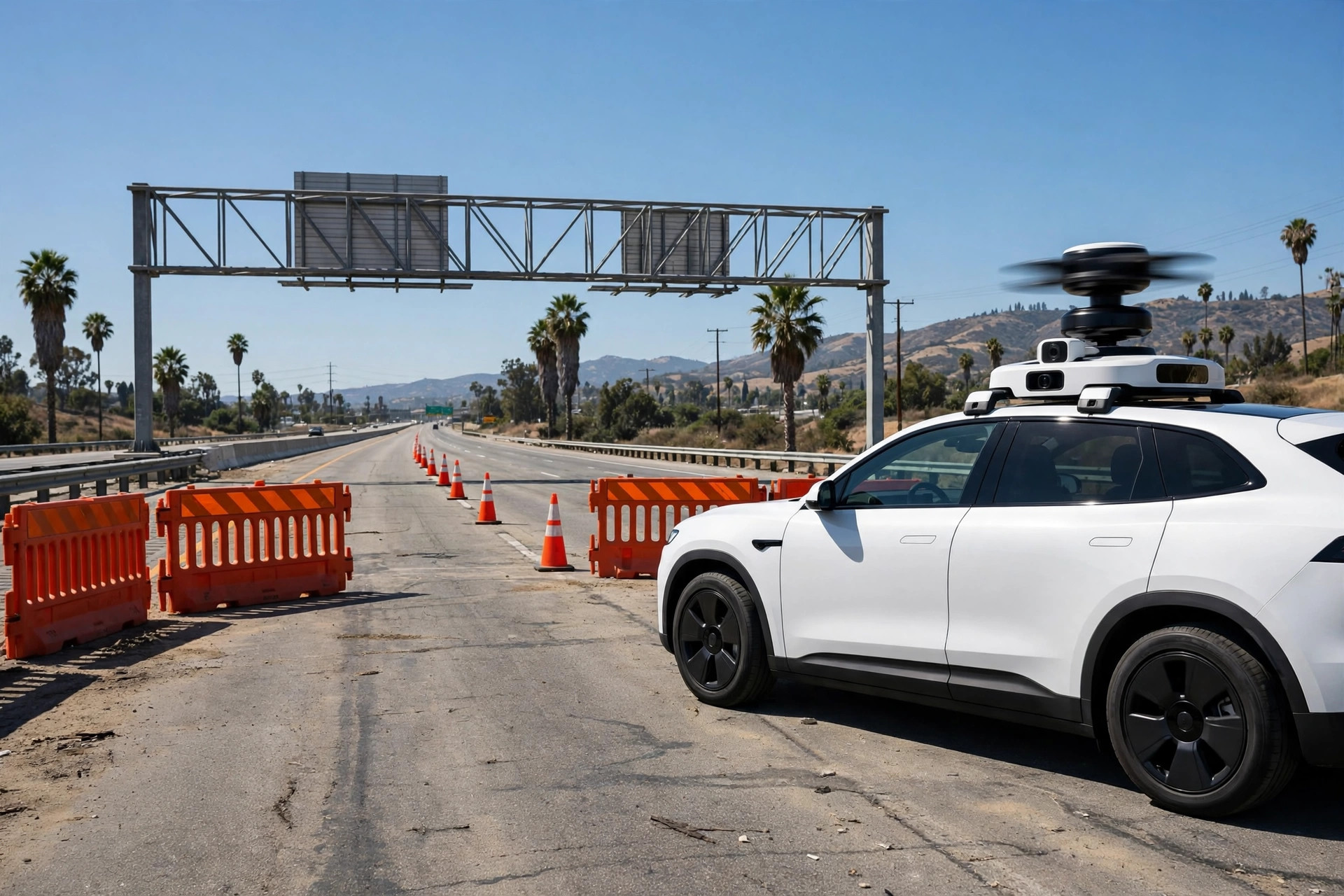
Waymo filed two voluntary software recalls with NHTSA on 19 November. NHTSA is the federal road-safety agency in the United States. The news reached the public on 20 November. One recall covers closed freeway lanes. The other covers manual traffic control by police and emergency crews.
At a Glance
- Waymo filed two voluntary software recalls with NHTSA on 19 November, announced 20 November.
- One recall covers closed freeway lanes; the other covers manual traffic control by police and emergency crews.
- The closed-lane fix is still being developed; the manual-control update was already completed on 6 November.
- City driving continues. Only freeway driving is voluntarily paused across the US.
What did Waymo actually recall — and what didn’t it?
The Waymo NHTSA recall is a software recall, not a hardware recall. The automated driving system, or ADS, is the software that drives the car. A recall remedy is the fix that a maker promises for a safety problem. Here the remedy is new code, sent to cars over the air. Think of it like a phone update, not a trip to the garage.
The first recall covers closed freeway lanes. Waymo cars entered lanes that road crews had closed. The second recall covers manual traffic control. That means hand signals and directions from police officers and emergency crews. Both recalls are voluntary. Waymo filed them itself, before any order from a regulator.
What the recall does not do matters just as much. It does not pull cars off the road. It does not stop city rides. It does not send cars to a workshop. Freeway driving is paused, but Waymo chose that pause itself. The pause covers freeways across the United States. City driving continues as normal.
The timeline tells a clear story. The software fix came first, on 6 November. The state ban came next, on 11 November. The public learned about the ban on 17 November. Only then did the federal recalls arrive. The order matters, because each step had a different cause.
Notice what sits between the ban and the recalls. A separate school-bus query opened around 13 November. That query is an investigation, not a recall. It covers roughly 2,895 to 3,000 vehicles. Keep it separate in your mind from the two recalls.
Why can’t a robotaxi tell a closed lane from an open one?
A closed lane is easy for a person to see and hard for a map to know. A human driver reads cones, signs, and flashing lights as one message. A robotaxi reads them as separate sensor signals. Its map may still show the lane as open. That gap is where the trouble starts.
Think of a road map on your phone. It shows a road that is open. A crew then closes that road with cones. Your phone does not know until someone reports it. A robotaxi faces the same problem, at freeway speed. Its high-definition map is a frozen picture of the road. Construction changes the road in real time.
Cones and barriers are edge cases. An edge case is a rare situation that normal rules do not cover. A lane may be half closed, or closed only in one direction. A barrier may sit at an angle. A sign may face away from the car. Each small change makes the scene harder to read.
The Burlingame case shows the pattern clearly. Three Waymo cars entered a construction zone on US-101, one after another. Each car made the same mistake. The first car did not warn the cars behind it in time. A geofence is a virtual boundary that limits where cars may drive. Waymo could draw one around a work zone, but only after it knows the zone exists.
On I-280, a Waymo tried to pass a CHP traffic-control vehicle. CHP stands for California Highway Patrol. The patrol car was running active freeway control. Passing it was the wrong move. The two incidents together pushed the state to act.
The fix for closed lanes is still being developed. Waymo says no crashes or injuries were reported in these incidents. That claim comes from the company, not from a regulator. The cars involved kept driving after the events. The remedy will arrive as a software update when it is ready.
What happens when a police officer waves a robotaxi through?
A police officer’s hand is a language, not a road sign. Humans learn it as children, from crossing guards and traffic cops. A wave means go. A raised palm means stop. A pointed finger means move that way. A robotaxi must learn the same language from cameras and code.
The problem is that hand signals change fast. An officer turns, steps aside, or lowers an arm. Another car or a pole can block the view for a second. In one incident, a Waymo vehicle was following an officer’s directions when the officer was briefly obscured. A collision followed. That short blind moment is what the new software must handle.
Here is the good news in this story. The manual-control update was already completed on 6 November. Waymo shipped the fix before it filed the recall. The recall still lists the problem, because the law asks makers to report it. Think of it like a doctor who treats a cut and then files the report. The treatment came first.
Behind the fix sits a large support system. Remote teams watch the fleet and step in when a car faces something strange. You can read how that backup works in our guide to the depots and remote support teams behind every robotaxi ride. That human backup is part of why a short blind moment does not have to become a disaster.
The fix teaches the car to stay cautious when the officer disappears from view. It should slow down and wait for a clear signal. It should not guess what the officer meant. Guessing is what turns a small gap into a crash. Patience is the safer choice, even if it slows traffic for a moment.
Why did California ban Waymo from freeways first?
California acted before the federal recalls arrived. The state DMV issued a freeway ban on 11 November. The ban was disclosed on 17 November. Its reason was blunt: imminent danger to public safety. Those four words carry real weight in a regulator’s order.
Think of the DMV as a school principal. A principal can suspend a student from one class while the rest of the day goes on. The DMV did the same thing here. It barred Waymo from freeways only. City streets stayed open. The ban was narrow, but the message was loud.
The incidents behind the ban were the ones you just read about. Three cars entered a closed work zone on US-101 near Burlingame. One car tried to pass a CHP vehicle on I-280. Regulators saw a pattern, not a single slip. A pattern is what turns a mistake into a safety case.
California’s rules for driverless cars changed in other ways this month too. New rules cover tickets for driverless cars and the testing of self-driving trucks. You can read what actually changed in our guide to California’s new autonomous-vehicle rules for tickets and semi-trucks. The freeway ban fits into that wider crackdown.
Waymo did not fight the ban in public. It paused freeway driving across the United States on its own. That choice went further than the California order. A company that widens its own pause is sending a signal. It would rather lose freeway rides than lose public trust.
The ban has no return date yet. Waymo must show the state that its cars can read closed lanes and hand signals. The closed-lane remedy is still being developed. Until it ships, the freeways stay closed to Waymo. Riders who need a freeway trip must use another way to travel.
Is this a repeat of the May recall?
No, and the chart below proves it in one glance. Three filings cover three different problems. The dates differ. The causes differ. The fixes differ. Treating them as one story would mislead every reader.
The first case dates to May 2025. It covered 1,212 vehicles. Those cars made low-speed contact with gates and chains. Picture a car nudging a parking barrier at walking pace. The fix for that problem was deployed in November and December of 2024. Yes, the fix came before the recall notice. That order is normal in software recalls.
The second case is not a recall at all. It is a separate NHTSA report dated 6 May 2026. It covers about 3,791 vehicles. Those cars entered flooded lanes. Water on a road is a different danger from a closed lane. A flooded lane looks passable until the car is already in it. Do not use this figure as a precedent for the freeway problem.
The third case is the November 2026 pair you have been reading about. It covers closed freeway lanes and manual traffic control. One remedy is still being developed. The other shipped on 6 November. The two recalls share a filing date, not a cause.
Think of three patients in one hospital. One has a broken arm. One has a fever. One has a sprained ankle. They share a building, not a disease. Waymo’s three filings share a company, not a failure.
Why does this matter to riders? A repeat failure would mean Waymo learned nothing. Three different failures mean something else. They mean edge cases keep appearing as the service grows. Each one teaches the system a new lesson. The question is not whether new edge cases will appear. The question is how fast Waymo can learn from each one.
What should riders — and Tesla watchers — take from this?
City rides continue, and that is the main point for riders. Your trip to the shops or the office looks the same as last week. The car still arrives without a driver. The price does not change because of a recall. Only freeway trips are off the table for now.
Riders should still pay attention to one thing. A robotaxi may stop or slow down near roadworks or police activity. That caution is a feature, not a fault. A car that waits is safer than a car that guesses. Give it a moment, and it will find a safe path.
Tesla watchers should read this story with care too. Tesla’s robotaxi service runs around the clock in several cities. Our look at Tesla’s robotaxi going 24/7 in 8 cities explains why its brief Texas lead over Waymo is misleading. The race is not only about who drives more hours. It is also about who handles the hardest edge cases.
Both companies face the same test. A closed lane and a waving officer are problems for every robotaxi, not just Waymo. The company that solves them first wins trust, not just miles. Trust is what lets a service expand to new cities. Miles alone do not open new markets.
The Waymo NHTSA recall also shows how regulation now works. A state can act fast, as California did. A federal agency can ask hard questions, as NHTSA did with the school-bus query. A company can file its own recall and pause its own service. Those three forces now shape every robotaxi launch.
Watch the closed-lane remedy next. Its arrival date will tell you more than any press release. A fast, well-tested fix means Waymo understood the problem. A slow fix means the problem runs deep. Either way, the freeways will wait. Safety, not speed, sets the timetable now.
For now, the story is simple. Two recalls, two different fixes, and no cars taken off the road. City rides go on. Freeway rides wait. The robotaxi future is delayed by a few exits, not cancelled.
Key takeaways
- The Waymo NHTSA recall covers two software problems, and only the closed-lane fix is still being developed.
- City rides continue while freeway driving stays paused across the United States.
- California banned Waymo from freeways on 11 November, before the recalls were filed.
- November 2026 is not a repeat of May 2025, because the causes and fixes are different.
Sources
- “Waymo recalls self-driving cars over closed freeway lanes, manual traffic control” — Reuters via CNA, 20 November 2026 — https://www.channelnewsasia.com/business/waymo-recalls-self-driving-cars-over-closed-freeway-lanes-manual-traffic-control-6570511
- “Waymo recalls self-driving cars over incidents involving shut freeway lanes, manual traffic control” — The Straits Times, 20 November 2026 — https://www.straitstimes.com/world/united-states/waymo-recalls-self-driving-cars-over-closed-freeway-lanes-manual-traffic-control
- Waymo recall coverage — Engadget, 21 November 2026 (no link)