Hi, this is Datumdraft. The car with no steering wheel finally has a real spec sheet, and it leaked through a private checkout screen instead of a flashy keynote. Invited buyers scrolling the personal order page spotted the Tesla Cybercab specs that Tesla never put on stage. Those screenshots tell a much sharper story than any prototype demo ever did.
At a Glance
- The invite-only order page lists 279 miles of estimated range for the pedal-free Cybercab.
- A 15-minute Supercharger stop adds nearly half of that total highway range back.
- Personal ownership requires an ongoing $299 monthly Autonomy Subscription just to keep the car running.
- Cybercab passenger rides joined Dallas robotaxi service separately from the personal checkout reveal.
What do the Tesla Cybercab specs actually give you for $29,990?
You get a compact two-seat autonomous coupe priced like a basic commuter car, packed with a giant screen and a surprisingly roomy trunk. Think of a car spec sheet like a restaurant menu for a kitchen you are not allowed to enter. You cannot grab the utensils or cook the meal yourself here. All you can do is inspect the ingredients, check the portion size, and decide if the meal fits your appetite.
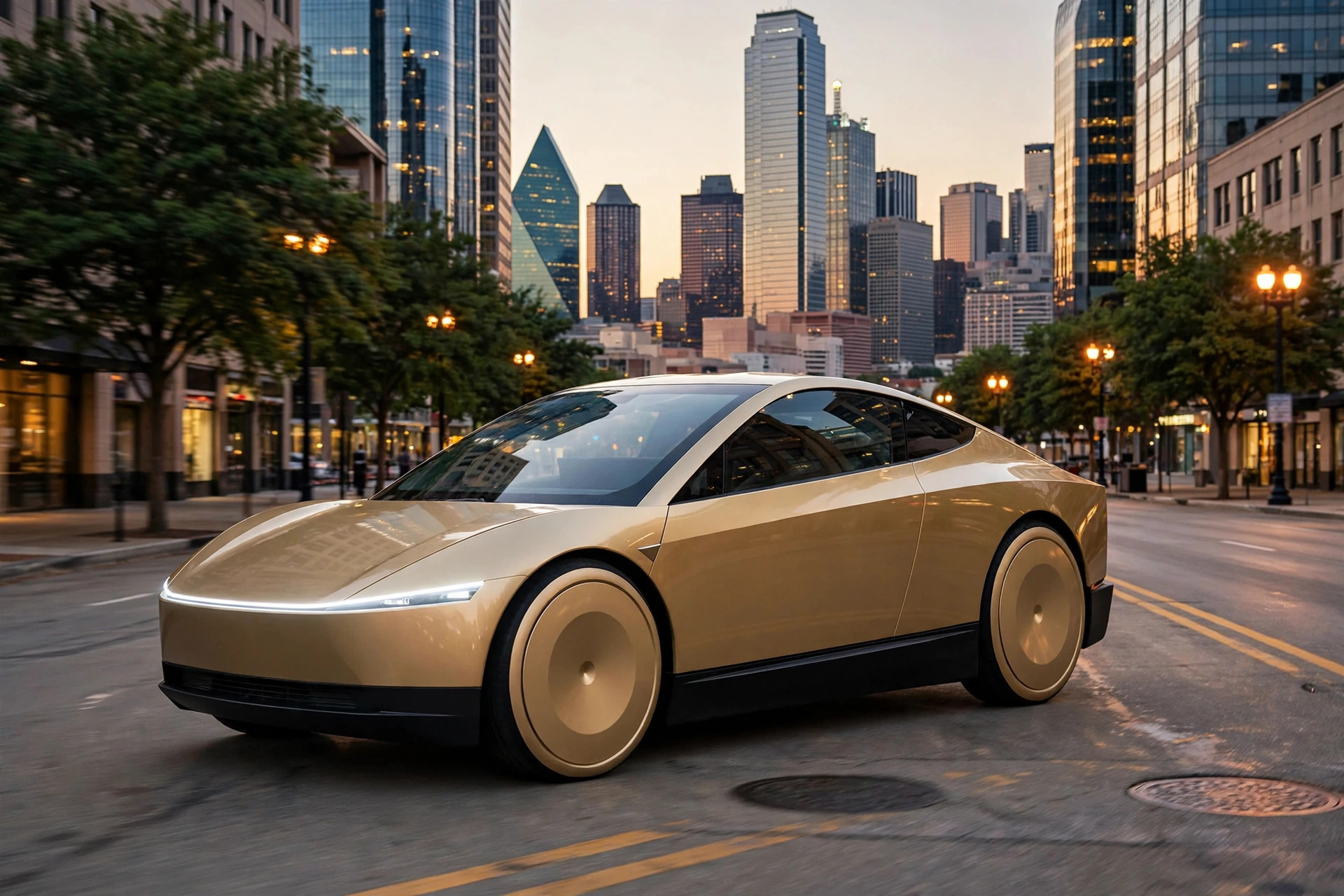
Invited shoppers who opened the private checkout screen found concrete hardware numbers for the first time. Tesla describes the vehicle on that page as fully autonomous with no steering wheel or pedals. You step inside, tap a destination, and let the software handle every turn, lane change, and stop. Because there is no driver’s station to build around, Tesla shaped the entire body for passenger comfort and low wind resistance.
Start with the exterior footprint, which feels tailored for crowded urban streets and tight city garages. The body stretches 176.2 inches from front bumper to rear bumper. That length makes the Cybercab slightly shorter than a familiar compact sedan like a Honda Civic. Parking in cramped downtown spots or squeezing through narrow neighborhood alleys becomes much easier when a car sheds extra inches.
The width tells a similar story about city maneuverability. Across its flanks, the Cybercab measures 69.0 inches wide. That narrow stance leaves extra breathing room next to tall pickups and delivery vans in tight lanes. Meanwhile, the roofline sits just 55.4 inches off the pavement. That low, sleek height helps the car slice cleanly through highway air instead of pushing a tall wall of wind.
Open the door, and the minimalist layout immediately stands out. With no steering column or dashboard gauges in the way, Tesla anchored the cabin around a 21-inch center touchscreen. Imagine mounting a standard desktop computer monitor right in the middle of your dashboard. Riders can follow the route map, stream shows, or catch up on news on a display far larger than most tablet screens.
Tesla also built practical power right into the cabin for people who plan to work on the move. Passengers get a 100W USB port to keep their devices topped up during trips. That wattage is strong enough to fast-charge a full-sized laptop while you answer emails or join a video call. You do not have to nurse a dying phone battery on the way to the airport.
Around the back, the hatch opens up to 20.1 cubic feet of cargo space. In everyday terms, that trunk easily swallows two large checked suitcases alongside a pair of weekend backpacks. A couple returning from a big grocery run can load weeks of bags without stacking boxes on their laps. For a compact two-seater built around metro trips, that storage space punches well above its exterior size.
Here is how the headline Tesla Cybercab specs stack up at a glance before we unpack the fine print behind each figure.
The table below gathers every verified detail from the checkout screenshots alongside the battery estimate derived from federal filings. Look closely at how lean hardware sits right next to strict ownership terms.
| Specification | Reported Detail |
|---|---|
| Estimated Range | 279 miles (EPA est. on invite-only order page; not yet on fueleconomy.gov) |
| Battery Capacity | About 47.6 kWh, derived from the EPA filing (326 V × 146 Ah; not Tesla-published) |
| Supercharging | Adds 123 miles in 15 minutes (based on steady 65 mph highway efficiency) |
| Exterior Dimensions | 176.2 in long × 69.0 in wide × 55.4 in tall |
| Center Touchscreen | 21-inch center display |
| Cabin USB Power | 100W USB output |
| Cargo Volume | 20.1 cu ft |
| Basic Vehicle Warranty | 4 years / 50,000 miles |
| Battery & Drive Unit Warranty | 8 years / 100,000 miles (minimum 70% capacity retention) |
| Purchase Price | $29,990 before taxes |
| Order Deposit | $1,000 non-refundable |
| Autonomy Subscription | $299/month (first month included; required to operate) |
Why does the same battery test say 418 miles and 279 miles?
The wide gap comes down to indoor lab testing versus messy real roads, and Tesla chose an even more cautious number than the standard formula allows. Picture a student’s raw score on a quiet practice quiz versus the curved grade printed on the final report card. The practice test runs in a calm, climate-controlled room with no distractions. Real streets throw rain, crosswinds, blasting air conditioning, and fast freeway merges at the battery.
Every electric vehicle sold in the United States completes indoor lab testing overseen by the Environmental Protection Agency, or EPA. Technicians run the car on indoor rollers to measure energy drain under controlled city and highway loops. In that certification test, the Cybercab reached an unadjusted result of 418.2 miles. Unadjusted simply means the raw indoor lab figure before anyone accounts for real-world weather, cabin heat, or brisk highway speeds.
Nobody commutes inside a windless laboratory, so federal rules require automakers to shrink that raw figure using an adjustment factor. An adjustment factor is just a multiplier that pulls idealistic lab mileage down to everyday street reality. Most automakers apply the standard multiplier of 0.7 to their unadjusted test scores. Multiply 418.2 miles by that standard 0.7 factor, and you land at roughly 293 miles.
Tesla did not print that higher estimate on the checkout screen. Instead, the invite-only order page displays an EPA estimate of 279 miles. That published number reflects an effective adjustment factor of roughly 0.67 against the raw indoor test. Put plainly, 279 miles sits about 33% below the unadjusted lab result of 418.2 miles.
Many readers online misread the smaller percentage floating around social media, so keep the comparison straight. Compared strictly to the roughly 293 miles you get from the standard 0.7 adjustment, Tesla’s listed 279 miles is about 14 miles lower. That gap works out to roughly 5% below the standard adjusted estimate. By dialing the listed number down below the standard formula, Tesla gives buyers a conservative buffer rather than chasing the highest possible sticker claim.
Keep the source of that 279-mile rating crystal clear as well. Invited buyers shared screenshots of the private checkout page on November 18 and November 19, 2026. You will not find this rating on Tesla’s public retail website yet. As of November 19, the government database at fueleconomy.gov also lists no Cybercab for the 2026 or 2027 model years.
Now look at the battery pack pushing all those miles down the road. Tesla did not publish an official battery capacity anywhere on the order page. Instead, analysts calculated a capacity of about 47.6 kWh, derived from the EPA filing. A kilowatt-hour, or kWh, is simply the fuel tank size of an electric car, measuring how much total energy the battery holds.
The underlying math is refreshingly straightforward. Federal certification paperwork lists a nominal pack voltage of 326 volts. Voltage measures electrical push, much like water pressure inside a garden hose. The same filing lists a pack rating of 146 amp-hours, which tracks how long a steady electrical current can flow. Multiplying those two figures gives about 47.6 kWh, derived from the EPA filing, of total stored energy.
Squeezing 279 rated miles from a battery of about 47.6 kWh, derived from the EPA filing, shows how hard Tesla leaned into aerodynamic efficiency. Many mainstream electric crossovers carry batteries nearly twice that size just to reach similar driving range. A smaller pack costs less to build, weighs less on the tires, and helps explain how Tesla hit a sub-$30,000 base price.
You may have also heard Elon Musk mention a 40 kWh battery pack in past remarks. Treat that comment strictly as talk about future efficiency improvements rather than the shipping spec. Musk attached no range figure to that smaller future pack, so buyers ordering today are getting the larger battery reflected in federal paperwork.
Fifteen minutes at a plug buys back almost half the car
A quick coffee break at a Tesla Supercharger restores nearly half of the Cybercab’s rated driving distance. Imagine topping off an insulated thermos at a cafe while waiting for a toasted bagel. You do not sit around waiting for a full pot to brew from scratch. You grab enough hot coffee to power through the entire afternoon and walk right back out the door.
A Supercharger is Tesla’s high-speed public fast-charging station built for rapid turnarounds on busy corridors. According to the invite-only order page, plugging in for 15 minutes adds up to 123 miles of driving range. Divide 123 miles by the car’s 279-mile rating, and you recover 44% of a full battery in a single quarter-hour stop. In everyday commuting terms, that single fifteen-minute top-up covers several days of typical city errands.
Pay close attention to the fine print tucked beneath that charging claim. The order-page footnote specifies that the 123-mile figure is based on the car’s efficiency at a steady 65 mph highway speed. That basis matters far more than casual shoppers realize. Electric cars burn noticeably more energy fighting wind at freeway speeds than they do cruising around neighborhood streets. Measuring replenishment at a steady 65 mph highway pace gives buyers a grounded benchmark rather than an inflated low-speed city number.
Fast turnarounds make or break a vehicle engineered to stay in motion all day. Even for private owners who only run errands across town, a lean battery brings a quiet practical perk at public stalls. Because the pack holds about 47.6 kWh, derived from the EPA filing, the car does not need record-breaking charger power to recover a huge chunk of its total distance. You pull into a station, grab a drink, and roll back out with enough range to cross an entire metro region and head home.
That balance between small battery size and snappy charging also fits the daily rhythm of urban driving. Most metro riders rarely drain a full tank in a single afternoon. Knowing a fifteen-minute pit stop restores 44% of the rated range removes much of the anxiety around skipping a full overnight fill-up.
The warranty is generous — the subscription is forever
Tesla pairs mainstream hardware protection with a mandatory monthly fee that never goes away. Imagine buying a sleek Italian espresso machine for your kitchen counter, only to learn its brew button stays locked unless you pay a monthly membership fee forever. You own the steel and the wiring sitting in your kitchen. Still, the manufacturer holds the digital switch that lets the machine actually work.
First, look at the warranty coverage, which matches what buyers expect from a traditional passenger car. Tesla includes a basic vehicle warranty lasting four years of ownership. That basic coverage caps out at 50,000 miles, whichever milestone arrives first. The battery pack and drive unit carry longer protection stretching to eight years. Mileage coverage on those core electric parts reaches 100,000 miles.
Tesla also guarantees a minimum 70% battery capacity retention across that eight-year window. Capacity retention simply measures how much of its original full charge a battery can still hold after years of wear. If your pack degrades faster than that floor, warranty protection steps in. Meanwhile, Tesla Insurance sits outside the bundle as an optional add-on rather than an included perk.
Now flip to the financial catch printed right on the checkout screen. The Cybercab carries a purchase price of $29,990 before taxes. Locking in an order requires a $1,000 non-refundable deposit up front. On top of buying the hardware, every personal owner must subscribe to Tesla’s Autonomy Subscription at $299 per month. Tesla includes the first month at delivery, and the order page states bluntly that the subscription is required to operate the vehicle.
Run the five-year numbers before calling this a thirty-thousand-dollar bargain. Paying $299 every month for five years totals $17,940 in subscription fees alone. That ongoing software bill equals the price of a solid used commuter sedan, paid strictly to keep the car moving. We unpacked every clause of the personal-sale deal and its $299 monthly catch when invite links first surfaced.
The ownership boundaries tighten even further once you check who can buy and where the car can drive. Personal orders opened on November 13, 2026 strictly to invited customers. Tesla limits sales to one car per customer and bars commercial use on personal units. Anyone hoping to buy a Cybercab next month and run an independent taxi business hits a hard contractual wall.
Just as important, the car operates only inside Tesla-designated Robotaxi service areas. Engineers call that boundary a geofence, meaning invisible digital map borders control where the software accepts trips. Early personal deliveries are estimated to begin in Austin in December 2026. If your house sits outside an approved map zone, you cannot simply summon your own Cybercab into your driveway yet.
Meanwhile in Dallas, strangers are already riding in it
On the very same day checkout screenshots circulated online, paying riders in Dallas stepped into pedal-free Cybercabs for the first time. Picture a transit agency rolling a sleek new express train onto a subway line that has already carried commuters for months. The tracks, stations, and dispatch centers were already humming. Only the vehicle pulling up to the curb changed.
Keep these two November 19 stories cleanly separated in your mind. The checkout leak revealed personal ownership terms aimed at early Austin buyers. Separately, Tesla’s official Robotaxi account posted “Howdy Dallas” to confirm that Cybercab passenger rides had joined public service in Dallas. Dallas now stands as the second city with public Cybercab rides after Austin.
Tesla did not launch Dallas robotaxi service from zero this week. Driverless Model Y robotaxis have carried paying passengers around Dallas since April 2026. The Cybercab simply joined that established service network, letting local riders hail the dedicated two-seater inside an active zone covering about 81 square miles. That footprint expanded back in August and roughly equals the land area of a mid-sized American city.
Keeping driverless cars clean, charged, and safe across dozens of square miles demands heavy logistics behind the scenes. Every smooth ride depends on maintenance bays, rapid cleaning crews, and remote operators ready to step in when construction cones block a lane. You can explore how Tesla runs those robotaxi depots and fleet operations as its Texas network expands.
State paperwork also points to a larger wave of vehicles preparing behind the curtain. On November 17, Tesla added 200 Cybercabs to the Texas state registry. Those entries carry 2027 model-year vehicle identification numbers, or VINs, which work like unique factory serial numbers stamped onto each car. Still, treat that registry count carefully: state registrations represent operating permits on paper, not a headcount of cars actively hauling riders across Dallas today.
What is still blank on this spec sheet?
Several practical details remain completely blank, even after invited buyers scrolled past every line of the checkout page. Reading these leaked Tesla Cybercab specs feels like browsing an apartment listing that gives you exact bedroom dimensions while leaving the monthly utility setup empty. You know your couch fits through the front door, yet essential everyday questions still sit unanswered.
First, public government records have not caught up with Tesla’s private order page. Neither Tesla’s main retail website nor the federal fueleconomy.gov database lists the Cybercab yet. The checkout screen also leaves the model year tied to that 279-mile estimate unstated. Until federal regulators post an official public window-sticker entry, outside observers only have buyer screenshots and certification math to rely on.
Home charging sits as another blank line on the page. The checkout screenshots explain public Supercharging speeds clearly, yet they say nothing about how personal owners will handle charging at home. That silence does not prove anything one way or another. Until Tesla publishes an official owner’s manual or support guide, residential charging simply remains undocumented.
Federal safety questions also hang over any production vehicle built without manual controls. In September, the National Highway Traffic Safety Administration asked Tesla to prove under oath that a car with no brake pedal meets federal safety standards. Meanwhile, Tesla’s road validation outside Texas has looked quite different from the stripped-down passenger fleet in Austin and Dallas. Our earlier report on Cybercab test cars running in Detroit with steering wheels explains why validation prototypes still carry human controls outside active robotaxi zones.
Will a sparse checkout screen scare off early adopters? Probably not, because invited buyers in Austin already know they are signing up for a first-generation autonomous car. Everyone else watching from outside Texas, however, will want those blank lines filled in before risking a non-refundable deposit.
Key takeaways
- The invite-only order page reveals 279 miles of EPA-estimated range, 20.1 cubic feet of cargo space, and a 21-inch touchscreen, though the car is not yet listed publicly on tesla.com or fueleconomy.gov.
- Tesla’s 279-mile figure applies an effective factor of roughly 0.67 to a 418.2-mile unadjusted EPA lab test, sitting about 33% below the raw test and roughly 5% below the ~293 miles from a standard 0.7 factor.
- Battery capacity is not Tesla-published; federal EPA filing specs of 326 volts and 146 amp-hours yield about 47.6 kWh, while Elon Musk’s 40 kWh remark refers strictly to future efficiency goals.
- Supercharging adds 123 miles in 15 minutes based on steady 65 mph highway efficiency, recovering 44% of rated range in a quarter hour.
- Personal buyers face a $29,990 base price, a $1,000 non-refundable deposit, and a required $299 monthly Autonomy Subscription ($17,940 over five years) for non-commercial use inside Tesla-designated Robotaxi areas, separate from Cybercab joining Dallas passenger service on November 19.
Sources
- “Tesla Cybercab Specs Revealed: Warranty, Range, Charging & More” — Not a Tesla App, November 19, 2026 — https://www.notateslaapp.com/news/5045/cybercab-specs-revealed-including-warranty-range-and-charging
- “Tesla Cybercab Spec Page Shows 279-Mile Range, 123 Miles in 15 Minutes” — eletric-vehicles.com, November 19, 2026 — https://eletric-vehicles.com/tesla/tesla-cybercab-spec-page-shows-279-mile-range-123-miles-in-15-minutes/
- “New Tesla Cybercab Specs List 279 Miles of Range” — Tesla North, November 19, 2026 — https://teslanorth.com/2026/11/19/tesla-cybercab-279-mile-range-specs/
- “Tesla’s Cybercab specifications pair 279-mile estimated range with eight-year battery coverage” — The Electric Viking, November 19, 2026 — https://theelectricviking.com/teslas-cybercab-specifications-pair-279-mile-estimated-range-eight/
- “Tesla Launches Cybercab Rides in Dallas With New V1.5 Design” — Not a Tesla App, November 19, 2026 — https://www.notateslaapp.com/news/5044/tesla-launches-cybercab-rides-in-dallas-with-new-v15-design
- “Tesla Cybercab Without Steering Wheel, Pedals Expands Public Rides to Dallas” — Teslarati, November 19, 2026 — https://www.teslarati.com/tesla-cybercab-without-steering-wheel-pedals-expands-public-rides-dallas/