Hi, this is Datumdraft.
Most EV shoppers compare battery size down to the last kilowatt-hour, then skip right past the EV motor types on the spec sheet. Yet two electric cars with the exact same battery can deliver very different driving range in daily traffic. The motor turns stored electricity into motion, and the type under the hood quietly sets how much energy you lose on every commute.
At a Glance
- Permanent magnet motors power 80% to 85% of EVs because they waste little energy during slow, daily driving.
- Dual-motor EVs put an induction motor up front so it can switch off and spin freely without magnetic drag.
- Axial flux is a flat pancake motor shape built for high torque density, and YASA units still use rare-earth magnets.
- China produces about 89% of permanent magnets, pushing BMW, Renault, and Nissan toward magnet-free EESM rotors.
Why do two EVs with the same battery get different range?
Daily driving range depends on light-load efficiency during ordinary commuting, while peak efficiency numbers on a brochure hide that gap.
Imagine judging a marathon runner strictly by their top speed in a 100-meter dash. That top number tells you almost nothing about how efficiently they breathe at a steady jog. Electric motors work the same way. Brochures highlight peak efficiency, which happens under one narrow sweet spot of speed and load. On real roads, you spend most of your time cruising between 30 and 80 km/h with light pressure on the pedal.
Engineers call that everyday zone partial-load driving. A Permanent Magnet Synchronous Motor (PMSM) uses built-in permanent magnets on its spinning core, called the rotor. Because those magnets create a magnetic field on their own, the motor needs zero extra electricity just to keep that field alive. At peak output, a PMSM reaches 93% to 97% efficiency. More importantly, its efficiency stays high when you are barely touching the accelerator in city traffic.
That light-load discipline explains why PMSM units sit inside roughly 80% to 85% of global EVs. Automakers like BYD, Hyundai on its E-GMP platform, and Volkswagen on its MEB platform rely on PMSM units as their primary drive motors. Tesla also places a permanent magnet motor on the rear axle of its modern cars. If you are already comparing LFP vs. NMC battery trade-offs to maximize range per dollar, the motor efficiency curve matters just as much.
Compare that with an Induction Motor (IM). An induction motor has no permanent magnets at all. Instead, it uses electrical current to create a magnetic field inside the rotor every time it spins. That extra step costs energy at low speeds and light loads, dropping partial-load efficiency to roughly 85% to 92%. Induction motors also tend to weigh more for the same output, which adds mass to haul around town. Power electronics help narrow drivetrain losses too, as seen with silicon carbide inverter efficiency gains, yet the motor hardware still sets the baseline.
Why does Tesla bolt two different motors into the same car?
Putting a permanent magnet motor in the back and an induction motor in the front eliminates magnetic drag during cruising while keeping all-wheel-drive punch on tap.
Picture riding a bicycle down a gentle hill with an old wheel-driven dynamo light pressed against the tire. Even when you stop pedaling, the magnet inside that dynamo resists the wheel and slows you down. Now picture a second bicycle where the chain completely disconnects when you coast. It rolls freely with almost zero resistance.
A permanent magnet motor behaves like that dynamo light. Its magnets stay active forever, even when you cut power to the motor. If an automaker installs two PMSM units—one on each axle—the idle motor creates steady magnetic resistance whenever the car coasts or cruises on one axle. Engineers call this parasitic loss coasting drag.
An induction motor behaves like the bicycle with the disconnected chain. The moment the car cuts electrical current to the induction motor, its magnetic field vanishes. The rotor freewheels smoothly with minimal drag. Early Tesla vehicles used induction motors exclusively because they are durable and strong at highway speeds. When Tesla developed the dual-motor Model 3 and Model Y, its engineers split the workload across both motor types.
How the dual-motor handoff works on the road
During normal cruising, the rear permanent magnet motor handles almost all of the driving. Meanwhile, the front induction motor shuts off completely and spins along passively without dragging down battery range. The instant you floor the accelerator, merge onto a highway, or hit rain and snow, the front induction motor wakes up in milliseconds to deliver all-wheel drive.
Is an axial flux motor actually rare-earth-free?
Axial flux describes a flat motor shape built for high torque in tight spaces, and leading axial flux motors still rely on rare-earth permanent magnets.
Calling axial flux a magnet-free technology is like calling thin-crust pizza cheese-free. The crust tells you the shape of the pizza, while the toppings sit inside. Standard EV motors use a radial flux layout shaped like a tall soda can. Magnetic force pushes outward from the center shaft toward the outer wall. An axial flux motor flattens that soda can into a thin pancake.
Inside that pancake shape, magnetic flux runs parallel to the spinning shaft. Pushing the magnets farther out toward the rim acts like using a longer wrench on a tight bolt. You get more twisting force—high torque density—from a much shorter package. That compact footprint makes axial flux motors easy to tuck between an engine and a transmission, or directly beside a wheel.
Many tech blogs still lump axial flux into “rare-earth-free” roundups by mistake. YASA, the best-known axial flux maker, builds permanent magnet motors that contain rare-earth materials. The geometry changes how the motor uses those magnets, while the magnet chemistry stays permanent.
Myth vs. Fact: Axial Flux Motors
- Myth: Axial flux motors eliminate rare-earth magnets for affordable mass-market EVs.
- Fact: YASA axial flux motors use rare-earth permanent magnets, and today’s production cars using them (Ferrari SF90, Lamborghini Revuelto, Koenigsegg Regera) are hybrid supercars.
Mercedes-Benz acquired YASA in 2021 to bring this pancake design to pure electric performance cars. The automaker plans to deploy YASA axial flux motors on its upcoming AMG.EA electric platform. Until those models scale up, axial flux remains a high-performance packaging tool rather than a budget commuter motor.
What is the hidden catch behind permanent magnets?
Heat sensitivity and heavy reliance on Chinese magnet supply are driving major automakers toward a fourth option that removes permanent magnets altogether.
Think of a refrigerator magnet versus a living-room dimmer switch. A refrigerator magnet sticks at one fixed strength all day, and high heat can permanently weaken it. A dimmer switch lets you dial brightness up when you need light and turn it down to zero when you leave the room.
Permanent magnet motors face two real-world headaches tied to that fixed-magnet nature. First, extreme heat can cause demagnetization, meaning the magnets permanently lose strength. Keeping motor temperatures safe under heavy towing or repeated highway launches puts serious pressure on EV thermal management systems. High-power setups like an 800V EV architecture help cut electrical current and wire heat, yet the rotor magnets still require strict cooling.
Second, the supply chain sits on a narrow bottleneck. China controls roughly 89% of global permanent magnet production. That concentration exposes automakers to raw-material price swings, export rules, and geopolitical shocks.
Enter the dimmer switch: EESM
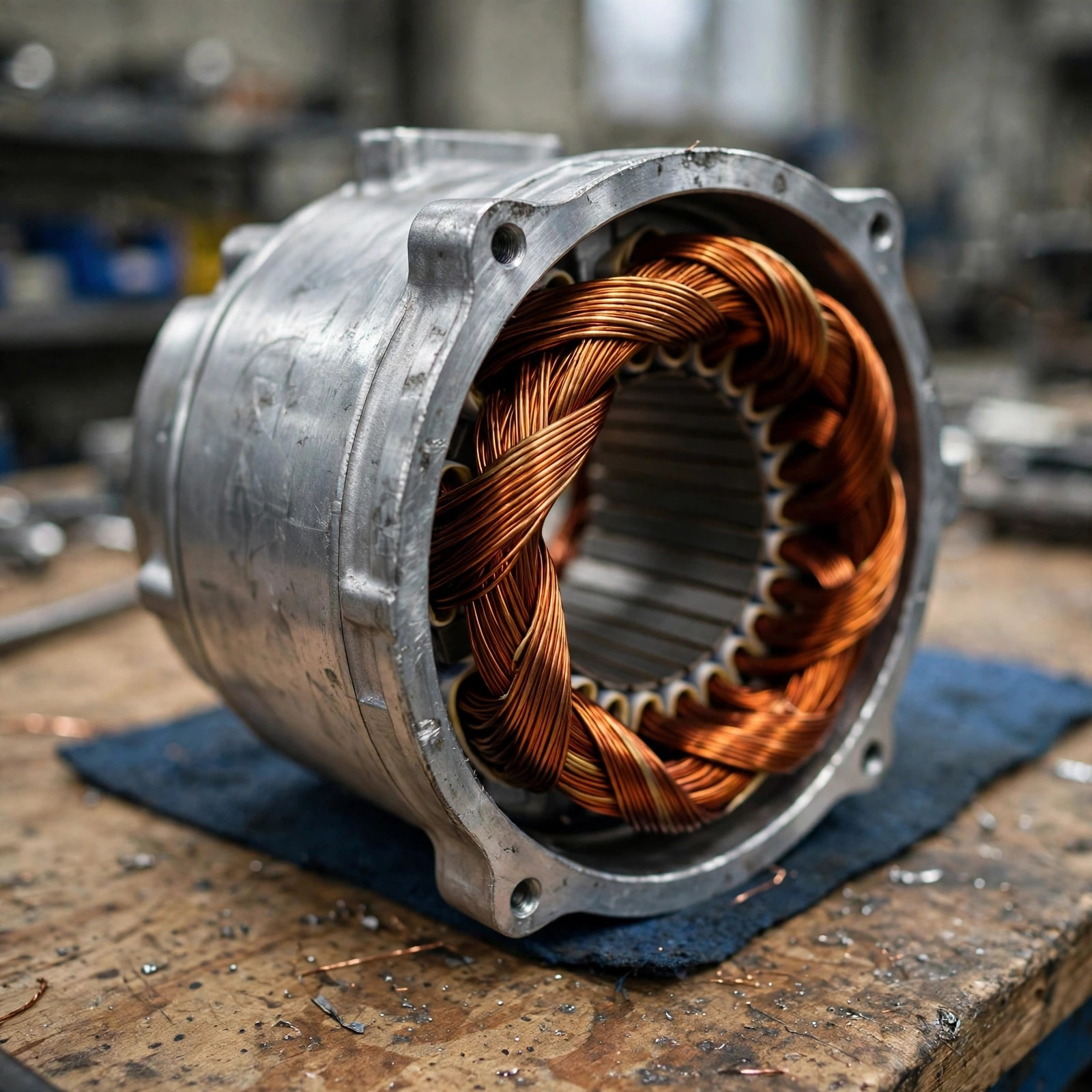
To escape rare-earth dependence without sacrificing too much efficiency, several legacy automakers turned to the Externally Excited Synchronous Motor (EESM). An EESM replaces permanent magnets on the rotor with copper wire coils. Sending electrical current into those coils turns the rotor into an adjustable electromagnet.
That dimmer-switch control solves multiple problems at once. Engineers eliminate rare-earth magnets from the rotor completely. They can also dial down magnetic field strength at high highway speeds or during coasting, trimming the drag that plagues permanent magnet designs. BMW built its Gen5 and Neue Klasse EV powertrains around EESM motors. Renault and the Nissan Ariya use this same magnet-free architecture.
| Motor Type | Rotor & Magnets | Efficiency Strength | Main Trade-Offs | Real-World Examples |
|---|---|---|---|---|
| PMSM | Permanent magnets (uses rare earths) | 93-97% peak; strongest at partial load | Coasting drag; heat demagnetization; ~89% China magnet supply | BYD, Hyundai E-GMP, VW MEB, Tesla rear axle |
| Induction (IM) | No permanent magnets (induced current) | High-speed cruising; freewheels when off | Lower partial-load efficiency (85-92%); heavier build | Early Tesla models; Tesla Model 3/Y front axle |
| Axial Flux (YASA) | Pancake geometry; uses permanent magnets | High torque density in a compact disc | Still uses rare earths; high cost for mass-market EVs | Ferrari SF90, Lamborghini Revuelto, Koenigsegg Regera (hybrids); upcoming AMG.EA |
| EESM | Copper electromagnet coils (rare-earth-free) | Adjustable field for highway speed and coasting | Needs power to excite rotor; extra rotor complexity | BMW Gen5 & Neue Klasse, Renault, Nissan Ariya |
How can you read EV motor types on a spec sheet in 30 seconds?
One line on an EV spec sheet reveals whether engineers built the car for city efficiency, all-wheel-drive punch, supply-chain independence, or track packaging.
Reading an EV motor layout works like reading a specialty coffee menu. Once you see the bean origin and roast level, you already know whether the cup tastes bright or heavy before taking a sip. Motor pairings give away an automaker’s priorities just as fast.
Four questions to ask when checking an EV spec sheet
- Is it a single PMSM? Expect strong everyday city and suburban efficiency, since the motor avoids excitation losses at low speeds.
- Does an AWD model mix PMSM and induction? Look for a rear permanent magnet unit paired with a front induction motor that freewheels during highway cruising.
- Does the brand list an externally excited (EESM) motor? That automaker prioritized zero rare-earth rotor magnets and adjustable highway efficiency.
- Does a headline promise an axial flux breakthrough? Check whether the car is a hybrid supercar or an upcoming performance EV, and remember that YASA units still use permanent magnets.
Key Takeaways
No single EV motor wins every metric. Permanent magnet motors own 80% to 85% of the market because they stretch range during ordinary partial-load driving. Induction motors survive on the front axles of dual-motor EVs because they disconnect cleanly and coast without magnetic drag.
Axial flux motors solve tight packaging and torque density for supercars and upcoming Mercedes-AMG electric platforms. EESM motors give brands like BMW, Renault, and Nissan a clean exit from rare-earth magnet supply chains. Every motor on a spec sheet is an engineering trade-off between daily range, weight, heat, and raw materials.
Next time you compare two electric cars, look right beside the battery capacity and check the motor setup on each axle. If you already drive an EV—or have one on your shortlist—drop the model and its real-world efficiency in the comments.
Sources
- EV Motor Types Explained: PMSM, Induction and More — evseekers.com
- Traction Motors and Magnets — electronsx.com
- Benchmark Minerals — EV Motors Guide (referenced for global PMSM market share and permanent magnet supply concentration in China)