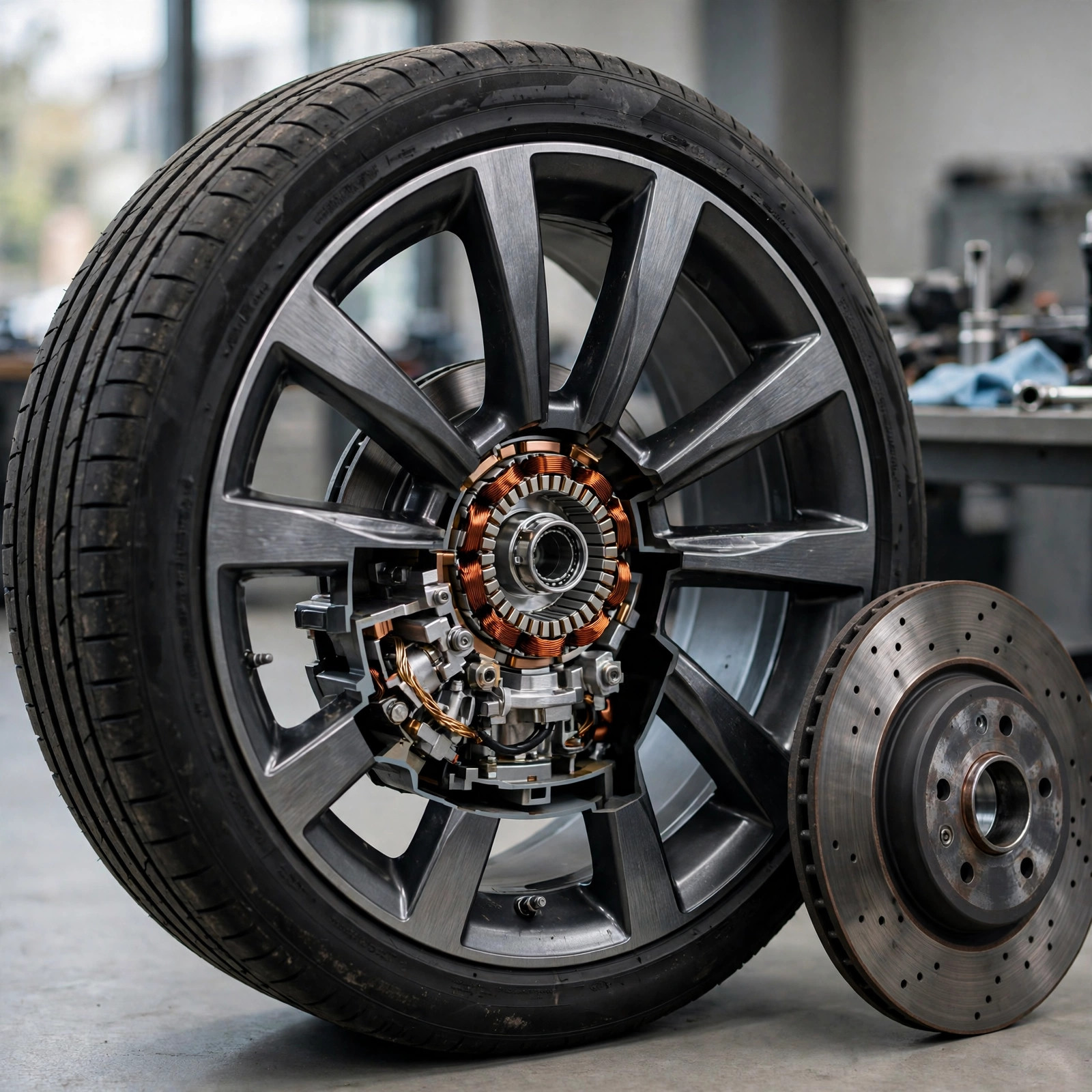
Hi, this is Datumdraft. Putting an electric motor inside each wheel — an in-wheel motor — sounds like an easy win for cabin space and handling. So why does almost every electric car on the road still hide its motors between the axles? The answer comes down to 36 kilograms of metal sitting on the wrong side of your suspension, plus 126 years of tough business lessons.
At a Glance
- In-wheel motors place a brushless motor inside each wheel hub, deleting driveshafts and differentials for independent torque control.
- Adding 34-39 kg of unsprung mass per corner hurts ride comfort, grip, and component durability on rough roads.
- Both modern production EVs that shipped with hub motors in 2022 came from automakers that soon went bankrupt.
- Today, central e-axles rule passenger cars while hub motors return in heavy trucks, urban shuttles, and active-suspension sports cars.
What happens when you put a motor inside each wheel?
Moving the motors into the wheels removes heavy mechanical shafts and frees up the center of the car. Picture four people pushing a shopping cart by spinning each wheel directly with their hands. If the left two people pull backward while the right two push forward, the cart spins in place.
A standard electric vehicle (EV) works more like pushing that cart with one long pole tied across the axle. Engineers use a central motor connected to the wheels through a driveshaft, a spinning rod that carries power. A differential, a gearset that lets left and right wheels spin at different speeds in turns, and constant-velocity (CV) joints complete the chain.
An in-wheel motor, also called a hub motor, replaces that entire chain. It places a brushless direct current (DC) electric motor right inside the wheel hub, either driving the rim directly or through a compact planetary gearset. If you want to see how these hub designs compare with central units, check out our guide to EV motor types.
Deleting those mechanical links opens up flat floor space for batteries, passengers, or cargo. It also allows per-wheel torque vectoring, which means software adjusts the pushing force at each corner in milliseconds. Under specific test conditions, independent four-wheel control even allows a vehicle to rotate in place, though current production passenger cars do not ship with hub-motor zero-turn modes.
Why does 36 kilograms at the wheel ruin the ride?
The biggest barrier to in-wheel motors is where their weight sits relative to the suspension springs. Imagine jogging down a gravel trail while wearing a 36-kilogram backpack. Your knees and hips absorb the bumps, so your feet still land cleanly.
Now imagine strapping that same 36 kilograms of metal directly to your ankles. Every step slams down harder, and every pebble throws your stride off balance. That exact difference separates sprung mass (weight supported by the car’s springs, like the cabin and battery) from unsprung mass (weight hanging outside the springs, like tires, rims, and brakes).
Modern in-wheel motors add roughly 34 to 39 kilograms of unsprung mass at each corner. DeepDrive’s IW 2000 unit weighs 34 kilograms. Protean Electric’s Gen 5 PD18, which packs an integrated inverter and passed validation up to 1,500 newton-meters of torque in August 2024, weighs about 36 kilograms per wheel. That equals two loaded medium suitcases bolted straight to each rim.
When a heavy wheel hits a pothole, it bounces harder and takes longer to settle back onto the asphalt. Less tire contact means worse grip and a harsher ride. On top of the weight penalty, the wheel hub is a brutal neighborhood for electronics.
Hub motors must survive road salt, deep puddles, flying gravel, and constant vibration. They also sit inches away from glowing brake discs, which makes sealing and cooling much harder than in standard EV thermal management layouts. Protecting sensitive windings and inverters inside a wet, hot, vibrating wheel drives up cost and repair complexity.
How did 126 years of hype end in two 2022 bankruptcies?
In-wheel motors have spent over a century impressing auto show crowds without surviving mass production. Think of a big-budget sci-fi series that films dazzling pilot episodes for decades, finally gets picked up for two full seasons, and gets canceled after episode one. The technology works in demonstrations, yet scaling it profitably has tripped up automaker after automaker.
The idea started around 1900 with the Lohner-Porsche, an early electric vehicle built by Ferdinand Porsche that mounted motors inside the front hubs. After gas engines took over, hub motors vanished from showrooms for decades. They returned in waves of concept cars, including the 2005 Chevrolet Sequel, the 2005 Mitsubishi MIEV, and the 2005 Honda FCX.
Later prototypes kept the dream alive, such as a 2008 Protean-equipped Ford F-150 and the 2012 Hiriko Fold city car. Even Protean’s early production-intent motor in 2013 weighed 68 pounds (about 31 kilograms) per unit with 75 kilowatts and 735 pound-feet of torque, yet major automakers stayed on the sidelines.
Modern mass production finally arrived in 2022 with two startups, both using hub motors supplied by Elaphe. Lightyear built the solar-assisted Lightyear 0 sedan. Lordstown Motors built the Endurance pickup truck with four hub motors making 440 combined horsepower, a 109-kilowatt-hour battery, and a curb weight around 2,948 kilograms.
Both companies ran out of cash and filed for bankruptcy shortly after brief production runs. Another well-known startup, Aptera, often gets cited online as a current hub-motor EV. That claim is outdated: Aptera used in-wheel motors in its 2022 prototype, then dropped them in its 2024 prototype.
| Year | Model | Motor Setup | Outcome |
|---|---|---|---|
| ~1900 | Lohner-Porsche | Early front hub electric motors | Early commercial EV pioneer |
| 2005 | Chevrolet Sequel / Mitsubishi MIEV / Honda FCX | Experimental wheel-hub motors | Concept vehicles only |
| 2008-2012 | Protean Ford F-150 / Hiriko Fold | Retrofitted and compact hub units | Prototypes; no mass volume |
| 2022 | Lightyear 0 | Elaphe in-wheel hub motors | Brief production; maker went bankrupt |
| 2022 | Lordstown Endurance | 4x Elaphe hub motors (440 hp, 109 kWh, ~2,948 kg) | Brief production; maker went bankrupt |
| 2022-2024 | Aptera Prototype | Hub motors in 2022 prototype | Removed from 2024 prototype |
Can engineers actually fix the unsprung weight problem?
Extra wheel weight is a serious engineering hurdle, yet it is solvable on the right kind of vehicle. Picture strapping a 1-kilogram wrist weight onto a 30-kilogram child, then strapping that exact same weight onto a 120-kilogram heavyweight athlete. The athlete barely notices it because their body is far heavier than the added load.
Vehicle engineers call this the sprung-to-unsprung mass ratio. Adding 36 kilograms to each wheel feels punishing on a light compact sedan. On a heavy pickup truck or commercial van, that same 36 kilograms makes up a much smaller share of the vehicle’s total weight.
Real-world test data backs this up. A joint study by Protean Electric and Lotus found that adding extra suspension damping removes most of the ride penalties caused by hub motors. Once precise torque vectoring kicked in, the test vehicle actually showed a net positive gain in handling.
An August 2021 Society of Automotive Engineers (SAE) report titled “The Case for In-Wheel Motors” reached a similar finding. Engineers can offset the extra wheel weight by tuning dampers and reinforcing shock mounts. The report also noted that heavy trucks and SUVs experience the smallest drop in ride quality because of their high sprung-to-unsprung ratio.
Still, you should separate verified test data from marketing optimism. In 2013, Green Car Reports covered Protean Electric’s claims about its hub motors. The company said they could improve fuel economy by up to 30 percent and recover up to 85 percent of kinetic energy. Those figures were company claims from 2013, not independent road-test results. In actual production EVs, how much stopping energy gets recaptured depends heavily on how the car blends regenerative braking with friction brakes.
Fact-Check: Three Common In-Wheel Motor Myths
- Myth 1: No production car has ever used in-wheel motors. False. The Lohner-Porsche used them around 1900, and both the Lightyear 0 and Lordstown Endurance reached brief production in 2022 before their makers went bankrupt.
- Myth 2: Aptera currently builds its solar EV with hub motors. Outdated. Aptera used hub motors in its 2022 prototype, then removed them in its 2024 prototype.
- Myth 3: Independent tests proved 30% better efficiency and 85% energy recovery. Unverified. Those numbers came from Protean Electric’s own 2013 company claims reported by Green Car Reports.
Where are in-wheel motors actually coming back in 2026?
In-wheel motors stopped trying to win the family sedan market and shifted into specialized niches. Think of a tool that failed to replace the everyday Swiss Army knife, then built a thriving career as a specialized surgical scalpel. It does not belong in every kitchen drawer, yet it shines where space and control pay the bills.
For mass-market passenger cars, the central e-axle remains the undisputed winner in late 2026. It costs less to manufacture, stays dry inside the frame, and lets local mechanics swap a bent wheel without replacing an electric motor. Mainstream automakers have no strong reason to abandon it.
Hub motors are instead targeting three distinct segments where their tradeoffs make sense. Protean Electric announced in September 2025 that it is preparing production-ready in-wheel motors for 2026, aiming squarely at applications where packaging and agility carry high value.
- Heavy commercial trucks: Large trucks carry high body weight, which keeps the sprung-to-unsprung ratio favorable while freeing up underbody room for cargo or batteries.
- Urban shuttles and delivery vans: Removing axles allows a completely flat, low floor for easy passenger boarding, wheelchairs, or stacked delivery boxes.
- High-performance sports cars with active suspension: Expensive sports cars already pay for computer-controlled active suspension that reacts in milliseconds to cancel out extra wheel bounce.
As automakers move toward software-defined vehicles, self-contained wheel corners also fit neatly into modern by-wire architecture. Steering, braking, and propulsion at each corner can respond to one central software brain without mechanical shafts running under the cabin.
| Factor | Central e-Axle | In-Wheel Hub Motor |
|---|---|---|
| Motor location | Inside the vehicle frame (sprung) | Inside each wheel hub (unsprung) |
| Mechanical links | Uses driveshafts, differential, CV joints | Deletes driveshafts and differential |
| Unsprung mass added | None at the wheel hub | About 34-39 kg per corner |
| Torque vectoring | Good (via brakes or dual-motor axles) | Millisecond per-wheel independent control |
| Cabin / cargo space | Constrained by axle and tunnel layout | Flat floor with maximum packaging freedom |
| Durability & repair | Protected from road debris; lower wheel repair cost | Exposed to water, salt, brake heat; costly wheel damage |
| 2026 primary market | Mass-market passenger cars and crossovers | Heavy trucks, urban shuttles, active-suspension sports cars |
Key takeaways
In-wheel motors failed in mainstream passenger cars because of cost, durability, and ride comfort tradeoffs, rather than an impossible law of physics. Central e-axles simply deliver a smoother, cheaper package for everyday sedans and crossovers.
The next time you see a headline about an EV with motors inside the wheels, run it through a quick three-question test:
- Is the vehicle heavy enough to maintain a high sprung-to-unsprung mass ratio?
- Does its price tag support reinforced damping or active suspension?
- Does the extra flat-floor cabin or cargo space justify higher wheel repair costs?
If the answer is yes on all three counts, you are likely looking at a serious commercial truck, shuttle, or sports car program. If it is a budget commuter car, history suggests it will stay a concept. Do you think hub motors will eventually trickle down to everyday family cars, or stay locked in commercial and performance niches? Share your view in the comments.
Sources
- Hub motor — Wikipedia
- In-Wheel Motors Explained — MotorGrail
- The Case for In-Wheel Motors — SAE / Protean Electric, August 2021
- Protean Launches Production In-Wheel Electric Motor — Green Car Reports, 2013
- Gen 5 Pd18 Testing and Validation — Protean Electric, August 2024
- Protean Electric Announces Production-Ready In-Wheel Motors for 2026 — Electric & Hybrid Vehicle Technology International, September 2025