Hi, this is Datumdraft.
Every time you lift your foot or press the brake pedal in an electric car, two completely different braking systems share the work. They pass your car’s weight back and forth in fractions of a second. Most drivers never feel the handoff, which feeds two stubborn myths: that electric vehicles stop on motor power alone, and that turning on one-pedal driving adds 20% more range. Knowing how both systems actually share the work saves you from cold-weather surprises, rusty brake discs, and awkward driving habits that do not add a single mile.
At a Glance
- Every EV still needs friction brakes: the motor handles routine slowing, while mechanical pads take over below 7 km/h.
- Under ideal conditions, regen recovers roughly 60–70% of kinetic energy, while cold or full batteries sharply limit it.
- Dense city driving yields 20–30%+ more range than friction-only cars, whereas steady highway cruising barely benefits.
- Switching to one-pedal driving adds only 2–9% efficiency in studies; gentle braking matters far more than pedal style.
Why does every EV still have two completely different brakes?
Press the brake pedal in an electric car, and there is a good chance your brake pads are not touching the rotors at all. Instead, your car’s electric motor is doing the slowing work first, while traditional friction brakes wait in the wings as backup.
Picture a stationary exercise bike wired to a phone charger. When you crank up the magnetic resistance to slow the pedals, your leg motion turns into electricity that charges the phone. Now imagine stopping that same bike by dragging the sole of your sneaker against the floor. The bike stops either way, yet dragging your shoe turns all of your motion into useless heat and worn rubber.
An electric vehicle (EV) uses both tricks. Regenerative braking uses the drive motor in reverse as an electric generator. When you accelerate, the battery sends electricity to the motor to spin the wheels. When you slow down, the spinning wheels drive that same motor backward, turning forward motion (kinetic energy) back into electricity for the battery.
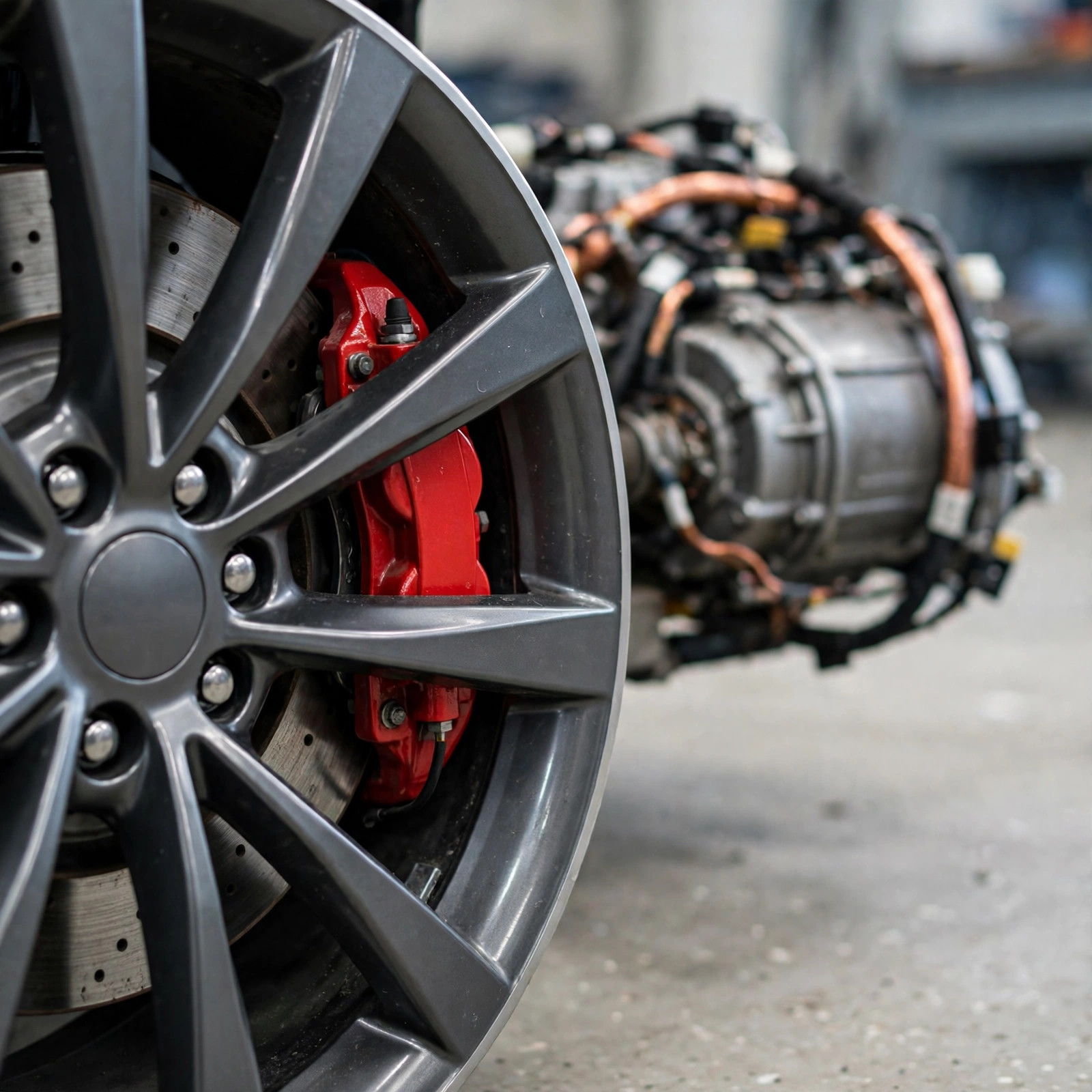
Friction braking is the sneaker on the floor. Hydraulic fluid pushes metal-backed brake pads against spinning iron discs (rotors) inside each wheel. That clamp converts your speed straight into heat. Regenerative braking supplements these mechanical brakes, and it never replaces them.
Even on a perfect day, regen cannot catch every drop of energy. Modern EV motor types convert motion to electricity at roughly 80% to 85% efficiency on their own. Once that electricity passes through the inverter (the device that converts current types), the gears, and into the battery cells, heat claims another slice. Under ideal conditions, an EV nets roughly 60% to 70% of its braking kinetic energy back into the pack.
Which four moments force regenerative braking to hand over to friction?
Regenerative braking is brilliant at slowing a heavy car down, until four everyday situations force it to tap out. In each of those moments, your mechanical pads step in immediately so your stopping distance stays safe.
Think of your EV battery like a dry kitchen sponge. Pour water onto it slowly, and the sponge drinks almost all of it up. Dump a whole bucket at once, and most of the water splashes onto the counter. Try pouring onto a sponge that is already soaked or frozen solid in the freezer, and the water runs right off.
Your battery behaves the exact same way when it receives electric current during a stop. Here are the four limits that hand braking back to the friction pads:
- Final crawl below 7 km/h (about 4 mph): A spinning electric motor generates braking force by pushing against magnetic fields. As the wheels slow to a walking pace, that motor torque drops toward zero. Mechanical brake pads always finish the stop and hold the car still.
- Hard emergency stops above roughly 0.3g: One “g” equals the pull of Earth’s gravity, so 0.3g feels like a firm, urgent stop for a yellow light. Stopping harder than that generates more electrical current than the motor and battery can safely accept. Friction brakes jump in right away to supply the extra clamping force.
- A 100% full battery: Battery charge is measured as state of charge (SoC), from 0% empty to 100% full. When your pack is completely full, there is nowhere left to store incoming electricity. Software cuts regen to prevent overcharging, and the friction pads handle the slowdown.
- Freezing battery temperatures below 0°C (32°F): Cold lithium-ion cells resist incoming current to avoid permanent plating damage inside the battery. In a 2023 University of Michigan study, EVs recovered 62.3% of braking kinetic energy under optimal temperatures, yet recovery fell to roughly 31% in freezing conditions.
How fast you brake matters just as much as the weather. Slamming the pedal creates a sudden surge of current that exceeds the battery’s intake limit, just like dumping that bucket on the sponge. Everything above the limit gets burned off as heat through the friction pads. Starting your slowdown earlier and braking smoothly keeps more current inside the battery’s safe window.
Automakers fight these limits on two engineering fronts. Better EV thermal management warms cold cells before you leave the driveway so winter regen stays stronger. Higher-voltage packs built around 800V EV architecture also handle higher power bursts with less wire heat, though battery chemistry still sets the final ceiling.
| Driving Condition | What Limits Regen | Who Stops the Car | Verified Benchmark |
|---|---|---|---|
| Low speed (below 7 km/h) | Motor braking torque fades near zero speed | Friction pads finish and hold the stop | Handoff around 7 km/h (~4 mph) |
| Hard braking (above 0.3g) | Current surge exceeds motor and battery intake | Friction pads join immediately | Threshold around 0.3g deceleration |
| Full battery (100% SoC) | No empty cell capacity to store energy | Friction pads replace regen | Regen sharply reduced at 100% SoC |
| Freezing battery (below 0°C) | Cold cells limit safe charging current | Friction pads carry larger share | ~31% freezing vs. 62.3% optimal (U. of Michigan, 2023) |
Does one-pedal driving beat a blended brake pedal, and why is Tesla different?
Turn on one-pedal driving and you will not magically unlock 20% more range, despite what half of the EV forums claim. That popular claim mixes up a driving control style with the energy recovery hardware underneath.
Imagine paying a $50 dinner bill. You can put the full $50 on one credit card, or split $35 on one card and $15 on another. Changing how you pay does not shrink the bill. Braking works the same way: if you slow your car at the exact same rate, the physics of kinetic energy recovery stays nearly identical.
One-pedal driving means lifting off the accelerator triggers strong motor braking right away. Blended braking means lifting off the accelerator lets the car coast lightly, and pressing the brake pedal triggers motor regen first before adding friction pads. If a driver slows down along the same smooth curve, both setups recover almost the same electricity.
Real-world tests back this up. Researchers at Eindhoven University of Technology (TU/e) tested one-pedal algorithms on their Lupo EL electric car and measured efficiency gains of 2% to 9%. Separate testing on the Chevrolet Bolt found roughly a 5% gain from one-pedal driving. Those modest numbers come mostly from drivers lifting earlier, not from hidden magic inside the motor.
Myth check: one-pedal driving is not regenerative braking
Regenerative braking is the electric motor recovering energy during deceleration. One-pedal driving is only a pedal mapping choice. Turning off one-pedal mode in a blended-pedal EV does not turn off regenerative braking.
So why do so many EV drivers insist you must use one-pedal driving for regen? Blame the Tesla exception. Tesla designs its brake pedal as a friction-only pedal. In a Tesla, regenerative braking happens only when you lift off the accelerator pedal, while stepping on the brake pedal clamps the mechanical pads directly.
Most other automakers take the opposite path. The Ford Mustang Mach-E, Porsche Taycan, Polestar 2, Chevrolet Bolt, Hyundai Ioniq lineup, and even the Toyota Prius all use blended brake pedals. Press the brake pedal in those cars, and the software maxes out motor regeneration first before calling on the steel pads. Treating Tesla’s split-pedal layout as the rule for every EV leads drivers to think the brake pedal always wastes energy.
| Feature | Blended Braking (Most EVs) | Split / Friction-Only Pedal (Tesla) |
|---|---|---|
| Brake pedal function | Triggers motor regen first, then blends friction pads | Operates mechanical friction pads directly |
| Where regen happens | Both brake pedal and optional lift-off regen modes | Accelerator lift-off (one-pedal / Hold mode) only |
| Example models | Ford Mustang Mach-E, Porsche Taycan, Polestar 2, Chevy Bolt, Hyundai Ioniq, Toyota Prius | Tesla Model 3, Model Y, Model S, Model X |
| Efficiency gap under same stop profile | Theoretically minimal vs. one-pedal (2–9% in TU/e Lupo EL; ~5% in Chevy Bolt studies) | Must rely on accelerator lift-off to capture regen |
How does brake-by-wire hide the handoff, and why do EV rotors rust?
If your car swaps between an electric generator and steel brake pads mid-stop, why does the pedal still feel like one smooth machine? Software sits in the middle and choreographs the entire transition.
Think of a stagehand swapping props in the dark while the spotlight stays locked on the lead actor. The audience watches one unbroken scene, even though the backstage crew changed the gear behind the curtain. Your brake pedal works on the same illusion.
In older gas cars, pressing the brake pedal pushed hydraulic fluid straight to the wheel calipers. Modern blended EVs use brake-by-wire systems. A sensor reads how far and how fast your foot pushes the pedal, while a spring or hydraulic simulator feeds back steady resistance to your shoe. Behind the scenes, the control computer splits the total stopping request between motor regen and mechanical pads hundreds of times per second.
One distinction trips people up here. Brake-by-wire changes how the car blends motor and friction braking and how the pedal feels under your foot. It does not change whether the car needs friction brakes. Every road-legal EV still carries mechanical calipers, pads, and rotors for low speeds, hard stops, and fail-safe backup.
Because the electric motor handles so much of your daily slowing, those iron brake rotors face an unusual side effect: surface rust. On a gas car, every stop scrapes moisture and road salt off the discs. On an EV, the pads might barely touch the rotors for days of gentle city commuting. In damp or salty winter climates, thin rust builds up on the disc face and can cause light scraping noises or uneven wear.
Surface rust on an EV rotor is a normal maintenance quirk of regenerative braking, not a safety defect in the car. Keeping the discs clean takes only a small habit adjustment, which we cover next.
Where does regen actually pay off, and how do you get more from every stop?
Regenerative braking can feel like free energy in downtown traffic, and practically disappear the moment you merge onto the interstate. Where you drive decides how much range regen puts back in your battery.
Picture a sailboat approaching a harbor dock. If the skipper lowers the sails early and lets the boat glide in gently, very little effort goes to waste. Charging at the dock at full speed and throwing the engine into hard reverse burns energy for nothing. The same rule holds on the road: regen shines when you stop often, and it works best when you plan ahead.
Many online summaries toss out a single headline number like “30% more range” without saying where the car was driven. In dense, stop-and-go city traffic, regenerative braking can add 20% to 30% or more range compared with an identical friction-only vehicle. On suburban or mixed commutes, the real-world gain drops to roughly 10% to 20%. On a steady highway cruise where you rarely touch the brakes, regen adds less than 5% because wind resistance—not braking—eats almost all of your energy.
Laboratory drive cycles tell a similar story. Data cited from the U.S. Department of Energy’s Argonne National Laboratory shows regenerative braking recovering roughly 5% to 15% of total trip energy across standard city driving cycles. That is still a meaningful boost, just grounded in physics rather than hype.
| Driving Environment | Range Gain vs. Friction-Only Car | Why It Happens |
|---|---|---|
| Dense city driving | 20–30%+ | Frequent stops create constant chances to recapture kinetic energy |
| Suburban / mixed driving | 10–20% | Moderate mix of traffic lights and steady cruising speeds |
| Steady highway cruising | Under 5% | Rare braking; aerodynamic drag consumes most battery energy |
Note: Across standard U.S. city test cycles, DOE Argonne National Laboratory figures place total trip energy recovery from regenerative braking at roughly 5% to 15%.
Four practical habits to get more from your EV brakes
- Brake early and gently before red lights: Long, smooth stops keep incoming current below the battery’s ceiling so the motor captures energy instead of dumping it into the pads.
- Precondition your battery in winter: Warming the pack while plugged in before a cold morning commute helps avoid the sharp freezing-weather drop in regen recovery.
- Drop the one-pedal guilt: If your EV uses a blended brake pedal, pick whichever mode helps you decelerate most smoothly. Smooth timing beats pedal style every time.
- Clean your rotors after wet or salty weather: On an empty, safe stretch of road, apply a few firm stops to scrub light surface rust off the discs.
Key takeaways
The real breakthrough in EV braking is not deleting friction pads. It is software letting your electric motor and mechanical brakes each handle the exact speed and force range they do best. Your motor recycles routine city slowdowns, while your pads guarantee safe stops below 7 km/h, in emergencies, and on freezing or full-battery mornings.
You do not need to force yourself into one-pedal driving to unlock those gains, unless you drive a Tesla with its split friction-only brake pedal. Focus on smooth, early deceleration, warm your battery before freezing drives, and give your rotors an occasional firm wipe in wet weather.
Do you prefer one-pedal driving or a blended brake pedal—and have you noticed your EV’s regen drop off in winter? Share your experience in the comments, and bookmark or share this guide with a friend switching to their first EV.
Sources
- Regenerative Braking Explained: How Much Range Does It Add? — EV Compared, August 11, 2026
- Is One-Pedal Driving the Most Efficient for EVs? — Phil Royle, The Watt Car, February 1, 2022
- Regenerative Braking Explained: How EVs and Hybrids Recover Energy — GAC Group, August 19, 2026
- Design and Realization of a One-Pedal-Driving Algorithm for the TU/e Lupo EL — J.J.P. Van Boekel, I.J.M. Besselink, & H. Nijmeijer, Eindhoven University of Technology, 2015
- Evaluating the Energy Efficiency of a One Pedal Driving Algorithm — Wang & Besselink, Eindhoven University of Technology, December 2015
- University of Michigan — Regenerative Braking Kinetic Energy Recovery Study (Optimal vs. Freezing Conditions), 2023
- U.S. Department of Energy, Argonne National Laboratory — Standard City Cycle Regenerative Braking Total Energy Recovery Benchmarks
- Chevrolet Bolt EV One-Pedal Driving Efficiency Comparison Data — General Motors / Industry Testing